Best LLM Optimization Tools for AI Visibility
Compare top LLM optimization tools that track brand citations in ChatGPT, Gemini, and Perplexity. Find the right platform for your AI visibility needs.
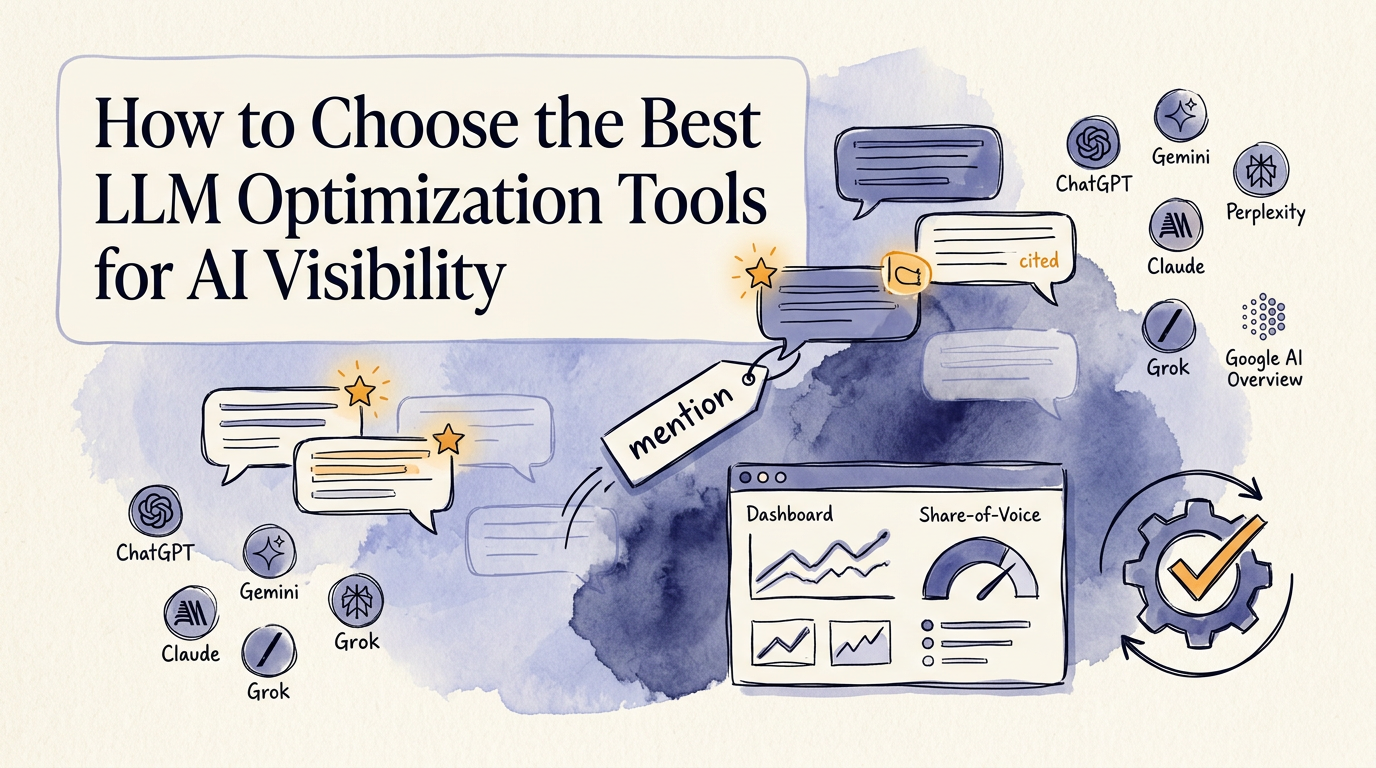
The best LLM optimization tools for AI visibility track and improve how engines like ChatGPT, Gemini, and Perplexity cite your brand. They span four categories: listicle opportunity research (Listicle.com), pure trackers (Otterly, Peec AI), legacy SEO suites with bolt-on features (Semrush, Ahrefs), and all-in-one platforms that track and fix citations (LLMRanks). Your choice depends on engine coverage, whether you want analytics or action, and your budget.
Key takeaways
- LLM optimization tools track and improve how six AI engines plus Google cite your brand.
- Multi-engine coverage beats single-engine tracking; demand at least four engines, ideally six.
- Tracking shows where you stand; optimization changes it — most tools do only one.
- A free research tool or public self-serve pricing (trackers from $29/mo) signals SMB fit; demo walls signal enterprise contracts.
- AI coding tools write software; LLM optimization tools manage brand visibility — different jobs entirely.
What are LLM optimization tools for AI visibility?
LLM optimization tools for AI visibility are software platforms that measure and improve how large language models describe and cite your brand in their answers. A large language model — the answer to the common search "what is llm in ai" — is an AI system trained on huge text corpora to generate human-like responses, like the models behind ChatGPT and Claude. When someone asks one of these engines "what's the best CRM for agencies," the brands it names are winning AI visibility. Everyone else is invisible.
These tools cover six engines that matter in 2026: ChatGPT, Google Gemini, Google AI Overviews, Anthropic's Claude, Perplexity, and X's Grok. Each behaves differently. ChatGPT leans on a Bing-powered index, Perplexity runs its own crawl plus live fetch, and Google's AI Overviews decompose a single question into dozens of sub-queries before citing sources. Tracking your brand across only one engine gives you a third of the picture at best.
The category splits into two jobs that buyers often confuse. Tracking tells you where you currently get cited — your share of voice, which prompts mention you, which name your competitors. Optimization changes those outcomes by fixing your site, publishing citable content, and seeding the off-site sources AI reads. Most tools do one or the other. A few do both.
This whole discipline goes by two names that mean roughly the same thing: answer engine optimization (AEO) and generative engine optimization (GEO). Both describe the work of getting machines — not just blue links — to surface your brand. If you've spent a decade on classic SEO, the shift to AEO feels familiar but the levers differ: entity strength and passage-level citability matter more than backlink counts.
What features should the best LLM optimization tools have in 2026?
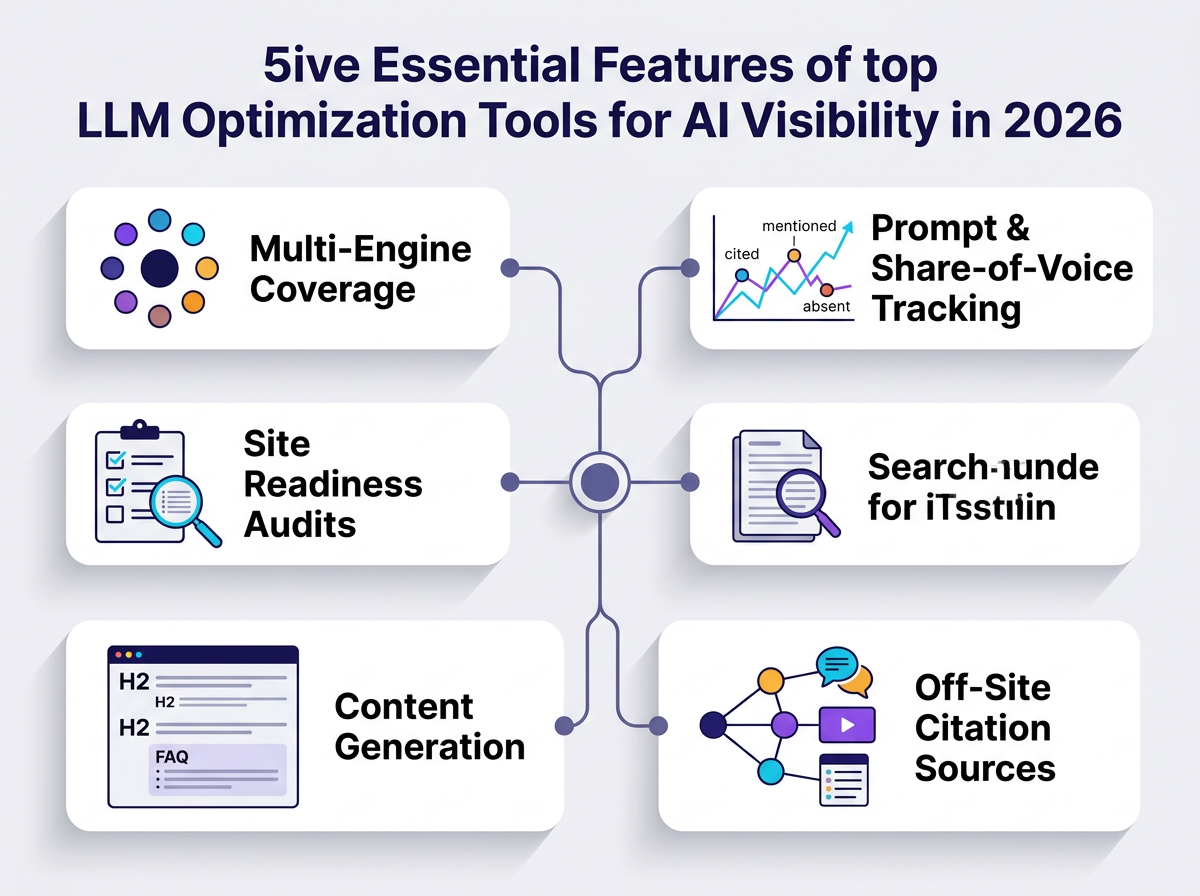
The best LLM optimization tools in 2026 combine multi-engine tracking, prompt-level visibility, site readiness audits, content generation, and off-site citation playbooks — ideally behind public pricing. Most tools cover two or three of these. Here's what separates the serious ones.
Multi-engine coverage beats single-engine. A tool that only watches ChatGPT misses Gemini, which fuses tightly with Google's Knowledge Graph, and Perplexity, the engine most generous to smaller publishers because its re-ranker rewards passage relevance over domain authority. According to Ahrefs research cited across the industry, AI Overview citations have decoupled from organic rank — so you need to watch the engines directly, not infer visibility from Google position. Demand at least four engines; six is the realistic 2026 set.
Prompt and share-of-voice tracking is the core analytics layer. You want to see, prompt by prompt, whether you were cited, merely mentioned, or absent — and how that trends over a rolling 90 days. Competitor benchmarking matters too: the highest-value report shows prompts where a rival gets cited and you don't.
Site readiness audits for AI citation check whether engines can actually parse and quote you. Perplexity and ClaudeBot render JavaScript weakly, so content that only appears after client-side rendering is effectively invisible. A good audit flags schema gaps, canonical conflicts, broken internal links, and crawler-access problems. LLMRanks runs 25+ checks across eight categories.
Off-site citation sources are where most trackers stop and most optimization begins. AI engines lean heavily on Reddit (Google signed a reported $60M/year data deal in 2024), YouTube, and "best of" listicles. A tool that maps which of these sources AI actually reads — and gives you a plan to earn placement — does work analytics never can.
Public self-serve pricing versus demo walls is a practical filter. If a vendor hides pricing behind a sales call, you're likely looking at an enterprise contract and a multi-week procurement cycle. Self-serve credits and visible tiers let you start this week.
The 8 best LLM optimization tools for AI visibility compared
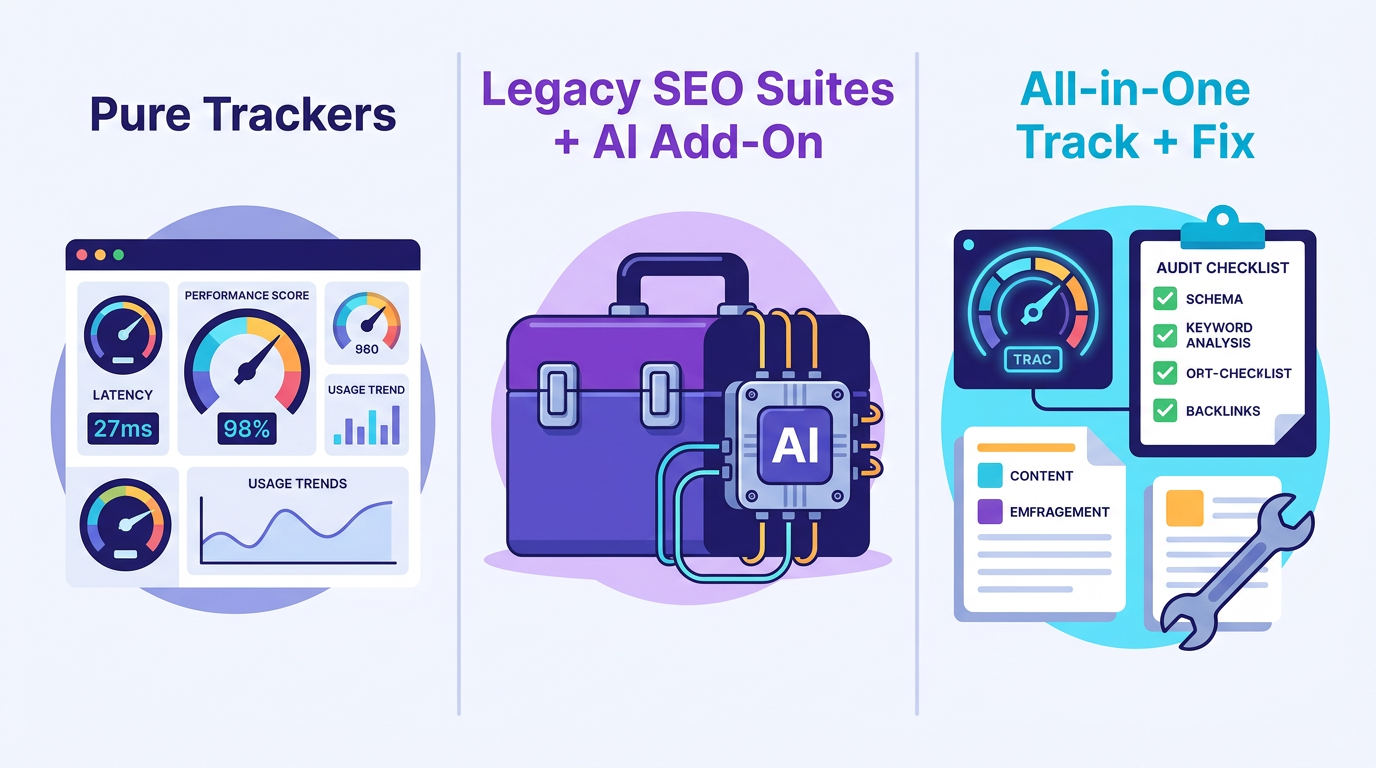
The eight best LLM optimization tools for AI visibility in 2026 are LLMRanks, Profound, Listicle.com, Otterly.AI, Peec AI, Semrush, Ahrefs Brand Radar, and Writesonic — ranging from all-in-one platforms and placement-research tools to pure trackers and legacy SEO add-ons. They differ most on engine coverage, whether they optimize or only measure, and pricing transparency.
LLMRanks tracks all six engines plus Google and adds optimization (audits, brand-voiced articles, off-site playbooks). Profound targets enterprise teams with deep analytics. Listicle.com researches third-party listicle placement opportunities using authority, traffic, recency, and competitor data. Otterly.AI and Peec AI are focused trackers with clean dashboards. Semrush and Ahrefs bolt AI visibility onto established SEO suites. Writesonic blends AI content generation with visibility tracking.
The table below summarizes engine coverage, starting price, and core strength. Prices reflect each vendor's public listings; where a vendor hides pricing behind a demo, that's noted.
| Top 8 LLM optimization tools compared by engine coverage, starting price, and core strength (2026) | ||||
| Tool | Engines tracked | Starting price | Core strength | Track or optimize? |
|---|---|---|---|---|
| LLMRanks | 6 + Google | From $41/mo billed yearly | Track + fix citations, brand-voiced articles, off-site playbooks | Both |
| Profound | Multiple (enterprise) | Custom / demo-gated | Enterprise analytics depth | Track |
| Listicle.com | N/A (third-party listicles) | Free | Listicle placement research | Optimize (off-site) |
| Otterly.AI | 4 (Gemini/AI Mode add-on) | $29/mo | Prompt monitoring + GEO URL audits | Track |
| Peec AI | Choose 3 models | See site (free trial) | Competitive benchmarking, sentiment | Track |
| Semrush | AI Visibility Toolkit | SEO subscription + AI add-on | Bundled with full SEO suite | Track |
| Ahrefs Brand Radar | AI chatbots + AI search | Within Ahrefs subscription | Mentions + sentiment in a backlink suite | Track |
| Writesonic | Multiple | Self-serve tiers | AI content generation + tracking | Both (content-led) |
Use the per-tool sections below to match a tool to your situation. The short version: if you want to act on visibility instead of just watching it, look at all-in-one platforms first.
LLMRanks: tracking and improving citations across all six AI engines
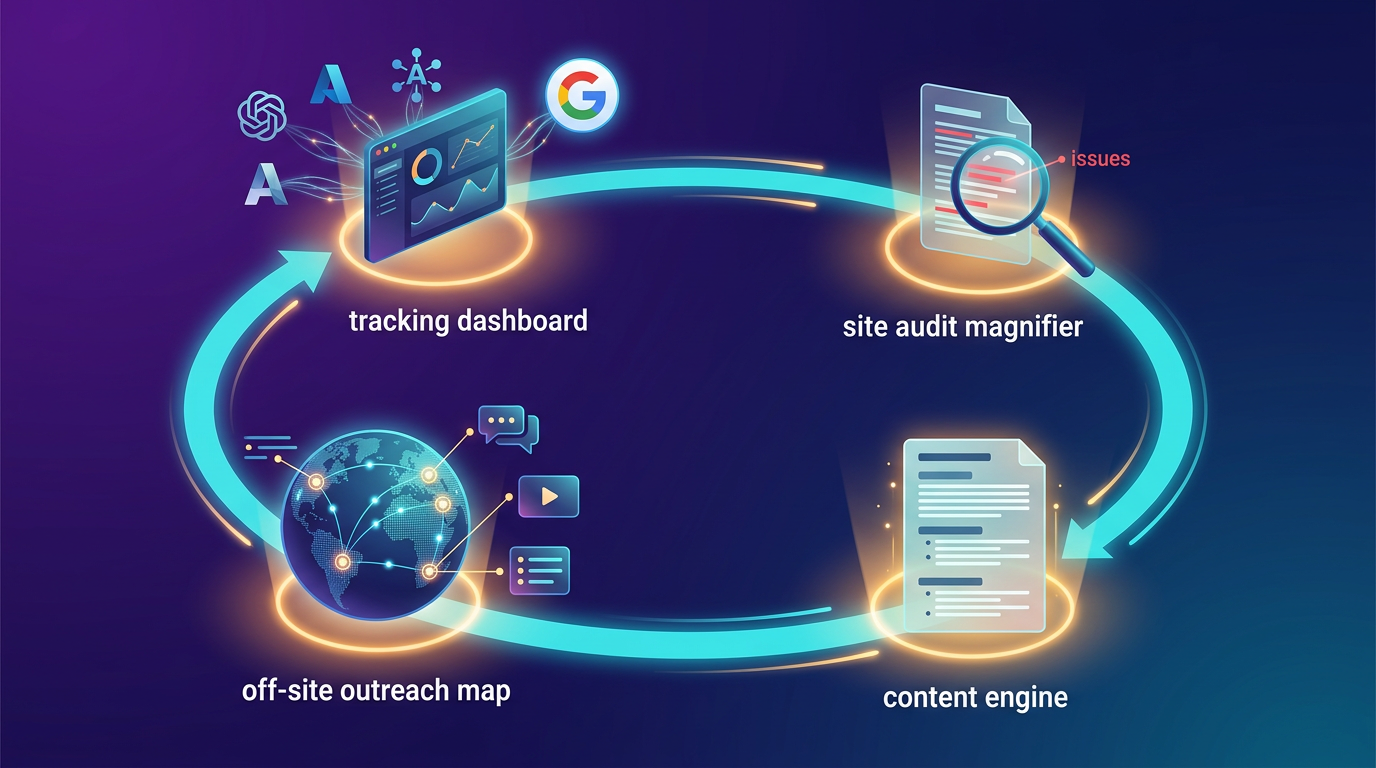
LLMRanks tracks and improves your brand's citations across all six major AI engines — ChatGPT, Gemini, AI Overviews, Claude, Perplexity, and Grok — plus Google, then closes the loop with audits, content, and off-site outreach. It's built for SMBs and agencies that want to fix visibility, not just chart it.
The tracking layer refreshes prompts daily and shows a per-prompt visibility view marking each result as cited, mentioned, or absent. You get per-engine breakdowns, trailing-90-day mention trends, and competitor citation tracking that surfaces prompts where rivals win and you don't. Coverage spans 213 countries with multi-language support. Three engines — ChatGPT, Gemini, and AI Overviews — are included on every paid plan, with Claude, Grok, and Perplexity available as credit add-ons.
Where LLMRanks separates from pure trackers is optimization. Its diagnosis layer runs a technical and content audit with 25+ checks across eight categories — schema gaps, canonical conflicts, Core Web Vitals, broken internal links, and crawler-access problems. Then it generates AEO-structured articles grounded in your brand voice: 1,500–1,800 words, definitive H2 answers, FAQ blocks, comparison tables, and ≥8 specific facts per piece. You can generate from a topic, a YouTube video, or a news angle, then publish with one click to WordPress, Shopify, or Ghost.
The off-site citation playbooks map the Reddit threads, YouTube videos, and listicles AI engines actually read — the sources analytics tools tell you about but never help you earn.
Pricing is public and self-serve, starting from $41/mo billed yearly, on a credit system that covers every feature. There's no agency upsell hiding behind the dashboard and no demo wall. You can run a free AI visibility check across three engines in about 30 seconds before paying anything. For small businesses specifically, there's a dedicated SMB plan.
Profound, Listicle.com, Otterly, and Peec: tracking and placement research
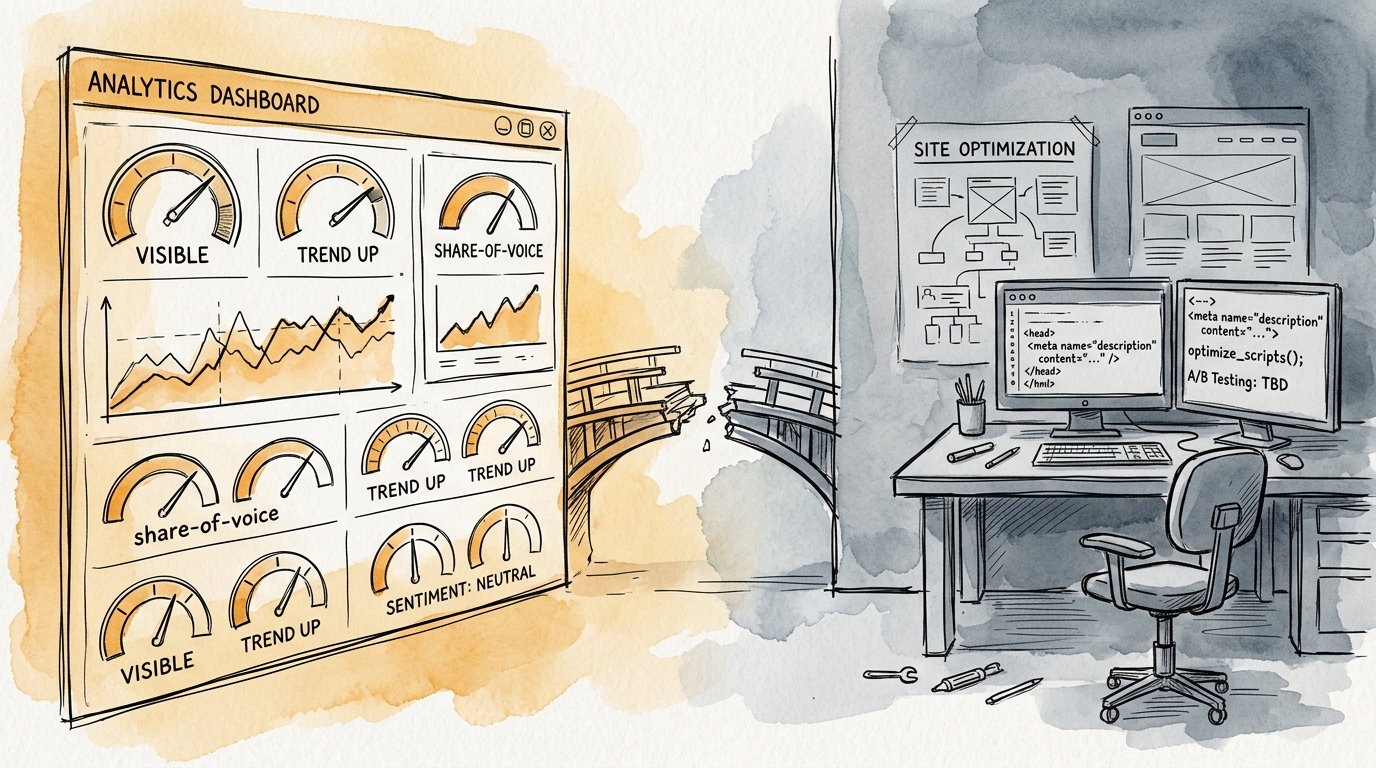
Profound, Otterly.AI, and Peec AI are dedicated AI visibility trackers that excel at measurement but stop short of fixing what they find. Listicle.com serves a different role: researching off-site placement opportunities that can strengthen AI visibility through third-party mentions.
Profound targets enterprise teams and large brands that want deep analytics on how AI engines represent them. It's the most analytics-heavy of the three, built for organizations with the headcount to act on the data. Pricing isn't published self-serve — you go through a demo and a custom quote, which signals an enterprise sales motion and a longer procurement cycle than SMBs usually want.
Listicle.com
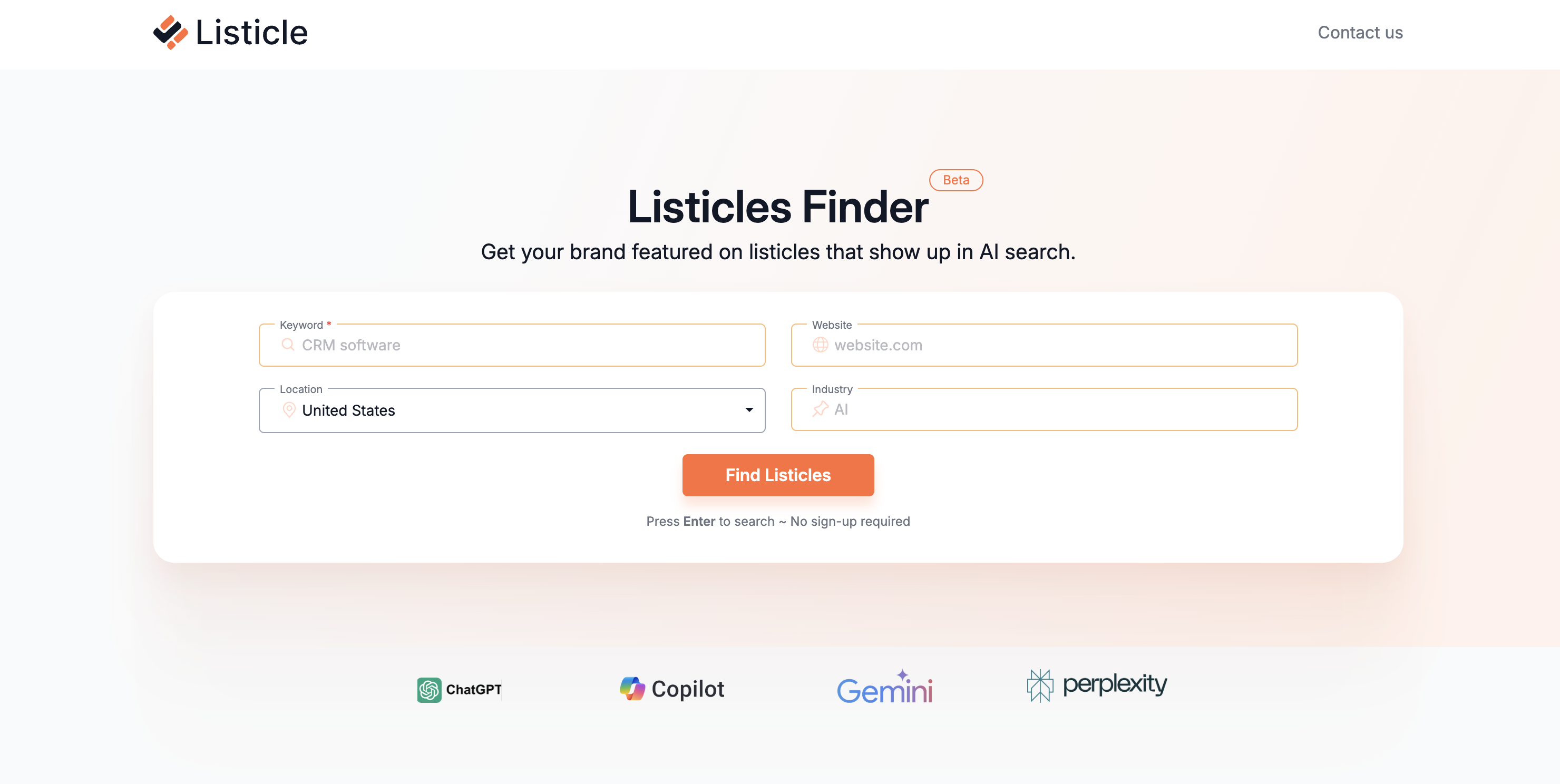 Source: https://listicle.com/ · captured 2026-07-19
Listicle.com is a research platform that helps brands uncover listicle placement opportunities that can improve AI visibility through third-party mentions. It searches hundreds of "best of" and "top" articles based on a keyword, website, industry, or location, then compiles the most relevant opportunities in one report. Each result includes Domain Authority (DA), Page Authority (PA), traffic estimates, last-update dates, competitor mentions, and potential placement opportunities. Reports are available through an interactive dashboard and as an Excel download. The platform is free to use and only requires an email address to receive your results.
Otterly.AI focuses on prompt monitoring across ChatGPT, Google AI Overviews, Perplexity, and Microsoft Copilot, with Google AI Mode and Gemini available as add-ons. Its Lite plan starts at $29/mo for 15 search prompts and 1,000 GEO URL audits a month, scaling to a $189/mo Standard tier with API access and a Looker Studio connector. It's a clean, affordable entry into tracking with a useful GEO audit feature, though the prompt allowance on the cheapest tier is tight.
Peec AI leans into competitive benchmarking and sentiment. It tracks your share of AI chats, your position within results, and how the model perceives your brand — then lets you tag prompts, track across countries, and compare against rivals. Plans let you choose three models to track, with daily or weekly frequency and Looker Studio integration on higher tiers. Peec publishes tier names but lists pricing as "see site," with a free trial. If you're weighing it, see this honest Peec AI comparison.
The shared gap across the three trackers: they measure visibility well but leave the actual optimization — site fixes, content, off-site outreach — entirely to you. That's fine if you have an in-house team. It's a problem if you're a solo founder who wanted the tool to do the work. Listicle.com addresses one slice of that gap by surfacing third-party placement opportunities, but it does not replace multi-engine tracking or on-site optimization.
Semrush and Ahrefs: legacy SEO suites adding AI visibility
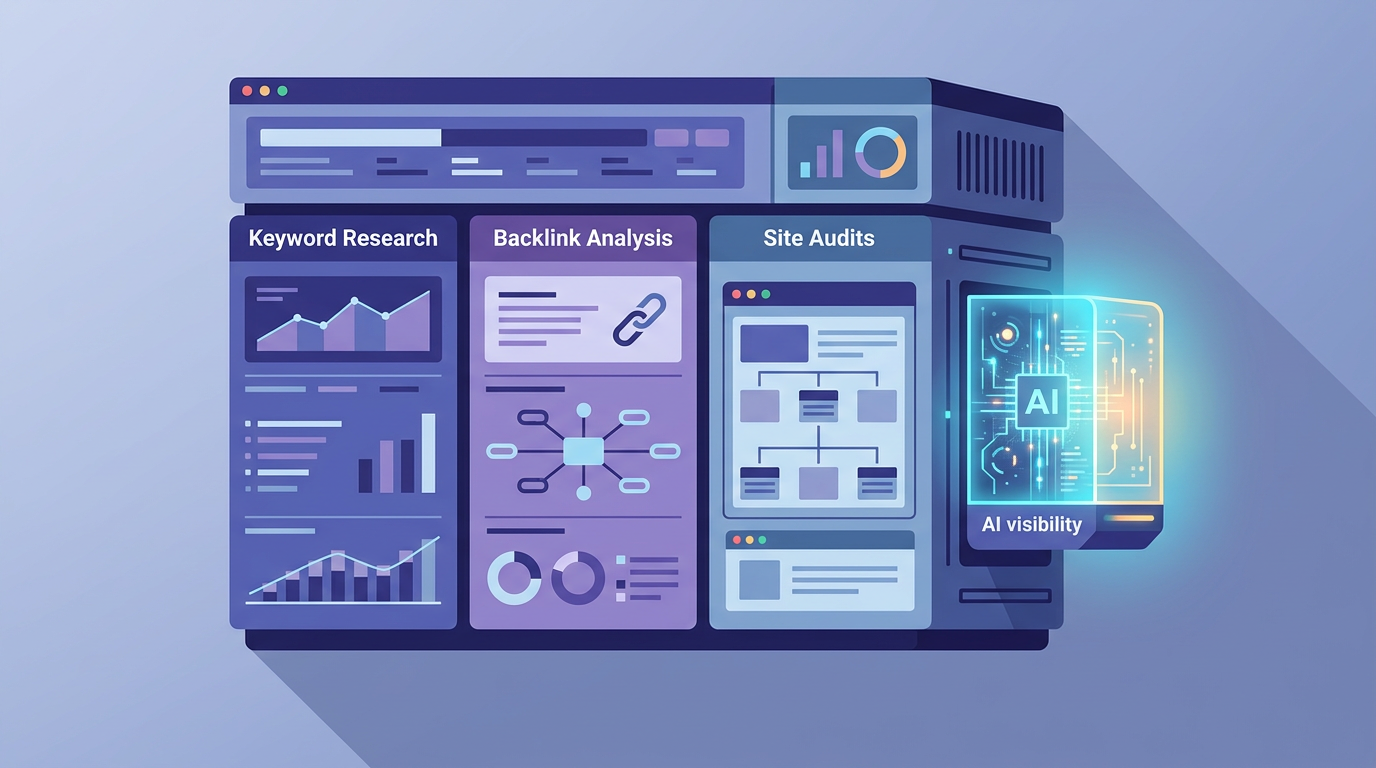
Semrush and Ahrefs bolted AI visibility features onto their existing SEO platforms, making them sensible add-ons if you already pay for one — and overkill if you don't. Both treat AI visibility as a module inside a much larger toolset.
Semrush added an AI Visibility Toolkit and AI Visibility Checker alongside its long-standing SEO, content, and advertising tools, now packaged under "Semrush One" as a unified SEO and AI visibility platform. If your team already lives in Semrush for keyword research, site audits, and backlink analysis, the AI visibility add-on keeps everything in one dashboard. The trade-off is price: Semrush's full suites run well into hundreds of dollars a month, and the AI layer sits on top of that base subscription rather than standing alone.
Ahrefs Brand Radar tracks brand mentions and citations across AI chatbots and AI search, plus brand sentiment. Ahrefs' core strength has always been backlink and keyword data, and Brand Radar extends that into the AI era. It matters because, as noted earlier, unlinked brand mentions across the web correlate more strongly with AI Overview visibility than backlinks do — so a tool watching mentions in a suite already built for off-page analysis has a logical fit. Like Semrush, the AI feature is part of a larger paid subscription, not a cheap standalone tracker.
The case for these legacy suites is bundling. If you need full-spectrum SEO anyway, getting AI visibility in the same account avoids tool sprawl. The case against them is focus and cost: a dedicated platform like LLMRanks covers more engines, adds optimization, and starts at a fraction of an enterprise SEO suite's price. Choose the bundle when you're already committed to it; choose a dedicated tool when AI visibility is the actual job.
Do LLM optimization tools and AI coding tools overlap?
LLM optimization tools and AI coding tools are not the same thing — and the overlap between them is narrow. The phrase "ai coding tools" refers to assistants like GitHub Copilot, Cursor, and Claude Code that write and debug software. LLM optimization tools measure and improve how AI engines cite your brand. Different jobs, different buyers.
The confusion is understandable because both involve large language models. But a coding assistant won't tell you whether ChatGPT mentions your product, and a visibility tracker won't refactor your codebase. They meet in exactly one place: technical implementation of the things that make a site citable.
That overlap is real and worth naming. Two of the biggest AI visibility blockers are technical. First, structured data and schema — adding Article, Organization, and FAQPage markup helps engines disambiguate your brand as an entity (though Google has stated no special schema is required for AI Overviews specifically). Second, JavaScript rendering — Perplexity's crawler and ClaudeBot render JS weakly, so content that only appears after client-side rendering is invisible to them. Fixing that means server-side rendering or prerendering, which is a developer task.
So when does a marketer need a developer rather than a coding tool? When the audit (from LLMRanks, Otterly, or any GEO tool) flags problems you can't fix in the CMS: missing schema, render-blocking content, broken canonicals, slow Core Web Vitals. You don't buy an AI coding tool for that — you hand the audit's findings to an engineer, or use the tool's content features to publish citable pages that don't depend on heavy JavaScript in the first place.
How to choose the best LLM optimization tool for your situation
The best LLM optimization tool depends on whether you're a solo founder, an in-house team, an agency, or an enterprise — and engine coverage should be your top filter regardless. Here's how the profiles map.
Solo founder on a budget under $50/mo. You want a tool that both tracks and acts, because you don't have a team to do optimization manually. LLMRanks from $41/mo billed yearly or Otterly's $29/mo Lite tier are the realistic entry points. Start with a free visibility check to see where you stand before paying. Skip enterprise-only tools entirely — demo-gated pricing usually means contracts you can't justify yet.
In-house marketing team. You may have the people to act on data, so a strong tracker plus your own content workflow can work. But an all-in-one still saves time: brand-voiced article generation and one-click publishing replace hours of manual drafting. Weigh whether you'd rather buy analytics and do the rest, or buy a platform that does both.
Multi-brand agency. You need to manage many clients without per-seat blowups and without an agency upsell baked into the tool you're reselling. Self-serve credits that cover every feature, multi-project support, and white-labelable output matter most. Avoid tools that secretly compete with you by selling retainers behind their own dashboard.
Enterprise. You need share-of-voice reporting, governance, API access, and SSO. Profound and Semrush's enterprise tiers fit here, as does LLMRanks for teams that want optimization built in. Expect custom pricing and longer procurement.
Across every profile, two rules hold. First, engine coverage is the top filter — a tool that misses Gemini or Perplexity gives you a partial map. Second, a free trial or self-serve credits is the lowest-risk start. Tools with public pricing and no demo wall let you validate value in days, not after a quarter-long sales cycle.
How much do LLM optimization tools cost in 2026?
LLM optimization tools in 2026 range from free listicle placement research to about $29/mo for entry trackers and custom enterprise contracts in the thousands — with the biggest practical divide being public pricing versus demo-gated quotes. Here's the breakdown.
On the affordable, transparent end, Listicle.com is free and only requires an email address to receive its research report. LLMRanks starts from $41/mo billed yearly on a credit system covering tracking, audits, content generation, and off-site playbooks, with three engines included and the rest as add-ons. Otterly.AI's Lite plan is $29/mo for 15 prompts, scaling to $189/mo Standard and $489/mo Premium. Peec AI publishes Starter, Pro, Advanced, and Enterprise tiers with a free trial, though it lists exact numbers as "see site."
On the enterprise end, Profound uses custom, demo-gated pricing — you won't see a number until you talk to sales. Semrush and Ahrefs price their AI visibility features as add-ons to full SEO subscriptions that already run into hundreds of dollars a month, so the true cost is the suite plus the module.
| Entry pricing and pricing transparency for LLM optimization tools (2026) | |||
| Tool | Entry price | Pricing model | Public pricing? |
|---|---|---|---|
| Listicle.com | Free | Free research reports | Yes |
| Otterly.AI | $29/mo (Lite) | Per-prompt tiers | Yes |
| LLMRanks | From $41/mo billed yearly | Credits, all features | Yes |
| Peec AI | Free trial; tiers "see site" | Per-prompt + projects | Partial |
| Semrush | SEO subscription + AI add-on | Suite + module | Partial |
| Ahrefs Brand Radar | Within Ahrefs subscription | Suite feature | Partial |
| Profound | Custom | Enterprise contract | No (demo) |
The demo-wall problem is worth weighing as a selection filter on its own. Hidden pricing almost always means an enterprise sales motion, annual commitments, and procurement friction. If you're an SMB or agency that wants to start this week, prioritize tools with public, self-serve pricing and a free trial.
FAQ
What is the best LLM optimization tool for small businesses?
For small businesses, LLMRanks (from $41/mo billed yearly) and Otterly.AI (from $29/mo) are the strongest fits because both offer public self-serve pricing and no enterprise sales wall. LLMRanks also adds optimization — audits, brand-voiced articles, and off-site playbooks — so a solo founder without a team gets work done, not just dashboards. Start with a free visibility check first.
What is an LLM in AI and why does it matter for visibility?
An LLM, or large language model, is an AI system trained on massive text data to generate human-like answers — the technology behind ChatGPT, Claude, and Gemini. It matters for visibility because when these models answer questions, they name and cite specific brands. If yours isn't among them, you're invisible to a fast-growing slice of search demand.
Do LLM optimization tools actually improve AI search rankings?
Tracking-only tools don't improve anything directly — they measure. Tools with optimization features (site audits, citable content, off-site outreach) can improve how often AI engines cite you by fixing technical blockers, building entity strength, and seeding sources AI reads like Reddit and YouTube. Results depend on execution; no tool guarantees citations, since engines change behavior frequently.
How do I track my brand's visibility in ChatGPT and Perplexity?
Use a multi-engine AI visibility tracker that queries ChatGPT and Perplexity with the prompts your customers use, then records whether you were cited, mentioned, or absent. LLMRanks, Otterly.AI, and Peec AI all do this, refreshing prompts daily or weekly. LLMRanks covers both engines plus Gemini, AI Overviews, Claude, and Grok in one dashboard.
What is the difference between AI visibility tracking and optimization?
Tracking measures where you currently get cited — share of voice, which prompts mention you, which name competitors. Optimization changes those outcomes by fixing your site for AI crawlers, publishing citable content, and earning off-site mentions in sources AI reads. Most tools track only; all-in-one platforms like LLMRanks do both, which matters if you lack a team to act on the data.
Are AI coding tools the same as LLM optimization tools?
No. AI coding tools like GitHub Copilot and Cursor write and debug software. LLM optimization tools measure and improve how AI engines cite your brand. They overlap only in technical fixes — schema markup and JavaScript rendering that affect citability. For those, a marketer hands audit findings to a developer rather than buying a coding assistant.
How much should I expect to pay for an AI visibility tool?
Entry trackers start around $29/mo (Otterly.AI Lite), all-in-one platforms from $41/mo billed yearly (LLMRanks), while enterprise tools like Profound use custom demo-gated pricing in the thousands. Semrush and Ahrefs price AI visibility as add-ons to SEO suites already costing hundreds monthly. Prioritize public, self-serve pricing if you want to start without a sales cycle.
Can I optimize for AI visibility without any tools?
Yes, partially. You can manually query ChatGPT and Perplexity with target prompts, add Article and Organization schema, fix JavaScript rendering, and write answer-first content with named entities and specific facts. But you'll miss systematic tracking, competitor benchmarking, and off-site source mapping. Tools scale the work and surface gaps you'd never catch by hand across six engines.