Stop Guessing: Measure Real AI Brand Mentions
Most AI brand visibility tools scrape mentions, not real citations. Here's how to track how ChatGPT, Gemini, and Perplexity actually describe your brand in
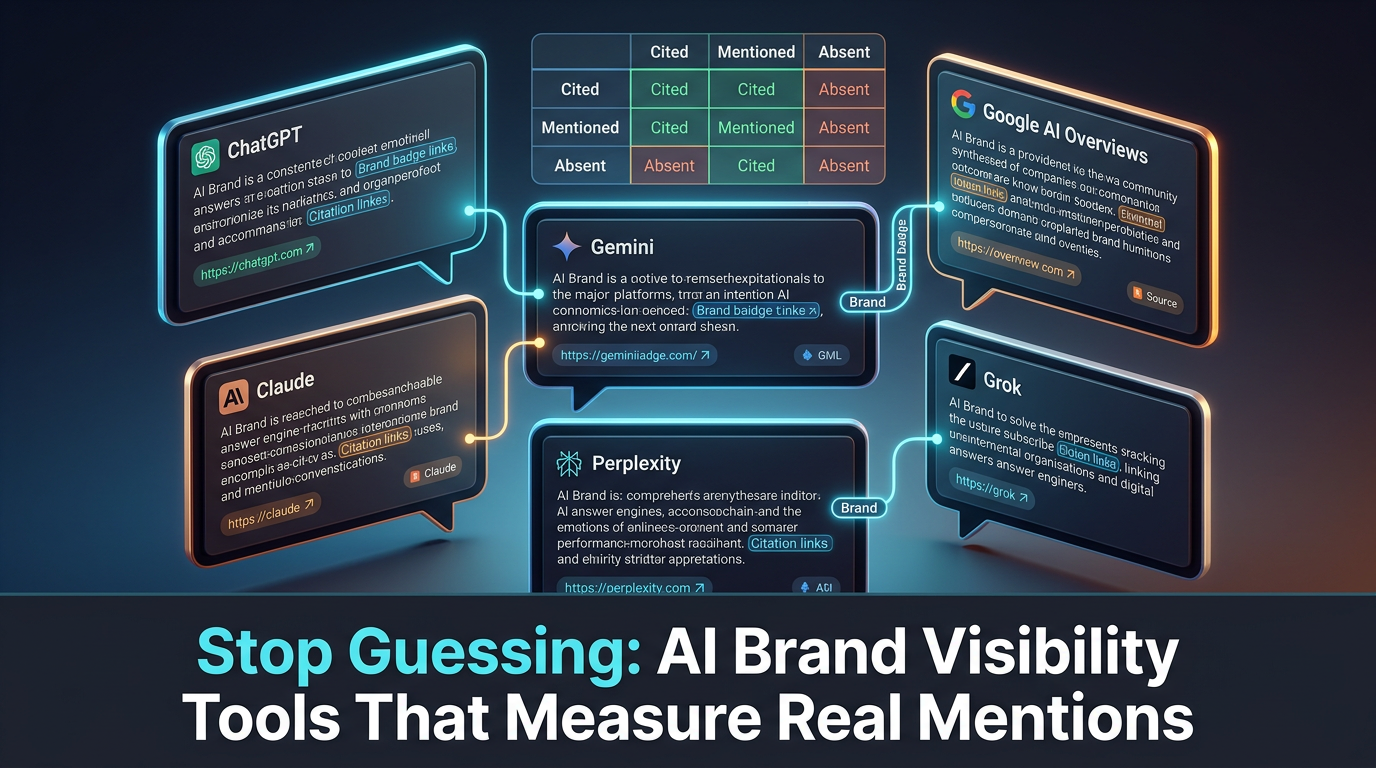
Most AI brand visibility tools measure the wrong thing. They count scraped brand mentions across the web instead of tracking how ChatGPT, Gemini, Claude, Perplexity, Grok, and Google AI Overviews actually cite you inside live answers. A mention is not a citation. This guide gives you a falsifiable framework for picking tools that track real AI engine output across all six engines — and how to validate the problem yourself first.
Key takeaways
- Scraped brand mentions are not live AI citations — only citation tracking shows real answer presence.
- Six engines (ChatGPT, Gemini, AI Overviews, Claude, Perplexity, Grok) each cite sources differently.
- Prompt-level tracking beats keyword-level tracking because AI engines answer questions, not rank pages.
- Public self-serve pricing separates usable tools from demo-wall vendors hiding numbers behind sales calls.
- Reddit, YouTube, and G2 feed AI answers; Google's 2024 Reddit deal made threads heavily cited.
What are AI brand visibility tools and what do they actually measure?
AI brand visibility tools track how AI engines describe, mention, and cite your brand inside the answers they generate for real user prompts. The category emerged in 2024 as ChatGPT, Gemini, and Perplexity started replacing the classic blue-link search experience for millions of buyers. A good tool measures presence inside generated answers. A weak one just counts how often your brand name appears in scraped web text.
That distinction decides whether the tool is useful. There are six engines that matter in 2026: ChatGPT, Gemini, Google AI Overviews, Claude, Perplexity, and Grok. Each one builds answers differently, so a tool that watches only ChatGPT tells you almost nothing about how Gemini or Perplexity treat you. Coverage across all six is the baseline, not a premium feature.
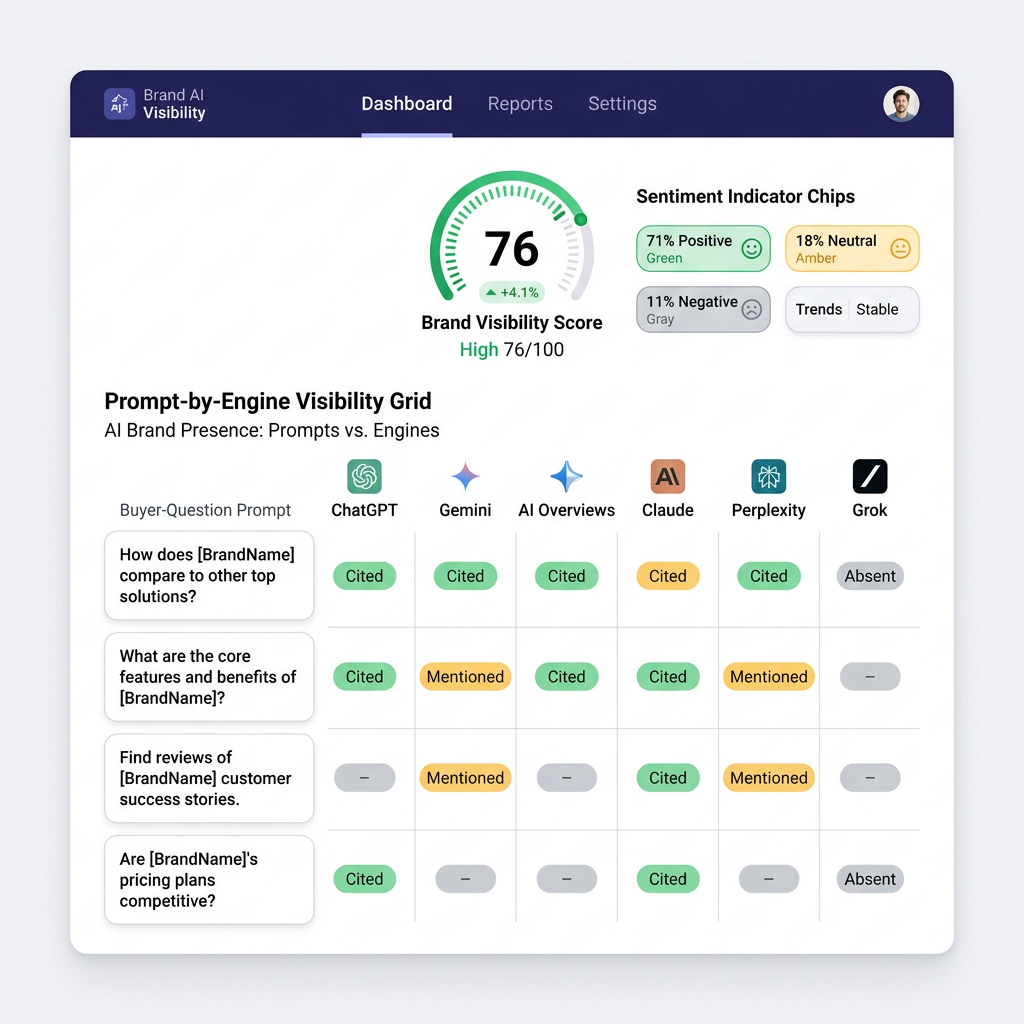
The other axis is granularity. Keyword-level tracking — the old SEO habit of watching where you rank for a term — does not map cleanly to AI. Engines don't rank pages; they answer questions. Prompt-level tracking watches specific buyer questions like "best CRM for solo founders" or "affordable project management for agencies" and grades whether you were cited, merely mentioned, or absent in the answer. Prompt discovery — finding the exact questions your buyers ask AI — is where this starts.
Consumer-grade chatbots make the stakes obvious. When someone opens Meta AI, the assistant built into WhatsApp and Instagram, and asks which tool to buy, the answer is synthesized from sources the model trusts. If your brand isn't in that synthesis, you don't exist for that buyer. AI brand visibility tools exist to tell you, precisely and repeatedly, whether you made the cut. The serious ones grade each prompt against each engine and capture sentiment, so you know not just if you appeared but how you were described.
Why do most AI brand visibility tools measure the wrong thing?
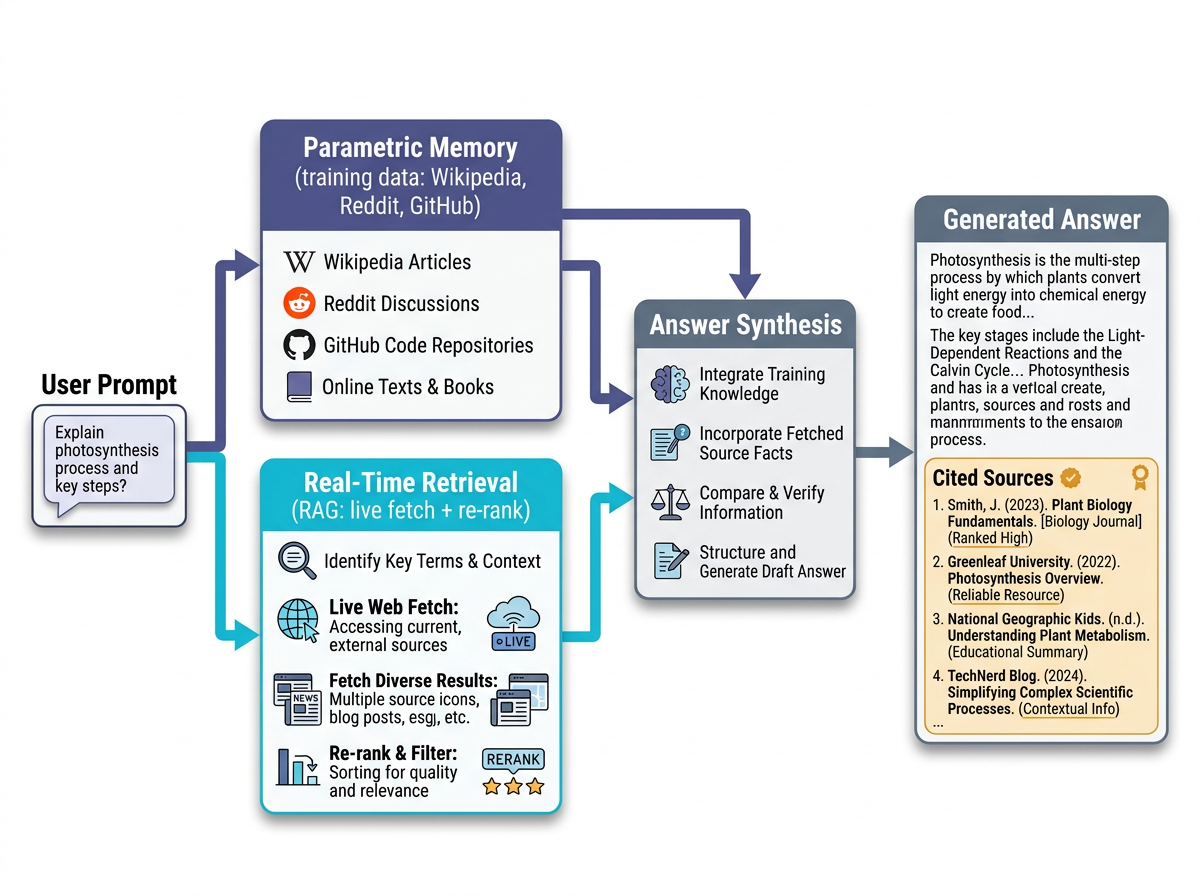
Most AI brand visibility tools count scraped brand mentions, which is a fundamentally different signal from how AI answers are actually built and cited. Scraping the web for your brand name tells you who wrote about you. It says nothing about whether ChatGPT pulled that page into an answer, whether Gemini trusted it, or whether Perplexity cited it. A mention sitting in a blog post that no engine retrieves is invisible to buyers.
The gap comes from how engines generate answers. AI responses draw on two layers. Parametric memory is what the model absorbed during training — heavy presence in Wikipedia, Reddit, GitHub, and old news archives. Real-time retrieval, or RAG, is a live search call at the moment you ask, where the engine fetches pages, re-ranks them, and quotes the winners. The brands that get cited are the ones that rank in the underlying retrieval index and structure their content so a passage can be quoted in isolation.
This is why "brand rank ai" style dashboards mislead. Counting raw mentions across crawled text is the easy thing to build, so plenty of vendors build it and call it AI visibility. But the answer a buyer reads in a free answer AI query often cites three to eight sources — and those sources are pulled from the retrieval index, not from a generic mention pile. If your tool can't show you the actual citations inside actual answers, it's measuring noise.
Run the test yourself. Ask Perplexity "best AI visibility tool for agencies" and watch it cite specific URLs under each claim. Now ask whether your mention-counting tool predicted any of those citations. It usually can't, because mentions and citations live in different systems. The tools worth paying for grade live engine output prompt by prompt, then tell you why an engine skips you when it does.
How do the six major AI engines decide which brands to cite?
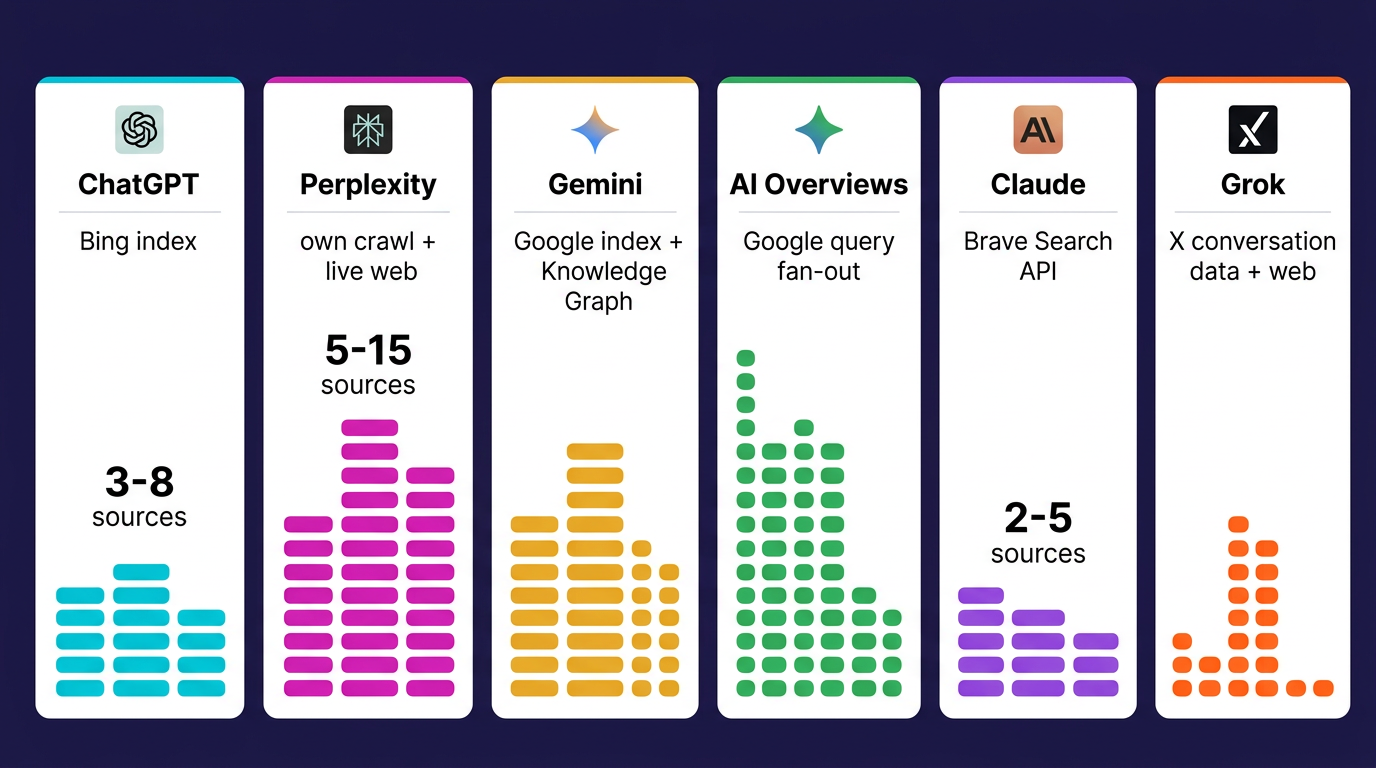
Each of the six major AI engines uses a different retrieval pipeline, which is the single biggest reason one tool must cover all of them rather than just one. Citing the right brands depends on which search index, which crawl, and which re-ranker an engine runs — and those differ sharply.
ChatGPT in search mode leans on Bing's index plus OpenAI's own crawl, and it cites roughly three to eight sources inline. If Bing ranks you in the top 10 for the rewritten query, you have a real shot at the citation. Tracking ChatGPT visibility means watching how the Bing-flavored retrieval treats your pages.
Perplexity runs its own crawl index blended with live web fetches, and it's the most generous engine for smaller publishers because its re-ranker rewards passage relevance over raw domain authority. It pulls 5 to 15 sources per answer and cites nearly every claim. Perplexity tracking often reveals wins that ChatGPT misses.
Gemini and Google AI Overviews are fused to Google's index and Knowledge Graph. The defining 2026 shift is query fan-out: Google's AI Mode decomposes a single question into many sub-queries, retrieves for each, then synthesizes. You now have to rank for sub-questions you never knew existed. AI Overviews tracking and Gemini tracking both ride Google's stack, so a Google-weak page tends to lose in both.
Claude commonly uses the Brave Search API with internal re-ranking, cites fewer sources — often two to five — but quotes longer passages verbatim, which rewards clean, self-contained writing. Claude tracking tends to favor editorial depth.
Grok, built into X, weights X conversation data heavily alongside web retrieval, so social presence and timely posts matter more here than on any other engine. Grok tracking catches signals the others ignore.
Six engines, six pipelines. A tool that watches only Bing-powered ChatGPT can't tell you why you vanished from a Google-powered AI Overview. That's why coverage across all six engines plus Google is the real requirement, not an add-on.
What features should you look for in AI brand visibility tools in 2026?
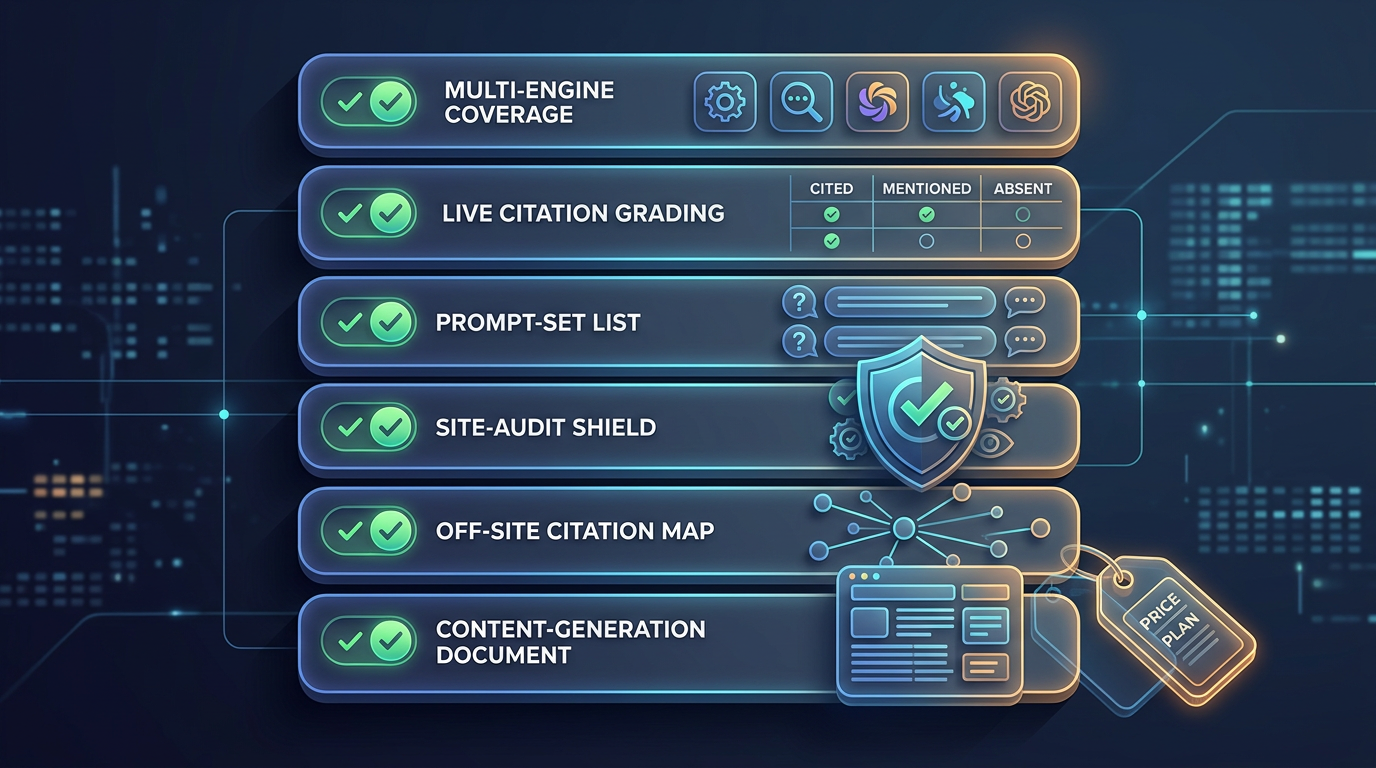
The non-negotiable feature is live citation tracking across all six engines, not scraped mention counting. Everything else builds on that foundation. Use the checklist below when you evaluate any AI brand visibility tool, and treat each item as falsifiable — ask the vendor to demonstrate it on your own brand.
Multi-engine coverage. The tool should grade ChatGPT, Gemini, AI Overviews, Claude, Perplexity, and Grok. If it covers two engines and calls itself complete, walk away.
Live citation tracking, not mentions. Demand cell-level grading of each prompt against each engine — cited, mentioned, or absent — with sentiment capture. LLMRanks grades every prompt-by-engine cell this way and rolls it into a 0-100 visibility score. Profound offers similar Answer Engine Insights showing how AI represents your brand across conversations.
Prompt set management. You should be able to build and refresh your own prompt list on a daily cadence, because buyer questions shift. Discovering the prompts buyers actually type is half the battle.
Site readiness and AEO audit. Visibility is downstream of structure. The tool should audit your pages for the things engines need — schema gaps, canonical conflicts, broken internal links, and crawler access. LLMRanks runs 25+ checks across 8 categories; that's the kind of AEO foundation that turns tracking into action.
Off-site citation playbooks. AI answers lean on Reddit, YouTube, and review sites. A strong tool maps where those citations come from and surfaces outreach opportunities — Profound flags earned media on Reddit and relevant threads, and the same logic applies to YouTube and listicles.
Content generation in brand voice. Tracking tells you where you're absent; you still have to fill the gap. Tools that generate AEO-structured, brand-voiced articles with article and FAQPage schema close the loop faster. LLMRanks ships clean HTML with one-click publishing.
Transparent self-serve pricing. If you can't see a price without booking a demo, that's a signal about who the tool is built for. Public pricing and self-serve credits mean the vendor expects you to succeed without a sales call. Run a free visibility check first before you commit a budget.
How do the leading AI brand visibility tools compare?
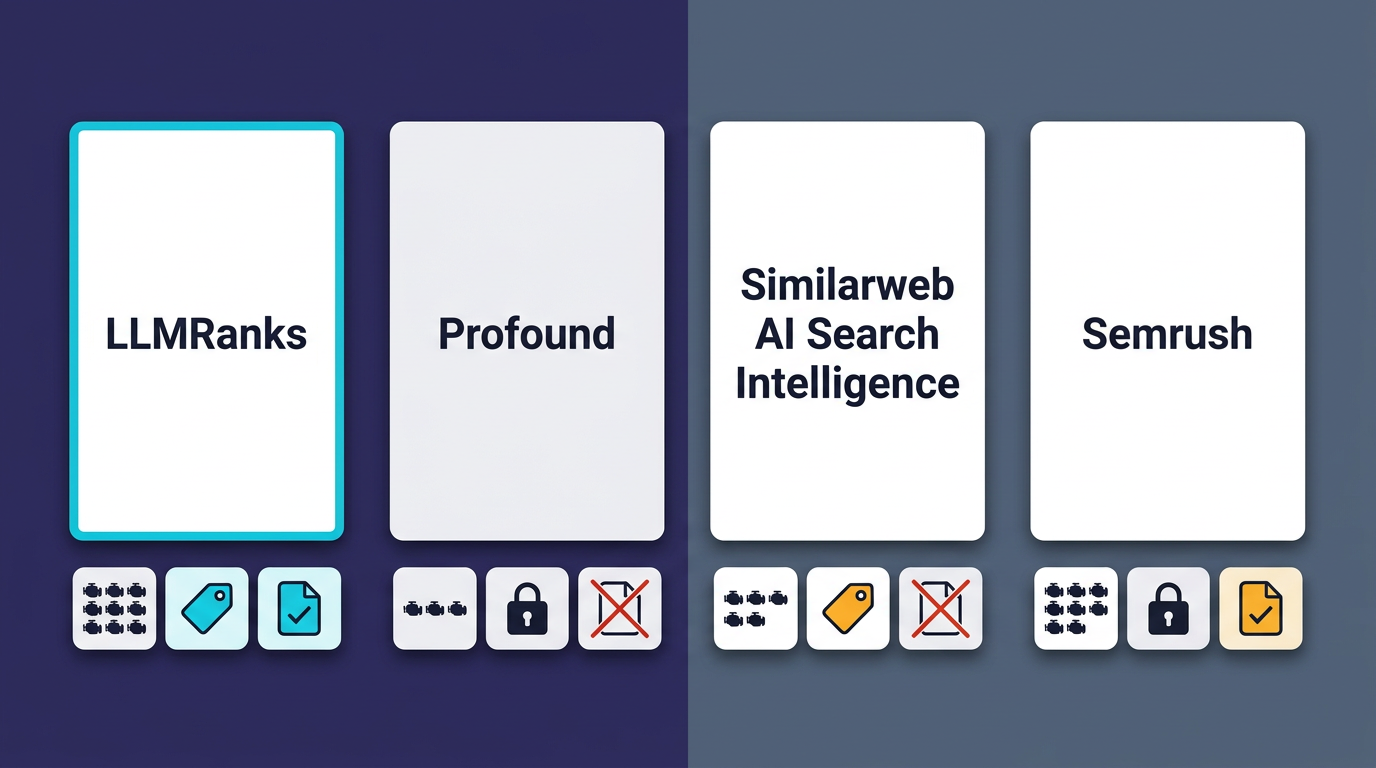
Profound, Similarweb AI Search Intelligence, Semrush, and LLMRanks all track AI visibility, but they differ on engine coverage, pricing transparency, and whether they generate the content to fix gaps. The table below maps the differences that matter at purchase time.
| Profound vs Similarweb vs Semrush vs LLMRanks: AI brand visibility tools compared (2026) | |||||
| Tool | Engine coverage | Citation tracking method | Public self-serve pricing | Content generation | Primary audience |
|---|---|---|---|---|---|
| LLMRanks | 6 engines (ChatGPT, Gemini, AI Overviews, Claude, Perplexity, Grok) + Google | Cell-level prompt × engine grading: cited / mentioned / absent + sentiment | Yes — from $69/mo monthly, tiers billed yearly | Yes — brand-voiced AEO articles, schema, one-click publish | SMBs and agencies |
| Profound | Multiple engines (ChatGPT, Gemini, Claude, Perplexity, others) | Answer Engine Insights + citation tracking + sentiment | Not publicly listed | Agents for marketing functions; not core article generation | Marketing, PR, brand teams, agencies |
| Similarweb AI Search Intelligence | Major LLMs incl. ChatGPT | Brand visibility, prompt analysis, citation analysis, sentiment score | Not publicly listed | No | Digital brands and marketers |
| Semrush | AI Visibility Toolkit across AI search | AI search visibility tracking within a broader SEO suite | Suite pricing; AI toolkit add-on | Content Toolkit (not AI-citation specific) | Brands, marketers, enterprise |
Profound is built for larger marketing, PR, and brand teams. Its PR-team solution and prompt-volume analytics are strong, but pricing isn't published, which usually means a sales conversation before you see a number. Similarweb AI Search Intelligence ships solid brand visibility and citation analysis with a sentiment score, again without public pricing. Semrush folds AI search visibility into its larger SEO suite, which suits teams already living inside Semrush but adds breadth you may not need.
LLMRanks covers all six engines plus Google, grades each prompt-engine cell as cited, mentioned, or absent, and publishes its pricing openly — Solo at $69/mo, Business at $129/mo, and Agency at $449/mo per its pricing. It also generates AEO-structured articles in your brand voice and publishes them in one click, so the same platform that finds the gap can fill it. For a like-for-like look at adjacent vendors, the Peec AI comparison walks through the trade-offs honestly. General roundups from Zapier and Profound's agency list are useful for a wider market scan.
How much do AI brand visibility tools cost in 2026?
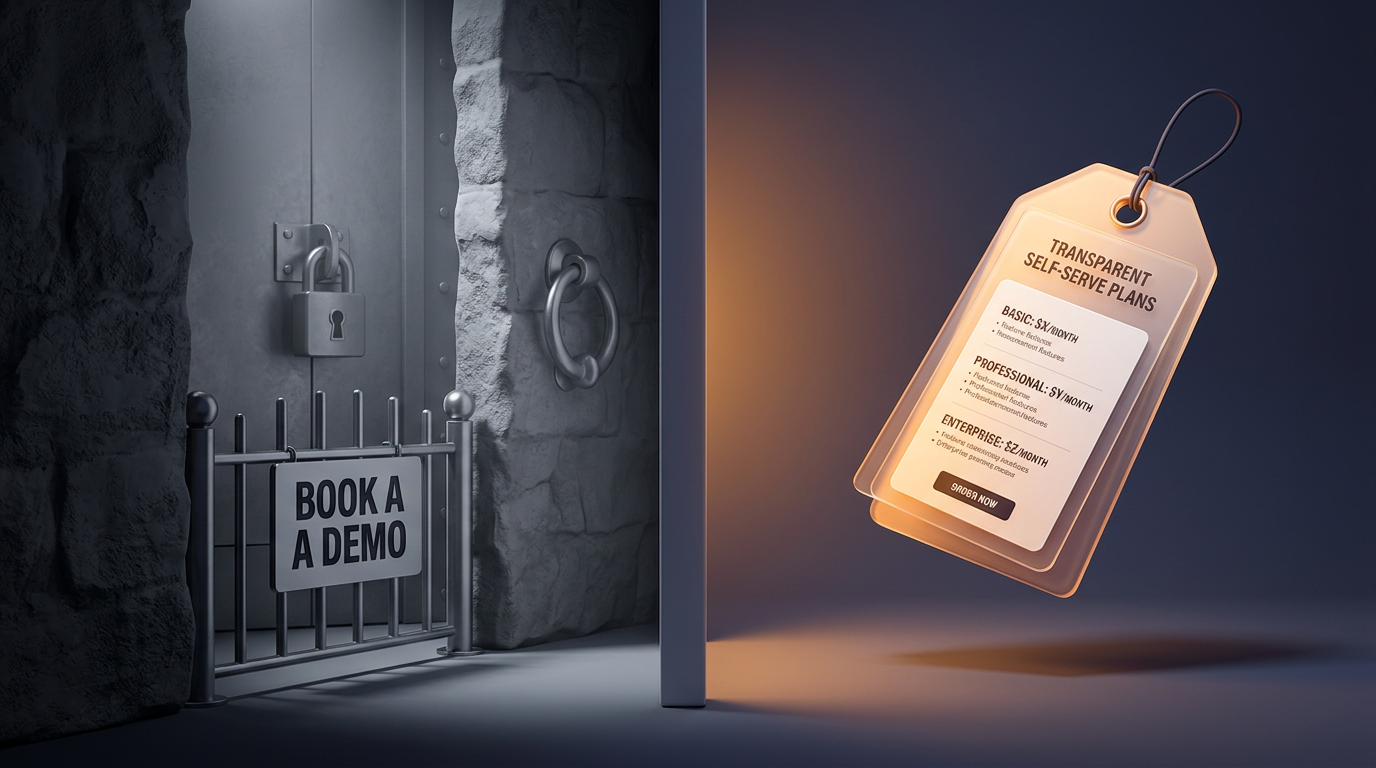
AI brand visibility tools in 2026 split into two pricing worlds: transparent self-serve plans you can buy today, and demo-wall vendors who hide the number until a sales call. Which side a tool sits on tells you who it's built for.
Demo-wall pricing is common among enterprise-leaning platforms. Profound and Similarweb AI Search Intelligence don't publish pricing, so you book a call, sit through a demo, and get a quote shaped by your company size. That model works for big teams with procurement budgets. For a solo founder or a lean marketing team, it's friction before value.
Pricing models also differ in structure. Seat-based pricing charges per user and gets expensive as teams grow. Credit-based pricing charges by usage — prompts tracked, articles generated, audits run — which scales more predictably for smaller teams. LLMRanks uses a credit model with public tiers: Solo at $69/mo, Business at $129/mo with 2,000 monthly credits, and Agency at $449/mo with 8,000 credits for multi-brand tracking, all listed on the visibility product page. Solutions for small business start in that same range.
Watch for the agency-retainer upsell. Some platforms run a self-serve dashboard up front but funnel you into a managed-services retainer once you're hooked. That changes the math from a software subscription to a five-figure annual relationship. An independent platform that doesn't sell retainers behind the dashboard keeps your costs predictable.
For context on adjacent AI software pricing, conversational platforms like Relevance AI (AI agents) and physical-security tools like Spot AI sit in entirely different categories but anchor the broader "AI tool" price range buyers compare against. The point: judge AI brand visibility tools against each other, not against unrelated AI software, and favor the ones that show you a number without a sales call.
How do you track AI brand visibility without paying for a tool first?
You can validate the entire problem manually before spending a dollar by asking the same buyer questions across each AI engine and recording who gets cited. This is the cheapest way to prove you need a tool — or prove you don't yet.
Start by listing 10 to 20 questions a buyer would actually ask, then run each one through ChatGPT, Gemini, Perplexity, Claude, and Grok. When you ask AI questions free across engines, log three things per answer: were you cited, were you merely mentioned, and how were you described. Perplexity makes this easiest because it cites a source under nearly every claim. ChatGPT and Gemini show citations too once you trigger search behavior with a deepsearch-AI-free style prompt that pushes the model to fetch live sources rather than answer from memory.
For off-site signals, run site:reddit.com "your brand name" in Google and skim the threads — those posts feed AI Overviews and Gemini directly. Check YouTube for review and comparison videos mentioning your category. Treat this like free AI study tools: lightweight, manual, good enough to surface the obvious gaps.
Manual tracking breaks down fast, though. You can't run 20 prompts across 6 engines daily by hand. You won't catch sentiment drift, you can't measure share of voice against competitors, and you have no record of whether last month's content fix moved anything. The numbers are also noisy — answers vary run to run, so a single check tells you little.
Graduate to a paid tool when manual checking eats more than an hour a week, when you need to prove ROI to a boss or client, or when you're managing more than one brand. At that point a platform that grades prompts daily and shows where you actually show up pays for itself in saved hours alone.
How does off-site content shape what AI engines say about your brand?
Off-site content — Reddit threads, YouTube videos, and review sites — is often what AI engines cite when describing your brand, sometimes more than your own website. This is the part most brands miss, and it's where the better tools earn their keep.
Reddit's influence jumped after Google signed a reported $60M-per-year data licensing deal with Reddit in 2024, covered by Reuters. The result: for almost any commercial query, Google AI Overviews and Gemini now surface a Reddit thread. If your category has an active subreddit and your brand isn't discussed there, you're handing the citation to whoever is. Genuine participation — not spam — in the right subreddits is now a visibility lever.
YouTube is the other heavyweight, especially inside Gemini and AI Overviews, which lean on video and transcripts. A solid review or comparison video mentioning your brand creates a citable source that AI can pull, with your name and category sitting side by side in the transcript.
Review sites set their own thresholds. Brands generally need around 30+ reviews on G2 or Capterra for category visibility and closer to 100+ to show up in "best of" AI answers. Listicles — the "7 best tools for X" posts — are prime citation targets too, which is why getting included in them is a deliberate play, not an accident.
Mapping all of this is the off-site citation playbook: identify every external source AI reads about your category, then earn presence in the ones that matter. Profound surfaces earned media opportunities on Reddit, and an off-site playbook approach turns scattered mentions into a deliberate strategy. The brands that win AI citations treat Reddit, YouTube, and review sites as part of their visibility surface, not afterthoughts. Free research and playbooks help you start mapping yours.
Which AI brand visibility tool is right for SMBs versus agencies?
SMBs and solo founders need transparent pricing and self-serve speed; agencies need multi-brand tracking without a retainer trap — and LLMRanks fits both because it was built around exactly those constraints.
For an SMB or solo founder, the priorities are simple: see a price, start today, and don't get funneled into a sales call. A tool that hides pricing behind a demo wall costs you a week before you learn anything. The Solo plan at $69/mo covers all six engines with 1,000 monthly credits — enough for a lean team to track its core prompts, audit its site, and generate a few brand-voiced articles. That's the free AI study tools mindset applied to a paid product: start small, prove value, scale when ready.
Agencies have a different shape of need. They manage many brands, report to clients monthly, and want a platform that won't suddenly upsell them into a managed-services retainer that competes with their own offering. The Agency plan at $449/mo handles multi-brand tracking with 8,000 credits, and because LLMRanks doesn't sell agency retainers behind the dashboard, there's no channel conflict. The agency keeps the client relationship; the tool stays a tool.
Both segments benefit from content generation built in. Tracking shows the gap; brand-voiced article generation with one-click publishing to WordPress, Shopify, or Ghost fills it without a separate writing workflow. That matters most for lean teams who can't staff a content desk.
If you're comparing options, scan the Zapier roundup and the Reddit discussion for outside perspective, then talk to a real human before you decide. The right tool is the one that covers all six engines, shows its price, and helps you act on what it finds.
FAQ
What is the difference between AI brand visibility and traditional SEO rankings?
Traditional SEO ranks your pages in a list of blue links for a keyword. AI brand visibility measures whether ChatGPT, Gemini, Perplexity, Claude, Grok, or AI Overviews cite or mention your brand inside a synthesized answer. Engines answer questions instead of ranking pages, so visibility is tracked prompt by prompt and graded as cited, mentioned, or absent.
Can I track how ChatGPT mentions my brand for free?
Yes, manually. Ask ChatGPT in search mode the buyer questions relevant to your category, then log whether your brand is cited, mentioned, or absent. Perplexity makes this easiest since it cites sources under each claim. Manual checks work for validation but break down past a handful of prompts, since you can't run dozens of questions across six engines daily by hand.
Do AI brand visibility tools cover Gemini and AI Overviews?
The good ones do. Gemini and Google AI Overviews both run on Google's index and Knowledge Graph, using query fan-out to decompose questions into sub-queries. Tools like LLMRanks track both alongside ChatGPT, Claude, Perplexity, and Grok. Avoid tools covering only one or two engines, since each engine cites sources through a different retrieval pipeline.
How accurate are AI brand visibility tools?
Accuracy depends on method. Tools that track live citations inside actual AI answers are far more reliable than ones counting scraped web mentions. AI answers vary run to run, so a single check is noisy; daily prompt grading across many prompts smooths that variance. Cell-level grading of each prompt against each engine gives the clearest, most falsifiable picture.
How often should I check my AI brand visibility?
Daily tracking is ideal because AI answers shift run to run and buyer prompts change. Manual checks once a week catch big gaps but miss sentiment drift and competitor moves. Tools like LLMRanks refresh prompt tracking daily so you can tell whether a content fix actually moved your citation rate across the six engines.
Why does my brand appear in Google but not in AI Overviews?
Google AI Overviews use query fan-out, decomposing one question into many sub-queries and synthesizing answers from passage-level relevance, Reddit threads, and structured content. Ranking for the head term isn't enough; you must rank for the sub-questions and structure pages so a passage can be quoted in isolation. A site audit for schema and answer-first structure usually reveals the gap.
What does it cost to track AI brand visibility in 2026?
Pricing splits into demo-wall vendors who hide numbers behind sales calls and transparent self-serve tools. LLMRanks publishes tiers: Solo at $69/mo, Business at $129/mo, and Agency at $449/mo, all covering six engines. Profound and Similarweb AI Search Intelligence don't list public pricing, which typically means a sales conversation before you see a quote.
Do I need a separate tool for each AI engine?
No — and you shouldn't use one. Each engine cites sources differently, so a tool watching only ChatGPT can't explain why you vanished from a Google-powered AI Overview. Pick one platform that covers all six engines plus Google, grades each prompt-engine cell, and captures sentiment, so you see the full picture in a single dashboard.