New Way to Do Auto Blogging in 2026
Research-first, human-reviewed auto blogging that ranks. Skip thin AI posts—learn the method that gets cited and survives Google's spam filters.

Bulk-publishing thin AI articles on every keyword you find is dead. Google's October 2025 Core Update demoted low-effort AI content, and its scaled-content-abuse policy (updated March 2024) penalizes mass-produced pages regardless of who wrote them. Google does not care that content is AI-written — it cares whether it's spam. The durable method in 2026 is research-first, human-reviewed, and drip-scheduled. Here's how it works.
Key takeaways
- Google penalizes scaled content abuse, not AI authorship — its March 2024 spam policy and October 2025 Core Update target thin pages regardless of who wrote them.
- Bulk keyword-dumping typically produces a traffic spike that collapses within one to three months (directional timing, not a published Google figure).
- The durable method is AI-plus-human: curate primary sources, draft with automation, human-review before publishing, then drip-schedule over 30 to 90 days.
- Citability beats volume — fact-dense, source-grounded, answer-first content is what ChatGPT, Perplexity, and AI Overviews actually cite.
- Only ~38% of AI-Overview-cited pages rank in the organic top 10 (Ahrefs, early 2026); passage relevance to sub-queries wins, not head-term rank.
Why bulk AI auto blogging collapses within 3 months
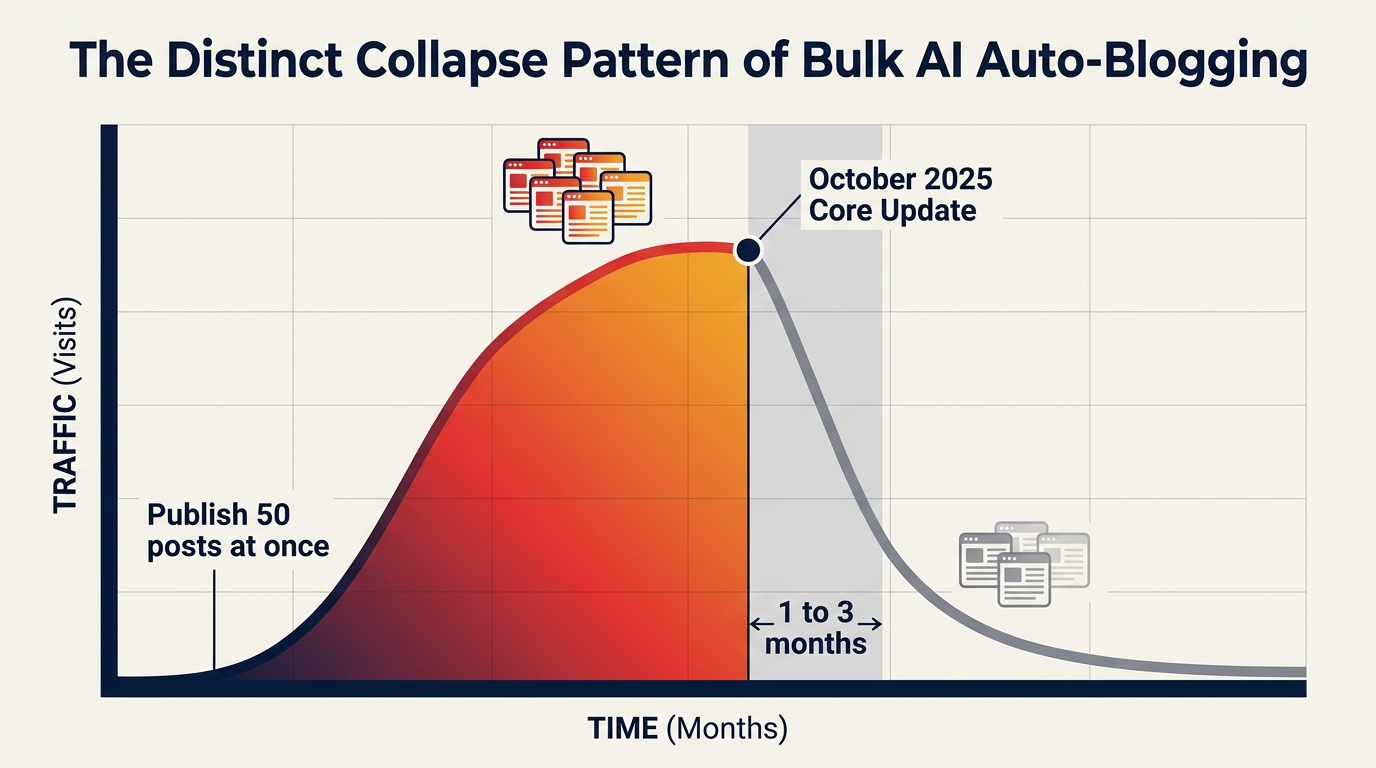
Bulk AI auto blogging collapses because Google's ranking systems treat mass-produced, thin content as spam — and the correction usually lands within one to three months of the initial spike. The pattern is predictable: you point a tool at 200 keywords, publish 50 posts in a day, watch impressions climb, then watch them evaporate on the next crawl-and-rank cycle.
The policy backing this is specific. Google's scaled content abuse policy, updated in March 2024, targets "the practice of generating many pages... primarily for manipulating search rankings and not helping users" — and it explicitly applies regardless of whether the pages were made by automation, humans, or a mix. The same March 2024 core update folded the standalone Helpful Content System into Google's core ranking, so there's no separate signal to dodge anymore; helpfulness is baked into how everything ranks.
Then came the October 2025 Core Update. Black Pug Studio reports it demoted low-effort AI content while rewarding expert-driven pieces, and notes that fully AI-generated articles generally don't perform — marketers who lean on them are the least likely to report strong results. SmartWP frames the mechanism plainly: done lazily, autoblogging produces thin, duplicate content that Google's Helpful Content system penalizes.
The tell-tale spam pattern is thin content on every keyword: many pages, low information gain per page, templated structure, no primary sources, no human fingerprint. That's the fingerprint spam systems catch. A caution on timing — the exact "tanks in 1 to 3 months" window is directional, drawn from the demotion behavior of the October 2025 update and the 2024 spam policy, not a published Google figure. The direction is well-evidenced. The stopwatch is not.
Does Google penalize AI content? No — it penalizes spam
Google does not penalize AI-generated content. It penalizes content created primarily to manipulate rankings, regardless of how it was produced. Google has restated this repeatedly through 2024 and 2025: in its guidance on AI-generated content, the company says "appropriate use of AI or automation is not against our guidelines" and that its focus is on "the quality of content, rather than how content is produced."
That reframes the whole problem. The enemy is not authorship — it's spam, thin pages, and manipulation. The dividing line is value and the work behind the content. A page that adds something the top results don't already say survives; a page that regurgitates the SERP does not. Google's information-gain patent (US20220245190) is operative here: your page needs to contribute novel claims, data, or perspective, or it reads as redundant.
Kitful.ai puts the 2026 reality directly: Google rewards helpful, accurate content over who wrote it, and can detect filler. AI-detection tools are unreliable, so the safeguard is not evading detection — it's quality. "People-first" content answers the query intent in the first 100 words and satisfies the searcher without sending them back to Google.
So stop optimizing against AI. Optimize against thinness. The work you put in — real research, real examples, real editorial judgment — is what converts an AI draft from a spam candidate into something Google is glad to rank.
The research-first auto blogging method that actually ranks
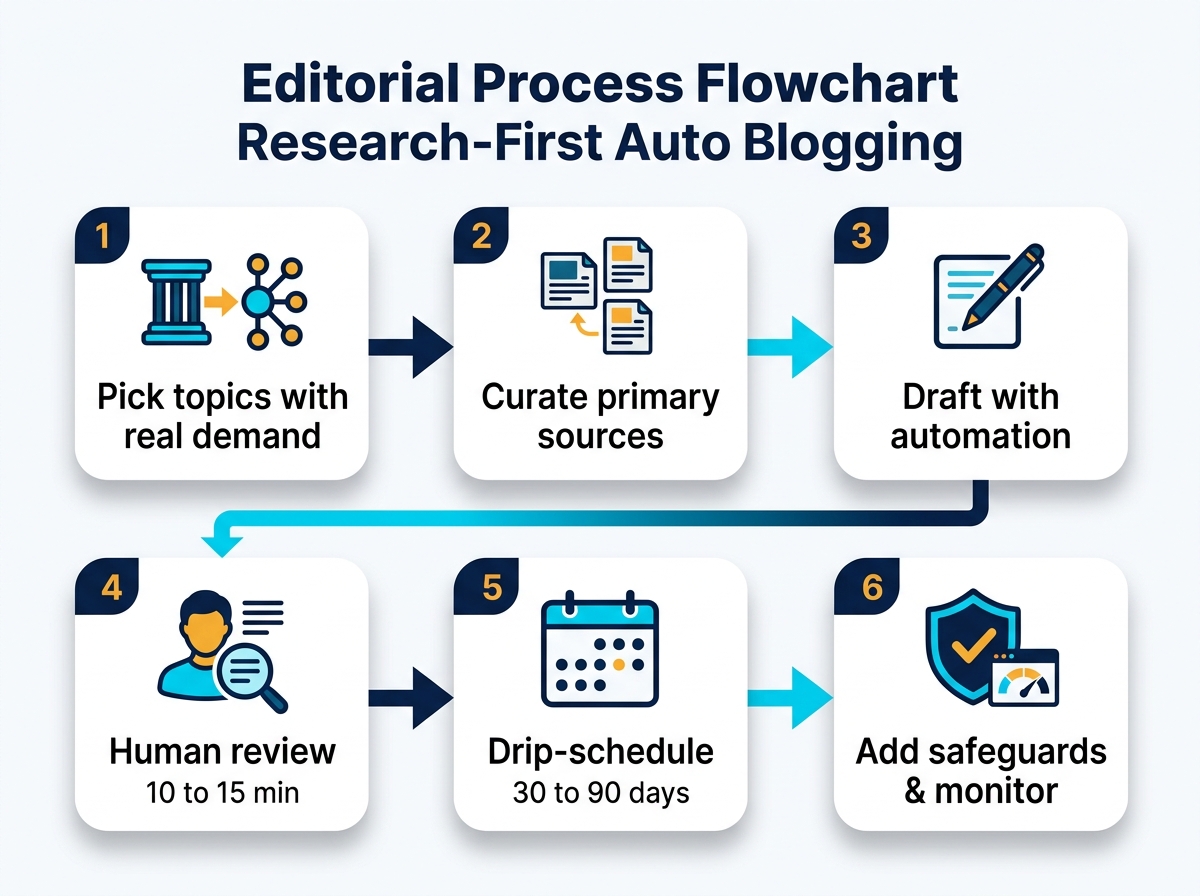
The method that ranks in 2026 is human-plus-AI: curate real sources, draft with automation, then human-review before publishing — the opposite of dumping mass keyword content. Across 15 sources this year, from tool vendors like RightBlogger to independents like Black Pug Studio and Gone Travelling Productions, the process consensus is nearly identical. Here it is as ordered steps.
- Pick topics with real demand. Build pillars and clusters, not scattered keyword-fills. Ryan Robinson describes a content engine — plan plus workflow plus calendar plus SEO plus review steps — and pillars that turn isolated posts into a connected structure Google reads as topical authority. Black Pug Studio recommends targeting lesser-known keywords over competitive high-volume terms, because thin pages on big keywords don't build trust.
- Curate real primary sources before drafting. This is the moat. SmartWP notes the difference between useful automation and thin content comes down to the setup, not the tool — and that RSS feeds don't automatically grant republication rights. Choose sources like an editor: official docs, government data, original research, named authorities.
- Draft with automation. Let the tool produce the baseline. Robinson is blunt that a draft gets you only 80 to 90 percent of the way there — automation handles consistency, not the finish.
- Human-review before publishing. Import posts as Draft or Pending Review, never straight to live. RightBlogger recommends spending 10 to 15 minutes per post adding personal examples, opinions, and internal links; Kitful.ai calls a "human in the loop" necessary for fact-checking and adding roughly 10 percent human flavor. This is where E-E-A-T signals — experience, expertise — get injected.
- Drip-schedule at a sustainable cadence. Instead of dumping 50 posts at once, drip them out over 30 to 90 days. Robinson: consistency beats intensity — a sustainable 90-day schedule beats an aggressive plan that gets quit. Solo bloggers can start at one post a week.
- Add safeguards and monitor. Use duplicate detection, plagiarism checks, rate limits, and import logs. Connect Google Search Console and Analytics early, then run a weekly checkup. Don't automate anything you can't monitor.
One honest caveat: expect a long runway. Gone Travelling Productions estimates ROI is unlikely for at least 6 to 12 months, and roughly 100 posts before real traction. This is a compounding system, not a growth hack.
How to make AI-generated content citable, not just published

Citable content is content an AI engine can extract, attribute, and quote in isolation — which means fact-dense, source-grounded, and answer-first. Ranking in Google is the eligibility gate; getting cited by ChatGPT, Perplexity, Gemini, and Google AI Overviews is a separate skill most autoblogging guides skip. Here are the moves that earn the citation.
- Hit roughly one verifiable claim per 50 to 75 words. "Postgres 16 introduced logical replication for partitioned tables in September 2023" beats "Postgres improved replication." Vague prose is unextractable; discrete assertions get quoted.
- Anchor every claim to a named entity, a date, and a number. LLMs latch onto strings like "October 2025 Core Update" or "March 2024" because those exact tokens reappear in the query reformulation. Replace adjectives with measurements and "recently" with "in Q3 2025."
- Open each H2 with the answer. The retriever pulls a 200-to-800-token passage, not your whole page. Each section should stand alone and answer one sub-question in its first two sentences. Bury the answer in paragraph 14 and a 600-word competitor beats your 4,000-word essay.
- Cite primary sources with deep links and dates. RAG systems verify claims before quoting them, so a page that links Google's own spam policy gets cited; a page that states the same thing unsourced gets paraphrased without credit — or dropped.
- Use comparison tables and enumerated claims. Tables get extracted as structured rows and, per 2026 absorption research, show roughly +55% citation influence. Closed enumerations — "there are three deployment modes" — get quoted as a unit.
The reason this matters more than raw rank: citation has decoupled from ranking. Ahrefs' early-2026 analysis of 4 million AI-Overview-cited URLs found only about 38% of cited pages rank in the organic top 10 for the query — down from roughly 76% in July 2025. What earns the citation is passage-level relevance to a fan-out sub-query, not head-term dominance. Fact-dense, self-contained sections win the sub-queries a keyword tool never shows you.
Spam auto blogging vs research-first auto blogging
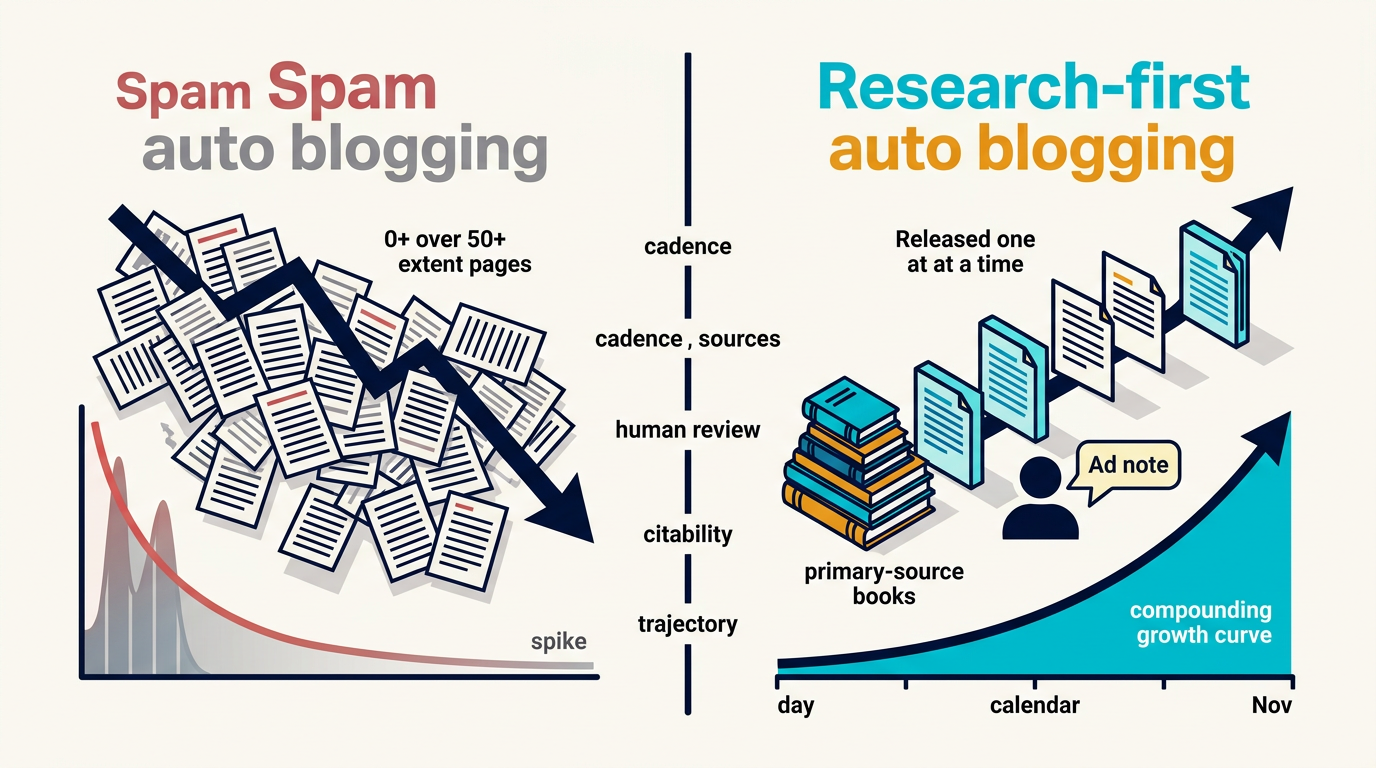
The two approaches diverge on five axes — cadence, source basis, human review, citability, and where they end up after 6 to 12 months. Spam collapses; research-first compounds. Use this to self-diagnose which one you're running.
| Dimension | Spam auto blogging | Research-first auto blogging |
|---|---|---|
| Publishing cadence | Mass dump — 50+ posts at once | Drip — scheduled over 30 to 90 days |
| Source basis | Keyword lists, RSS republishing | Curated primary sources and original research |
| Human review | None — first draft auto-published | Required — 10 to 15 min editorial pass per post |
| Citability by AI engines | Low — thin, unattributed, no fact density | High — fact-dense, source-grounded, answer-first |
| 6 to 12 month traffic trajectory | Spike then collapse (October 2025 Core Update demotion) | Slow compounding after ~100 posts |
If you're on the left column, you're running the pattern Google's scaled-content-abuse policy names directly. The move isn't more posts — it's moving your process to the right column.
How LLMRanks builds research-backed, AI-citable articles
LLMRanks operationalizes the research-first method by attaching real research to every piece of content it generates, then tracking whether AI engines actually cite the result. The research layer is the moat — it's what separates a value-add draft from the spam Google demotes. Very few tools do this; most stop at "paste a keyword, get an article."
Here's what that looks like in practice. LLMRanks generates brand-voiced articles that are AEO-structured — answer-first sections, fact density, extractable tables — grounded in a brief built from your brand voice, not a generic template. Finished pieces publish with one click to WordPress and export to other CMS platforms, so the human-review step (import as draft, add your examples, then publish) fits the workflow rather than fighting it.
The part most autoblogging tools can't do: LLMRanks tracks your citations live across six AI engines — ChatGPT, Gemini, Google AI Overviews, Claude, Perplexity, and Grok — plus classic Google rankings. According to its product pages, a citation source map shows the exact pages each engine pulls from per prompt, and a visibility heatmap is colored by sentiment and drillable to the exact AI answer. Coverage spans 213 countries and multiple languages. ChatGPT, Gemini, and AI Overviews are included on every plan; Claude, Perplexity, and Grok run as credit add-ons.
Because AI engines lean heavily on Reddit, YouTube, and listicle sources — Google's Reddit data deal alone made Reddit threads over-represented in AI Overviews — LLMRanks also provides off-site citation playbooks that map where each engine actually reads, so you're not only publishing citable pages but seeding the venues that feed the models.
On pricing: LLMRanks publishes self-serve tiers with no demo wall. Per its pricing page, the Solo plan is $69/mo, Business is $129/mo with 50+ tracked prompts refreshed daily and full editorial control, and Agency is $449/mo with 100+ tracked prompts per brand for multi-brand portfolios. There's no agency retainer hiding behind the dashboard — you run it yourself. That transparency is the point: research-first automation you can monitor, measure, and prove.
FAQ
Is AI-generated blog content against Google's guidelines in 2026?
No. Google states that appropriate use of AI or automation is not against its guidelines and that it focuses on content quality, not how content is produced. What violates guidelines is content created primarily to manipulate rankings — the scaled content abuse policy updated in March 2024 applies to spam whether written by AI, humans, or both.
How much content can I publish per day without triggering a spam penalty?
There's no fixed number, but the pattern that triggers penalties is mass-dumping thin pages. SmartWP and RightBlogger recommend dripping posts over 30 to 90 days instead of publishing 50 at once. Solo bloggers can start at one post a week; the safe rule is don't publish faster than you can human-review and monitor.
Why did my auto-blog traffic spike then crash after a few months?
You almost certainly published thin, mass-produced AI content across many keywords — the exact pattern Google's scaled content abuse policy targets. The October 2025 Core Update demoted low-effort AI content. The initial spike happens before Google's ranking systems fully assess quality; the correction lands on a later crawl-and-rank cycle, often within one to three months.
What makes AI content citable by ChatGPT and Perplexity?
Fact density (roughly one verifiable claim per 50 to 75 words), named entities plus dates plus numbers, answer-first section openings, primary-source citations, and comparison tables. AI engines extract and quote self-contained passages that answer a specific sub-query and can be verified against a source — not vague prose buried mid-article.