Engine layer
AI Search Engines
AI search engines are systems that retrieve web pages and synthesize a direct, cited answer instead of returning a list of blue links. The five that matter…
AI search engines are systems that retrieve web pages and synthesize a direct, cited answer instead of returning a list of blue links. The five that matter in 2026 — ChatGPT, Claude, Perplexity, Google's AI surfaces, and Microsoft Copilot — each crawl, rank, and cite differently, so a page that gets quoted in one may be invisible in another. What they share is a bias toward answer-shaped, fast-loading, well-structured content from sources they can verify. This guide orients you across the whole layer; each engine has its own deep-dive page.
How AI search engines differ from classic search
Classic search returns ranked links; AI search returns a synthesized answer with citations injected inline. The mechanics vary by platform, but they fall on a spectrum between two poles: engines that lean on a maintained index and engines that fetch pages live at query time.
Retrieval style shapes what you must optimize:
| Engine | Retrieval model | Freshness strength | JS rendering |
|---|---|---|---|
| ChatGPT | Index + live fetch | Good | Partial |
| Claude | Live-fetch heavy | Conservative | Weakest |
| Perplexity | Search-first | Strongest | Tight timeout |
| Google AI | Index + query decomposition | QDF-dependent | Strong |
| Copilot | Bing index + fetch | IndexNow-driven | Moderate |
Because several engines fetch pages live with tight timeouts, your server response time and rendering strategy directly affect whether you get cited. Slow pages, heavy client-side hydration, cookie walls, and bot challenges cause silent drops. This is where Technical SEO and Core Web Vitals stop being classic-SEO housekeeping and become AI-visibility levers.
Getting the crawler permissions right
The most common and most damaging mistake is conflating consent regimes. Each engine splits its crawlers into distinct agents — a search/index crawler, a live-fetch agent, and often a separate training crawler — and they must be controlled separately in robots.txt.
Crawler reads
- HTML markup
- Plain text
- Outbound links
Agent drives
- Clicks & navigates
- Fills out forms
- Compares & checks policies
The blocking effects that matter:
| Agent | Engine | Function | Blocking effect |
|---|---|---|---|
| OAI-SearchBot | ChatGPT | Search index/crawl | Removes from ChatGPT search |
| ChatGPT-User | ChatGPT | Live fetch (user-initiated) | robots.txt may not apply — not reliably blockable |
| GPTBot | ChatGPT | Training | No citation effect |
| ClaudeBot | Claude | Index | Removes from Claude search |
| PerplexityBot | Perplexity | Index | Removes from Perplexity |
| Perplexity-User | Perplexity | Live fetch | Blocks live citations |
| Googlebot | Index (gates AIO) | Removes from Search + AIO | |
| Google-Extended | Gemini training/grounding | No AIO/AI Mode effect | |
| bingbot | Copilot | Index (gates Copilot) | Removes from Bing + Copilot |
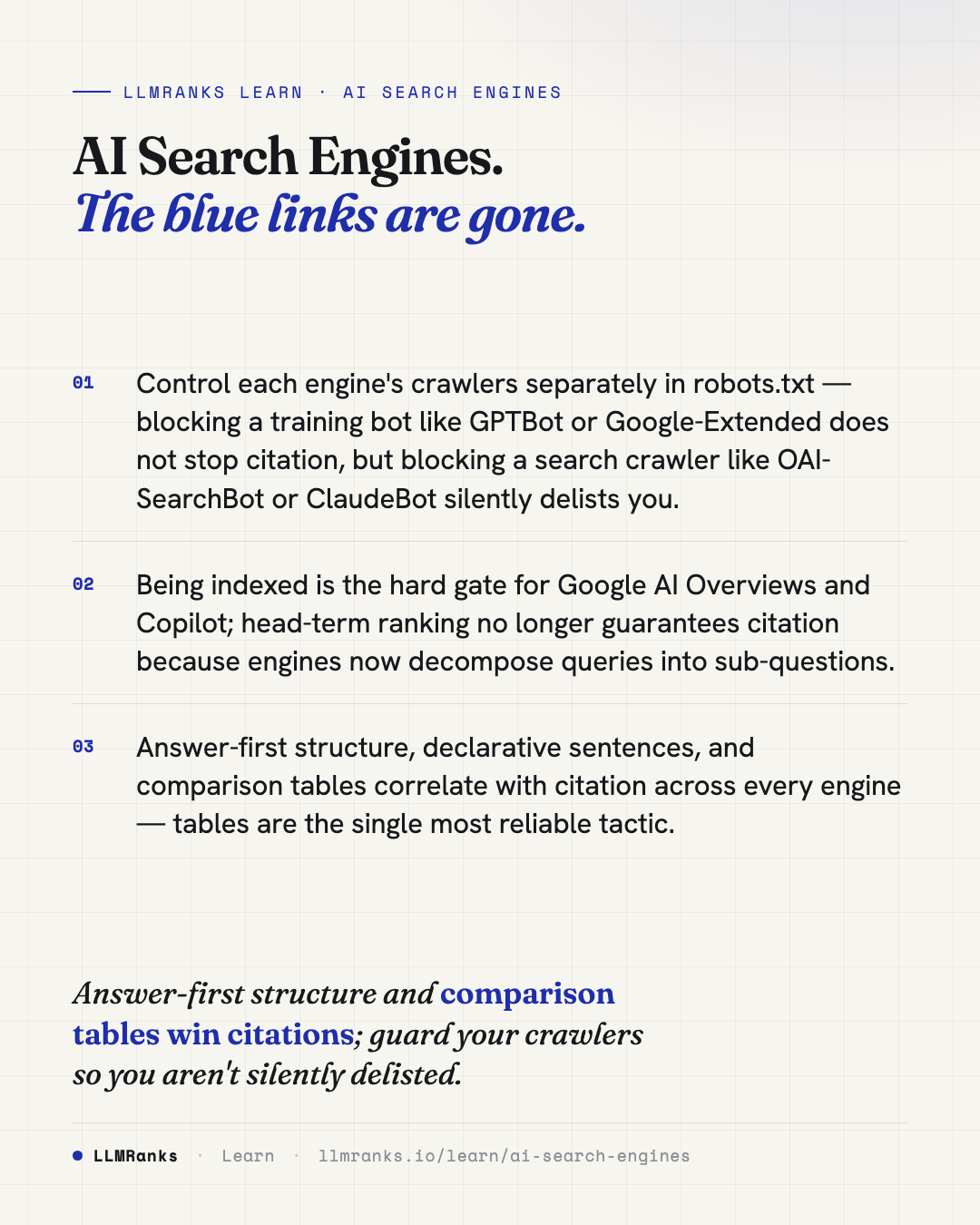
The trap: engineering teams block every AI bot thinking they are protecting training data, and silently delist themselves from search citations. Blocking GPTBot or Google-Extended does not stop citation. Blocking OAI-SearchBot, ClaudeBot, or PerplexityBot removes you entirely. A blanket User-agent: * disallow is catastrophic for AI visibility.
Note two live-fetch exceptions: ChatGPT-User is user-triggered, so OpenAI states robots.txt rules may not apply — a page can be pulled into an answer even when crawlers are blocked. And Cloudflare's "Block AI Scrapers and Crawlers" toggle now blocks ClaudeBot, so check WAF rules alongside robots.txt.
How the major engines select and cite sources
ChatGPT
ChatGPT runs a hybrid stack blending residual Bing signals, its own OAI-SearchBot crawl, and embedding-based passage retrieval — passages, not whole pages, are scored, so a clean 200-word section can be cited from an otherwise weak page. It favors clear H2/H3 hierarchy with question-shaped headings, definition-first paragraphs, tables (reported ~3x citation lift versus equivalent prose), and recent content. Citations appear as numbered chips, typically 3–8 sources with diversity weighting. See How ChatGPT Search Works.
Claude
Claude relies more heavily on live fetch at query time, with tight per-source timeouts observed around 2–3 seconds, so fast TTFB and CDN caching matter directly. It shows the strongest bias of any major engine toward primary sources — academic papers, official docs, primary news — and toward long-form analytical content. It handles freshness conservatively, citing publication dates inline and hedging or refusing when dates are missing or contradictory. Claude also quotes longer verbatim passages, so well-written declarative sentences get pulled in whole. See How Claude Web Search Works.
Perplexity
Perplexity is a search engine with an LLM answer layer, not the reverse. Its defining trait is forced source diversity: usually 5–10 sources per answer with strict per-domain caps, which rewards being the single best source on a niche topic over broad domain authority. Focus modes route to different indices (Academic, Social, Video, Finance), and it grounds entities in Wikidata. Being the original — with proprietary data, surveys, or benchmarks — is the only reliable defense against citation rotation. See How Perplexity Ranks Sources.
Google AI surfaces
Google now runs three distinct surfaces: AI Overviews above traditional SERPs, a conversational AI Mode, and the standalone Gemini app. Being in the regular Google index is the eligibility gate — Google officially documents that no extra files, schema, or markup are required. Both AI Overviews and AI Mode use query fan-out: a single query is decomposed into multiple sub-queries, each retrieving its own sources. See Gemini, AI Overviews & AI Mode.
The rank–citation link has sharply weakened. One early-2026 study of 863K keyword SERPs measured roughly 38% of AI Overview citations coming from positions 1–10 (down from about 76% in mid-2025), with about 31% from positions 11–100 and 31% from beyond the top 100 — passages that uniquely answer a fan-out sub-query. Fan-out often appears to run in two stages: an initial broad search reads which entities trusted sources currently rank, then a second wave verifies specific entities discovered live. The practical consequence is that an engine's shortlist mirrors what the trusted review sources rank right now, so you must be cited or ranked in those first-wave sources, not merely covered on your own page.
Critically, blocking Google-Extended does not remove you from AI Overviews or AI Mode if you are in the regular index. The only opt-out is nosnippet or max-snippet:0, which also kills your classic SERP snippet — there is no clean opt-out.
Microsoft Copilot
Copilot runs on the Bing index with a tight rank correlation — top Bing results dominate its citations. Being in the Bing index is the gate, and many sites with strong Google presence underperform because they neglect Bing index health. Bing remains more lexical than Google, weighting exact-match signals and social shares more heavily. See Microsoft Copilot & Bing Chat.
Microsoft's IndexNow protocol is the highest-leverage, most-ignored Copilot tactic: pushing URL change notifications on publish or update triggers near-instant recrawl, which for news is the difference between same-hour citation and multi-day lag.
What earns citations across every engine
Regardless of platform, a consistent set of patterns correlates with getting cited. These are the layer-wide principles worth building your Content Strategy & E-E-A-T and On-Page SEO around:
- Answer-first structure — lead with the direct answer in the first one or two sentences after a question-shaped heading. Every engine does passage extraction.
- Declarative, quotable sentences — clean claims survive both verbatim quoting and paraphrase.
- Tables for comparisons and specs — disproportionately cited everywhere; the most reliable single tactic.
- Original data — surveys, benchmarks, and proprietary datasets can't be substituted when you're the origin.
- Entity grounding —
OrganizationandPersonschema withsameAsto Wikidata, LinkedIn, and ORCID improves recognition; Perplexity and Google lean on it hardest. - Honest freshness signals — accurate
datePublishedanddateModifiedwith real content changes behind date bumps; inflated dates risk trust down-weighting on freshness-sensitive engines. - Fast, server-rendered, crawlable HTML — never depend on client-side hydration for your answer text.
The JSON-LD reality check
The 2024 habit of treating schema as a universal citation lever is now partially obsolete. Google still uses JSON-LD heavily because it gates rich results, which feed AI Overviews — worth full investment. Bing and Copilot use it for rich captions and answers — worth it. But ChatGPT, Claude, and Perplexity extract from visible HTML and largely ignore JSON-LD for citation; controlled testing found no measurable citation lift from adding Article or FAQPage schema on those surfaces.
The practical rule: implement schema for Google and Bing rich-result eligibility, but don't claim that JSON-LD drives ChatGPT, Claude, or Perplexity citations — it doesn't. On those platforms the lift comes from visible content structure. Learn more in Structured Data & Schema and, for the broader answer-optimization frame, AEO & GEO.
Two areas remain uncertain for 2026: Anthropic's exact crawler taxonomy and Microsoft's routing between OpenAI and in-house models in Copilot. Both companies have been less transparent than OpenAI and Google, so verify crawler names against live robots documentation and treat Copilot model-routing claims as directional.
What to do
- Audit your robots.txt, WAF rules, and Cloudflare AI-bot toggles against the crawler matrix above; fix any accidental block of OAI-SearchBot, ClaudeBot, PerplexityBot, or Perplexity-User.
- Measure TTFB under bot user-agents and confirm your primary answer content is server-rendered, not dependent on client-side hydration — this is critical for Claude and Perplexity.
- Verify Bing Webmaster Tools, submit sitemaps, and implement IndexNow so Copilot and Bing stay fresh; check for pages indexed in Google but missing from Bing.
- Restructure key pages answer-first: question-shaped headings, a direct answer in the first two sentences, and comparison tables wherever the source compares things.
- Build topical clusters where each page owns one narrow sub-intent, so you win fan-out sub-queries you'd never rank for on the head term. Strengthen this with Internal Linking.
- Add
OrganizationandPersonschema with completesameAslinks, and create or improve your Wikidata entry for entity grounding. - Keep
datePublishedanddateModifiedaccurate and only bump dates on substantive content changes. - Publish original data — surveys, benchmarks, proprietary datasets — as your durable defense against source-diversity rotation.
- For a per-engine execution plan, work through Cross-Engine AI Visibility and the individual engine guides, and see Off-Page Authority for building the trusted-source presence that first-wave retrieval depends on.
save this card
 Download card
1080×1350 · post it anywhere