Citation layer
AEO & GEO
Answer engine optimization (AEO) is the practice of structuring your content so AI answer engines — ChatGPT, Claude, Perplexity, Gemini/AI Mode, and Google…
Answer engine optimization (AEO) is the practice of structuring your content so AI answer engines — ChatGPT, Claude, Perplexity, Gemini/AI Mode, and Google AI Overviews — can retrieve, trust, and cite it. It rides on the same search indexes as classic SEO, so ranking eligibility still matters, but the winning moves diverge: answer-density per passage beats total length, unlinked brand mentions outweigh backlinks, and citation increasingly decouples from head-term rank. This guide orients you across the whole layer; each area below has a dedicated page for the deep dive.
How AI engines retrieve and cite content
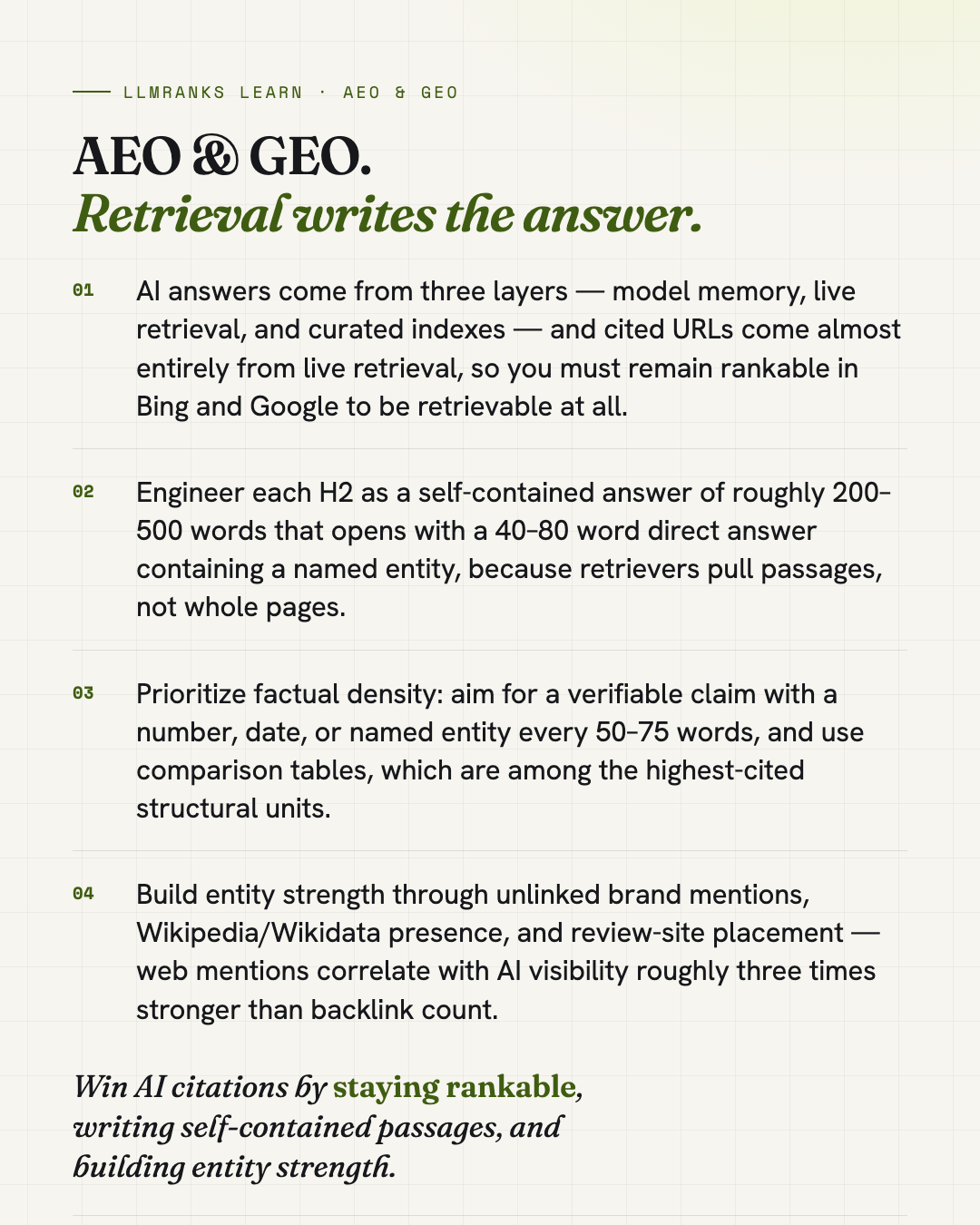
The five surfaces that matter all use hybrid retrieval pipelines, but the mix differs sharply. Three layers work together: parametric memory baked into model weights during pretraining; real-time retrieval, where a live search API call re-ranks results and injects passages into context; and curated vector stores the provider maintains. A query like "best Postgres connection pooler 2026" can trigger all three — memory drafts a candidate answer, retrieval validates it, and the cited URLs come almost entirely from the live retrieval layer.
Getting into each layer takes different work. Parametric memory rewards heavy presence in widely-trained sources like Wikipedia, Reddit, and GitHub that are at least six to eighteen months old. Live retrieval rewards ranking in the underlying index — Bing for ChatGPT, Google for AI Overviews and Gemini, a blend for Perplexity and Claude. Curated indexes reward crawler access (allow GPTBot, OAI-SearchBot, ClaudeBot, PerplexityBot, and Google-Extended), clean HTML, and passages that chunk cleanly. For the full breakdown of how selection works, see How LLMs Choose Citations.
Behavior varies by engine, and this is a moving target as of late 2025 / early 2026:
| Engine | Retrieval behavior | Sources cited |
|---|---|---|
| ChatGPT (Search) | Bing-powered plus own crawl; biased to Bing top 10 | 3–8 inline |
| Claude | Often Brave Search plus re-ranking; quotes longer passages | 2–5 |
| Perplexity | Own index plus live fetch; rewards passage relevance over domain authority | 5–15 |
| Gemini / AI Mode | Fused with Google's index and Knowledge Graph; query fan-out | Varies |
| Google AI Overviews | Subset of AI Mode on classic SERPs; same fan-out | Varies |
The biggest 2026 shift is query fan-out: AI Mode decomposes one question into multiple sub-queries, retrieves for each, and synthesizes. You now need to rank for sub-questions you didn't know existed. Citation has decoupled from rank accordingly — one 2026 analysis of roughly 4M cited URLs found only about 38% of AI Overview citations rank in the organic top 10, down from about 76% in mid-2025. What earns the citation is passage-level relevance to a fan-out sub-query, not head-term rank. More on per-engine differences in Citation Behavior by Engine and AI Search Engines.
What makes content citable
Engines preferentially cite content that minimizes the model's hallucination risk — content that is verifiable, attributable, and quotable in isolation. The strongest signals, roughly ordered by observed impact:
- Factual density: at least one specific, verifiable claim per 50–75 words. "Postgres 16 introduced logical replication for partitioned tables in September 2023" beats "Postgres has improved replication."
- Named entities, dates, and numbers: strings like version numbers, release dates, and concrete limits act as retrieval anchors because they appear identically in query reformulations.
- Definitive claims with hedging only when genuinely warranted.
- Original data and primary research: benchmarks, surveys, and internal datasets are up-weighted by re-rankers.
- Direct quotes from named authorities, because the attribution is preserved through synthesis.
- Answer-first sections: each H2 opens with a 40–60 word direct answer.
- Comparison content, which showed roughly +55% citation influence in 2026 absorption research — alongside statistics (~+62%) and, for technical topics, code blocks (~+77%).
Anti-patterns that kill citability include walls of text without headings, answers that depend on prior paragraphs ("as mentioned above"), marketing hedging, numbers without units or dates, and JavaScript-rendered content without server-side rendering — several LLM crawlers execute JS less aggressively than Googlebot. Gated content also disappears unless crawlers are explicitly allowed. See What Makes Content Citable and Getting Quoted Verbatim for the full patterns.
A note on schema: controlled 2026 evidence found no AI-citation lift from adding JSON-LD, and Google states there is no special schema needed for AI Overviews or AI Mode. AI extractors read visible HTML and largely ignore structured markup. Keep schema for rich-result eligibility and entity disambiguation via sameAs — just don't sell it as a citation lever. See Structured Data & Schema.
Structural patterns that get cited
Structure determines whether a passage survives retrieval and synthesis. The highest-leverage pattern is the front-loaded answer: a 40–80 word opening that directly answers the query and names an entity in the first 15 words. In testing across Perplexity and ChatGPT, this paragraph is quoted verbatim in 60–70% of citations when it meets those conditions.
Write sub-query-focused H2s that name the specific question — "How fast is PgBouncer compared to PgCat in 2026?" beats "Performance Considerations." The win comes from naming the sub-query, not from question punctuation; don't force every heading into a question, since Q&A formatting alone measured slightly negative (−5.7%) for absorption in 2026 research. That same finding means FAQ-ifying everything is now an anti-pattern, and Google ended FAQ rich results on May 7, 2026 — but genuine FAQ blocks (3–5 items answering real long-tail questions) still earn citations.
Other reliable units: a bulleted "Key Takeaways" block near the top (five self-contained bullets is the sweet spot, and Perplexity and Gemini often quote it as a block); definition lists for glossary content; and plain HTML comparison tables with a header row, consistent units, 3–7 rows, and a descriptive caption. Avoid div-based "tables" styled with CSS grid — extractors miss those. For procedures, use ordered lists of 3–9 verb-first steps. Deeper guidance lives in Content Patterns LLMs Favor.
Depth, length, and chunk engineering
The "longer = better" heuristic from 2018–2022 is dead for AEO. What matters is answer-density per chunk, not total word count. Observed sweet spots by content type:
| Content type | Optimal length |
|---|---|
| Definitional / "what is" | 600–1,200 words |
| Comparison ("X vs Y") | 1,500–2,500 words |
| How-to / tutorial | 1,200–2,000 words |
| Pillar / topical authority | 3,000–5,000 words |
| Listicle ("best N tools") | 2,000–3,500 words |
| Original research / benchmark | 2,500–4,500 words |
The real metric is retrievable chunks per page. A 4,000-word page with 10 well-structured H2s gives you 10 chances to be cited; a 4,000-word essay gives you one. Each H2 should be 200–500 words of self-contained content that starts with a topic sentence naming the primary entity, carries at least two specific facts, ends without a dangling reference, and answers one fan-out sub-query on its own.
Note that Google pushes back on chunking-as-requirement — its systems can understand multiple topics on a page — so chunk for retrieval quality, not because parsers demand it. No validated word-count bound exists; circulating "optimal 150–300 words" figures failed verification. Self-containment is the property that matters. See Content Length for AI Search.
Entities, brand mentions, and the Knowledge Graph
In 2026, unlinked brand mentions across the web outweigh backlinks for AI visibility — one 75,000-brand study measured web mentions at a Spearman correlation of 0.664 with AI Overview brand visibility, the strongest of 11 factors tested and roughly three times backlink count (0.218). This is the biggest divergence from classical SEO.
You build entity strength through several channels: a Wikipedia/Wikidata entry is the single highest-leverage signal, since it puts you in every major model's parametric memory; repeated co-occurrence with category terms teaches the model your positioning; structured citations on G2, Capterra, Crunchbase, and GitHub carry high signal; founder and employee profiles aid disambiguation; and consistent press naming counts even when nofollow. Podcast show notes are surprisingly strong because they place founder, company, and topic in close proximity.
Practical checks: confirm a Wikidata Q-number and Wikipedia notability (three independent secondary sources), add sameAs links to Wikipedia, Wikidata, Crunchbase, LinkedIn, and GitHub, deploy Organization schema with founder and founding date, and count Reddit and YouTube mentions. Review thresholds matter — roughly 30 reviews for category visibility, 100 for "best of" inclusion. Google's Knowledge Graph feeds Gemini and AI Overviews directly, with entities entering via Wikipedia→Wikidata, schema sameAs triangulation, and repeated co-citation. See Entities & the Knowledge Graph.
The sources that feed the models
A handful of platforms disproportionately shape what engines say. Wikipedia is trained on heavily (often up-weighted) and cited constantly for definitional queries. Reddit is now over-represented in Google AI Overviews and Gemini under Google's licensed data deal — for commercial queries like "best CRM for solo founders," a Reddit thread is almost always cited, so genuine participation in category subreddits is a real strategy. Note that the thread gets cited, not your individual comment, so aim to be present in the highest-upvoted threads rather than trying to control them.
YouTube transcripts are in training corpora, and Gemini cites video natively at high rates — upload accurate transcripts and keyword-rich chapters rather than relying on auto-captions that mangle technical terms. Review aggregators (G2, Capterra, TrustRadius) are cited constantly for "best X" and "X alternatives" queries; volume, recency, and correct category tagging all matter. For developer tools, a well-documented GitHub README with comparison tables and clear entity naming feeds both training and retrieval. See The Sources That Fuel LLMs.
How AEO relates to SEO
AEO and SEO share a foundation and diverge in tactics. They align on clean semantic HTML, fast Core Web Vitals, topical authority, primary research, Internal Linking, accurate recent content, and baseline indexability — do these once and both benefit, because retrieval rides on the same indexes: if Bing and Google can't rank you, most engines can't retrieve you. They diverge on length (answer-density beats bloat), click strategy (give the full answer up front rather than withholding it), authority signals (brand mentions over backlinks), schema value, target queries (fan-out sub-questions with no keyword-tool volume), and measurement (citation share, not just rank). The full breakdown is in SEO vs AEO: Where They Align and Where They Diverge.
The clean mental model: score every page on two axes. Rankability is the eligibility gate — Technical SEO, crawlability, Core Web Vitals, Off-Page Authority, and Content Strategy & E-E-A-T. Citability is chunk self-containment, answer-first structure, factual density, entity strength, and sub-query coverage. A page can be highly rankable and barely citable (the buried-answer essay) or highly citable and unrankable. Diagnose which axis is failing, because the fixes differ. For where this is heading, see SEO in 2026 and The Agentic Web.
What to do
- Confirm crawler access for the major AI bots and make sure key pages are server-side rendered, indexable, and not gated.
- Rewrite each priority page so it opens with a 40–80 word direct answer that names your primary entity in the first 15 words.
- Segment long pages into H2 sections of 200–500 words, each answering one specific sub-query and self-contained enough to be quoted alone.
- Enumerate the fan-out sub-questions behind each head term using People Also Ask and real Reddit phrasing, then build an H2 for each.
- Raise factual density — add a verifiable claim with a number, date, or named entity every 50–75 words, and add plain HTML comparison tables where you compare options.
- Build entity strength: secure a Wikidata Q-number, add
sameAsandOrganizationschema, and grow review volume and category placement on G2/Capterra. - Establish genuine presence in category subreddits and, for dev tools, a well-documented GitHub README.
- Track citation share by querying each engine on your target questions on a schedule and comparing where you appear against competitors.
save this card
 Download card
1080×1350 · post it anywhere