You ask AI one question.
It secretly runs a dozen.
When you ask ChatGPT, Gemini, or Google a question, it doesn't search what you typed — it quietly fans out into a whole list of background searches you never see. We captured the real ones. They decide whether your business gets mentioned at all.
One question becomes
a fan of searches.
AI search doesn't answer from a single lookup. It decomposes your question into multiple background searches, retrieves sources for each, and synthesizes one answer. Google calls it "query fan-out." The consequence: the thing that gets cited is a passage answering a sub-query — not a page ranking for your keyword.
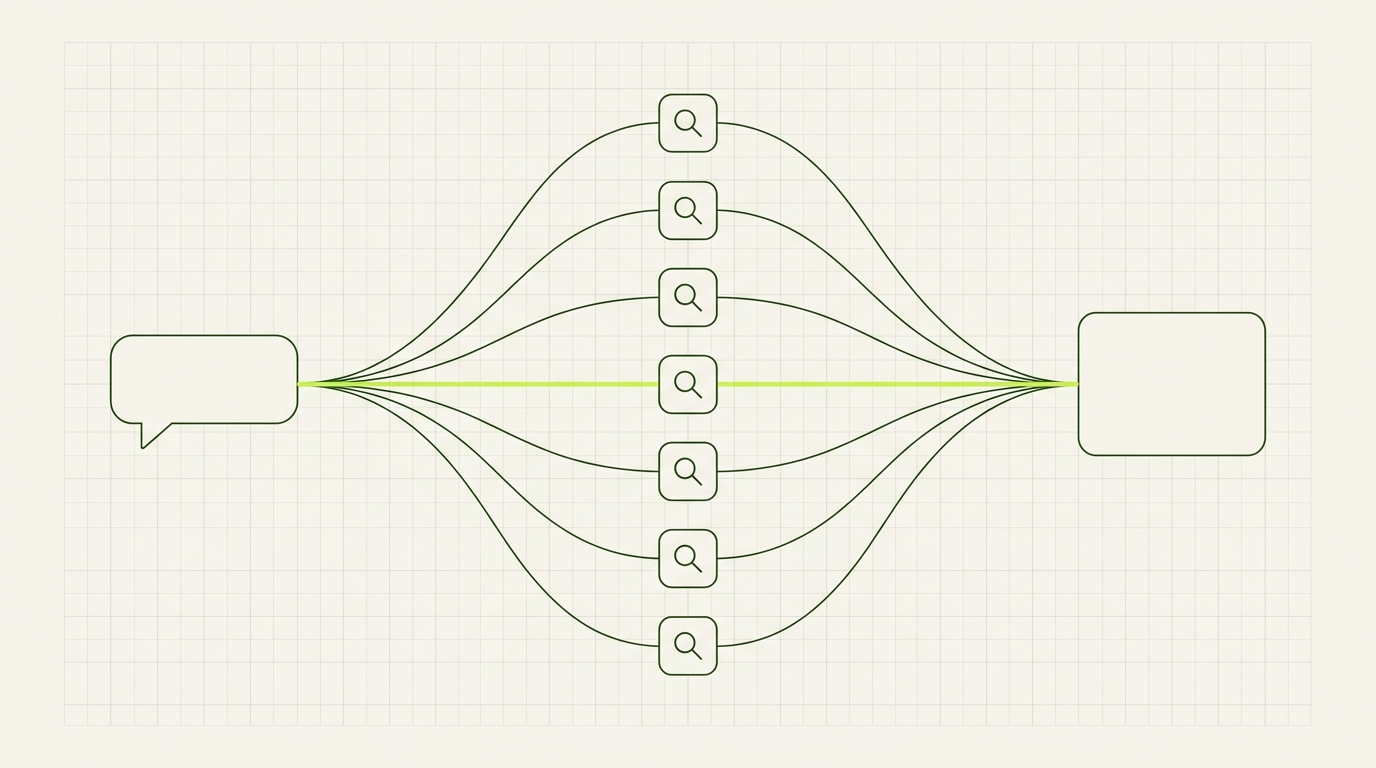
Google, in its own docs: AI Overviews & AI Mode use a "query fan-out technique — issuing multiple related searches across subtopics and data sources." Google's patent (US11663201B2) calls the underlying technique "query variants." "Fan-out" is the industry's name for it.
So here are the
searches it actually ran.
One simple buyer question. These are not our guesses — they're the real sub-queries each engine fired, captured straight from the engines.
The AI didn't know these
vacuums. It found them.
You named no brand. So where did the specific models come from? We ran the same question two ways — memory only, then with web search on — and watched what changed.
Same question — memory gives you 2024's answer; search gives you today's, found live.
There's no magic number —
it scales with the question.
Change the shape of the query and the fan-out changes with it. A comparison fans out wide; a narrow how-to collapses to almost nothing. Anyone quoting a fixed "5 to 30 searches" is guessing — here's what really happened.
| The question | ChatGPT | Gemini |
|---|---|---|
| best robot vacuum for pet hair buyer | 3 | 8 |
| Roomba vs Roborock comparison | 6 | 5 |
| how to choose … small apartment how-to | 1 | 3 |
A practitioner study (Seer, Nov 2025) measured ~10.7 fan-out searches on average for Gemini 3 — but Google itself publishes no number. Treat any count as "it depends on the question," never a fixed figure.
Google won't show its searches —
but the fingerprints do.
Run the same query against Google AI Mode and scan the entire response: zero sub-queries. Google keeps its fan-out server-side. But you can still read it — because the searches show up in what it cites and names.
Sub-queries exposed — same query, three engines
Google AI Mode & AI Overviews run on Gemini and use the same documented fan-out — Google just doesn't expose the searches. So the visible Gemini fan-out is your closest window into what Google is doing under the hood.
This is why ranking #1
no longer saves you.
Because AI cites the passage that answers a sub-query — not the page that ranks for the head term — being #1 stopped guaranteeing the citation. The link between rank and citation has come apart.
Rank-decoupling: Ahrefs, Mar 2026 (863K SERPs / 4M AI Overview URLs). Zero-volume share: Seer, Nov 2025. A keyword tool can't show you 95% of these searches — only the fan-out can.
Optimize for the searches —
not the keyword.
The fan-out is a to-do list. Cover the recurring themes as self-contained passages an engine can lift whole. For robot vacuums, the data says:
Don't chase the ephemeral one-offs (a single model that'll be replaced, a news event) — cover the durable sub-query themes. SEO gets you eligible; covering the fan-out gets you chosen.
Here's how we build
for the fan-out.
Most tools optimize for the keyword you typed. LLMRanks pulls the real fan-out for your topic and writes the article to answer every sub-query in it — at generation time, before you ever wait on rankings.
See the real fan-out for your topic
Stop optimizing for one question.
Optimize for the dozen AI asks.
You've seen the hidden searches. Now build content that answers them — and see the real fan-out for your own topics.
Build for the fan-out → llmranks.io