query fan-outAI ModeAEOChatGPTGeminiAI search
Google AI Mode Query Fan-Out: How It Works
Google's AI Mode fans out into hidden sub-queries before answering. See the real sub-queries captured from ChatGPT, Gemini, and AI Mode and how to rank.
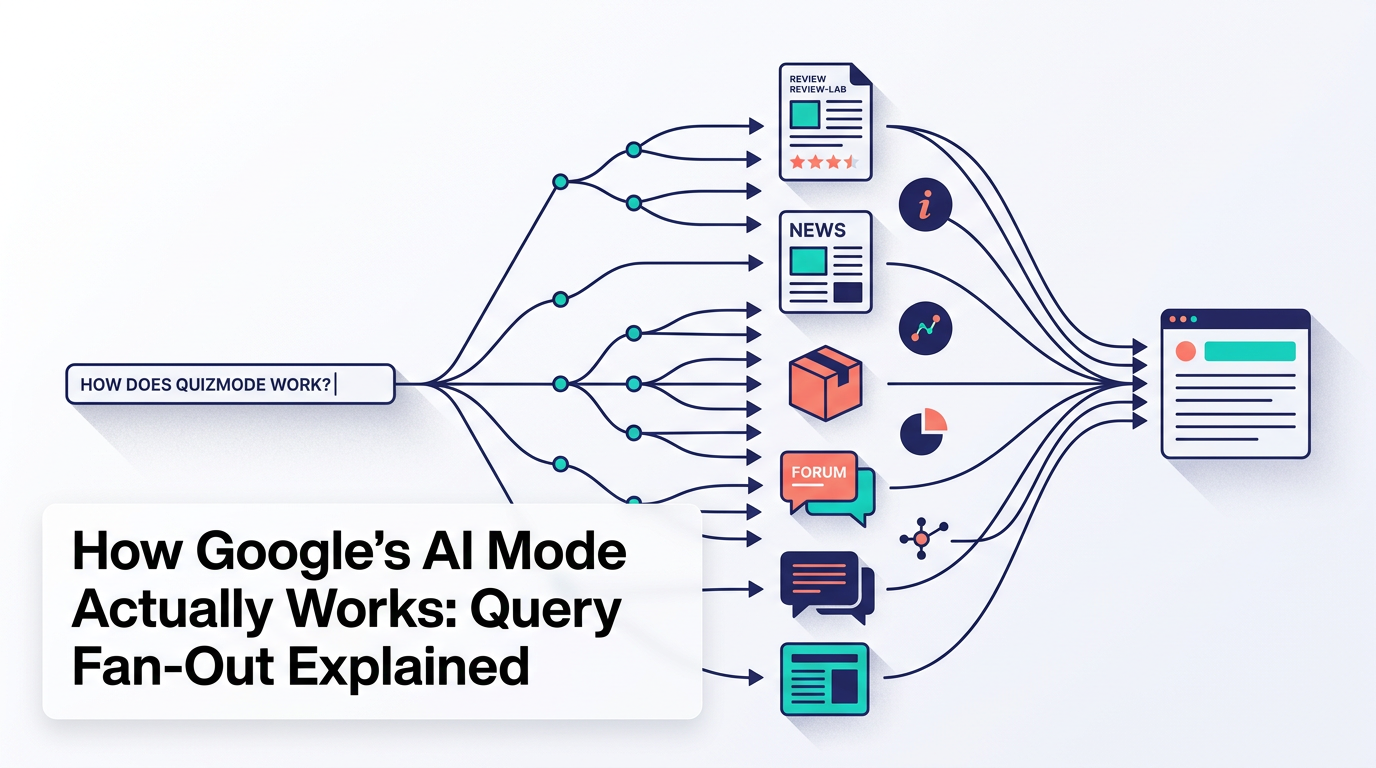
Query fan-out is the mechanism Google AI Mode uses to decompose a single question into multiple sub-queries, retrieve sources for each, then synthesize one answer. We typed "best robot vacuum for pet hair" and watched ChatGPT silently fire 3 searches and Gemini fire 8 — almost none matching the phrase we typed. The head term you target is no longer the query that wins the citation.
Key takeaways
- Query fan-out decomposes one question into multiple sub-queries that rarely match the typed phrase verbatim.
- Sub-query count scales with question complexity: ChatGPT fired 1-6, Gemini 3-8 across three test queries.
- Google AI Mode exposes zero sub-queries, but its diverse citations reveal the hidden fan-out.
- Only ~38% of AI Overview-cited pages rank in the organic top 10 (Ahrefs, early 2026).
- AI finds brands live via search, not training memory — get cited on Wirecutter and RTINGS-class sources.
What is query fan-out in Google AI Mode?
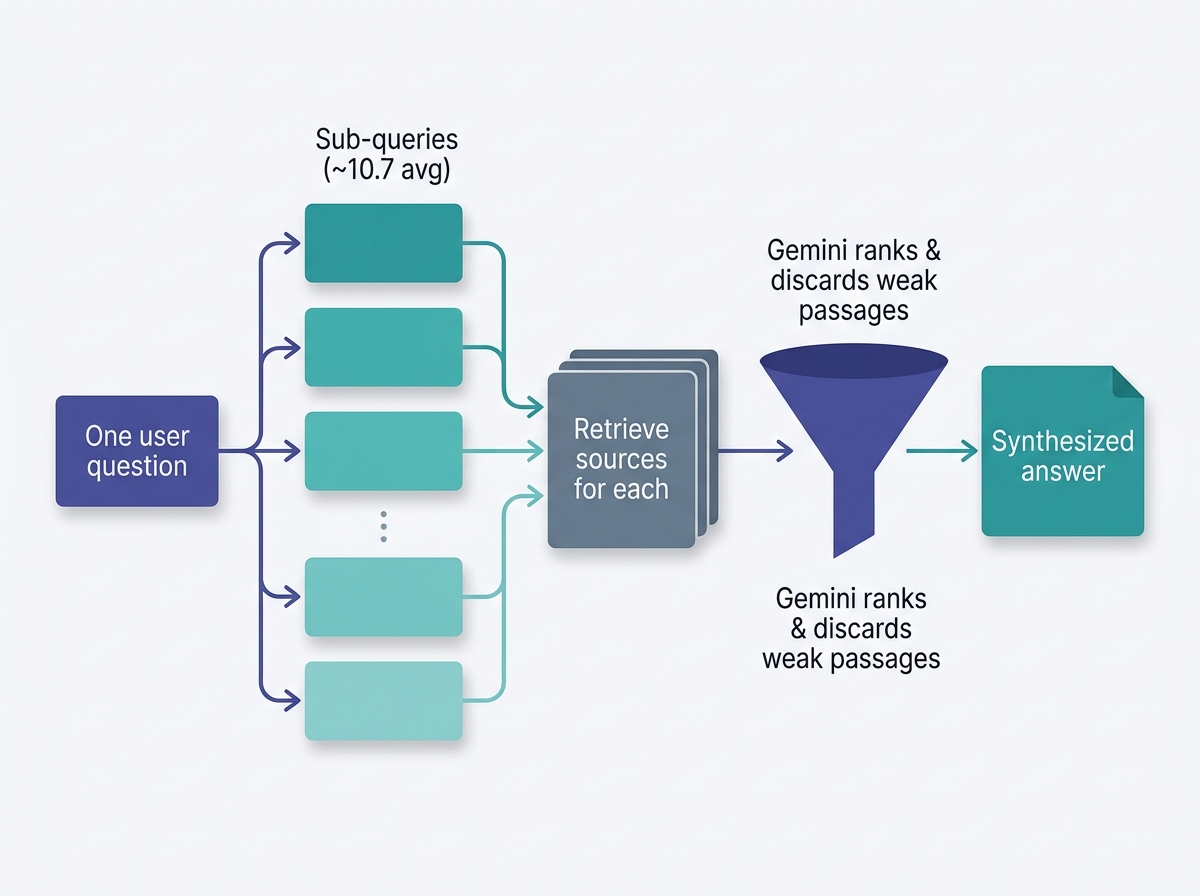
Query fan-out is the process where Google AI Mode breaks one user question into several distinct sub-queries, retrieves sources for each, and then synthesizes a single answer. You type one thing; the system searches for many. Google officially documented this fan-out mechanism for AI Overviews in 2026, describing how a complex question gets decomposed into related searches that run in parallel.
The reasoning layer behind this is Google's Gemini stack, which evolved from the earlier MUM model. After the sub-queries return their results, Gemini ranks the retrieved passages, discards the weak ones, and assembles the chunks that best answer the original intent. The answer you read is a synthesis of dozens of passages, not a single page summarized.
The count varies, but the only credibly measured figure for fan-out volume is roughly 10.7 average sub-queries for Gemini 3, recorded by Seer Interactive in November 2025. That is practitioner data, not a Google-published number — Google itself discloses no count. Treat 10.7 as a directional benchmark, not a fixed rule.
What makes fan-out matter for anyone publishing content: the sub-queries rarely match the phrase the user typed. AI Mode rewrites, expands, and specifies. A broad buyer question becomes a cluster of narrower searches — recency-tagged versions, brand-specific lookups, authority-site hunts. If your page only targets the head term, you are optimizing for a query the engine may never actually run. We set out to capture exactly which sub-queries fire, and the results reshape how optimization should work.
We captured the real sub-queries: 'best robot vacuum for pet hair'
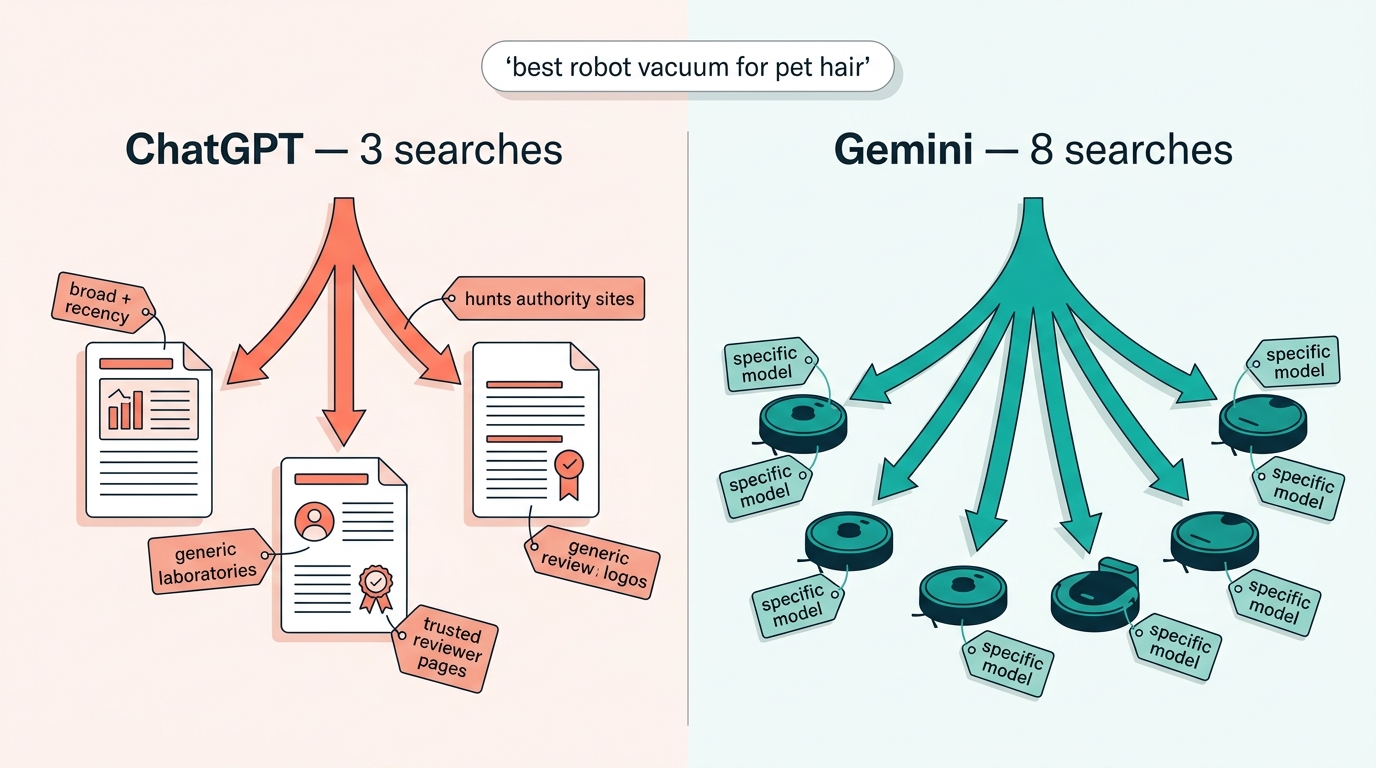
We typed one buyer question — "best robot vacuum for pet hair" — into ChatGPT and Gemini in June 2026 and recorded every search each engine actually fired. The results were stark: ChatGPT ran 3 searches and hunted authority review sites; Gemini ran 8 and searched specific current product models. Almost none of the fired sub-queries matched the phrase we typed verbatim.
ChatGPT's strategy was to find trusted reviewers first. It fired one broad recency-tagged query, then two that explicitly named authority sites — Wirecutter and RTINGS. It wanted to know what the experts already ranked before forming an opinion. Gemini took the opposite route: it searched named product models directly, vetting specific machines like the Ecovacs Deebot X8 Pro Omni and the Roborock S8 MaxV Ultra one at a time, with a single authority-site search mixed in.
| Engine | Real search query fired | Pattern |
|---|---|---|
| ChatGPT | best robot vacuum pet hair 2026 reviews | Broad + recency |
| ChatGPT | Wirecutter best robot vacuum pet hair 2026 | Hunts authority site |
| ChatGPT | RTINGS best robot vacuum pet hair robot 2026 | Hunts authority site |
| Gemini | "Ecovacs Deebot X8 Pro Omni" pet hair review | Specific model |
| Gemini | "Roborock S8 MaxV Ultra" pet hair review | Specific model |
| Gemini | "MOVA P50 Pro Ultra" pet hair | Specific model |
| Gemini | "Roborock Saros 20" pet hair | Specific model |
| Gemini | wirecutter best robot vacuum for pet hair | Authority site |
Notice what isn't there: the exact string "best robot vacuum for pet hair" on its own. Both engines transformed it. ChatGPT added "2026" and "reviews" and bolted on site names. Gemini abandoned the category phrase entirely in favor of specific model names it had already decided were worth vetting. This is the practical reality of fan-out — the query you optimize for is not the query that retrieves your page.
There is no fixed number of sub-queries — fan-out scales with the question
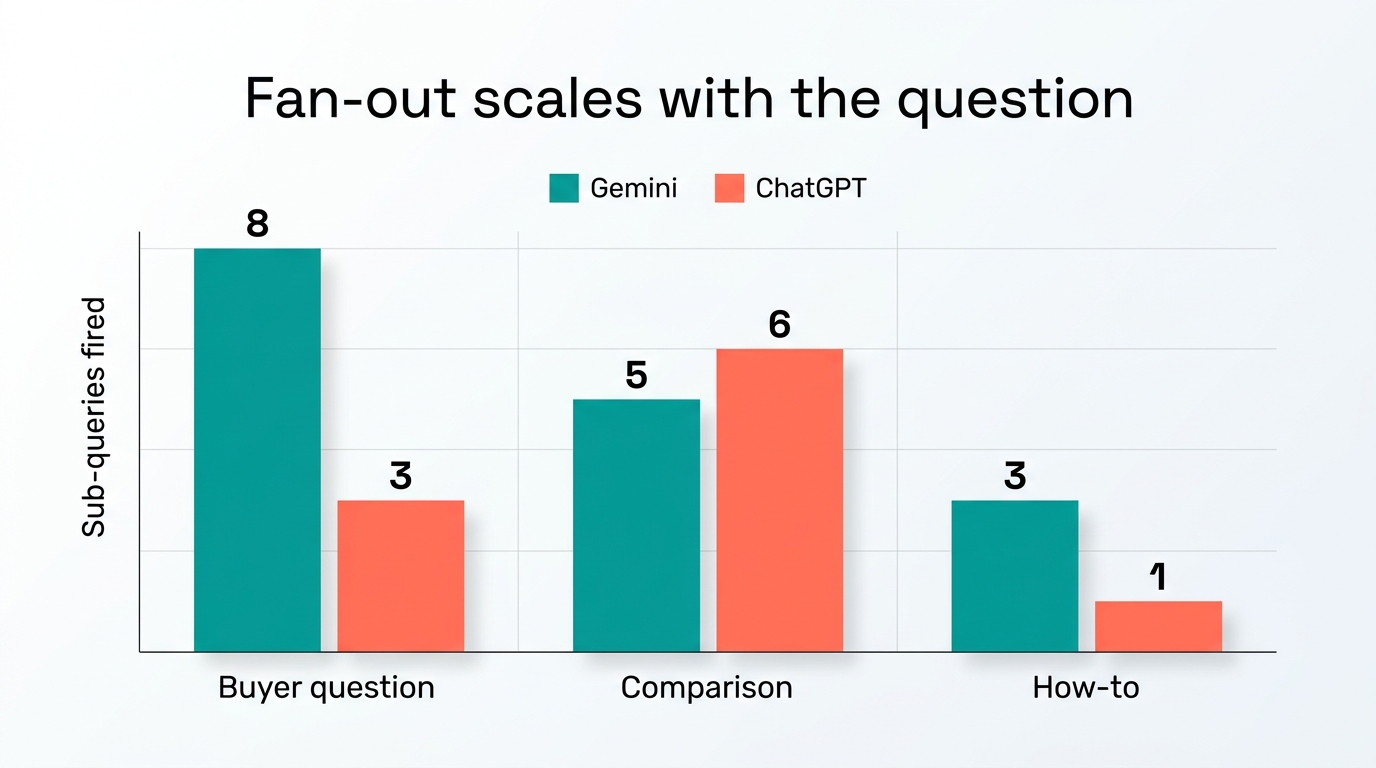
There is no fixed number of sub-queries; fan-out scales with the complexity of the question. People often assume AI Mode fires a set count — five, ten, a constant. Our data contradicts that. Across three robot-vacuum queries, ChatGPT fired between 1 and 6 searches and Gemini fired between 3 and 8.
The pattern tracks question type. A broad buyer question ("best robot vacuum for pet hair") triggered the most fan-out: Gemini fired 8 searches, ChatGPT 3. A comparison question ("Roomba vs Roborock") sat in the middle: Gemini 5, ChatGPT 6. A narrow how-to ("how to choose a robot vacuum for a small apartment") triggered the least: Gemini 3, ChatGPT just 1.
| Question | Type | Gemini searches | ChatGPT searches |
|---|---|---|---|
| best robot vacuum for pet hair | Buyer | 8 | 3 |
| Roomba vs Roborock | Comparison | 5 | 6 |
| how to choose a robot vacuum for a small apartment | How-to | 3 | 1 |
The takeaway is that you cannot plan around a fixed fan-out budget. A vague, high-stakes buyer question that needs many comparison points will spawn more sub-queries than a single-answer how-to. Google discloses no official count for AI Mode, and our small sample shows wide variance even between two engines on identical questions. The 10.7 average from Seer Interactive is a useful anchor, but the real number for any given query depends entirely on how much the engine thinks it needs to check before answering. Complex questions fan out wide; simple ones barely fan out at all.
Why Google AI Mode exposes zero sub-queries (and how to read them anyway)
Google AI Mode exposes zero sub-queries — we scanned its entire response for "best robot vacuum for pet hair" and found none, while ChatGPT exposed 3 and Gemini 8 for the identical question. Google does not show its work. You get the answer text and a list of cited source domains, and nothing about the searches that produced them.
But the fan-out fingerprint shows in what Google cites. For our query, the AI Mode answer led with the Ecovacs Deebot X8 Pro Omni — the exact model Gemini had searched by name — and cited RTINGS, the exact site ChatGPT had targeted. The response surfaced 10 cited domains including Forbes, RTINGS, PCMag, and VacuumWars. That diversity is the tell. A single retrieved page cannot produce citations spanning a dedicated review lab (RTINGS), a tech-news outlet (PCMag), and a niche enthusiast site (VacuumWars) unless multiple distinct searches ran behind the scenes.
This is consistent with the fact that Google AI Mode and AI Overviews both run on Gemini and use the same documented query-fan-out mechanism. They simply choose not to expose the searches. To read the hidden fan-out, work backwards from the citations: cluster the cited domains by type (authority lab, news outlet, brand page, forum), and each cluster roughly maps to a sub-query the system fired. A model named in the answer body but absent from the typed question is almost always evidence of a model-specific vetting search.
The practical method: run your target query in AI Mode, list every cited domain, and ask what search would surface that specific source. The set of those inferred searches is your fan-out map — and it tells you which sources you need to appear on to be retrieved.
AI finds brands live, not from memory: the two-stage retrieval pattern
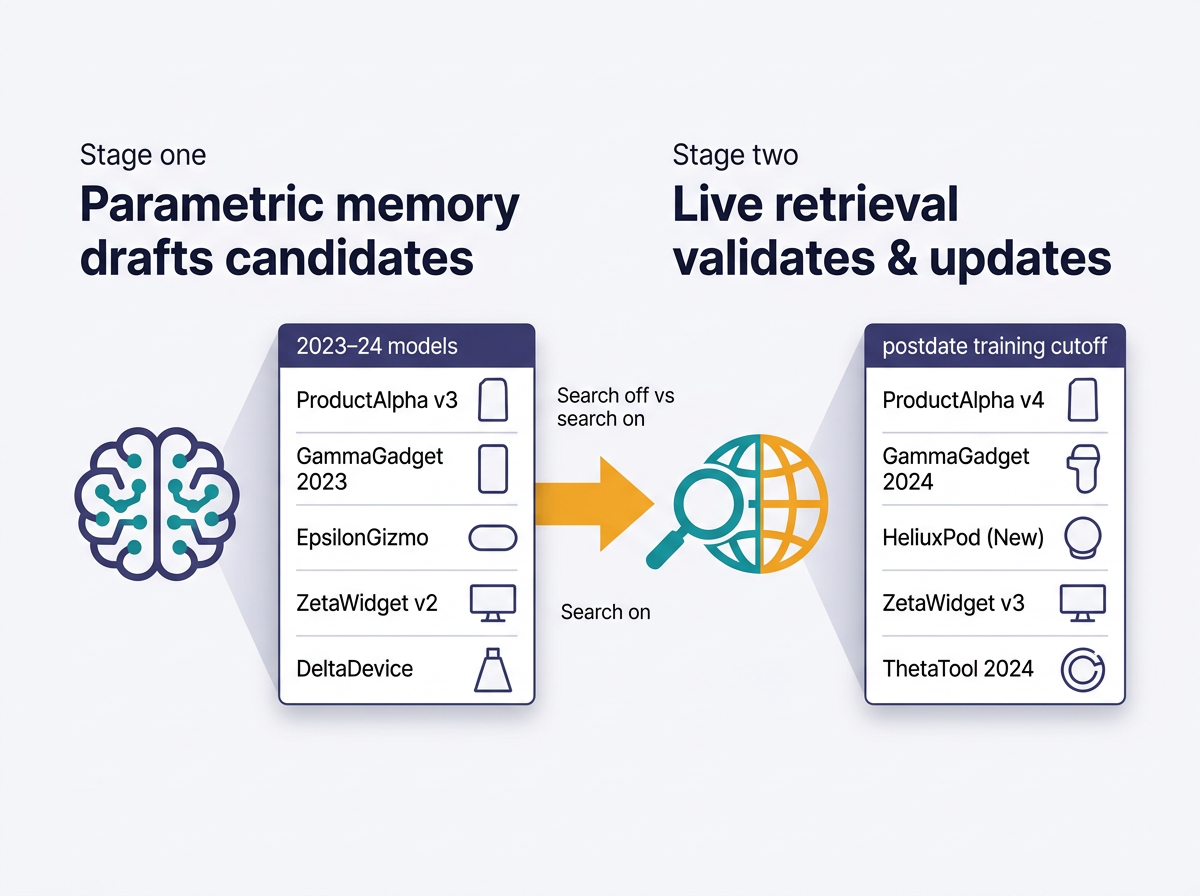
AI does not recommend brands from its training memory — it finds them live through search. We proved this by running the same buyer question twice: once with web search off, once with it on. With search off, the engine named older 2024 models from memory. With search on, it surfaced newer models that postdate its own training cutoff.
With web search off, the engine recommended the Roomba j9+, Roborock S8 Pro Ultra, Roomba j7+, Shark Matrix Plus, and Eufy X10 Pro Omni — all 2023-24 models, consistent with a self-reported training cutoff around January 2025. These are what the model "knows" from parametric memory: products baked into its weights during pretraining.
With web search on, the shortlist changed entirely. The engine searched and surfaced the Roborock Saros 20, MOVA P50 Pro Ultra, and Dreame L60 Ultra PE — all newer than its training. It could not have known these from memory because they did not exist when it was trained. It found them by searching trusted review sites first, reading which models those sites rank right now, then firing a second wave of searches to vet each specific model.
That is the two-stage retrieval pattern: parametric memory drafts a candidate answer, then real-time retrieval validates and updates it against the live web. The shortlist with search on mirrored what the trusted review sites rank today, not the model's memory. The AEO consequence is direct — to get recommended, you do not optimize the model's training data (you can't), you get into the first-wave sources the engine queries. If Wirecutter and RTINGS rank a product today, that product enters the answer today, regardless of training cutoff.
How AI Mode fan-out differs from classic Google ranking
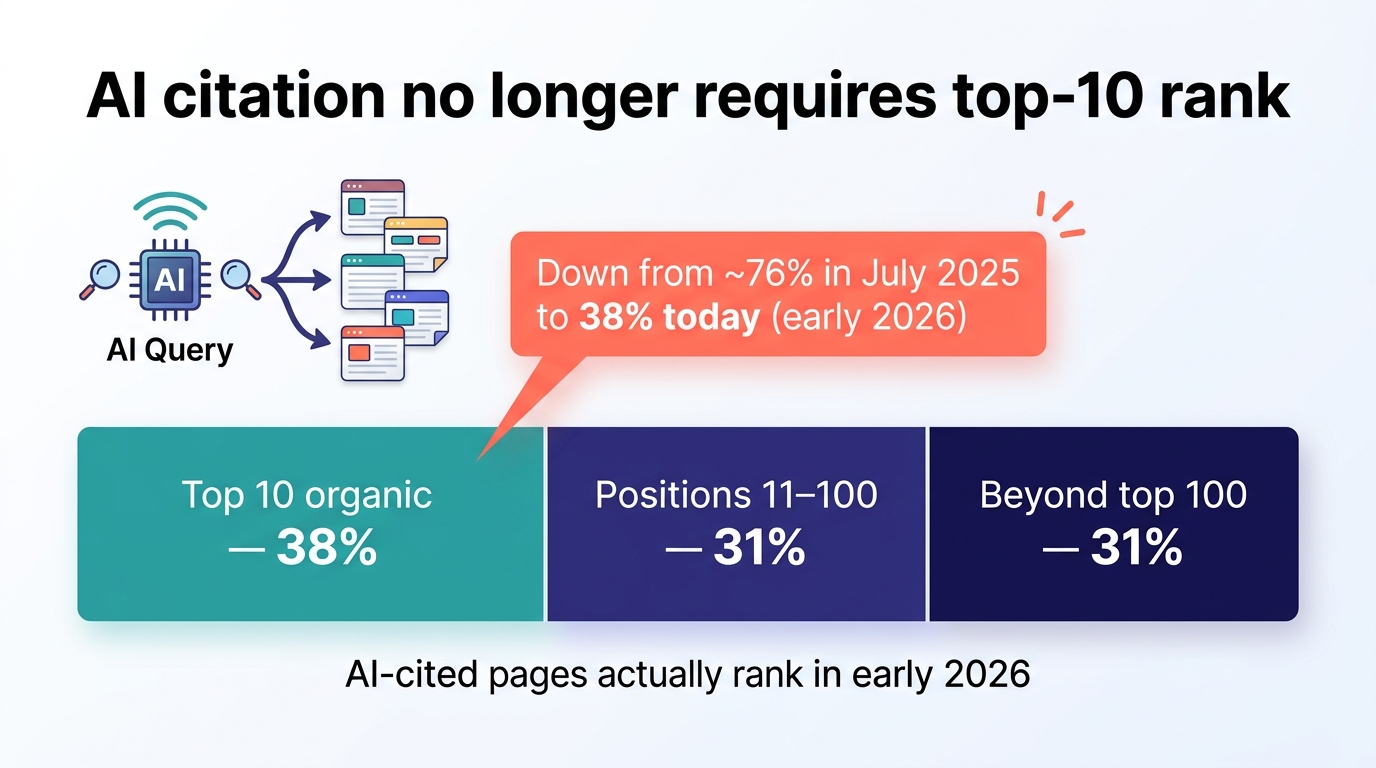
Query fan-out has decoupled AI citation from organic rank. In classic Google search, ranking in the top 10 was the prerequisite for visibility. In AI Mode, that link has broken. Only about 38% of AI Overview-cited pages now rank in the organic top 10 for the query, according to Ahrefs' analysis of 4 million cited URLs in early 2026 — down sharply from roughly 76% in July 2025.
The rest are scattered far down the index. Around 31% of cited pages rank between positions 11 and 100, and another 31% rank beyond the top 100 entirely. A page on position 80 for the head term can be cited in the AI answer while the page ranking #1 is ignored. That would have been impossible under classic ranking logic.
The reason is fan-out. AI Mode does not cite the best page for the typed query; it cites the best passage for one of the sub-queries it fired. A page might rank poorly for "best robot vacuum for pet hair" but contain a tightly written paragraph that perfectly answers the sub-query "Roborock Saros 20 pet hair review." That passage wins the citation. Citation rewards passage-level relevance to a sub-query, not head-term rank.
This flips optimization strategy. Chasing a top-10 ranking for a competitive head term is no longer the only path into the answer — and increasingly not the most efficient one. Covering the specific sub-questions the head term decomposes into, with self-contained passages that answer each on its own, now matters as much as classic rank. The engine assembles its answer from passages, so the unit of optimization is the passage, not the page.
How to optimize for query fan-out in 2026
Optimizing for query fan-out means building one self-contained, answer-first section for each sub-question your head term decomposes into. Since the engine retrieves passages, not pages, your job is to supply a clean passage for every likely sub-query — including the ones no keyword tool will show you.
Start by enumerating the sub-questions. Three sources reveal them: Google's "People Also Ask" boxes, AI Mode's own follow-up suggestions, and the actual phrasing people use on Reddit and in forums. For a buyer query, also list the specific named products that authority reviewers currently rank, because — as our data showed — those become model-specific vetting searches. Many of these sub-queries have zero traditional search volume. "Roborock Saros 20 pet hair review" may not register in any keyword tool, yet it was a real search Gemini fired. You are optimizing for questions with high decomposition frequency and no measurable volume.
Build one H2 per sub-query, each opening with a direct 40-60 word answer, followed by 200-500 words of self-contained supporting detail. Self-contained is the operative word: a passage that opens with "As mentioned above" cannot be retrieved in isolation. Name the entity, state the fact, cite the source, and finish the thought within the section. Passage retrieval scores each chunk on its own, so each chunk must stand alone.
The second lever is getting cited on the authority sites the engines re-query. Our capture showed both ChatGPT and Gemini explicitly searching Wirecutter and RTINGS by name. If your product or claim appears on the sources the engines trust, you enter the answer through their citations even when your own page never ranks. That means earning placement, mentions, and reviews on the first-wave sources for your category — not just optimizing your own domain. The fan-out makes those trusted sources the gatekeepers, and ranking on them is now part of the optimization job.
What query fan-out means for brand visibility and citation share
Query fan-out means brands surface in AI answers through co-citation on trusted sources, not by ranking for the head term. Our robot-vacuum data demonstrated this directly: Google AI Mode led its answer with a model that appeared because Gemini searched it by name after reading it on review sites. The brand won the slot by being ranked on RTINGS and PCMag, not by owning the head-term SERP.
This reframes what drives AI visibility. Ahrefs' study of roughly 75,000 brands found that unlinked web mentions correlate with AI Overview brand visibility at a Spearman coefficient of 0.664 — the strongest of 11 factors tested, and about three times the correlation of backlink count (0.218). Being named across the web, in context, alongside category terms, is what gets a brand into the parametric memory and the live retrieval set. Links matter less than mentions.
The measurement metric shifts accordingly. Rank tracking told you your position for a keyword. Citation share tells you how often you appear in AI answers across a panel of target questions, relative to competitors. That is the metric that proves AI visibility now, and it is invisible in classic analytics. To measure it, run your priority questions against each engine on a schedule and parse which domains and brands get cited.
One more force shapes the citation pool: Reddit. Google's licensing deal has made Reddit threads heavily over-represented in AI Overviews and Gemini answers for commercial queries. For nearly any "best X" question, a Reddit thread is in the citation mix. Genuine participation in your category's subreddits — honest, detailed answers that name your product among real alternatives — is now part of earning citation share, not an afterthought.
The data behind this study
Every figure here comes from original research we ran in June 2026 — capturing the real sub-queries ChatGPT and Gemini fired, scanning Google AI Mode's response, and testing memory-versus-search retrieval. The full method and dataset are public so you can verify and cite them:
- Research report: what AI actually searches — method, the verbatim captures, and findings
- Raw dataset (JSON) — the captured sub-queries and counts
AI fan-out drifts over time, so re-running the same prompts later will differ.
FAQ
What is query fan-out in AI search?
Query fan-out is when an AI engine breaks a single question into multiple distinct sub-queries, retrieves sources for each, then synthesizes one answer. Google officially documented this for AI Overviews in 2026. The sub-queries rarely match the phrase the user typed — the engine rewrites, expands, and specifies before searching.
How many sub-queries does Google AI Mode generate?
There is no fixed number — fan-out scales with question complexity. Google discloses no official count. The only credibly measured figure is roughly 10.7 average sub-queries for Gemini 3 (Seer Interactive, November 2025). In our June 2026 tests, Gemini fired 3-8 searches and ChatGPT fired 1-6, depending on question type.
Can you see the sub-queries Google AI Mode runs?
No. Google AI Mode exposes zero sub-queries — we scanned a full response and found none, while ChatGPT showed 3 and Gemini 8 for the same query. You can infer the fan-out from the citations: a diverse set of cited domains (review labs, news outlets, brand pages) reveals the distinct searches that ran behind the scenes.
Does ChatGPT use query fan-out like Google AI Mode?
Yes, but with a different style. In our June 2026 test, ChatGPT fired 3 searches for one buyer question and hunted authority review sites like Wirecutter and RTINGS by name. Gemini fired 8 and searched specific product models directly. Both decompose the typed question into sub-queries; their retrieval strategies differ.
Why does AI recommend different products with web search on versus off?
Because AI finds brands live, not from memory. With search off, the engine named older 2023-24 models baked into its training. With search on, it surfaced newer models that postdate its training cutoff — found by searching trusted review sites and reading what they rank today. Parametric memory drafts; live retrieval updates.
Do you need to rank in the top 10 to be cited by Google AI Mode?
No. Only about 38% of AI Overview-cited pages rank in the organic top 10, down from roughly 76% in July 2025 (Ahrefs, 4 million URLs). Around 31% rank 11-100 and 31% rank beyond position 100. Citation rewards passage-level relevance to a fan-out sub-query, not head-term rank.
How do I optimize my content for query fan-out?
Enumerate the sub-questions your head term decomposes into using People Also Ask, AI Mode follow-ups, and Reddit phrasing. Build one answer-first H2 per sub-query, each a self-contained 200-500 word passage. Many target sub-queries have zero keyword-tool volume. Also earn citations on the authority sites engines re-query, like Wirecutter and RTINGS.
Is query fan-out the same as AI Overviews?
Query fan-out is the mechanism; AI Overviews is a surface that uses it. Google AI Mode and AI Overviews both run on Gemini and use the same documented query-fan-out process. AI Overviews appears on classic search results pages, while AI Mode is the dedicated conversational interface. Both decompose queries and hide the sub-searches.