Answer Engine Optimization Tools vs Old-School
Compare AEO tools vs old-school SEO trackers: 12 platforms tested for AI citation coverage, pricing from free to $2,500/mo, and what actually moves AI visibility.
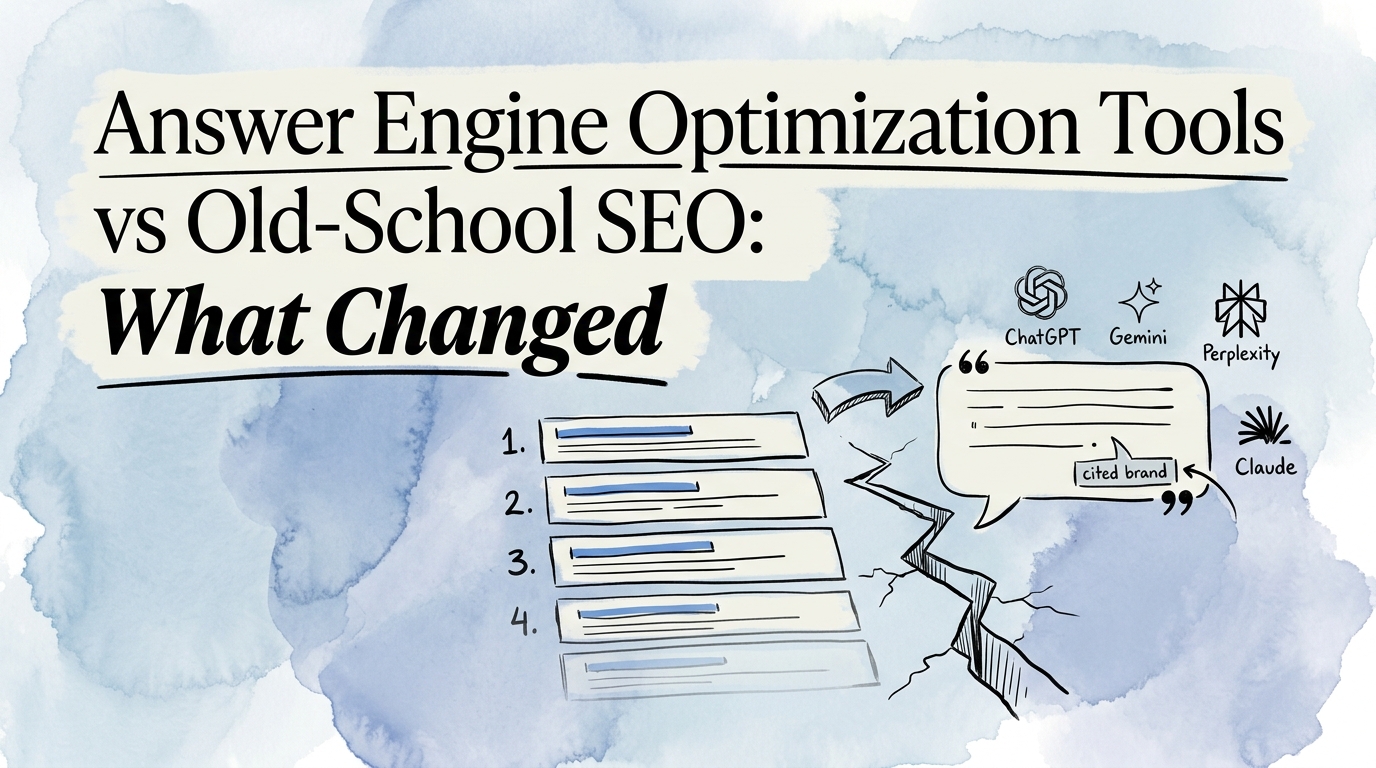
Answer engine optimization tools exist because classic rank-trackers go blind the moment a query gets answered inside ChatGPT, Perplexity, or Google AI Overviews. Where an SEO tool reports your position in a list of blue links, AEO tools measure whether ChatGPT, Gemini, Claude, and Perplexity actually cite your brand in their answers. Here's the uncomfortable part: across nine vendor-authored 2026 guides, every single one crowns a different #1 — almost always its own product.
Key takeaways
- AEO tools measure AI citation share across engines; SEO tools only measure keyword rank in a SERP.
- Tools split into monitoring-only dashboards (Otterly, Peec AI) and execution platforms (AirOps, Scrunch, LLMRanks).
- Pricing spans free to $2,500+/mo, with no consensus #1 across nine vendor guides in 2026.
- Only ~38% of AI Overview citations come from pages ranking in Google's organic top 10.
- Most multi-engine tools track ChatGPT, Gemini, and Perplexity; vendor 'best' rankings are self-serving.
What are answer engine optimization tools, and how do they differ from SEO tools?
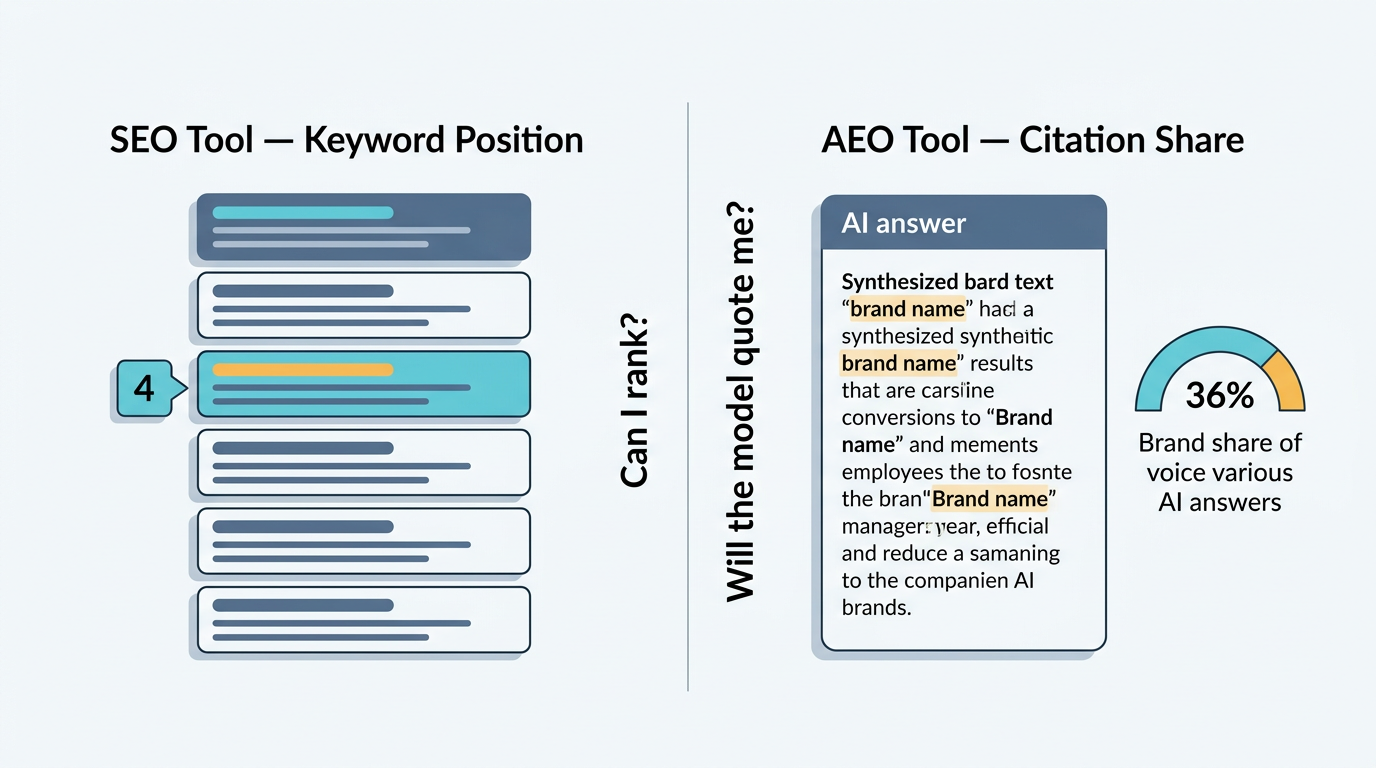
Answer engine optimization tools measure how often AI engines cite, mention, or recommend your brand in their generated answers — a metric classic SEO tools never tracked. Where a rank-tracker like Semrush or Ahrefs tells you that your page sits at position 4 for a keyword, an AEO tool tells you whether ChatGPT names you when a user asks "best CRM for solo founders." Those are different questions, and in 2026 they no longer share the same answer.
Classic SEO tools measure keyword position in a SERP. AEO tools measure citation share — the percentage of AI answers across a query set where your brand appears. Most multi-engine platforms watch the same core surfaces: ChatGPT, Google Gemini, Google AI Overviews, Perplexity, and Claude, with some adding Microsoft Copilot and Grok. LLMRanks, for example, tracks all six major engines plus Google in one dashboard.
The shift matters because the click is disappearing. Google AI Overviews now appear on a majority of informational queries and cut publisher click-through rates by an estimated 30–60% on affected terms. When the answer renders inside the chat window, the user never visits your page — so your rank is irrelevant and your citation is everything.
That reframes the whole job. SEO asked "can I rank?" AEO asks "will the model quote me?" A page can sit at position 1 and never get cited, while a 600-word answer block on page 3 gets pulled into every AI Overview. If you want the full breakdown of how these platforms differ, LLMRanks published a guide to choosing the best LLM optimization tools that maps the category. The tooling exists because the old scoreboard stopped reflecting reality.
Why classic SEO tracking goes blind in AI search
Classic SEO tracking goes blind in AI search because citation has decoupled from rank — the page a model quotes is frequently not the page Google ranks first. According to an Ahrefs analysis of roughly 4 million cited URLs in early 2026, only about 38% of AI Overview citations come from pages ranking in the organic top 10, down from roughly 76% in July 2025. The other \~62% come from pages ranking 11–100 or beyond. Your rank-tracker simply cannot see that.
The mechanism is query fan-out. Google AI Mode and AI Overviews decompose a single question into 5 to 30 sub-queries, retrieve passages for each, then synthesize one answer. Google documented this fan-out behavior in 2026. What earns the citation is passage-level relevance to one of those sub-queries — not your ranking for the head term. You can be invisible for the main keyword and still get quoted because one H2 section nailed a sub-question you didn't know existed.
Brand mentions outweigh links here too. Ahrefs' study of 75,000 brands measured unlinked web mentions at a Spearman correlation of 0.664 with AI Overview brand visibility — the strongest of 11 factors tested — versus 0.218 for backlink count, roughly three times weaker. A classic SEO tool counts backlinks. It does not count the Reddit thread, the Perplexity citation, or the unlinked TechCrunch mention that's actually driving your AI visibility.
So the gap is structural, not cosmetic. Rank tracking measures the wrong surface (the SERP), the wrong unit (the page, not the passage), and the wrong signal (links, not mentions). AEO tools were built to watch what rank-trackers can't.
Monitoring-only vs execution platforms: the two categories of AEO tools
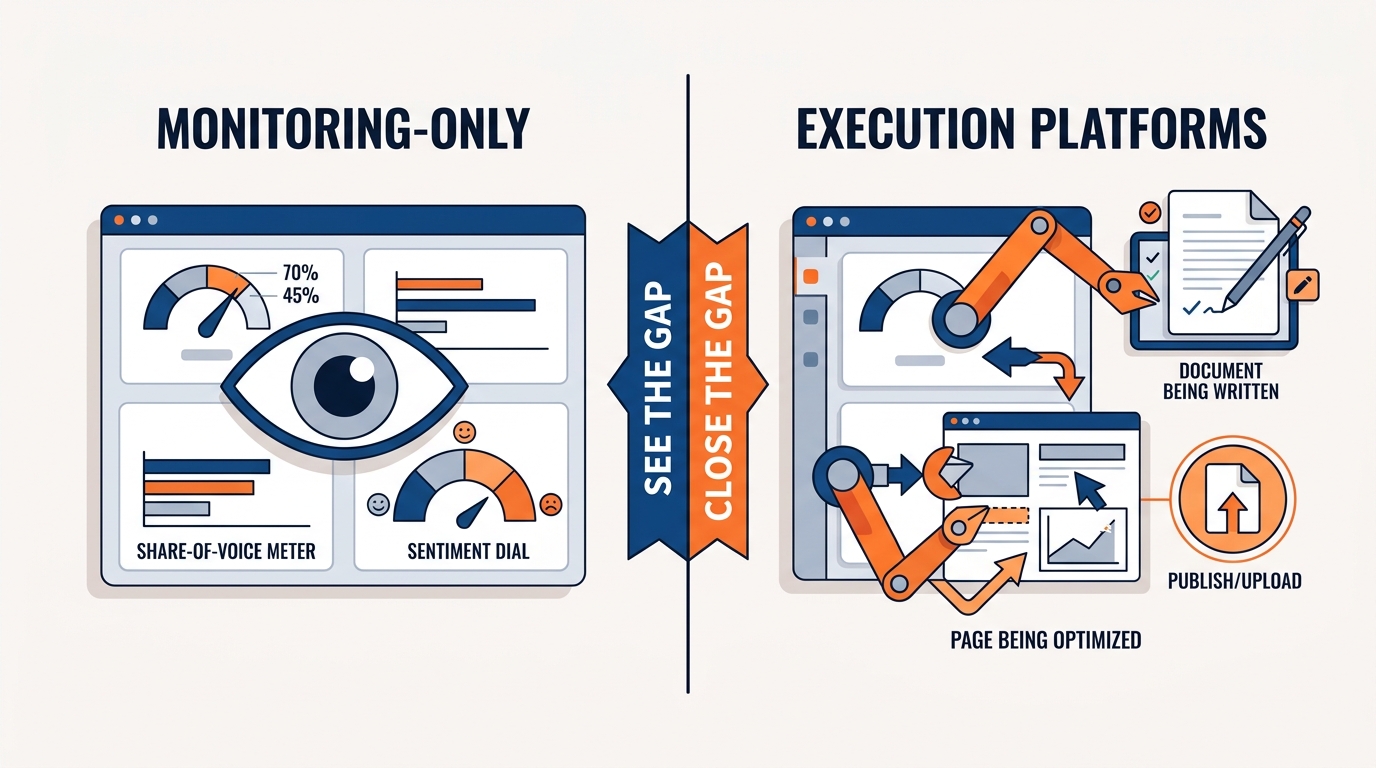
AEO tools split into two categories: monitoring-only dashboards that report your AI visibility, and execution platforms that also act on it by generating content or running off-site outreach. Knowing which category a tool belongs to is the single most useful filter when you shop, and most vendor guides blur the line on purpose.
Monitoring-only tools track brand mentions, citations, share of voice, and sentiment across AI engines — then stop. Otterly.AI tracks brand mentions and average position across ChatGPT, Perplexity, AI Overviews, Gemini, and Copilot. Peec AI measures visibility, position, and sentiment with custom prompts and tagging, aimed squarely at marketing teams and agencies. Profound runs over 6 million prompts daily across 10+ engines and surfaces deep answer-engine insights. All three tell you where you stand; none of them write the fix.
Execution-capable platforms add the doing. AirOps positions itself as connecting AI-search insight to content creation and refresh at scale. Scrunch AI runs an Agent Experience Platform that detects AI crawlers at the edge and serves them optimized content, then audits and optimizes pages. Adobe LLM Optimizer, launched October 2025, brings AEO reporting and remediation into Adobe Experience Cloud for enterprise teams. "Execution" means the tool generates articles, optimizes existing pages, or runs source-mapping playbooks — not just charts.
LLMRanks sits in both camps. It monitors citations across six engines plus Google, audits site readiness with 25+ technical checks, and generates brand-voiced, AEO-structured articles with one-click publishing to WordPress. That combination — see the gap, then close it in one platform — is what "execution" should actually mean for an SMB without a separate content agency on retainer.
The practical rule: if you already have a content team and just need a scoreboard, a monitoring dashboard suffices. If you're a lean team that needs to both measure and ship, an execution platform earns its higher price by removing a second tool and a second workflow.
How much do AEO tools cost in 2026?
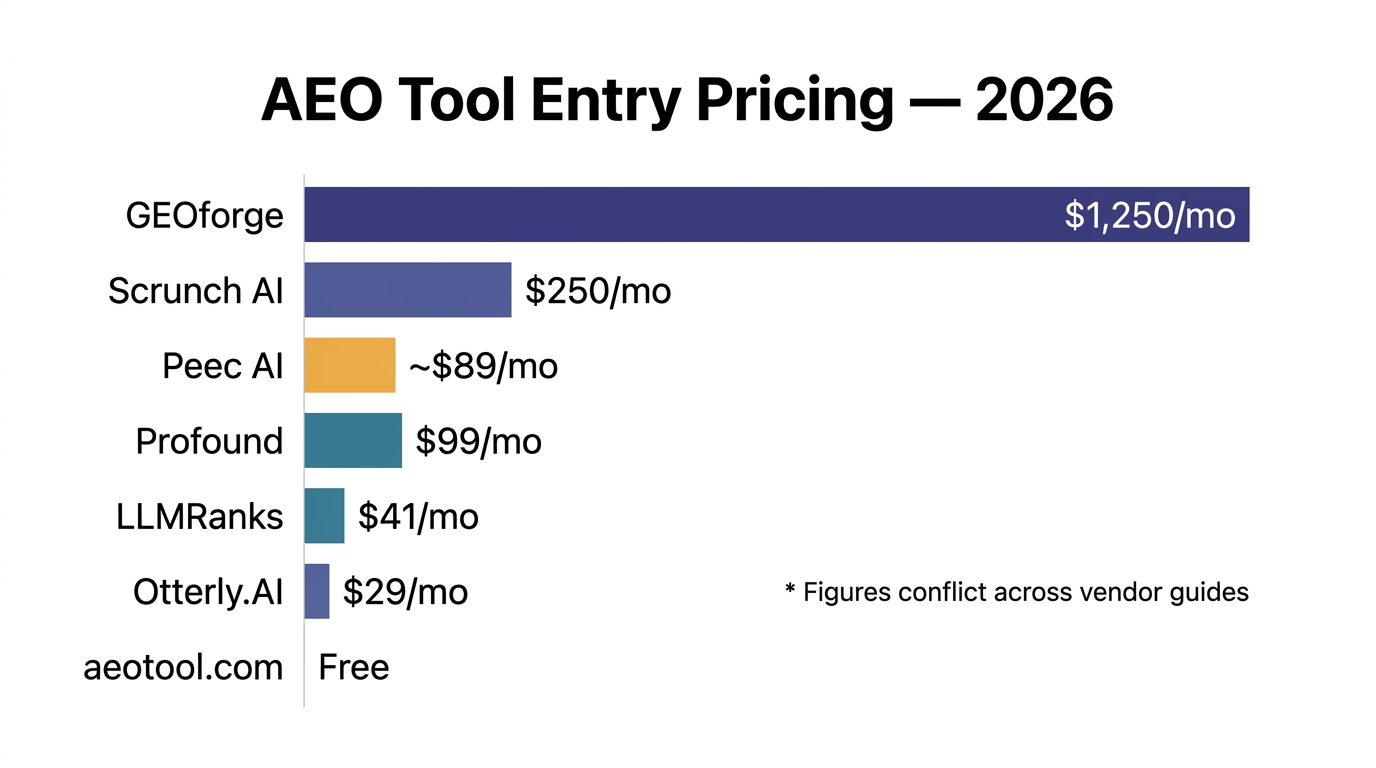
AEO tools in 2026 range from free to over $2,500/month, with monitoring entry tools clustering at $29–$99/mo and "complete" enterprise platforms running $250 to $1,250+/mo. There is no pricing consensus, and the same tool is often quoted at different numbers across guides.
At the entry end, Otterly.AI starts at a Lite tier around $29/mo per the AirOps comparison, while Profound's Starter plan sits at $99/mo. Free options exist too — aeotool.com offers a free FAQ schema generator and content analysis, and Ahrefs Brand Radar is bundled free for existing Ahrefs users (though its AI tracking is limited mainly to Google AI Overviews, per Profound's own tool guide).
The enterprise end gets steep and opaque. The Scrunch-authored guide lists GEOforge from $1,250/mo for one brand, plus $900/mo per additional brand and $2,500/mo for managed services. BrightEdge, Adobe LLM Optimizer, Bluefish, and Conductor don't publish pricing at all, which makes apples-to-apples comparison impossible.
Pricing also conflicts within the same market. Profound's Growth plan is listed at $499/mo by AirOps but $399/mo by both Scrunch and SE Ranking. Peec AI shows up as a $95–$495/mo range in one guide, $105.25/mo Starter in another, and €89/mo in a third. One AIclicks article even quotes its own product at $79/mo in a summary table and $39/mo in the body text.
LLMRanks publishes self-serve credit pricing with tiers from $41/mo billed yearly and no demo wall — you can see the price and start without booking a sales call. Three engines (ChatGPT, Gemini, AI Overviews) are included on every paid plan, with Claude, Perplexity, and Grok available as credit add-ons.
| Representative 2026 AEO tool pricing (as reported by vendor guides; figures conflict across sources) | ||
| Tool | Entry price | Category |
|---|---|---|
| aeotool.com | Free | Schema/analysis |
| Otterly.AI | ~$29/mo | Monitoring |
| LLMRanks | $41/mo (billed yearly) | Monitoring + execution |
| Profound | $99/mo Starter | Monitoring |
| Peec AI | ~$89–105/mo | Monitoring |
| Scrunch AI | $250/mo Core | Execution |
| GEOforge | $1,250/mo | Enterprise/managed |
Best answer engine optimization tools compared (feature matrix)
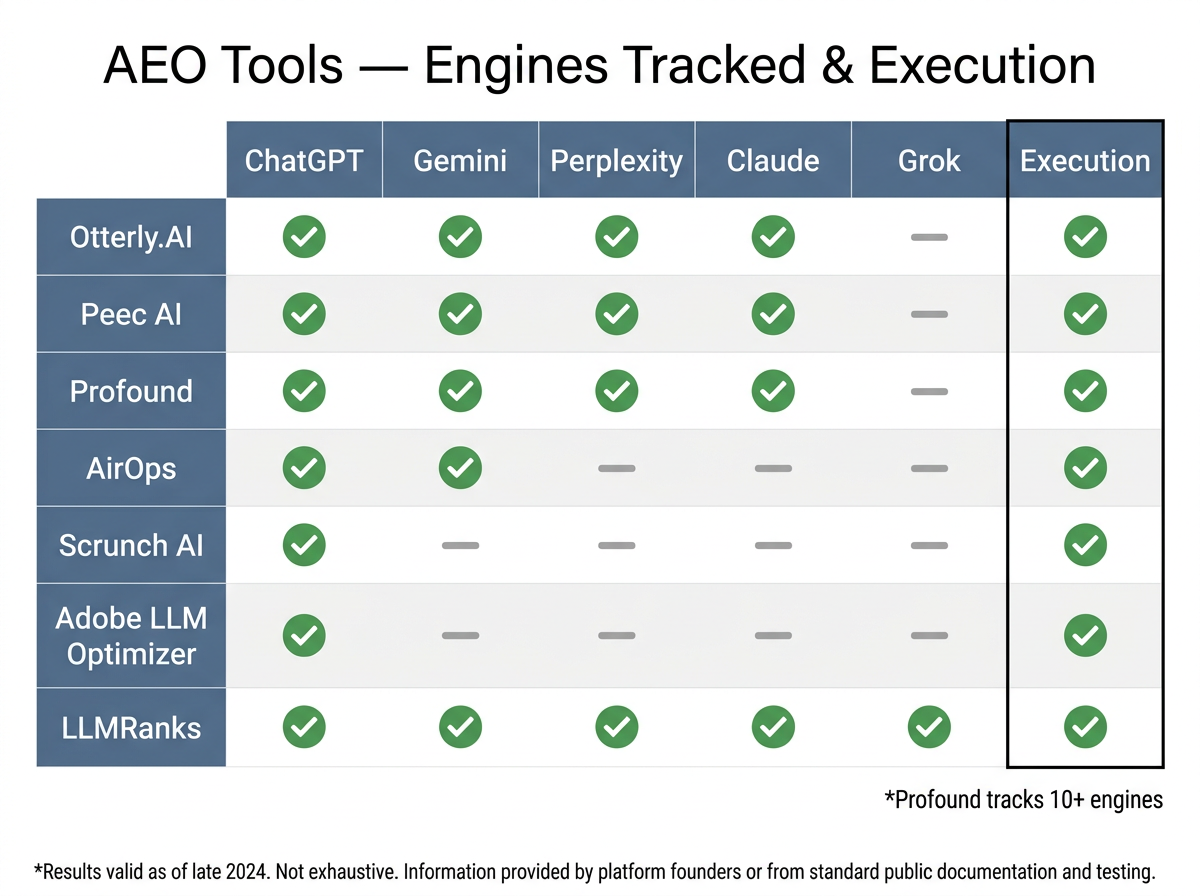
The best rated answer engine optimization tools differ less on which engines they track — most cover ChatGPT, Gemini, and Perplexity — and more on whether they execute or just observe. The comparison table below maps the leading platforms by category, starting price, engines tracked, and execution capability, using figures as reported by 2026 vendor guides.
A few patterns stand out. Multi-engine coverage is nearly universal at the top of the market: ChatGPT, Google Gemini, and Perplexity appear in almost every tool, while Claude, Grok, Microsoft Copilot, and DeepSeek vary. Profound tracks the widest spread at 10+ engines. Execution capability is the real divider — Otterly, Peec AI, and Profound are monitoring dashboards, while AirOps, Scrunch, Adobe LLM Optimizer, and LLMRanks act on findings.
| Leading AEO tools by category, price, engines tracked, and execution capability (2026) | ||||
| Tool | Category | Starting price | Engines tracked | Execution? |
|---|---|---|---|---|
| Otterly.AI | Monitoring | ~$29/mo | ChatGPT, Perplexity, AI Overviews, AI Mode, Gemini, Copilot | No |
| Peec AI | Monitoring | ~$89/mo | ChatGPT, Gemini, Perplexity + more | No |
| Profound | Monitoring | $99/mo | 10+ engines | Limited |
| AirOps | Execution | Free Solo / Pro tier | ChatGPT, Gemini, Perplexity, AI Overviews, AI Mode | Yes (content) |
| Scrunch AI | Execution | $250/mo | Multi-LLM | Yes (AXP, content) |
| Adobe LLM Optimizer | Enterprise execution | Not public | Multi-engine | Yes |
| LLMRanks | Monitoring + execution | $41/mo (yearly) | ChatGPT, Gemini, AI Overviews, Claude, Perplexity, Grok + Google | Yes (articles + outreach) |
Review scores deserve a skeptical read. The Scrunch guide cites Profound at 4.5/5 on G2 (959 reviews) but 3.1/5 on a third-party platform; Peec AI at 4.9/5 on G2 but 3.25/5 independently; Semrush AI Toolkit at 4.5/5 versus 2.6/5. Vendor-platform ratings run systematically higher than independent ones, so treat any single "best rated" claim as a starting point, not a verdict. If you want a head-to-head, LLMRanks publishes honest Peec AI alternatives and AthenaHQ alternatives breakdowns rather than a generic listicle.
Why every vendor guide names a different #1 AEO tool
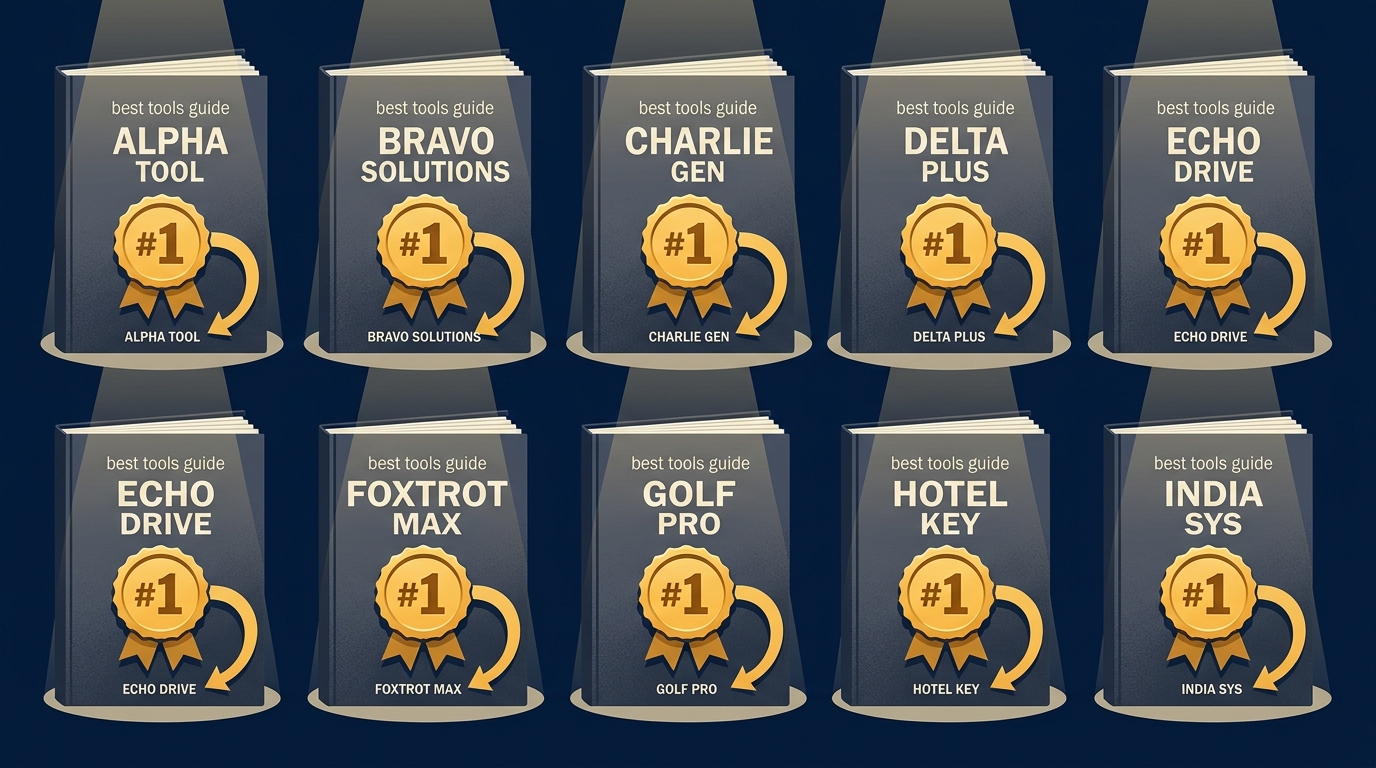
Every comprehensive "best AEO tools" guide names a different #1 because nearly all of them are written by a vendor that sells one of the tools — and that vendor ranks its own product first. This is the single most important thing to understand before you trust any ranking, including the ones near the top of Google.
The pattern is almost comically consistent across nine vendor-authored guides. The AirOps guide crowns AirOps as "the only tool connecting AI insight to content execution." The Profound guide names Profound "the leading platform." The Scrunch guide claims only Scrunch and Adobe meet all five of its criteria. AIOSEO's guide favors its own WordPress plugin; HubSpot's page recommends HubSpot's AEO add-on; Meltwater's listicle tops out at Meltwater GenAI Lens. Three of those make mutually exclusive "only tool that..." claims about the exact same capability.
Here's how to read one critically. First, check the byline domain — if the guide lives on a tool vendor's blog, the #1 pick is a marketing decision, not a benchmark. Second, watch for how competitors are framed: self-interested guides describe rivals as "monitoring-only" or "limited" while glossing over their own gaps. Third, distrust pricing and ratings sourced from a single guide; we've documented Profound's Growth plan quoted at both $399 and $499, and G2 scores that sit two full points above independent reviews.
LLMRanks is itself a vendor — so apply the same skepticism here. The difference worth naming: LLMRanks publishes public pricing, doesn't sell agency retainers behind the dashboard, and wrote up how it made its own site AI-citable rather than hiding methodology. Verify any ranking against an independent source like the G2 AEO category before you buy.
What features actually matter in geo optimization tools
The geo optimization tools worth paying for share four capabilities: broad multi-engine tracking, real citation attribution, off-site source mapping, and content generation that publishes. Everything else is dashboard decoration. ("GEO" — generative engine optimization — and AEO are the same practice under two labels; ignore vendors who insist they're different.)
Multi-engine coverage comes first. Tracking only Google AI Overviews — Ahrefs' main limitation per Profound's guide — leaves you blind to ChatGPT, Perplexity, and Claude, which together drive a large share of AI answers. A serious tool watches at least six engines plus Google. LLMRanks covers ChatGPT, Gemini, AI Overviews, Claude, Perplexity, and Grok on every paid plan.
Citation attribution beats scraped brand mentions. Some tools count any web mention of your name; the useful ones tell you which prompt, on which engine, in which country, produced a citation — and where a competitor took your spot instead. Per-prompt, per-engine tracking is what turns a vanity chart into an action list.
Off-site source mapping matters because AI engines lean heavily on third-party sources. Google's $60M/year Reddit licensing deal means Reddit threads now dominate AI Overviews for commercial queries, and Gemini cites YouTube natively at high rates. A tool that maps which Reddit threads, YouTube videos, and listicles a model actually reads gives you a real off-site playbook instead of guesswork.
Content generation closes the loop. Monitoring tells you you're absent; generation fixes it. The strongest execution tools draft AEO-structured articles — definitive H2 answers, FAQ blocks, clean schema — in your brand voice with one-click publishing to WordPress, Shopify, or Ghost. That removes the second tool and the second workflow most teams otherwise stitch together by hand.
How to choose an AEO tool for SMBs, founders, and agencies
The right AEO tool depends on your role: solo founders need self-serve monitoring, in-house teams need monitoring plus content execution, and agencies need multi-brand tracking without a hidden retainer conflict. Match the tool to the workflow, not to whichever guide ranked it #1.
For a solo founder, choose a tool with transparent self-serve pricing and no demo wall, because your time is the scarce resource and you can't afford a week of sales calls to learn a price. Entry monitoring tools at $29–$99/mo (Otterly.AI, Profound Starter) or LLMRanks at $41/mo billed yearly let you start the same day. You want to know which prompts mention you and which don't — that's enough to prioritize.
For an in-house marketing team, choose a platform that both monitors and generates content, because the gap between "we're not cited" and "we fixed it" is where most teams stall. Execution platforms like AirOps, Scrunch AI, or LLMRanks remove the handoff to a separate writing tool. Look for one-click publishing and a site-readiness audit so engineering isn't a bottleneck.
For a multi-brand agency, choose multi-brand tracking with per-client tags and — critically — a vendor that doesn't sell agency retainers behind its own dashboard. Several platforms upsell managed services that compete with your offering; GEOforge, for instance, charges $2,500/mo for managed services. LLMRanks is built for agencies and SMBs with no agency upsell, so you resell visibility without training a competitor.
One more filter cuts across all three: prefer free-trial or credit-based access over a demo-wall. If you can't see pricing or test the product without a sales rep, you can't compare it honestly — and that opacity is itself a signal.
What AEO tools still can't measure in 2026
No AEO tool in 2026 can fully measure AI citation attribution — the discipline is still immature, and every honest vendor treats its numbers as directional, not exact. Three blind spots are worth naming before you over-trust any dashboard.
Citation attribution itself is incomplete. AI engines don't publish citation logs, so tools reconstruct visibility by running prompt panels and parsing answers. That's a sample, not a census. Run the same prompt twice and a model may cite different sources, which means week-to-week movement includes real change plus noise. Treat trend lines as signal and single data points as estimates.
Parametric-memory queries are invisible to retrieval tracking. When ChatGPT answers "what is a CRM" from its training weights without searching the live web, no monitoring tool sees a retrieval event because there isn't one. Your brand's presence in that answer was baked in months earlier through Common Crawl, Wikipedia, and Reddit. Tools that track live retrieval can't measure the parametric layer, and that layer drives a large share of generic answers.
Referral data is partial. Traffic from chatgpt.com or perplexity.ai shows up as a referrer in analytics, but the citations you earned without a click — the "X says..." attribution a user reads and never acts on — are unmeasured by classic analytics entirely. Since zero-click is now the dominant pattern, most of your AEO value never appears in GA4.
The workaround the better tools use is prompt-panel monitoring: run a fixed set of target queries against each engine on a schedule, parse whether and where you're cited, and compute citation share versus competitors over time. It's the best available method, but it's an approximation. Any vendor claiming pinpoint citation accuracy is overselling — including, if you read between the lines, most of the guides that ranked themselves first.
FAQ
What are answer engine optimization tools?
Answer engine optimization tools track how often AI engines like ChatGPT, Gemini, Perplexity, Claude, and Google AI Overviews cite or mention your brand in their generated answers. Unlike SEO rank-trackers, they measure citation share across AI surfaces rather than keyword position in a SERP, and the better ones also audit your site and generate content to improve those citations.
What is the best answer engine optimization tool in 2026?
There's no agreed-upon #1. Across nine 2026 vendor-authored guides, each crowns its own product — AirOps, Profound, Scrunch, and others all rank themselves first. The best tool depends on your needs: monitoring dashboards like Otterly suit observers, while execution platforms like LLMRanks suit teams that need to both measure and fix AI visibility. Verify any ranking against independent sources before buying.
How much do AEO tools cost?
AEO tools range from free to over $2,500/month in 2026. Entry monitoring tools cost $29–$99/mo (Otterly.AI, Profound Starter), mid-market platforms run $189–$499/mo, and enterprise tools like GEOforge start at $1,250/mo plus $2,500/mo for managed services. Several enterprise tools (BrightEdge, Adobe LLM Optimizer) don't publish pricing. LLMRanks offers public self-serve tiers from $41/mo billed yearly.
What is the difference between AEO tools and SEO tools?
SEO tools measure your keyword position in a search results page. AEO tools measure whether AI engines actually cite your brand in their answers — citation share, not rank. The distinction matters because only about 38% of AI Overview citations come from pages ranking in Google's top 10, so a high rank no longer predicts whether a model will quote you.
Which AI engines do AEO tools track?
Most multi-engine AEO tools track ChatGPT, Google Gemini, and Perplexity as core surfaces, with many adding Google AI Overviews, AI Mode, Claude, Microsoft Copilot, and Grok. Coverage varies widely — Ahrefs Brand Radar tracks mainly Google AI Overviews, while Profound monitors 10+ engines. LLMRanks covers six major engines (ChatGPT, Gemini, AI Overviews, Claude, Perplexity, Grok) plus Google.
Are there free answer engine optimization tools?
Yes. aeotool.com offers a free FAQ schema generator and content analysis, AEO Checker provides a free visibility report, and Ahrefs Brand Radar is bundled free for existing Ahrefs users — though its AI tracking is limited mainly to Google AI Overviews. Free tools handle basic checks; live multi-engine citation tracking and content execution generally require a paid plan.
Do AEO tools work for small businesses and solo founders?
Yes. Solo founders and SMBs are well served by tools with transparent self-serve pricing and no demo wall, since they can start the same day without a sales call. Entry monitoring tools at $29–$99/mo work for observation, while platforms like LLMRanks ($41/mo billed yearly) add site audits and content generation so a lean team can both measure and fix AI visibility.
What is the difference between AEO and GEO optimization tools?
AEO (answer engine optimization) and GEO (generative engine optimization) describe the same practice — improving how AI engines cite your brand — under two different labels. Most geo optimization tools and AEO tools are identical in function: tracking citations, mentions, and sentiment across ChatGPT, Gemini, and Perplexity. Vendors who insist the two are fundamentally different are usually marketing a distinction that doesn't exist.