SEO vs AEOanswer engine optimizationAEOAI search optimizationGEO
SEO vs AEO: Same SEO, Opposite AI Results
SEO vs AEO, with original data: 6 tools with near-identical SEO authority, yet AI cited one 100x more than another. 342 answers on what now gets you named.
SEO vs AEO comes down to one question: can you rank, or will the AI name you? They are no longer the same thing — and we have the data to prove it. We asked ChatGPT, Gemini, and Google's AI Overviews the same buyer questions hundreds of times and logged exactly who they recommended. The result is stark: six tools with near-identical SEO authority produced AI visibility that ranged from 217 citations to 2. The tool with the weakest SEO of the group won. The one with the strongest got named least.
This guide is the full study — 342 AI answers, 781 cited sources, six tools — and what every number means for getting found in the age of AI search. It is dense on purpose: this is the data we wish existed when we started.
Key takeaways
- SEO optimizes for a ranking on a results page. AEO (answer engine optimization) optimizes for being named and cited inside the AI's answer. They have split.
- We tested 6 project-management tools with elite, near-identical SEO (Domain Rating 90–92) across 342 AI answers. AI visibility ranged from 217 citations to 2.
- No SEO metric — domain authority, traffic, or keyword footprint — predicted who AI names. The most AI-cited tool had the smallest keyword footprint of the group (8,100 keywords).
- The three engines named different winners, so you can't optimize once and win everywhere.
- AI's citations came from Reddit, YouTube, and niche blogs — the big review sites (G2, Capterra) were just ~1% of 781 cited sources.
- Every engine names brands far more than it links them — Gemini named a brand on 100% of answers but linked a source on only 52%.
SEO vs AEO: what's the actual difference?
Traditional SEO optimizes for a position — a rank in the ten blue links. AEO optimizes for inclusion — being the source an AI engine quotes, names, and links when it answers a question. (For the full primer on the term, see what AEO is and how it differs from GEO.)
The distinction matters because the search box is becoming an answer box. Google's AI Overviews now reach over 2 billion users a month, and when an AI summary appears, users click through far less often — one randomized field experiment found AI Overviews cut organic clicks by 38%. Your ranking becomes background; your citation becomes the whole game.
So SEO and AEO ask different questions. SEO asks "can I rank?" AEO asks "will the model name me?" For two decades those were effectively the same question — rank well and you got the traffic. What changed? The entire point of this study is that the answer to the first no longer guarantees the second.
How we tested it
We treated the AI engines like a lab — the same questions, repeated, with every answer logged.
We wrote 30 real buyer questions about project-management software, engineered across five axes so the results are sliceable rather than a flat average:
- Generic — "best project management software," "best project management app," "what project management software do most companies use"
- Company size & stage — startup, small team, small business, large enterprise, personal use
- Industry & function — marketing, software development, agency, construction, nonprofits, consultants, product teams, creative teams
- Work style — remote teams, agile/scrum, Kanban, freelancers
- Feature & price — free, most affordable, time tracking, Gantt charts, simplest, for beginners
Crucially, none of these questions name a brand — so the engines tell us who they rank, unprompted. We asked each question to ChatGPT, Gemini, and Google AI Overviews, three times each (AI answers vary run to run, so we average), in the US in English, June 2026. That's 270 open answers. A further 8 "seeded" questions (head-to-heads like "Asana vs Monday" and "alternatives to X") add 72 answers, used only for context — never the leaderboard. Total: 342 answers, zero errors.
For every answer we recorded three things: the full answer text; each brand named, classified as cited (a top, primary recommendation) or mentioned (named in passing); and every source domain the engine linked — 781 cited domains in all. For SEO authority, we pulled each tool's metrics from Ahrefs: Domain Rating, organic traffic, keyword footprint, referring domains, and Ahrefs' own AI-citation index.
Finding 1: AI names a different winner on every engine
Across all 270 open answers, here is how often each tool was named (its share of voice), and how often it was named as a top recommendation:
| Tool | Named (share of voice) | Cited as a top pick |
|---|---|---|
| Asana | 81% | 67% |
| ClickUp | 74% | 63% |
| Monday.com | 70% | 57% |
| Trello | 60% | 48% |
| Notion | 44% | 31% |
| Jira | 43% | 34% |
Asana led — named in 81% of every answer, and cited as a top pick in two-thirds. ClickUp followed at 74%, Monday.com at 70%. But the all-engines average hides the most important pattern. Split the same data by engine and the field scrambles:
| Tool | ChatGPT | Gemini | AI Overviews |
|---|---|---|---|
| Asana | 90% | 83% | 71% |
| ClickUp | 87% | 79% | 58% |
| Monday.com | 67% | 82% | 61% |
| Trello | 53% | 58% | 68% |
| Notion | 57% | 39% | 37% |
| Jira | 40% | 58% | 31% |
Asana narrowly tops all three — but its closest challenger changes every time: ClickUp is the runner-up on ChatGPT (87%), Monday.com on Gemini (82%), and Trello on Google's AI Overviews (68%, where ClickUp drops to 58%). The mid-pack lurches even harder. Monday.com jumps from 67% on ChatGPT to 82% on Gemini. Notion is named on 57% of ChatGPT answers but collapses to 37% on Google's AI. Jira swings from 40% on ChatGPT to 58% on Gemini.
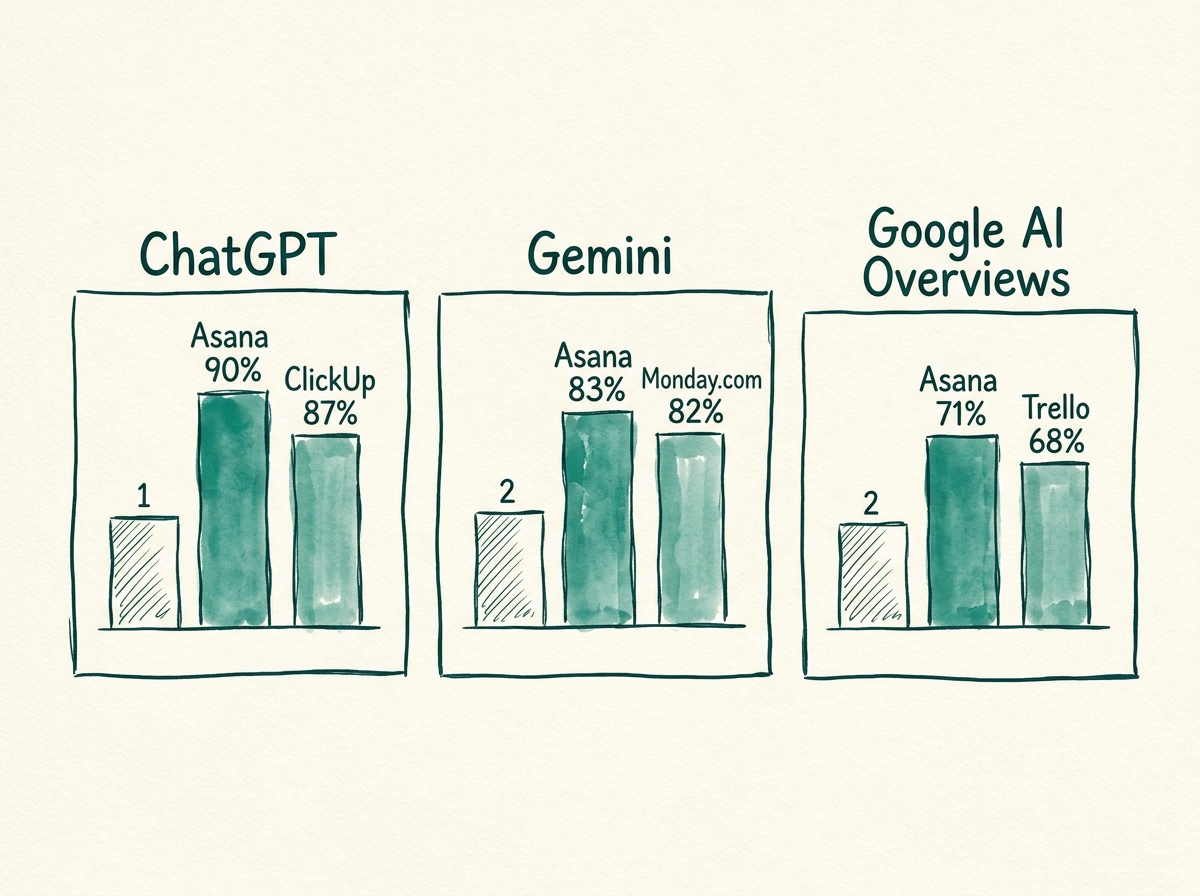
The lesson: you cannot optimize once and win everywhere. AI visibility is not one race — it is three, scored separately. A brand can dominate one engine and be mid-pack on the next, and an all-engines average will quietly hide both facts.
Finding 2: your shortlist isn't AI's shortlist
The engines didn't only rank the obvious six. Across the 270 answers they repeatedly named brands most buyers would never shortlist — a genuine second tier the AI keeps surfacing:
| Brand (outside the "big six") | Times named (of 270 answers) |
|---|---|
| Wrike | 44 |
| Smartsheet | 37 |
| Microsoft Project | 35 |
| Linear | 29 |
| Basecamp | 29 |
| Motion | 25 |
| GitHub | 22 |
| Slack | 20 |
These aren't rounding errors. Wrike was named 44 times and Smartsheet 37 — each roughly as often as Notion or Jira inside the famous six. And the outsiders are engine-specific: on Google AI Overviews, the AI-calendar app Motion and Microsoft Project spike hardest; on ChatGPT, dev-focused Linear and Wrike lead. The engines also blur category lines — Slack, GitHub, and Google Docs surface for project-management questions despite not being PM tools. If your competitive set is "the obvious five," AI's is wider — and you may be losing to names you've never benchmarked against.
Finding 3: being recommended and being cited are different games
Here is a trap almost everyone falls into: treating a mention (your brand named in the answer) and a citation (a clickable linked source) as the same thing. They are not, and every engine names brands far more than it links them:
| Engine | Names a brand | Links a source |
|---|---|---|
| Google AI Overviews | 100% | 99% |
| ChatGPT | 100% | 83% |
| Gemini | 100% | 52% |
Every engine named at least one brand on 100% of answers — but Gemini linked a source on barely half. The roster tools were linked rarely even when named: Asana was named 81% of the time but its own domain was cited around 5%; most others sat near 0–3%. The one exception was telling — ClickUp was the only tool ChatGPT meaningfully linked, on about 18% of its answers.
The implication for SEO vs AEO is sharp. On Gemini especially, the game isn't earning a backlink — it's being in the model's knowledge so it says your name with no link at all. "Get cited" and "get recommended" are two separate targets, and they require different work — which is why it pays to track mentions and citations as separate signals.
Finding 4: SEO authority doesn't predict AI visibility
This is the core of the study. All six tools have elite SEO — they sit at Domain Rating 90–92, the very top of the scale, with strong traffic and deep backlink profiles. Great SEO got every one of them into the running. Yet identical authority produced wildly different AI results. Here is the full picture, sorted by keyword footprint (largest to smallest), with authority from Ahrefs and AI visibility from both Ahrefs and our own study:
| Tool | DR | Referring domains | Traffic | Keywords | AI cited (Ahrefs) | Named (our study) |
|---|---|---|---|---|---|---|
| Atlassian / Jira* | 92 | 122K | 1.7M | 101K | 252* | 43% |
| Asana | 91 | 83.5K | 817K | 48.8K | 154 | 81% |
| Monday.com | 91 | 76.3K | 339K | 40K | 101 | 70% |
| ClickUp | 90 | 64K | 208K | 8.1K | 217 | 74% |
| Trello | 91 | 134K | 398K | 4K | 14 | 60% |
| Notion | 92 | 144K | 32.6K | 501 | 2 | 44% |
Read down the columns. Domain Rating barely moves — 90 to 92, a dead heat. Now read the AI columns: they swing from 252 to 2. And every SEO metric that does vary fails to rescue the story:
- ClickUp ranks for the smallest keyword footprint here — 8,100 keywords, a fraction of Asana's 48,800 or Atlassian's 101,000 — has the lowest Domain Rating (90), and the fewest referring domains (64,000). Yet it is the most AI-cited single product (217 Ahrefs citations) and #2 in our naming (74%).
- Atlassian / Jira ranks for the most keywords (101,000) and most traffic (1.7M) of anyone — yet the Jira product is named the least in our study (43%).
- Notion has the most referring domains of the group (144,000) and a top Domain Rating (92) — yet ChatGPT cites it twice.
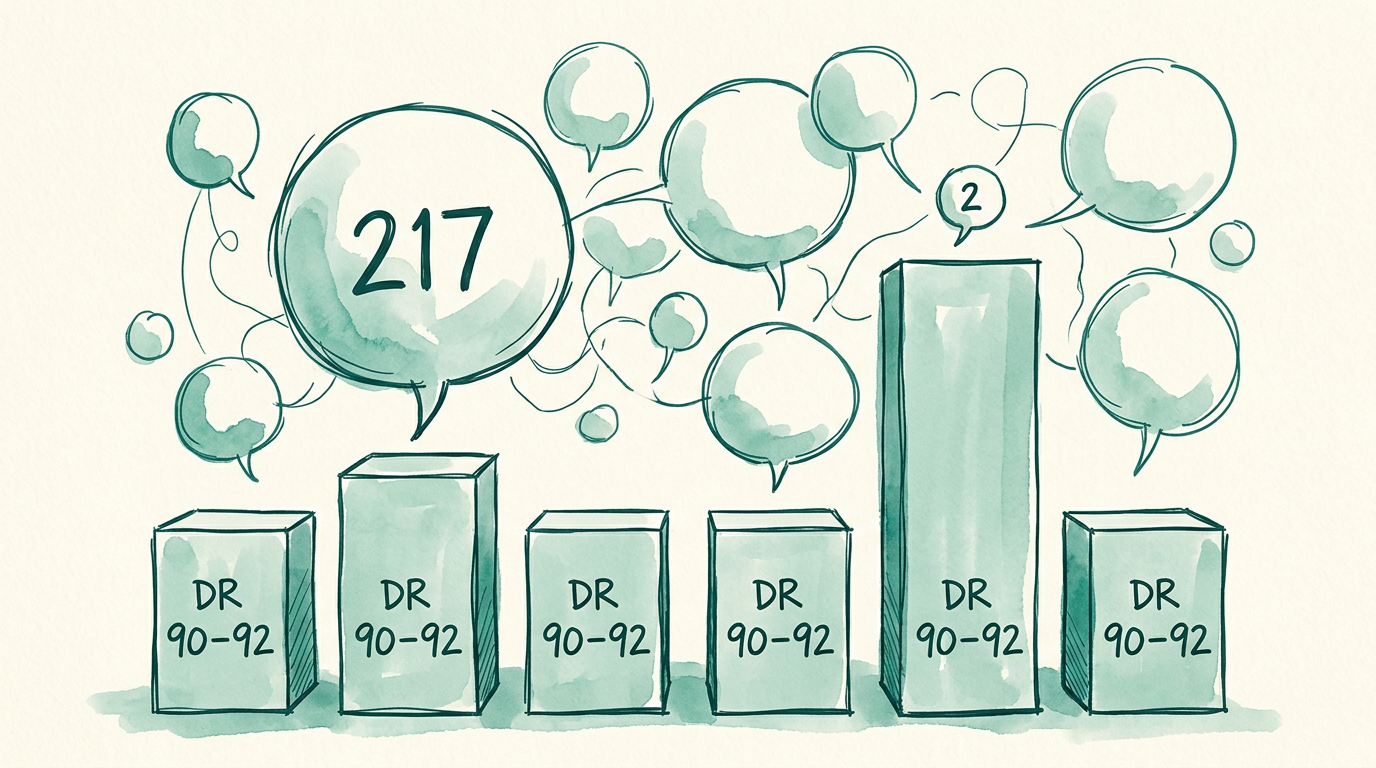
No SEO metric — domain authority, traffic, or keyword footprint — reliably predicts who AI names. SEO is the foundation: it gets you eligible. A separate layer on top decides who gets chosen.
That layer is AEO. The pattern holds on the second AI engine too: in Ahrefs' Google-AI-Overviews citation index, Monday.com (733) and ClickUp (445) lead while Notion (3) and Trello (10) sit near zero — again, no relationship to their near-identical Domain Rating.
A note on Atlassian: its atlassian.com domain covers the whole Atlassian suite (Confluence, Bitbucket, and more), so its Ahrefs citation figure overstates the Jira product specifically. That's exactly why we measured product-level naming ourselves — and Jira, the single most SEO-heavy footprint in the group, lands at the bottom of AI's list.
Finding 5: AI cites Reddit and niche blogs — not the review sites you pay for
If authority doesn't earn the citation, what does? We classified all 781 cited sources. The big software-review aggregators every brand invests in are almost entirely absent:
| Source type | Share of AI citations |
|---|---|
| Niche / long-tail blogs & listicles | 59% |
| Vendor pages (own + competitor "best-of") | 16% |
| Reddit / forums | 8% |
| YouTube / video | 6% |
| Industry / education sites | 6% |
| News / media | 2% |
| G2, Capterra & other big review sites | ~1% |
The single most-cited domain across the whole study was reddit.com (66 citations), followed by youtube.com (49) and the Agile-certification site icagile.com (44). After those came a long tail of niche project-management blogs — thetoolchief, thedigitalprojectmanager, project-management.com, zapier — and vendors' own "best PM tools" listicle pages. G2, Capterra, and TrustRadius combined for roughly 1% of citations.
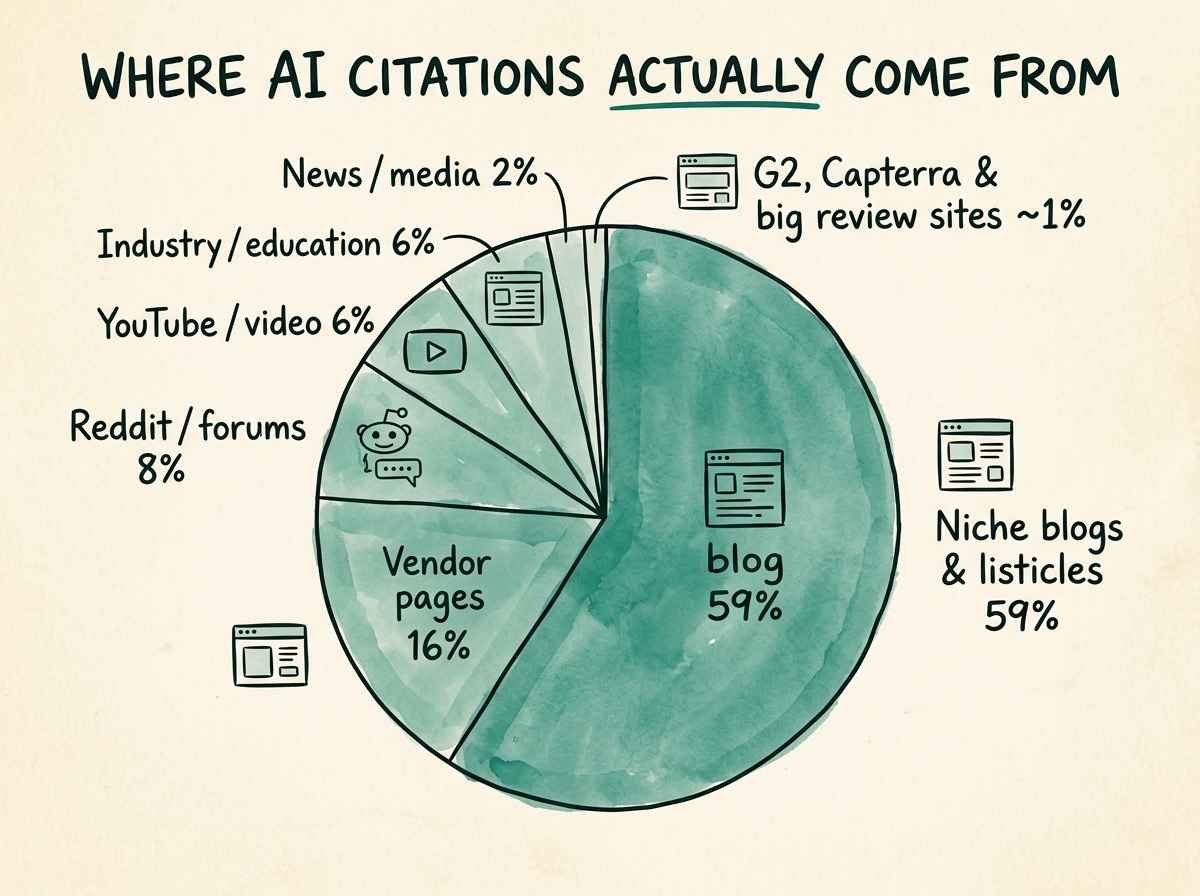
The engines also source differently. ChatGPT leaned on niche blogs and vendor pages and cited essentially no big-name review sites and no video. Gemini was the most vendor-heavy. Google AI Overviews was the community-and-video engine — YouTube, Reddit, and industry/education sites made up a far larger slice of its citations. So the practical AEO target is not the review directories everyone fights over; it's Reddit threads, niche publications, and citable content of your own — and the mix shifts by engine.
The SEO vs AEO playbook: build the layer on top
The takeaway is emphatically not "SEO is dead." Every one of these tools earned its place in the conversation because of strong SEO. The takeaway is that SEO is now table stakes — necessary, not sufficient. To move from eligible to chosen, add the AEO layer on top of the SEO you already have:
- Publish genuinely citable content. Original data (like this study), quotable claims, and clear comparisons are what get lifted into an AI answer. A page that simply ranks gives the model nothing to quote. (Here's how we rebuilt our own site to be AI-citable.)
- Earn presence on the sources AI actually cites. Reddit threads, niche industry blogs, and comparison pages — not just the review directories. In our data those niche and community sources were the overwhelming majority of citations.
- Measure per engine, continuously. ChatGPT, Gemini, and Google's AI Overviews name different winners, and AI answers drift over time. A single all-engines snapshot tells you almost nothing about where you actually stand — the tools built for this track each engine separately.
None of that replaces SEO. It sits on top of it — the same way the winners in this study didn't skip the foundation, they built the next floor.
See where you stand
The uncomfortable truth of SEO vs AEO is that you can rank #1 on Google and have no idea whether AI names you — and most brands don't. You can find out for free: check your brand's AI visibility across ChatGPT, Gemini, and the other major engines — the same method we used here, pointed at your brand and your competitors.
And if you want the receipts: the full dataset behind this study — every prompt, every engine, every answer, with who was named and what was cited — is public.
Frequently asked questions
What is the difference between SEO and AEO? SEO optimizes for ranking position in a results list; AEO optimizes for being named and cited inside an AI's answer. SEO asks "can I rank?"; AEO asks "will the model name me?" Our 342-answer study found domain authority didn't predict AI visibility — six tools at near-identical Domain Rating (90–92) ranged from 217 AI citations to 2 — so the two have measurably diverged.
Does SEO still matter for AI search? Yes — as a foundation. All six tools we tested had elite SEO, which got them into consideration. SEO is necessary but not sufficient; the AEO layer on top decides who actually gets named.
Does domain authority affect AI visibility? In our data, not reliably. Six tools at near-identical Domain Rating (90–92) produced AI citation counts from 217 to 2 — and the lowest-authority tool, with the smallest keyword footprint, was the most cited.
Which project-management tool does AI recommend most? Asana — named in 81% of 270 open answers, and the only tool to lead all three engines (90% ChatGPT, 83% Gemini, 71% Google AI Overviews). ClickUp was second (74%), then Monday.com (70%), Trello (60%), Notion (44%), and Jira (43%).
Do different AI engines recommend different tools? Yes. Asana led all three, but the runner-up changed each time — ClickUp on ChatGPT, Monday.com on Gemini, Trello on Google AI Overviews — and Notion fell from 57% on ChatGPT to 37% on Google's AI.
What sources does AI cite for product recommendations? Mostly niche blogs and listicles (59%), vendor pages (16%), Reddit and forums (8%), YouTube (6%), and industry/education sites (6%). The big review sites — G2, Capterra, TrustRadius — were about 1%. Reddit was the single most-cited domain.
Why isn't my brand showing up in ChatGPT? Often because AI pulls from Reddit, YouTube, and niche blogs more than the directories brands invest in — and because AI visibility has to be earned and measured per engine, not assumed from a Google ranking.
How do you do AEO? Keep your SEO as the foundation, then add citable content with original data, third-party presence on the sources AI cites, and per-engine measurement.