How LLMs Choose Citations
Large language models cite sources through hybrid retrieval pipelines that blend three layers: what the model learned in pretraining, live web search…
6 min read · updated 2026-07-13
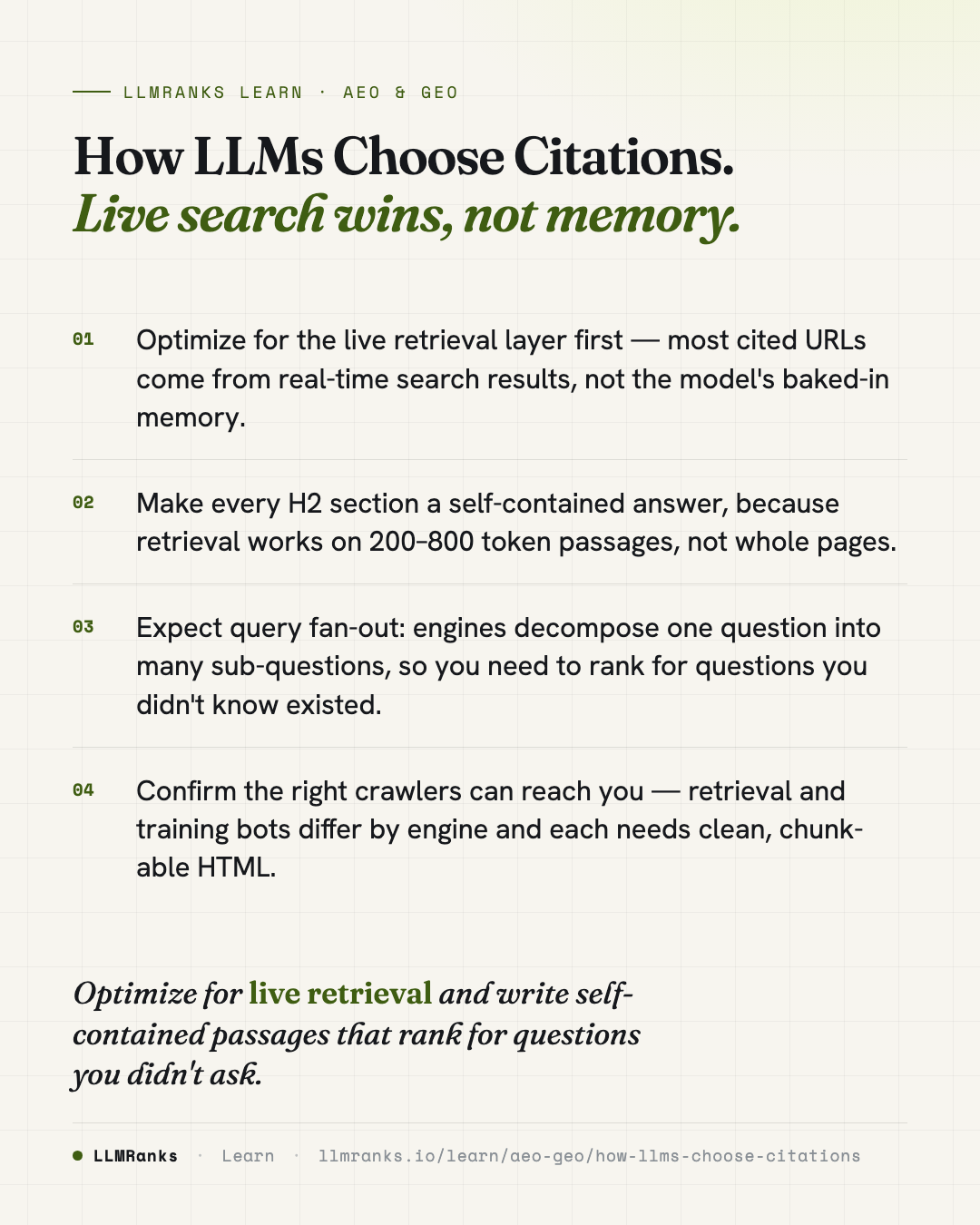
Large language models cite sources through hybrid retrieval pipelines that blend three layers: what the model learned in pretraining, live web search performed at the moment you ask, and pre-embedded indexes the provider maintains. For most queries, the actual cited URLs come almost entirely from the live retrieval layer — the model drafts a candidate answer from memory, then validates and updates it against fresh search results. What earns your page a citation is passage-level relevance to the specific query (or sub-query) being answered, not just your ranking for a head term.
The three retrieval layers
Every major AI answer engine — ChatGPT with search, Claude with web search, Perplexity, Gemini and Google AI Mode, and Google AI Overviews — uses a hybrid pipeline, but the mix differs sharply. Understanding which layer feeds a given answer tells you what to optimize.
| Layer | Mechanism | What gets you in |
|---|---|---|
| Parametric memory | Baked into model weights during pretraining | Heavy presence in large web crawls, Wikipedia, Reddit, GitHub, books, and news archives roughly 6–18 months old or older |
| Real-time retrieval (RAG) | A live web search call at inference; results are re-ranked and injected into context | Ranking in the underlying search index the engine uses |
| Vector store / curated index | Pre-embedded corpora the provider maintains | Crawler access, clean HTML, and content that chunks cleanly into semantic units |
A query like "best Postgres connection pooler 2026" can trigger all three at once: parametric memory drafts a candidate answer, retrieval validates or updates it, and the cited URLs come almost entirely from the retrieval layer. For more on the corpora behind the first layer, see The Sources That Fuel LLMs.
How retrieval behavior differs by engine
The following reflects behavior as of late 2025 and early 2026. This is a moving target, so treat specifics as a snapshot rather than a fixed rule. For a deeper split, see Citation Behavior by Engine.
- ChatGPT (search mode) uses Bing-powered retrieval plus its own crawl. It cites roughly 3–8 sources inline and shows a strong bias toward sources Bing ranks 1–10 for the rewritten query. It honors
OAI-SearchBotfor retrieval andGPTBotfor training. - Claude (web search) uses the Brave Search API in many configurations with internal re-ranking. It cites fewer sources — often 2–5 — but quotes longer passages verbatim.
ClaudeBotis its primary crawler. - Perplexity maintains its own crawl index alongside live web fetching. It chunks aggressively, pulling 5–15 sources per answer and citing every claim. It tends to be the fairest engine for smaller publishers, because its re-ranker rewards passage relevance over domain authority.
- Gemini / Google AI Mode is tightly fused with Google's index, Knowledge Graph, and reasoning stack. AI Mode performs query fan-out, decomposing one question into multiple sub-queries, retrieving for each, and synthesizing.
- Google AI Overviews runs a subset of AI Mode behavior on classic search pages, using the same query fan-out.
The engines that quote longer passages verbatim reward tightly written, quotable sections — see Getting Quoted Verbatim.
Query fan-out is the biggest recent shift
The single biggest change for 2026 is query fan-out. Instead of retrieving for your literal question, the engine breaks it into several sub-queries, retrieves sources for each, and stitches the answers together. Practitioner data has measured an average of around 10.7 sub-queries for one Gemini configuration (Seer Interactive, November 2025) — this is measured practitioner data, not a figure Google discloses, and Google does not publish a count. Google did officially document the fan-out mechanism in 2026.
The practical implication is blunt: you now need to rank for the sub-questions you didn't know existed. A page that only targets the head term will miss the sub-queries where the actual citations get awarded. Structuring content around the questions a reader (and a fan-out) would naturally ask is covered in Content Patterns LLMs Favor.
Citation has decoupled from rank
Getting cited is no longer the same as ranking first. In Google AI Overviews, only about 38% of cited pages rank in the organic top 10 for the query — down from roughly 76% in July 2025. Around 31% rank 11–100, and about 31% rank beyond the top 100 (Ahrefs, based on 4M cited URLs, early 2026).
What earns the citation is passage-level relevance to a fan-out sub-query, not head-term rank. That's genuinely good news for smaller sites: a precise, well-structured passage can be cited even when the domain isn't winning the classic ranking battle. It also means classic SEO and answer optimization overlap but are not identical — see SEO vs AEO: Where They Align and Where They Diverge.
Vector similarity works on passages, not pages
When a chunk is retrieved, it isn't your whole page — it's a 200–800 token passage. The retriever embeds the user's query and finds passages whose embedding has high cosine similarity to it, using high-dimensional embeddings (in the 1536–3072 dimension range for common or proprietary models).
The implication is direct: every H2 section should be a self-contained semantic unit that scores well on its own. A 4,000-word page that buries the answer in paragraph 14 loses to a 600-word page where the answer sits in the first 80 tokens under an H2. Lead each section with the answer, then support it.
- Put the answer first, under a descriptive heading.
- Keep sections tight enough to fit a retrievable passage.
- Don't force length; density and structure beat word count. See Content Length for AI Search.
For the broader picture of what makes a passage worth pulling, read What Makes Content Citable.
What to do
- Verify crawler access. Confirm the retrieval and training bots for each engine — such as
OAI-SearchBot,GPTBot,ClaudeBot,PerplexityBot, andGoogle-Extended— can reach your pages, and that your HTML is clean and chunk-able. - Restructure around self-contained H2 sections. Lead each one with a direct answer in the first 80 tokens, and keep it within a passage-sized block.
- Map the sub-questions. For each core topic, list the sub-queries a fan-out would generate and make sure a passage on your site answers each one.
- Compete on passage relevance, not just rank. Because citation has decoupled from top-10 position, prioritize precise, quotable passages over chasing a single head term.
- Match tactics to engine. Favor tight verbatim-friendly passages for engines that quote longer, and comprehensive per-claim coverage for engines that cite many sources.
- Re-check periodically. Per-engine behavior changes fast, so revisit your assumptions rather than treating any snapshot as permanent. Start from AEO & GEO for the full framework.
save this card
 Download card
1080×1350 · post it anywhere
put it to work
See how ChatGPT, Gemini and Google AI actually talk about your brand.