Evidence layer
Content Strategy & E-E-A-T
E-E-A-T stands for Experience, Expertise, Authoritativeness, and Trustworthiness. It is not a direct ranking factor — it's the framework Google's quality…
E-E-A-T stands for Experience, Expertise, Authoritativeness, and Trustworthiness. It is not a direct ranking factor — it's the framework Google's quality raters use to calibrate the algorithm, and increasingly the implicit lens that LLM grounding pipelines apply when they filter authoritative sources. Your job is to demonstrate each leg concretely rather than assert it, because Google ranking and LLM citation now draw from a heavily overlapping signal set. Build for verifiable trust once and you satisfy both surfaces.
The four legs of E-E-A-T
E-E-A-T is best understood as one framework with four demonstrable dimensions. Google has emphasized since 2022 that trust is the prerequisite — the center of the diamond — while the other three legs feed into it.
- Experience (the second E, added December 2022) is first-hand, verifiable engagement with the subject. Show it with original imagery, process artifacts like real dashboards and terminal output, specific temporal markers ("I ran this benchmark on Nov 14, 2025" beats "I tested this"), and first-person claims that are falsifiable and specific.
- Expertise is demonstrable subject-matter command. Show it with author bios linked to verifiable sources, correct in-domain terminology at the right density, anticipation of expert objections, and explicit methodology — sample sizes, error bars, limitations.
- Authoritativeness is how others perceive you, and it's largely off-page: citations in authoritative venues, presence in the Knowledge Graph, a Wikidata entity, and co-citation alongside recognized authorities. Practitioners argue unlinked brand mentions now carry weight comparable to links, though Google has not confirmed mention-weighting publicly — treat that as a contested claim.
- Trustworthiness ties it together: accurate
Organizationschema, real contact details, traceable WHOIS (no privacy-protected WHOIS for YMYL), citation hygiene, transparent affiliate disclosure, valid HTTPS, and balanced treatment of contested topics.
For deeper implementation, see E-E-A-T in Practice. The Off-Page Authority layer covers how external corroboration converts on-page expertise into recognized authoritativeness.
Helpful, people-first content
The standalone Helpful Content System was folded into the core ranking system in the March 2024 core update. There is no separate signal anymore — advice that treats it as a discrete classifier is out of date. See the Helpful Content System page for detail.
Operationally, "people-first" in 2026 means:
- Answer the query in the first 100 words. Long preambles get penalized via dwell-time signals and skipped by AI answers.
- Add information gain. Your page should contribute something the current top results don't already say. Aim for a meaningful share of novel claims, data, or perspective.
- Keep pages single-purpose. One query cluster per URL; split-and-link beats bloating one page with five unrelated intents.
- Earn the right to exist. If nothing unique would be lost when a URL 404s, it's a candidate for consolidation or retirement.
- Avoid scaled content abuse. The March 2024 spam policy targets many pages with low information gain and templated structure — regardless of whether they're written by humans or AI.
Topical authority through entity coverage
Topical authority in 2026 is measured by how completely you cover the entity set within a defined topic, not by page count. See Topical Authority for the full method.
The architecture is hub-and-spoke:
- Pillar page: comprehensive overview, roughly 3,000–6,000 words, targeting the head term.
- Cluster pages: each targets one sub-entity or long-tail intent, roughly 800–2,500 words.
- Bidirectional linking: the pillar links to every spoke; spokes link back to the pillar and to two to four sibling spokes with descriptive anchor text. See Internal Linking for anchor distribution guidance.
Aim to cover at least 80% of the topic's entity set before expecting an authority lift — a focused niche covering most of the topic outperforms sparse coverage of a broad one. Watch for cannibalization: cluster pages should stay semantically distinct, and near-duplicate URLs should be consolidated rather than left to split clicks.
Depth, fact density, and citations
Word count is a correlate, not a cause. Depth is the cause — see Content Depth vs Word Count. Long-form wins for pillar pages, definitive guides, YMYL topics, multi-dimension comparisons, and technical deep-dives. Short wins for direct-answer queries, transactional intents, news, glossary definitions, and FAQ entries (50–150 words per answer is optimal for AI citation). Stop counting words; count claims, citations, and unique entities.
Fact density is one of the most under-exploited levers for AI answer visibility. LLMs extract and cite discrete, verifiable assertions, so vague prose is unextractable. A "fact unit" is a specific number with unit and context, a named entity tied to an attribute, a dated event, a quantified relationship, or a named comparison. To raise density without padding:
- Replace adjectives with measurements — "fast" becomes "loads in 1.2s on 4G."
- Name entities instead of gesturing at "a popular framework." Named entities are nodes an LLM can reconcile; unnamed references are dead ends.
- Date everything time-sensitive — "recently" is worthless, "Q3 2025" is citable.
- Attribute every statistic; an unsourced number is a liability.
- Use tables for multi-attribute facts, which parse cleanly into many extractable units.
Citations matter more for AI answers than for classic SEO because retrieval systems perform claim verification. Content that links a claim to a verifiable primary source is preferentially selected because it reduces hallucination risk and provides an attributable provenance chain. Cite from the top of the sourcing hierarchy down — primary sources first (original research, official docs, government data, specs, filings), then authoritative secondary and reputable tertiary sources. Avoid load-bearing citations to other blogs or undated sources. Link to the deepest relevant URL with descriptive anchor text, and date your citations.
A page stating "INP should be under 200ms" is weaker than one stating "Google's guidance sets the 'good' INP threshold at ≤200ms" with a deep link — the latter gets cited, the former gets paraphrased without credit or dropped. Related structured-data patterns live in Structured Data & Schema, and answer-first formatting is covered in AEO & GEO.
Author signals and content provenance
Every non-trivial article should carry a visible byline linked to an author bio page, an 80–200 word bio block with verifiable credentials, and — for YMYL — a named reviewer with credentials and review date. The author bio page should live at a stable URL and include real photo, entity-mapped areas of expertise, a publication list, and sameAs links to profiles like LinkedIn, GitHub, Google Scholar, ORCID, and Wikidata.
In schema, use a consistent @id so the Person entity reconciles across all articles — fragmented or missing @id fragments split the author's entity graph. Keep reviewedBy distinct from author for YMYL. Don't fabricate authors: AI-generated headshots are detectable through reverse-image-search failures and absent off-site footprints, and constitute a trust violation. See Author Bylines & Signals for the full markup.
LLM grounding systems increasingly extract author entities and appear to weight retrieval by author authority where the entity resolves to a recognized expert. This is consistent with the E-E-A-T direction, but no controlled study confirms author-authority retrieval weighting — treat it as directional, not settled fact.
AI-generated content and Google's stance
Google's restated position through 2024–2025 is that AI-generated content is not inherently against guidelines. Content created primarily to manipulate rankings — regardless of how it's produced — is. The relevant policy is scaled content abuse, updated March 2024. See AI-Generated Content & Google.
In practice, pure AI generation at scale with no human review, no original data, and no expertise demonstration carries high risk. AI used as a drafting, research, or editing tool with substantive human contribution is permitted and effective. Google does not currently require AI disclosure, though this could change — the EU AI Act phases in disclosure requirements for some contexts in 2026, provenance metadata is becoming a soft trust signal, and surveys show most users want disclosure.
A defensible workflow uses AI for research and drafting while a human owns the outline, the analysis and first-person sections, original asset injection (data, screenshots, interview quotes), a fact-check pass verifying every number against primary sources, and — for YMYL — a named expert review board.
Freshness, originality, and readability
Freshness is query-dependent. News refreshes in hours; statistics quarterly to monthly; software tutorials per major release; evergreen how-tos every 6–12 months; glossary entries every 12–24 months. Only update dateModified when at least 20% of content actually changed or a material fact was corrected — systems detect fake freshness, and touching the date weekly with no substantive change loses freshness weighting. Surface both published and updated dates visibly with what changed, and maintain a changelog block; explicit revision history is cited more often. See Content Freshness.
Originality requires canonical hygiene internally (self-referencing canonicals, noindex on non-canonical facets, boilerplate kept below roughly 30% of rendered text) and control externally (syndication with canonical-back, monitoring for scrapers, unique on-domain versions of anything distributed widely). See Originality & Duplicate Content.
Readability is both a UX signal and an extractability signal. Target a Flesch Reading Ease of 50–70 for general audiences, or 30–50 for expert content — don't dumb down expertise, since that reads as low-expertise. Keep sentences averaging 15–20 words, paragraphs 2–4 sentences, and subheadings every 200–300 words phrased to match real queries. Front-load the answer in each section. Post-2023 DOJ testimony and the May 2024 Google API leak confirmed that click and engagement data feed ranking, so aim to be the terminal click for a query and avoid the clickbait titles, slow loads, and intro padding that cause pogosticking. Interaction responsiveness matters here too — see Core Web Vitals.
Managing content as a portfolio
Treat content as an actively managed portfolio, not a publish-and-forget archive, moving each page through five stages:
- Publish at "complete enough to be the best answer," with accurate sitemap
lastmodand internal links from existing pages on day one. - Optimize after four weeks or a full crawl-index-rank cycle: mine Search Console for striking-distance queries at positions 5–20, restructure answers to capture SERP features, and rewrite titles for pages ranking 3–10 with below-expected click-through (benchmark against your own per-position averages, since AI answers suppress organic clicks substantially).
- Expand in place when a sub-intent is a facet of the same intent, or spin off a new cluster URL when it has distinct search demand.
- Consolidate cannibalizing URLs by merging the weaker into the stronger, 301-redirecting the retired URL, and porting unique content and citations.
- Retire pages with near-zero impressions for six-plus months, no backlinks, and no strategic value. Use 301 where any equity exists, 410 for permanent removal with no successor, or
noindexto keep a page accessible but unindexed. Deliberate pruning of low-quality pages can lift sitewide quality — but never delete a page with external links without a redirect.
What to do
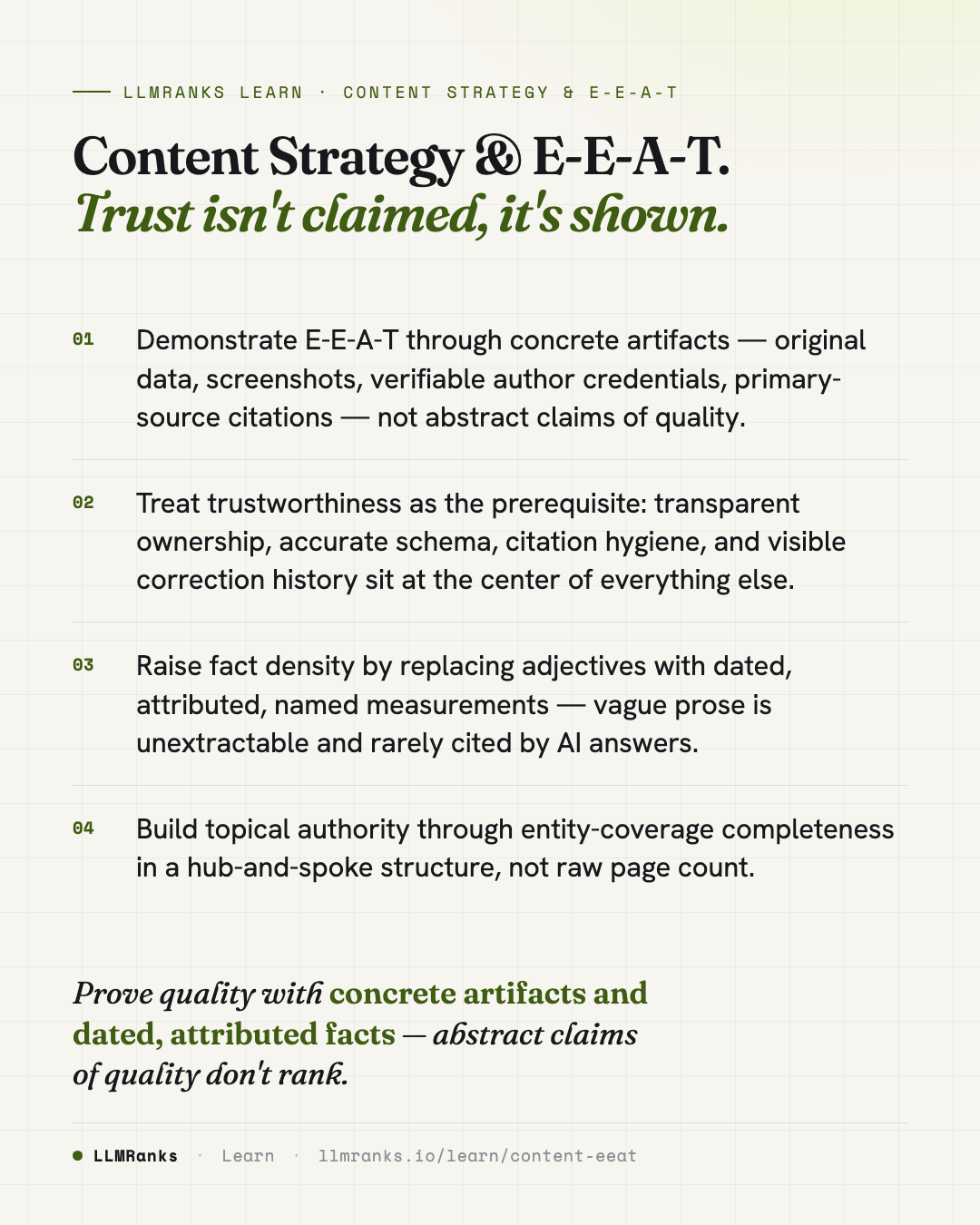
- Audit each key page against all four E-E-A-T legs and add concrete artifacts — original data, screenshots, verifiable author credentials — wherever a leg is asserted but not demonstrated.
- Verify trustworthiness fundamentals first: accurate
Organizationschema, real contact and address, valid HTTPS, transparent disclosures, and traceable WHOIS for any YMYL content. - Rewrite openings to answer the target query within the first 100 words and confirm each URL serves a single query cluster.
- Map your topic to an entity set and build a hub-and-spoke structure aiming for at least 80% coverage before expecting an authority lift.
- Raise fact density by replacing adjectives with dated, attributed measurements and naming every entity, then add primary-source citations with deep links.
- Set up verifiable author bylines and bio pages with consistent schema
@idandsameAscorroboration; never fabricate authors. - Assign a refresh cadence by content type and update
dateModifiedonly on substantive change, surfacing a visible changelog. - Run a quarterly portfolio review to optimize striking-distance pages, consolidate cannibalizing URLs, and retire dead weight with correct redirects.
save this card
 Download card
1080×1350 · post it anywhere