Consensus layer
Off-Page Authority
Off-page SEO in 2026 is about building your brand as a recognizable entity, not just accumulating links. Your off-page signals now feed three surfaces at…
Off-page SEO in 2026 is about building your brand as a recognizable entity, not just accumulating links. Your off-page signals now feed three surfaces at once: classical web ranking, AI Overviews and Gemini grounding, and LLM citation in tools like ChatGPT, Claude, and Perplexity. Each surface weights authority differently, so a site can rank organically yet earn zero AI citations — or get cited daily while sitting on page two. The throughline: links are one input into an entity-strength model, not the goal itself.
The authority stack: what actually moves the needle
The 2024 mental model — "build links, rank higher" — is dead as a primary framework. Off-page signals now feed three distinct ranking surfaces simultaneously: classical web ranking (Google's core algorithm, Bing), AI Overviews / Gemini grounding / Bing Copilot citations, and LLM training-corpus inclusion plus retrieval-time citation across ChatGPT search, Claude with web, Perplexity, and Google AI Mode.
These surfaces are separate but correlated. Because LLMs that increasingly mediate search only see text, not link graphs, entity extraction from raw text has become the new "PageRank for AI." That's why the modern framing is entity-building, not link-building.
When you prioritize off-page health, work roughly in this order: branded search trend first; then Wikipedia/Wikidata presence; then brand mention volume and co-occurrence consistency; then your AI citation share versus competitors; then a topically relevant editorial link profile; anchor-text health; Bing rankings; community presence; transcript-indexed mentions; local citation consistency; velocity-versus-brand divergence; and finally a manual-action check. Tools still optimizing for domain rating and dofollow counts are optimizing for a 2020 search engine that no longer exists.
What "quality" means for links now
Domain Rating (Ahrefs) and Domain Authority (Moz) remain useful as filters for obvious junk — a DR under 10 from a site you've never heard of — but they are weak positive predictors above a threshold. Link spam at the DR 60–80 tier was industrialized between 2022 and 2024. Google's link spam updates (December 2022, March 2024, plus an unannounced "neural link valuation" model reported by multiple SEO observers in late 2024 — this is industry inference, not Google confirmation) heavily devalue links from sites whose outgoing link patterns look commercial.
Score these signals instead of raw DR:
| Signal | Weight | What it measures |
|---|---|---|
| Topical relevance (page and domain) | High | How closely the linking page and site match your topic cluster |
| Editorial placement | High | In-body, contextual, surrounded by relevant prose |
| Link target | Medium | To a content asset, not just the homepage |
| Source's branded search | High | Whether the linking site is a real brand |
| Source's commercial outbound ratio | High | Flag sites with heavy commercial outbound links |
Placement follows a clear hierarchy. In-body editorial links in the first half of an article carry full value; late-article links roughly 70%; author-bio links around 30% and often discounted. Sidebar "recommended" widgets, footer links (especially sitewide), and comment links are near zero or actively suspicious. Roundups depend entirely on whether they're editorial or pay-to-play.
For anchor text, a natural distribution for 100 referring domains looks like 35–50% branded, 15–25% naked URL, 10–20% generic, 10–20% partial/topical, and only 2–6% exact-match commercial. Exceeding 8% exact-match is the single most reliable suppression trigger observed in 2025–2026 — more sensitive than in 2024 because the classifier now operates per keyword cluster, not per domain.
Finally, nofollow since 2019 is a hint, not a directive; sponsored generally passes no equity but can still carry brand signals; and ugc from high-trust platforms like Reddit, Stack Overflow, and GitHub appears to pass entity signals. A healthy profile is 30–50% nofollow/ugc/sponsored — a 95% dofollow profile reads as manipulation. See Link Tactics: Works vs Avoid for the full breakdown.
Tactics that still work
Digital PR is the highest-ROI link tactic now, by a wide margin. Publish an original data study, pitch journalists at major publications, and earn 5–50 high-authority editorial links with a branded and topical anchor mix. Secondary syndication drives the long tail. Campaigns typically run $8K–$25K and yield 10–40 referring domains, roughly 60% of them DR 70+. The bonus is brand mentions in news contexts, which feed LLM training data heavily. If a client has zero links from news-eligible domains in the last 12 months, prioritize digital PR.
Other tactics that remain viable:
- Guest posts — only on topically aligned sites with real organic traffic and no "write for us" backlink advertising. Use branded or topical anchors.
- Broken link building — clean and contextual, but low volume (2–5% conversion).
- Resource pages — effective for genuinely useful tools and guides, dying for generic content (conversion has fallen from ~8% in 2020 to ~1–2% now).
- Podcast tours — underrated. Show-notes links are topically perfect, and transcripts are heavily represented in LLM corpora. See Podcasts for Authority & AI.
- Brand-driven plays — sponsoring conferences, open-sourcing tools on GitHub, free calculators, and annual original research.
Journalist-request platforms fragmented after HARO and its successor Connectively shut down (Connectively closed in December 2024). The market is now split across Qwoted, Featured.com, Help A B2B Writer, SourceBottle, ResponseSource, and X's #journorequest. ROI declined as AI-generated pitches flooded these platforms, so named experts with verifiable credentials get 5–10× the reply rates.
Tactics to avoid
Hard avoids: private blog networks (detection improved dramatically with hosting graph, WHOIS, and content embedding analysis), paid links on marketplaces, mass and multi-way link exchanges, comment and forum-profile spam, article directories, press-release distribution used purely for syndication links, and GPT-generated guest posts at scale.
Use with care: sponsored content (marked sponsored, for brand and traffic, not equity), affiliate links (mark them sponsored or nofollow), and modest reciprocal links between genuinely related partners.
For local businesses, citation building is still core: Google Business Profile, Apple Business Connect, Bing Places, industry-specific directories, major aggregators, and local chamber/news/.gov mentions. NAP (Name, Address, Phone) consistency matters more than volume — even "Suite 100" versus "Ste. 100" creates entity-disambiguation issues. Avoid bulk cheap directory submissions; they don't help and create cleanup work.
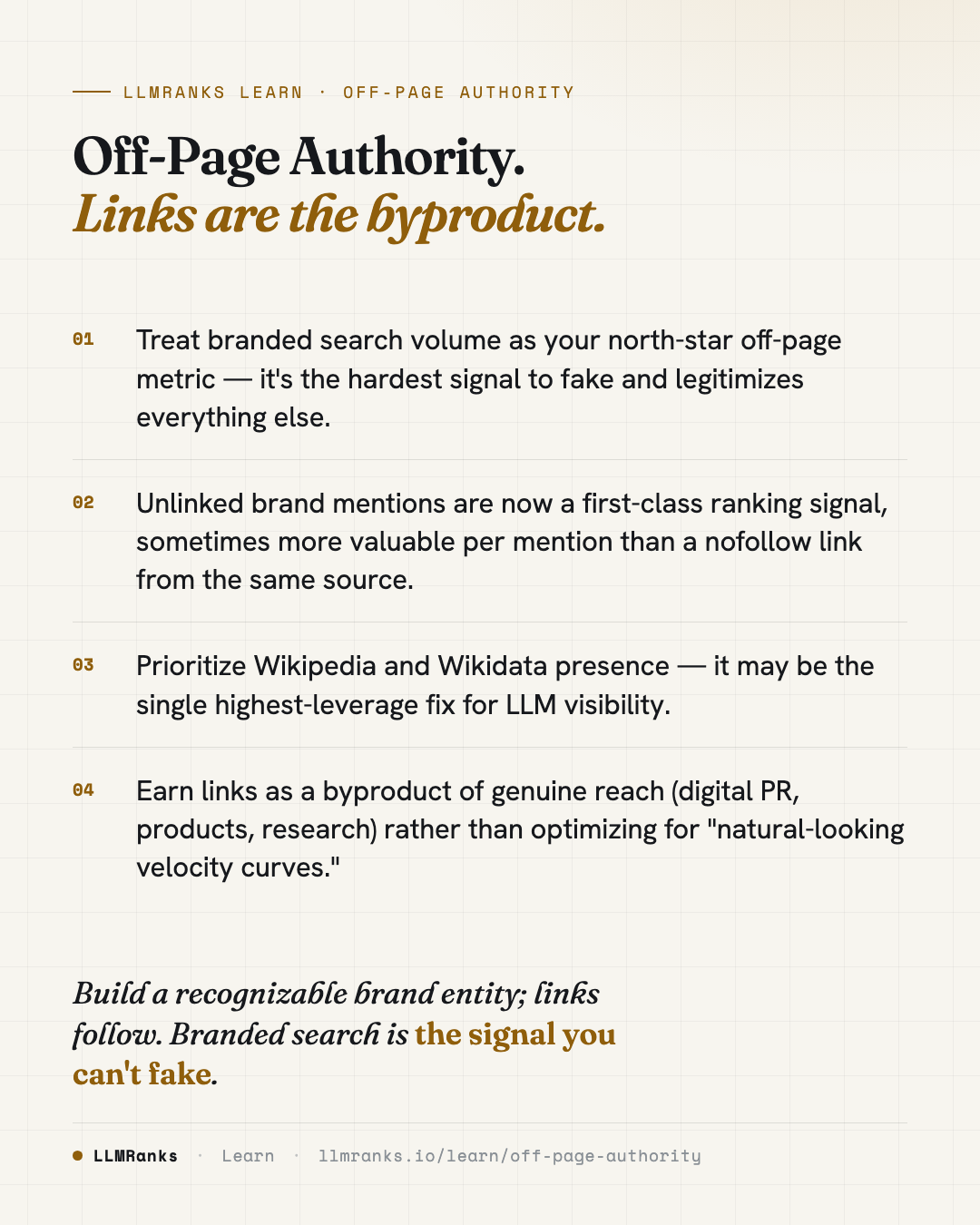
On outreach and velocity, Google's operative test is simple: would this link exist if Google didn't? Links should be earned, not transacted. Velocity itself isn't penalized — unnatural patterns are, specifically divergence between link acquisition and other authority signals. Stop chasing "natural-looking velocity curves" and instead earn links as a byproduct of real reach, which produces patterns Google reads as legitimate. Google now says most sites should never use the disavow tool; only recommend it with a manual action in Search Console or a documented negative-SEO attack. More in Outreach & Link Velocity.
Brand mentions and community signals
Unlinked brand mentions are now a first-class ranking signal, possibly more valuable per mention than nofollow links from equivalent sources. Ahrefs' June 2026 study of 75,000 brands measured branded web mentions at a Spearman correlation of 0.664 with AI Overview brand visibility — the strongest of 11 factors tested and roughly 3× the correlation of backlink count (0.218). Co-occurrence patterns build entity associations that drive both Google's entity layer and LLM retrieval.
To build entity strength: earn or contribute to a Wikipedia presence, create a Wikidata entry, get listed on entity-confirming sources like Crunchbase, G2, and Product Hunt, mark up Organization/Person/Product schema with sameAs, maintain consistent founder and exec visibility, and pursue co-citation alongside competitors in "best of" articles. See Brand Mention SEO and the Structured Data & Schema guide.
Community signals reinforce the same entity graph. The Reddit–Google content deal (announced February 2024) made Reddit a structural SERP fixture — it appeared in around 40% of informational SERPs by late 2024, normalizing to roughly 25–35% in 2026. Reddit visibility requires genuine, aged-account participation, not shilling. Hacker News front-page mentions generate large secondary effects; Stack Overflow and Stack Exchange carry domain-specific authority; and LinkedIn posts increasingly surface for branded queries. Detail lives in Reddit & Community Signals.
YouTube adds three off-page functions: direct SERP real estate, entity reinforcement (it's owned by Google), and LLM training and retrieval via auto-generated transcripts. Subscriber count is a weak signal; watch-time retention, topical consistency, and conversational brand mentions in transcripts matter more. Description links are nofollow but pass brand and entity signals. Practical plays: publish tutorials that mention your brand 20+ times, seed product mentions into creator content, and repurpose podcast appearances as uploads to double transcript coverage.
From off-page authority to LLM citations
LLMs surface your brand through two mechanisms. Parametric knowledge — what the model learned in pretraining — drives whether it mentions you at all and whether it associates you with the right category. Retrieval-time citation (RAG) drives which specific URLs get linked live, and depends on the underlying index (Bing for ChatGPT/Copilot, Google for Gemini/AI Mode, Perplexity's own index plus fallbacks).
The cleanest formulation: off-page authority determines candidate eligibility; passage-level content quality determines selection; brand entity strength determines parametric mention. To be in a retrieval candidate set you generally need enough classical authority to rank top 10–20 in the underlying index — if you can't rank top-20 organically, you're rarely retrieved. To be selected from that set, you need extractable, declarative, well-sourced passages (that's an On-Page SEO and AEO & GEO job). To be mentioned without retrieval, you need corpus-wide brand mention density and consistent category framing.
The retrieval backends and crawler behaviors of these tools shift frequently, and reported details (such as Claude's search backend or Perplexity's index composition) may have changed. Build your citation tracking to measure actual citations empirically rather than hardcoding assumed mechanics. See Authority → LLM Citations and AI Search Engines.
Branded search volume ties this together. It's a direct measure of demand and recognition that Google can't be gamed by cheaply; it legitimizes link velocity, feeds the entity model, and correlates with direct traffic and dwell time. Track its trend as your north-star metric — rising branded search with rising links is healthy; flat or declining branded search with rising link counts is a red flag for artificial link building. More in Branded Search Volume.
What to do
- Track your branded search trend (Google Trends plus Search Console brand impressions) as the single north-star off-page metric.
- Close any Wikipedia and Wikidata gap — treat it as the highest-leverage LLM-authority fix.
- Audit unlinked brand mentions and pursue polite outreach on high-authority sources (converts around 30%), while keeping neutral citations where they're more valuable unlinked.
- Run a digital PR campaign built on original data if you have no links from news-eligible domains in the last 12 months.
- Check your anchor-text distribution and reduce exact-match commercial anchors below ~7%.
- Audit Bing rankings separately, since they gate ChatGPT Search retrieval.
- Build genuine presence on Reddit, Hacker News, and Stack Overflow, and seed brand mentions into podcast and YouTube transcripts.
- For local clients, standardize NAP strings across your top citations.
- Track AI citation share across ChatGPT, Perplexity, Gemini, and Claude against competitors, and only consider disavow with a manual action or documented negative-SEO attack.
For the wider picture, see SEO in 2026, Content Strategy & E-E-A-T, and the Off-Page Authority hub.
save this card
 Download card
1080×1350 · post it anywhere