Perplexity Vs Chatgpt — for AI Search & LLM
Perplexity vs ChatGPT for AI search: only ~11% of their cited domains overlap. Perplexity cites 8.79 sources/answer, ChatGPT web-searches ~34.5% of queries.
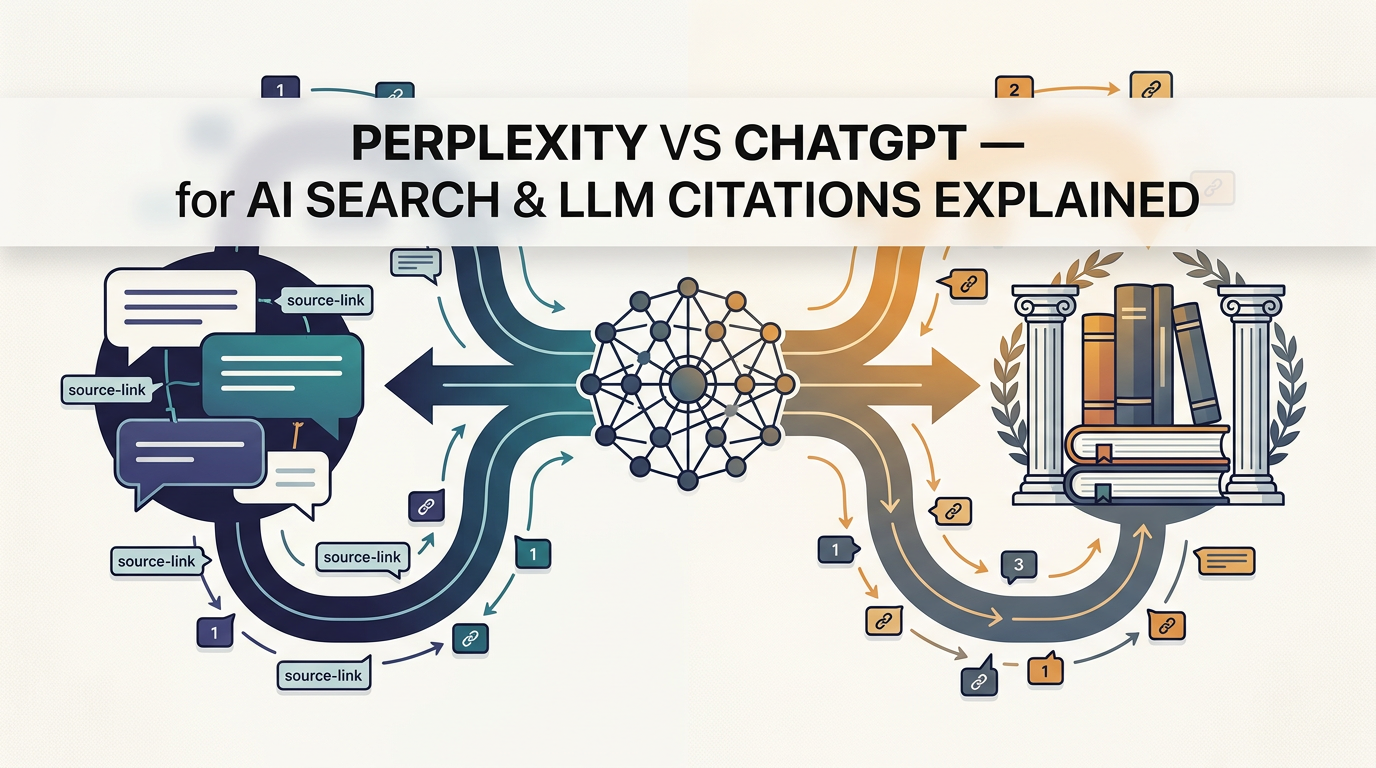
Perplexity and ChatGPT cite almost entirely different websites — only about 11% of the domains they reference overlap, per a 680-million-citation analysis by Averi. ChatGPT leans on Wikipedia (47.9% of its top-10 citations); Perplexity leans on Reddit (46.7%). That split means one AEO playbook cannot win both engines. You need two.
Key takeaways
- Only ~11% of domains cited by ChatGPT and Perplexity overlap, per Averi's 680M-citation analysis.
- Wikipedia feeds 47.9% of ChatGPT top-10 citations; Reddit feeds 46.7% of Perplexity's.
- Perplexity cites 8.79 sources per answer; ChatGPT web-searches only ~34.5% of queries.
- Both Pro tiers cost $20/month but deliver structurally different citation behavior.
- Win both engines with encyclopedic authority for ChatGPT and fresh community presence for Perplexity.
Perplexity vs ChatGPT citations: the ~11% overlap that changes everything
Only about 11% of the domains cited by Perplexity are also cited by ChatGPT, according to an Averi analysis of 680 million citations). That single number is the most important fact in this comparison. If you track your brand's visibility in ChatGPT only, you are blind to roughly 89% of the citation landscape that Perplexity works from — and the reverse is equally true.
The two engines don't just cite different pages. They favor structurally different kinds of sources. Wikipedia accounts for 47.9% of ChatGPT's top-10 citations, per Discovered Labs, which reflects ChatGPT's habit of answering from encyclopedic, well-established knowledge. Perplexity, by contrast, pulls Reddit into 46.7% of its top-10 citations — community threads, lived-experience posts, and current discussion.
Why the gap? The engines retrieve answers in fundamentally different ways. ChatGPT synthesizes from parametric memory — the knowledge baked into its model weights during training — and browses the live web only when it decides it needs to. Perplexity runs retrieval-augmented generation on every query, fetching fresh web sources in real time before it writes a word.
For a founder or agency trying to earn AI citations, that means a page built to rank in Wikipedia-adjacent authority might dominate ChatGPT and never surface in Perplexity, or vice versa. The engines aren't two flavors of the same thing. They read the web through different lenses, and your content strategy has to account for both. LLMRanks tracks citations across both engines plus four others precisely because tracking one platform hides most of the picture.
How each engine sources answers: parametric memory vs live retrieval
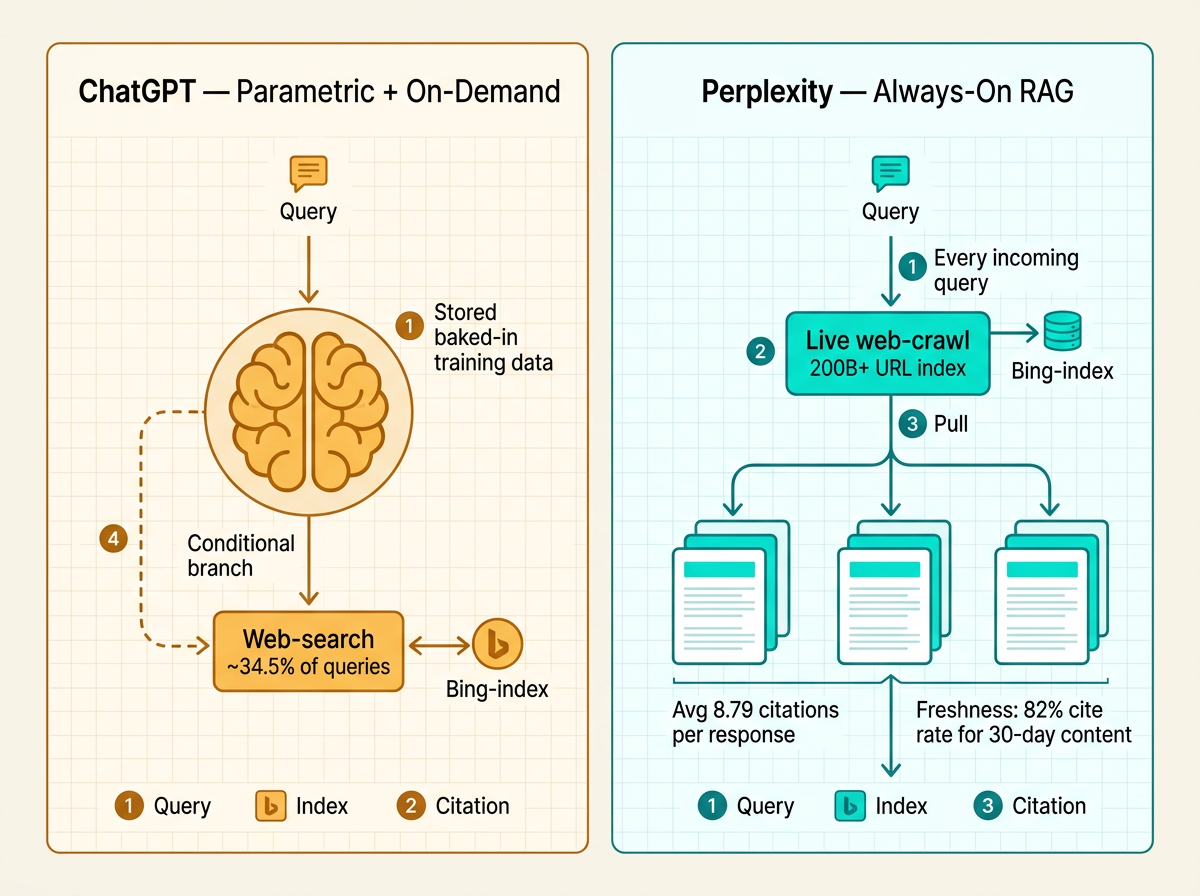
ChatGPT answers from training data first and searches the web second — it activates web search on only about 34.5% of queries, per a Semrush figure cited by NetRanks. The rest of the time it draws on parametric knowledge learned during pretraining, which is why it leans encyclopedic. When ChatGPT does browse, it uses Bing's index, and its citations align with Bing's top results roughly 87% of the time, according to Discovered Labs.
Perplexity works the opposite way. It runs retrieval-augmented generation continuously, crawling from a reported 200-billion-plus URL index and citing web sources on every answer by default. Perplexity averages 8.79 citations per response — the highest of any platform measured by AuthorityTech. Every claim gets a clickable source; ChatGPT shows sources only when its browsing tool fires.
That architecture drives two more differences worth knowing. Perplexity heavily rewards freshness: it cited 30-day-old content at an 82% rate versus 37% for older pages, per NetRanks, and DreamHost data shows roughly 3.2× more citations for content updated within the last 30 days. ChatGPT's parametric core is far less recency-sensitive, so a well-established page keeps earning ChatGPT citations long after it stops feeling new.
Citation accuracy also splits. In complex research tasks, Perplexity tied 78% of its claims to a specific source, versus 62% for ChatGPT, per Averi — and ChatGPT is more prone to fabricating plausible-sounding citations that don't exist. Perplexity also posted the lowest incorrect-answer rate (37%) in the Tow Center's tests. The practical takeaway: Perplexity is the retrieval-and-citation engine; ChatGPT is the synthesis-and-creation engine. Understanding how each engine sources answers is the foundation of any credible AEO plan.
Perplexity vs ChatGPT feature and citation comparison (2026)
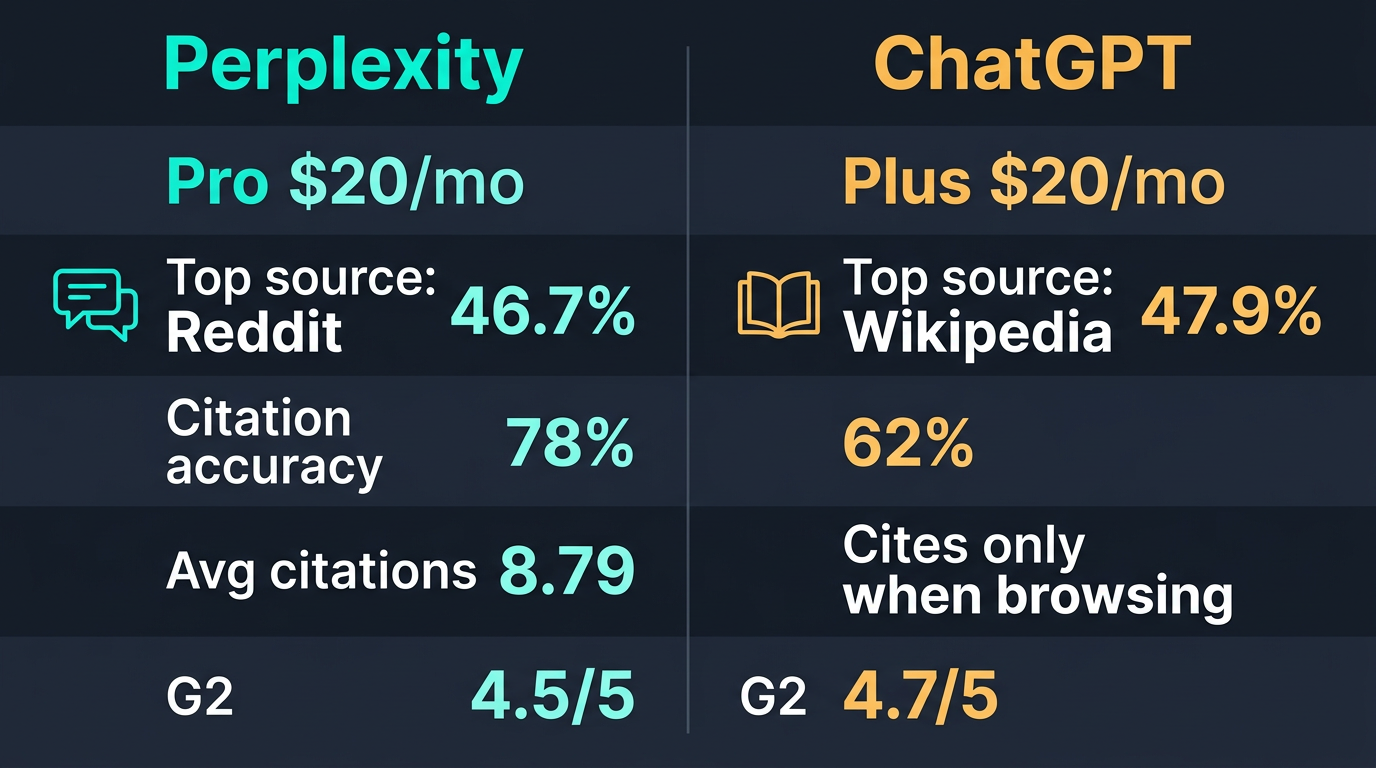
Perplexity Pro and ChatGPT Plus both cost $20/month, but they behave differently at almost every other level. The table below compresses the pricing, citation, and source-bias facts into one view.
| Attribute | Perplexity | ChatGPT |
|---|---|---|
| Entry paid tier | Pro — $20/month | Plus — $20/month (Go tier $8/month) |
| Retrieval model | Always-on RAG, real-time crawl of 200B+ URLs | Parametric knowledge + on-demand Bing browsing |
| Web-search activation | Every query by default | ~34.5% of queries (Semrush) |
| Avg. citations per response | 8.79 (highest measured) | Cites only when browsing tool runs |
| Top cited source | Reddit — 46.7% of top-10 citations | Wikipedia — 47.9% of top-10 citations |
| Citation accuracy | 78% of claims tied to a source | 62% of claims tied to a source |
| Content freshness bias | Strong — 82% cite rate for 30-day content vs 37% older | Weak — parametric core less recency-sensitive |
| Long-term memory | No; fresh each session | Yes; persists across sessions |
| G2 rating | 4.5 / 5 | 4.7 / 5 |
| Best for | Research, real-time facts, source-backed answers | Writing, coding, reasoning, long-form creation |
Domain overlap between the two sits at roughly 11%, and higher-priced tiers diverge too: ChatGPT Pro runs $200/month per Zapier (G2 recorded $100 in an April 2026 snapshot, likely a tier reshuffle), while Perplexity's $200 tier is called Max. Prices and model line-ups change fast, so treat these as point-in-time.
What the citation divergence means for getting your brand cited
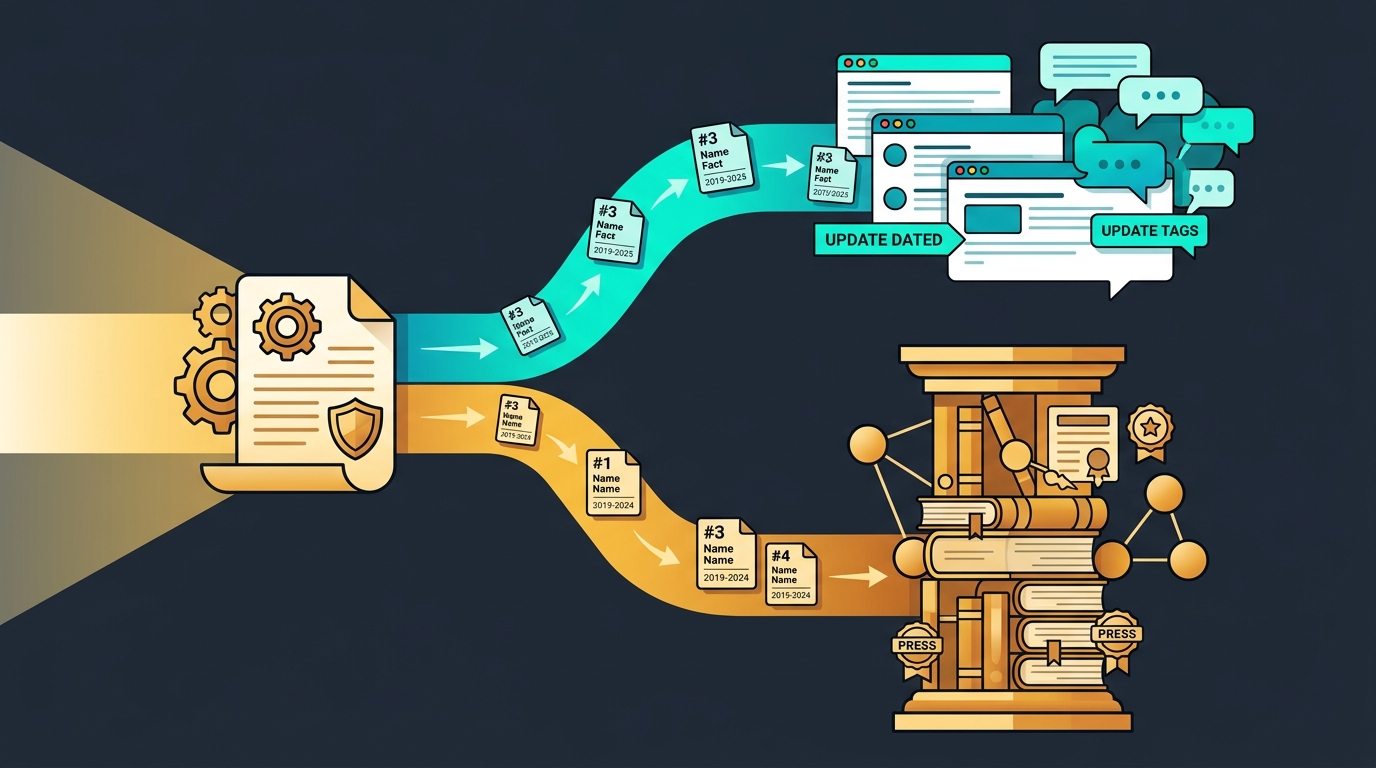
The divergence means you need two content strategies running at once — one built for ChatGPT's encyclopedic bias, one for Perplexity's fresh-web-and-community bias. Here is how that breaks down into concrete moves.
- Build encyclopedic authority for ChatGPT. Because Wikipedia feeds 47.9% of ChatGPT's top-10 citations, entity strength is your lever. Earn a Wikidata entry, get your brand named in context alongside your category terms across authoritative sites, and pursue press mentions with consistent naming. Unlinked brand mentions correlate with AI visibility at 0.664 in Ahrefs' 75,000-brand study — roughly 3× the 0.218 correlation for backlinks.
- Build community and fresh-web presence for Perplexity. Reddit sits in 46.7% of Perplexity's top-10 citations, so genuine participation in category subreddits matters. Detailed, honest answers that name your product as one option among several get pulled into citations far more than link-dropping. Perplexity's freshness bias also rewards regularly updated pages.
- Feed both with dense, dated, attributable facts. Every claim you publish should carry a number, a named entity, and a date so any engine can extract and verify it. Vague prose is unextractable.
- Track where citations actually come from. LLMRanks tracks brand citations live across ChatGPT, Perplexity, and four other engines, maps the exact off-site sources — Reddit threads, YouTube videos, and review sites — each engine pulls from, and audits your site for AI citation readiness. Its ChatGPT visibility tracker shows the encyclopedic sources feeding that engine specifically.
The strategic point: optimizing for "AI search" as one monolithic thing fails. As AuthorityTech puts it, each engine needs its own playbook — and their audit even flags ChatGPT as the hardest platform for owned-media brand visibility, since it leans on third-party co-occurrence. Read what AEO actually is before you split your effort.
Which should you optimize for in 2026 — Perplexity or ChatGPT?
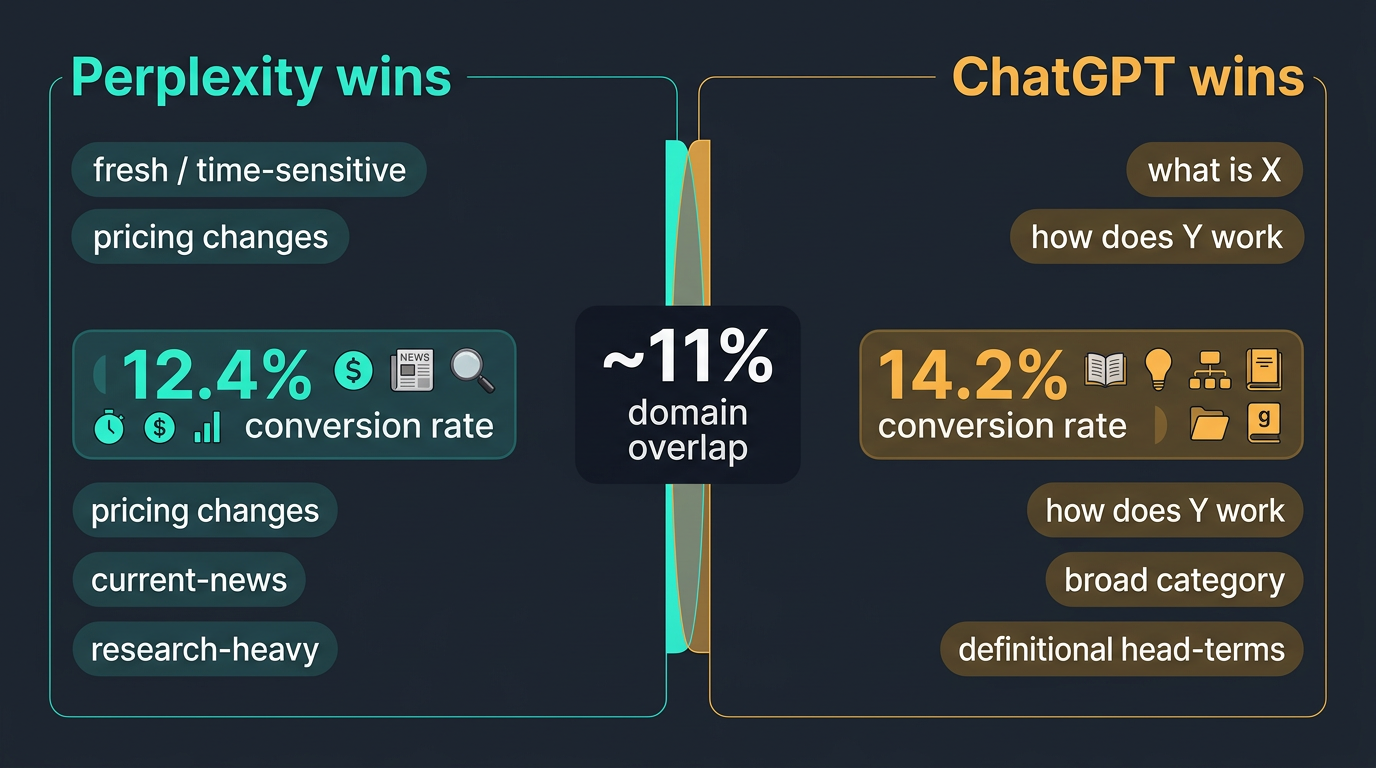
Optimize for both, but weight your effort by the queries your buyers actually ask. There is no single winner — the two engines serve different intents, and the smartest play is a platform-specific split rather than a monolithic "AI SEO" push.
For fresh, time-sensitive, or research-heavy queries — pricing changes, new-feature comparisons, current-news topics — Perplexity is where you win, because it retrieves in real time and rewards content updated within 30 days at more than double the rate of older pages. If your category moves fast, keep a steady drip of updated, source-backed pages and stay active in the relevant subreddits and review sites Perplexity crawls.
For definitional and head-term queries — "what is X," "how does Y work," broad category questions — ChatGPT often answers straight from parametric memory without browsing at all. Winning there is slower and more structural: you build entity authority through Wikipedia, Wikidata, co-occurrence with category terms, and consistent third-party mentions so the model learns your brand as part of the category.
Conversion data reinforces running both. AuthorityTech measured a 14.2% conversion rate on ChatGPT referrals and 12.4% on Perplexity — both strong, neither ignorable. And since only ~11% of their cited domains overlap, ceding one engine cedes an audience the other simply never reaches.
The safe answer for 2026: treat Perplexity and ChatGPT as two distinct citation surfaces, build encyclopedic authority for one and fresh community presence for the other, and measure your citation share on each separately. Use a free AI visibility check to see where you stand on both before you decide where to spend.
FAQ
Does ChatGPT cite sources like Perplexity does?
No, not by default. Perplexity cites web sources on every answer, averaging 8.79 citations per response. ChatGPT answers mostly from parametric training knowledge and shows sources only when its browsing tool activates — which happens on roughly 34.5% of queries, per a Semrush figure. Perplexity also ties 78% of claims to a source versus ChatGPT's 62%.
Is Perplexity Pro or ChatGPT Plus better value at $20 a month?
Both cost $20/month and win at different jobs. Perplexity Pro is better value for research, real-time facts, and source-cited answers. ChatGPT Plus is better for writing, coding, reasoning, and iterative long-form work. Most reviewers, including G2 and Zapier, recommend using both rather than choosing one — they are complementary tools, not direct substitutes.
Why do ChatGPT and Perplexity cite different websites?
They retrieve answers differently. ChatGPT synthesizes from parametric training knowledge and browses selectively, so it leans encyclopedic — Wikipedia is 47.9% of its top-10 citations. Perplexity runs real-time retrieval on every query across 200B+ URLs and favors fresh community content — Reddit is 46.7% of its top-10 citations. That produces near-disjoint source pools with only ~11% overlap.
How do I get my brand cited by both Perplexity and ChatGPT?
Run two strategies. For ChatGPT, build encyclopedic entity authority: Wikidata entries, consistent brand mentions alongside category terms, and press coverage. For Perplexity, maintain fresh, regularly updated pages and genuine presence in category subreddits and review sites. Track citation share on each engine separately — tools like LLMRanks map the exact sources each engine pulls from.