Content Patterns LLMs Favor
LLM-friendly content front-loads a direct, self-contained answer, uses headings that name the specific sub-questions people actually ask, and reserves…
5 min read · updated 2026-07-14
LLM-friendly content front-loads a direct, self-contained answer, uses headings that name the specific sub-questions people actually ask, and reserves structured formats like FAQ blocks for pages with genuine question demand. The single highest-leverage block is a 40–80 word opening paragraph that answers the query and names its main entity early. Getting these patterns right makes your content easier to retrieve, match, and quote verbatim.
The front-loaded answer pattern
The most reliable structure for a page that targets a question puts the answer first and the detail second. A clean template looks like this:
- H1: the topic
- A 40–80 word TL;DR or definition paragraph — this is what gets quoted
- H2: the user's question, restated in declarative form
- A direct 1–3 sentence answer
- Supporting detail, roughly 100–300 words
That opening 40–80 word paragraph is the single highest-leverage block on the page. In testing across Perplexity and ChatGPT, this paragraph was quoted verbatim in 60–70% of citations when it did two things: directly answered the query, and contained a named entity within the first 15 words.
The takeaway is practical. Don't bury your answer under throat-clearing context. Lead with the answer, name the thing you're talking about early, and keep the opening tight enough to be lifted whole into a generated response. For more on this, see Getting Quoted Verbatim and What Makes Content Citable.
Write headings around real sub-queries
Retrievers expand a query into a set of related sub-queries and match your headings against that expanded set. The win comes from naming the specific sub-query — not from adding a question mark.
Compare these:
| Weak heading | Stronger heading |
|---|---|
## Performance considerations | ## How fast is PgBouncer compared to PgCat in 2026? |
| (vague label) | ## PgBouncer vs PgCat performance in 2026 |
Both stronger versions work because they name the specific comparison a user might search. Use question form when it mirrors how people actually phrase the search — but don't force every heading into a question. Q&A formatting on its own measured slightly negative for absorption in 2026 research, so questions are a tool, not a default.
This matching behavior is why heading choices matter so much for retrieval. If you want the underlying mechanics, see How LLMs Choose Citations and Entities & the Knowledge Graph.
When FAQ blocks help — and when they hurt
FAQ blocks have a mixed record, and the honest picture is that they are now easy to overuse. Google restricted FAQ rich results to government and health sites in 2023 and ended them entirely on May 7, 2026. Separately, 2026 absorption research measured Q&A-formatted pages slightly worse than non-Q&A pages on average — about -5.7%. FAQ-ifying everything is a verified anti-pattern.
That said, FAQ blocks still earn citations when they answer real long-tail questions people actually search. The distinction is intent: a genuine question that shows up in "People Also Ask" or in AI-mode query fan-out is worth a structured answer; an invented question padded onto a page is not.
Guidance:
- Place 3–5 genuinely-searched FAQ items on pages that have real question demand.
- Skip the FAQ block entirely on pages without it.
- Keep each answer direct and specific — the answer text is what gets pulled.
When you do use one, mark it up with FAQPage schema so the question and answer text are unambiguous:
<section itemscope itemtype="https://schema.org/FAQPage">
  <div itemprop="mainEntity" itemscope itemtype="https://schema.org/Question">
    <h3 itemprop="name">What is the max connection limit in PgBouncer 1.22?</h3>
    <div itemprop="acceptedAnswer" itemscope itemtype="https://schema.org/Answer">
      <p itemprop="text">PgBouncer 1.22 supports up to 10,000 client connections per pool by default, configurable via max_client_conn.</p>
    </div>
  </div>
</section>
For the schema side of this, see Structured Data & Schema.
Key takeaways boxes
A bulleted "Key Takeaways" or TL;DR box near the top of long-form content gets cited disproportionately. It works for the same reason the front-loaded answer paragraph works: it packages the core claims into short, self-contained, liftable statements.
Treat the box as a summary of what the page proves, not a teaser. Each bullet should be a complete, standalone sentence that a reader — or a generated answer — could use without the surrounding context. On short pages this is less necessary; on long, detailed pages it gives retrievers an easy target to quote.
How these patterns fit together
These structural patterns reinforce each other. The opening paragraph gives a retriever something to quote. Sub-query headings help it find the right section. A takeaways box concentrates your strongest claims. And a restrained FAQ block captures genuine long-tail questions without dragging down the whole page.
None of this replaces substance. Naming an entity early only helps if the surrounding content is accurate and specific, and a heading that names a sub-query only earns citations if the section actually answers it. Structure makes good content easier to retrieve and quote; it does not manufacture authority on its own. For the broader picture of how retrieval and citation work, see AEO & GEO and The Sources That Fuel LLMs.
What to do
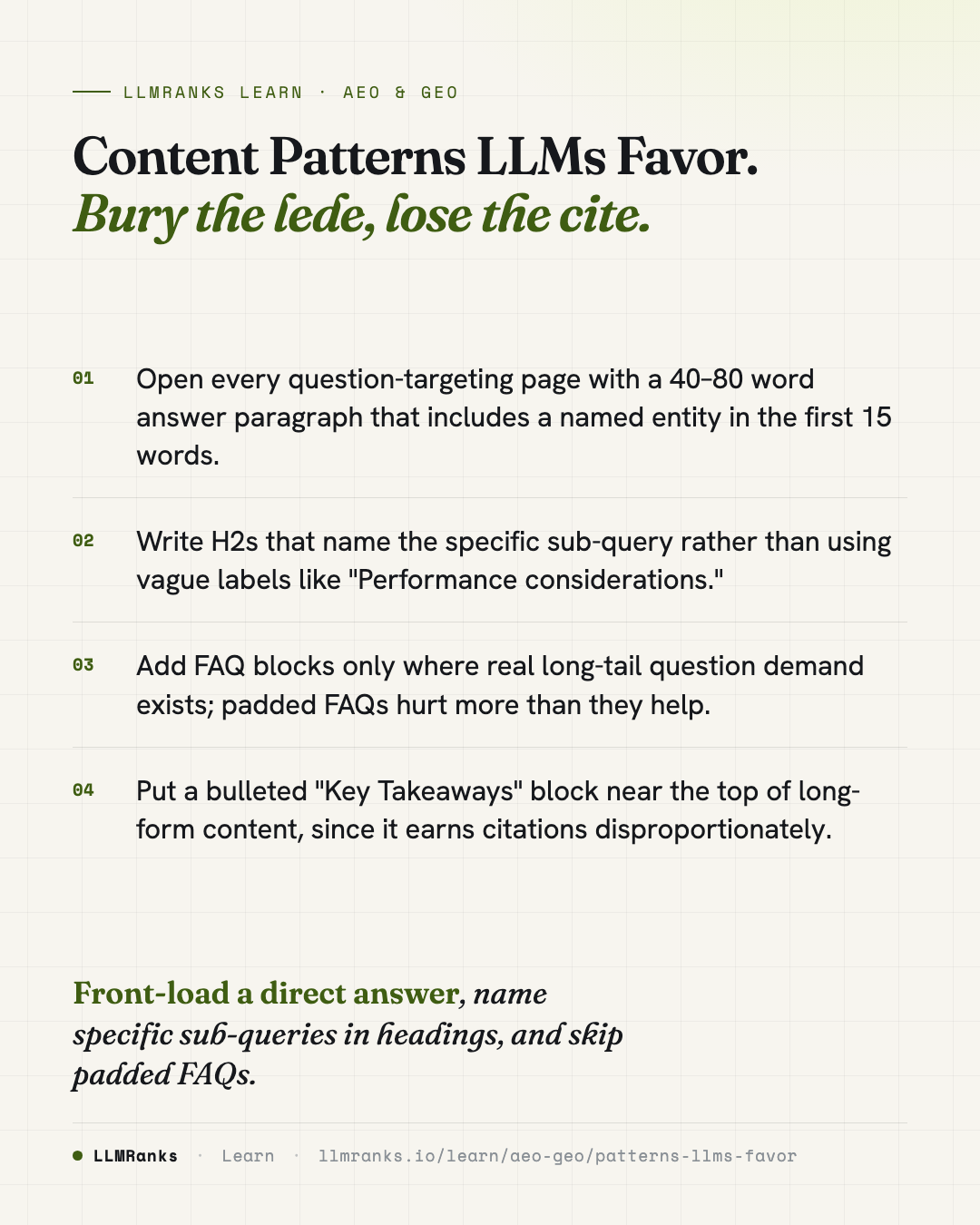
- Add a 40–80 word answer paragraph to the top of every question-targeting page, and put a named entity in the first 15 words.
- Follow it with an H2 that restates the user's question declaratively, then a 1–3 sentence direct answer and 100–300 words of supporting detail.
- Rewrite vague headings so each one names a specific sub-query; use question form only when it matches real search phrasing.
- Add a bulleted "Key Takeaways" box to long-form pages, with each bullet written as a complete standalone sentence.
- Add FAQ blocks only on pages with genuine long-tail question demand — 3–5 real questions from "People Also Ask" or query fan-out — and mark them up with FAQPage schema.
- Remove padded or invented FAQ blocks; on average they measured worse than pages without them.
save this card
 Download card
1080×1350 · post it anywhere
put it to work
See how ChatGPT, Gemini and Google AI actually talk about your brand.