What Makes Content Citable
LLMs and their re-rankers preferentially cite content that lowers the model's risk of being wrong. In practice that means writing that is verifiable,…
5 min read · updated 2026-07-14
LLMs and their re-rankers preferentially cite content that lowers the model's risk of being wrong. In practice that means writing that is verifiable, attributable, and quotable on its own — a specific claim a model can lift out of your page without reading the paragraph before it. If you want to get cited by ChatGPT and similar engines, the job is to make individual sentences and sections stand alone as trustworthy, self-contained answers.
Why citability comes down to verification
A model cites what it can defend. Content that is easy to attribute and quote reduces the model's hallucination risk, so re-rankers up-weight it. The three properties that matter most are that a claim is verifiable (a reader could check it), attributable (it names a source or authority), and quotable in isolation (it makes sense pulled out of context).
Everything below is a way to strengthen one of those three properties. For a deeper look at the selection mechanics, see How LLMs Choose Citations.
The signals that make content citable
These signals are ordered roughly by observed impact.
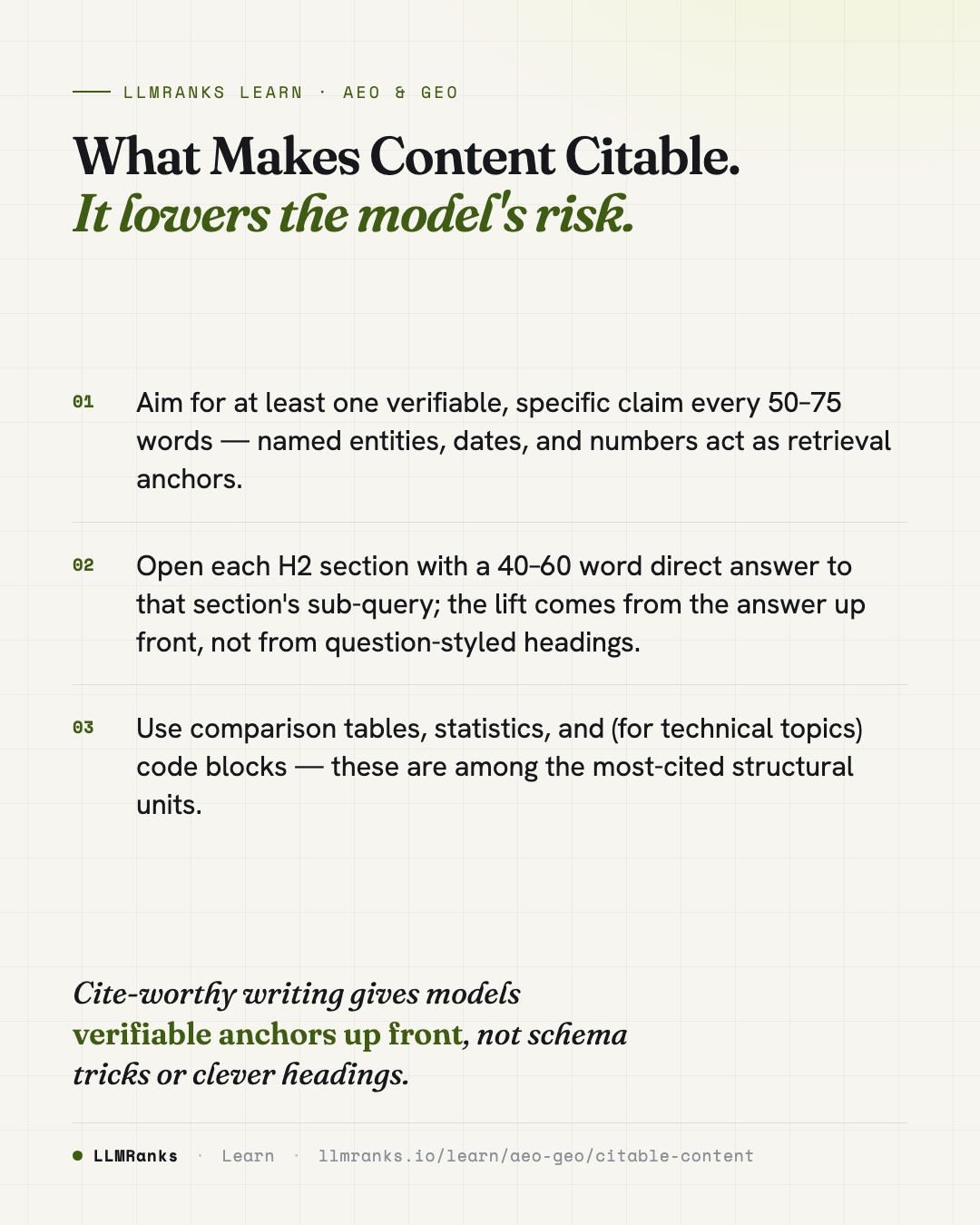
Factual density. Target at least one verifiable, specific claim per 50–75 words. "Postgres 16 introduced logical replication for partitioned tables in September 2023" beats "Postgres has improved replication."
Named entities, dates, and numbers. Models latch onto strings like "PgBouncer 1.22.0", "released October 2024", or "supports up to 10,000 concurrent connections." These act as retrieval anchors because they appear identically when the query is reformulated. See Entities & the Knowledge Graph.
Definitive claims, hedged only when warranted. "X is faster than Y by 2.3× on TPC-C at 32 cores" gets cited. "X may be faster in some cases" does not.
Original data and primary research. Benchmarks, surveys, and internal datasets are up-weighted. Both Perplexity and ChatGPT favor pages identified as primary sources.
Direct quotes from named authorities. "According to Bruce Momjian, core Postgres committer..." tends to get re-quoted verbatim because the attribution is preserved. More on this in Getting Quoted Verbatim.
Answer-first sections. Open each H2 with a 40–60 word direct answer to that section's sub-query. Question-phrased H2s help when they mirror real user queries, but Q&A formatting alone measured slightly negative for citation absorption (−5.7% in a 2026 study) — the lift comes from the direct answer up front, not the question styling.
Outbound citations to primary sources. Pages that cite Wikipedia, arXiv, RFCs, or vendor docs are scored higher, because the model can chain-verify your claims against sources it trusts.
Structure and format that get extracted
Certain structural units are quoted at much higher rates than plain prose. Based on 2026 absorption research:
| Structural unit | Measured citation influence |
|---|---|
| Code blocks (technical topics) | ~+77% (highest measured) |
| Statistics | ~+62% |
| Comparison tables | ~+55% vs pages without |
Comparison content in Markdown or HTML tables gets extracted as structured data and quoted often. If your topic invites a comparison, build the table. For technical subjects, real code blocks are the single most-cited unit measured. See Content Patterns LLMs Favor.
What about schema markup?
Schema.org types like FAQPage, HowTo, Article, Product, SoftwareApplication, Dataset, and ClaimReview are read as plain text where engines see them at all. Retrieval testing shows AI systems extract visible HTML and ignore JSON-LD, microdata, and RDFa.
The controlled evidence is skeptical of schema as a citation lever. A 2026 difference-in-differences study of 1,885 pages that added JSON-LD versus roughly 4,000 matched controls found no citation lift on AI Overviews, AI Mode, or ChatGPT. Google officially states no special markup is needed: "there's no special schema.org markup you need to add."
There is one verified exception. A small controlled study (EverGrow, June 2026) found LocalBusiness schema improved ChatGPT position (+3.3) and visibility (+10 percentage points) for local businesses at greater than 91% confidence, while doing nothing on Google, Bing, or Maps.
The practical takeaway: keep schema for rich-result eligibility and entity disambiguation, but don't treat it as an AI-citation lever. For the mechanics, see Structured Data & Schema.
Anti-patterns that kill citability
Each of these breaks verifiability, attribution, or quote-in-isolation:
- Walls of text without H2/H3 anchors — nothing for a model to grab.
- Answers that require prior context ("As mentioned above...") — they don't survive extraction.
- Marketing hedging like "industry-leading" or "best-in-class" — unverifiable, so unciteable.
- Numbers without units or dates ("up to 10x faster" — faster than what, when, on what hardware?).
- JavaScript-rendered content without SSR or prerender. Most LLM crawlers render less aggressively than Googlebot; Perplexity and ClaudeBot in particular are weak on JS execution as of late 2025.
- Gated content behind login or paywall walls without a
meta name="robots"allowance for LLM crawlers.
Different engines behave differently, so it's worth checking Citation Behavior by Engine before assuming one fix generalizes.
What to do
- Audit each page for factual density — aim for one specific, verifiable claim every 50–75 words, and add missing dates, versions, and numbers with units.
- Rewrite each H2 to open with a 40–60 word direct answer that makes sense on its own, without relying on earlier paragraphs.
- Replace marketing hedging with definitive, sourced claims; hedge only where the evidence genuinely warrants it.
- Add comparison tables, statistics, and code blocks wherever the topic supports them — these are your highest-value extractable units.
- Cite your own primary sources (docs, standards, research) so models can chain-verify your claims.
- Ensure content renders in plain HTML without JavaScript, and confirm LLM crawlers aren't blocked by robots rules or gates.
- Keep schema for rich results and entity disambiguation — but don't count on it to earn AI citations.
For the broader picture of how this fits alongside classic search, see AEO & GEO and SEO vs AEO: Where They Align and Where They Diverge.
save this card
 Download card
1080×1350 · post it anywhere
put it to work
See how ChatGPT, Gemini and Google AI actually talk about your brand.