How ChatGPT Search Works
ChatGPT search works by combining a scheduled crawl of the open web with live retrieval and passage-level scoring, then presenting answers with inline…
6 min read · updated 2026-07-17
ChatGPT search works by combining a scheduled crawl of the open web with live retrieval and passage-level scoring, then presenting answers with inline numbered citations. When you ask a question, ChatGPT may rewrite it into one or more targeted queries, pull candidate passages from its own crawl store and search partners, and cite a handful of sources it judges relevant and authoritative. Understanding which of its crawlers does what — and how it selects passages rather than whole pages — is the key to getting cited.
The four ChatGPT agents
OpenAI's bot documentation describes four distinct agents, each controlled separately in robots.txt. Treating them as one is the single biggest configuration trap — teams often block everything to protect training data and silently delist themselves from ChatGPT citations.
| Agent | Role | Notes |
|---|---|---|
OAI-SearchBot | Surfaces websites in ChatGPT's search features | Blocking it removes you from the search index |
ChatGPT-User | User-initiated actions in ChatGPT and Custom GPTs | OpenAI states robots.txt rules may not apply — live fetches are not reliably blockable |
GPTBot | Training-data crawler | Separate consent regime; blocking it does not block search/citation |
OAI-AdsBot | Validates ad landing-page safety | Not used for training |
Because ChatGPT-User fetches are user-triggered, a page can still be pulled into an answer even when crawlers are blocked. Everything else, though, depends on letting OAI-SearchBot in:
User-agent: OAI-SearchBot
Allow: /

User-agent: ChatGPT-User
Allow: /

User-agent: GPTBot
Disallow: /private/

User-agent: OAI-AdsBot
Allow: /
You can verify these agents by reverse DNS to *.chatgpt.com or against published IP ranges (for example, openai.com/searchbot.json for OAI-SearchBot). The crawler split was formalized in late 2024 and fully enforced by 2025.
How retrieval works
When you submit a query, ChatGPT does not always search once. OpenAI's ChatGPT-search help and privacy documentation states it rewrites a query into "one or more targeted queries" and "may send additional, more specific queries," via search partners including Bing (Microsoft) and Shopify. OpenAI does not call this "fan-out" and gives no count, but the multi-query decomposition is vendor-documented.
Beyond partner search, a maintained crawl store is strongly implied: OAI-SearchBot is a scheduled crawler distinct from the user-triggered ChatGPT-User, and OpenAI notes that robots.txt changes take about 24 hours to propagate — a pure per-query live fetch would honor them on the very next request.
One important caveat on how sources are chosen: OpenAI does not publicly describe OAI-SearchBot as a "proprietary index," and its bot documentation does not mention Bing. A model where an own index leads, Bing signals are residual, and Google acts as fallback is an inference from observed behavior, not stated design. In one 270-answer study, only about 10% of ChatGPT-cited pages ranked in Google's top 10 — so treat this as measured behavior, not documented architecture.
What ChatGPT favors when selecting sources
ChatGPT scores passages, not pages. A clean 200-word section with clear semantic boundaries can be cited from an otherwise weak page. That changes how you should structure content.
The favored profile includes:
- Clear H2/H3 hierarchy with question-shaped headings like "What is X?" or "How does Y work?"
- Definition-first paragraphs — put the answer in the first one or two sentences after the heading.
- Tables and structured comparisons, which are cited disproportionately. Leaked internal behavior in 2025 pointed to roughly a 3x citation lift for tables versus equivalent prose.
- Recency: within 18 months (via
dateModified) for evergreen content, or 90 days for trending topics. - E-E-A-T proxies: author schema with
sameAsto LinkedIn or ORCID, and organization schema with verifiable identity.
For deeper work on these fundamentals, see On-Page SEO and Content Strategy & E-E-A-T.
What gets cited — and what gets ignored
ChatGPT extracts visible, answer-shaped content. Q&A pairs, step sequences, and spec tables perform well, as do clear mainEntity declarations and speakable markup for definition snippets. Wikipedia-like factual density — a claim, its qualifier, and its source — matches what the engine looks for.
A notable point on schema: the markup wrappers such as Article, NewsArticle, FAQPage, HowTo, Dataset, and Product add little on their own. 2026 retrieval testing shows engines extract visible HTML and largely ignore JSON-LD, and a controlled Ahrefs study found no citation lift from adding it. Schema still has other uses — see Structured Data & Schema — but don't expect it to win ChatGPT citations by itself.
Content that tends to be ignored:
- JavaScript-rendered content without SSR or prerender.
OAI-SearchBot's JS execution improved in 2025 but remains weaker than Googlebot, so server-side rendering is still required. - Pages with
noindexorX-Robots-Tag: noai, noimageai. - Walled content behind cookie walls or aggressive interstitials.
- Listicles with thin paragraphs under 40 words per item.
- Content older than 24 months with no
dateModifiedupdate.
Citations, caching and freshness
Answers use inline numbered citations rendered as clickable chips that expand to a sidebar showing title, domain, and snippet. A typical response cites 3–8 sources, with diversity weighting: usually no more than two from the same domain unless the query is brand-specific.
Caching behavior rewards technically clean sites:
- Embeddings refresh on crawl, not on query — so recency depends on how often you get recrawled.
- Crawl frequency is tier-based: high-authority sites (Wikipedia, major news,
.gov) roughly hourly; mid-tier daily; the long tail weekly to monthly. Last-ModifiedandETagheaders are respected, and sites that serve them correctly get prioritized recrawls.If-Modified-Sinceis honored — return a proper 304 to preserve crawl budget.
This overlaps heavily with Technical SEO; the same server hygiene that helps traditional crawlers helps here.
How this has changed since 2024
| Aspect | 2024 | 2026 |
|---|---|---|
| Index source | Bing-dependent | Proprietary crawl appears dominant |
| Crawler split | GPTBot only | Distinct agents, controlled separately |
| Citation density | 2–4 per response | 5–10, more diverse |
| Passage retrieval | Page-level | Passage-level scoring |
| JS rendering | Minimal | Partial; SSR still required |
The direction is consistent: more independent crawling, more citations, and finer-grained passage scoring. ChatGPT is one of several engines worth optimizing for together — see Cross-Engine AI Visibility and the broader AI Search Engines overview, including Microsoft Copilot & Bing Chat.
What to do
- Audit your
robots.txtand confirmOAI-SearchBotis allowed; do not assume blockingGPTBotprotects you — it only affects training data. - Whitelist ChatGPT's user agents in your WAF or Cloudflare and verify them by reverse DNS to
*.chatgpt.comor the published IP ranges. - Restructure key pages with question-shaped H2/H3 headings and definition-first paragraphs that answer in the first one or two sentences.
- Convert comparisons and specs into tables, and keep list items substantial (aim above 40 words each).
- Serve content in visible, server-rendered HTML; don't rely on client-side JavaScript or on JSON-LD to carry the answer.
- Configure
Last-Modified,ETag, and correct 304 responses, and keepdateModifiedcurrent so you qualify for prioritized recrawls. - Add verifiable author and organization identity signals with
sameAslinks to strengthen E-E-A-T proxies.
save this card
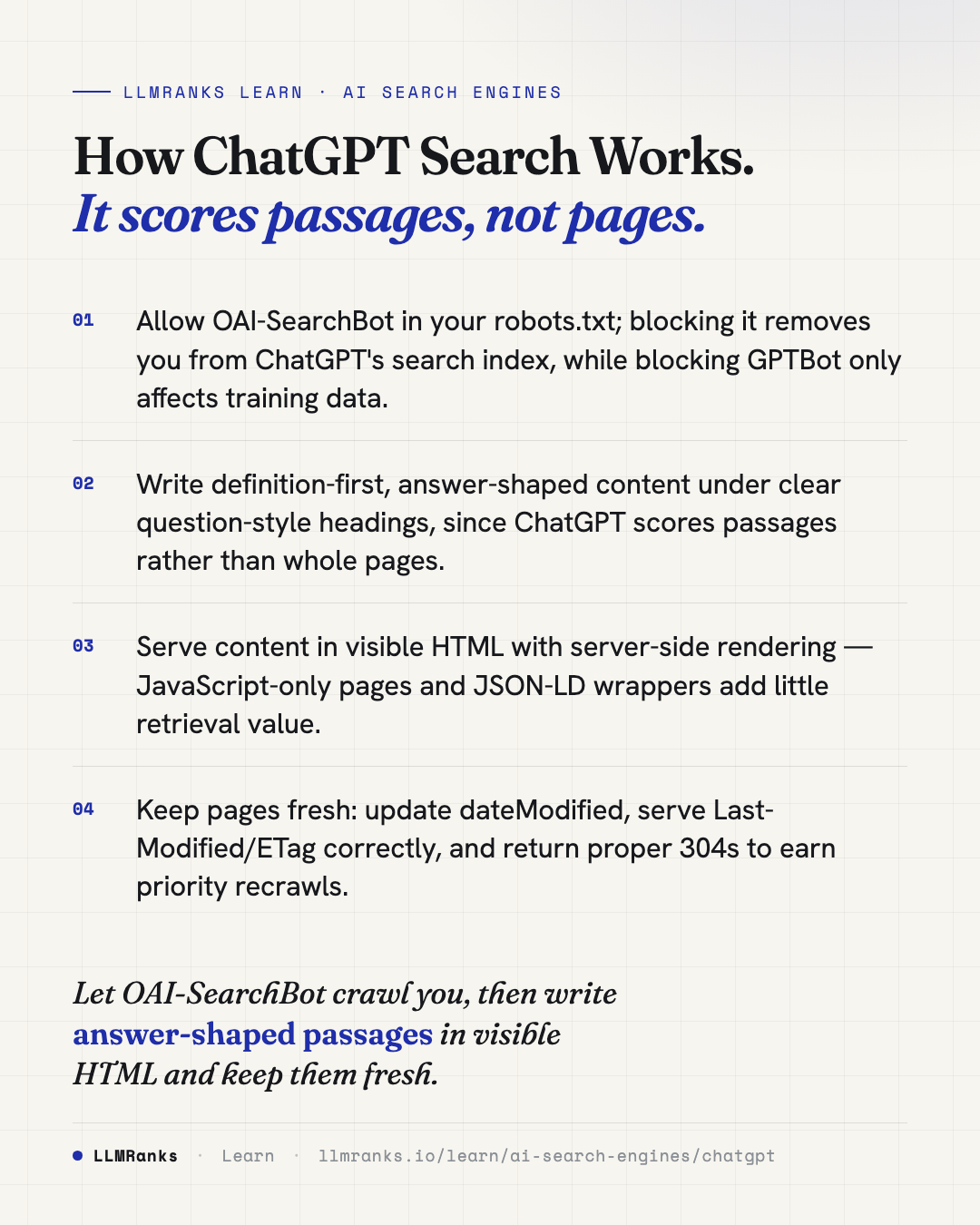 Download card
1080×1350 · post it anywhere
put it to work
See how ChatGPT, Gemini and Google AI actually talk about your brand.