Future-proofing
SEO in 2026
SEO in 2026 is about being retrieved, cited, and trusted — not just ranked. Search has shifted from a list of blue links to an interface where AI systems…
SEO in 2026 is about being retrieved, cited, and trusted — not just ranked. Search has shifted from a list of blue links to an interface where AI systems summarize and cite your content, often without sending a click. To stay visible, build a strong entity identity, produce content with genuine information gain, and let AI retrieval crawlers reach your pages while deciding training access by business model.
The macro shift: from ten blue links to agent-mediated retrieval
The biggest structural change since 2024 isn't an algorithm update — it's that search has become something closer to an API call than a destination. Google's AI Mode (which grew out of SGE and rolled through AI Overviews in 2024), ChatGPT Search, Perplexity, Claude with web access, and increasingly autonomous agents now sit between your content and the user. Your pages get retrieved, summarized, cited, or ignored, frequently with no click at all.
The practical consequence is to optimize for retrieval, citation, and attribution rather than ranking alone. Click-through from AI Mode results runs roughly 30–60% lower than equivalent classic search positions, though this varies widely by query class: commercial queries retain more clicks while informational queries collapse. For a deeper treatment, see The Zero-Click, Agent Future.
AI Mode also decomposes a single query into multiple sub-queries executed in parallel, then synthesizes the results. That means you're now optimizing to be retrieved for any of the sub-queries in the decomposition, not just the user's literal phrase.
What changed in Google's algorithm
The trend line across recent core updates is clear: site-level quality signals now dominate page-level signals. The March 2024 core update folded the Helpful Content System into core ranking, so "helpfulness" is no longer a discrete classifier but a continuous, site-wide signal — one section of thin or AI-spam content can suppress your whole domain. The August 2024 update refined site-level quality and cracked down on "site reputation abuse" (parasite SEO on high-authority domains).
The March 2024 spam update killed three patterns explicitly: scaled content abuse, site reputation abuse, and expired domain abuse. Note the wording: Google stopped framing this as AI-versus-human and started talking about scaled content abuse. The threshold is whether content provides unique value at scale.
Details on the mid- and late-2025 updates are less certain and change faster than any static summary — verify current specifics against official documentation. For the fuller history, see Google Updates 2024–2025.
Entity identity and semantic relevance
Search moved from string matching to entity matching over the past decade, and in 2026 the unit of ranking is the entity relationship. Establishing entity identity is now table stakes: give every important entity — your company, products, authors — a canonical URL, Organization/Person/Product schema with a permanent @id, and a sameAs array linking to authoritative profiles. Wikidata is the primary knowledge graph signal; if your brand qualifies for notability through secondary sources, get it listed legitimately. See Entity-Based SEO and Structured Data & Schema.
On the semantic side, Google classifies queries into intent buckets, and mismatching your content type to the intent means you won't rank. Map the content accordingly:
| Intent | What to serve |
|---|---|
| Informational | Comprehensive explainer, answer-first structure (a TL;DR in the first 100 words) |
| Commercial investigation | Comparison content with tables, original testing data, clear winner logic |
| Transactional | Product/category pages with Product/Offer schema and in-stock signals |
| Navigational | Own your brand SERP entirely |
Google ranks passages, not just pages. Score each section for coverage of a target sub-intent, look for topics competitors cover that you don't, and make each section answer its implied question without needing surrounding context — "orphan passages" that only make sense in document flow don't get cited. See On-Page SEO.
Brand authority and demand
Brand authority is arguably the most undervalued factor of 2026. The March 2024 Content Warehouse leak confirmed several long-suspected mechanics: a computed site-level siteAuthority score, a NavBoost system using Chrome and click data (including a 13-month click history window), and dampening for new sites. Branded queries and brand-anchor links feed authority.
The practical implications:
- Branded search volume is a leading indicator. Sites that grow branded search tend to gain non-branded rankings afterward. Drive demand through PR, podcasts, YouTube, community, and paid brand campaigns.
- In AI engines, brand recognition drives citation selection. When a model picks which of many sources to cite, recognized brands win disproportionately. Measure your share of model voice — how often your brand appears in responses to category prompts.
- Co-citation with your category needs to appear across third-party sources: press, listicles, comparison sites, and forum threads. This ties into Off-Page Authority.
Note that mentions can help even when unlinked — brand mention velocity in news and forums is a real signal worth tracking.
Content quality, E-E-A-T, and AI disclosure
Google's position is that AI-assisted content is fine if it demonstrates experience, expertise, authority, trust, and unique value; AI-generated spam at scale is penalized. There is no Google requirement to disclose AI use and no ranking penalty for undisclosed AI per se — only for low quality. The decisive factor is information gain: does the page add something the existing corpus lacks?
The added Experience signal is now heavily weighted, especially for YMYL and product reviews. Reward-worthy signals include original photos (not stock), first-person testing language, named authors with verifiable credentials, and Person schema with knowsAbout and sameAs links to profiles like LinkedIn or ORCID. Author entity reputation now propagates across sites, so getting your experts cited and quoted elsewhere is valuable. For YMYL topics, require a named, credentialed reviewer byline and review date regardless of AI use.
Disclosing AI assistance alongside named human review is becoming a positive trust pattern for sensitive content. Provenance standards like C2PA are rising for images and video, but there's no equivalent reliably consumed for text yet — treat it as immature. EU AI Act transparency obligations are phasing in and their exact enforcement timing should be verified against current sources. See Content Strategy & E-E-A-T and AI Content Disclosure Norms.
Structured data, HTML, and the retrieval crawlers
A key 2026 principle: AI engines primarily extract from rendered HTML, not JSON-LD. Controlled testing suggests structured data does not materially increase AI citation rates. Schema's real value is classic rich results and entity disambiguation in the knowledge graph, both of which help indirectly. So don't over-invest in schema as an "AI citation hack" — invest in clean, semantic, extractable HTML: proper heading hierarchy, real <table> elements, definition lists, answer-first paragraphs, and semantic landmarks. The highest-leverage structured-data work is an @id-based entity graph linking your schema nodes.
Organization, Product, Article, Recipe, and VideoObject schema remain high value. FAQPage and HowTo rich results are deprecated — Google removed FAQ rich results for all sites on May 7, 2026, and the markup shows no measured citation lift. Keep genuine visible Q&A content where the intent is real; stop selling the markup.
On crawler policy, the 2024 default of blocking all AI bots has reversed for most commercial sites, because blocking training crawlers is not the same as blocking retrieval crawlers — and blocking retrieval kills your citations. Allow retrieval bots universally, then decide on training bots by business model:
- Publishers/paywalled: block training, allow retrieval, negotiate licensing.
- SaaS/B2B/docs: allow nearly everything; training inclusion is future free distribution.
- E-commerce: allow retrieval (essential for agent discovery); training is lower-stakes.
- Affiliate/content: allow retrieval; block training if the writing itself is your moat.
Remember that robots.txt is honor-system — enforce hard blocks at the WAF, and distinguish training crawlers from user-action fetchers so you don't accidentally block a paying customer's agent. See robots.txt for AI Bots, Technical SEO, and Core Web Vitals.
A note on llms.txt: proposed in September 2024, it's a markdown index for LLM consumption. No major AI engine consumes it for live retrieval, and its empirical effect on citations is marginal to unmeasurable for most sites. Adoption is concentrated in developer-tool documentation. Treat it as low-cost insurance and better dev-audience UX, not a ranking lever — see llms.txt: The Reality Check.
Programmatic SEO and the agent frontier
Programmatic SEO with thin templates — [city] × [service] permutations with one swapped paragraph — is now actively penalized as scaled content abuse. Programmatic SEO with genuinely unique data per permutation still thrives. For each generated page, ask whether it contains data found on no other page, whether a user landing there would be satisfied, and whether low-value permutations are noindex'd rather than flooding the index. Index bloat from thin pages now suppresses siteAuthority. See Programmatic SEO in 2026.
Looking ahead, zero-click is the default now, with estimates trending past 60% of searches ending without a click. Optimize for being the cited answer, because a citation is a brand impression that drives later branded search. Conversational search means your content gets pulled across a multi-turn arc, so aim for topical completeness. Agent-driven search — autonomous systems that book, buy, and compare — is emerging but not yet dominant. Agent-readiness favors clean semantic HTML with stable selectors, structured availability feeds, and predictable architecture; standards for agent-facing endpoints are immature, so watch rather than build. See The Agentic Web, AI Search Engines, and AEO & GEO.
Several tactics are definitively dead and still appear in outdated advice: meta keywords, keyword density, exact-match anchor stuffing, article spinning, PBNs, AMP, Domain Authority chasing, arbitrary word-count minimums, and mass AI content with only light human review. See Dead SEO Tactics in 2026 and Internal Linking.
What to do
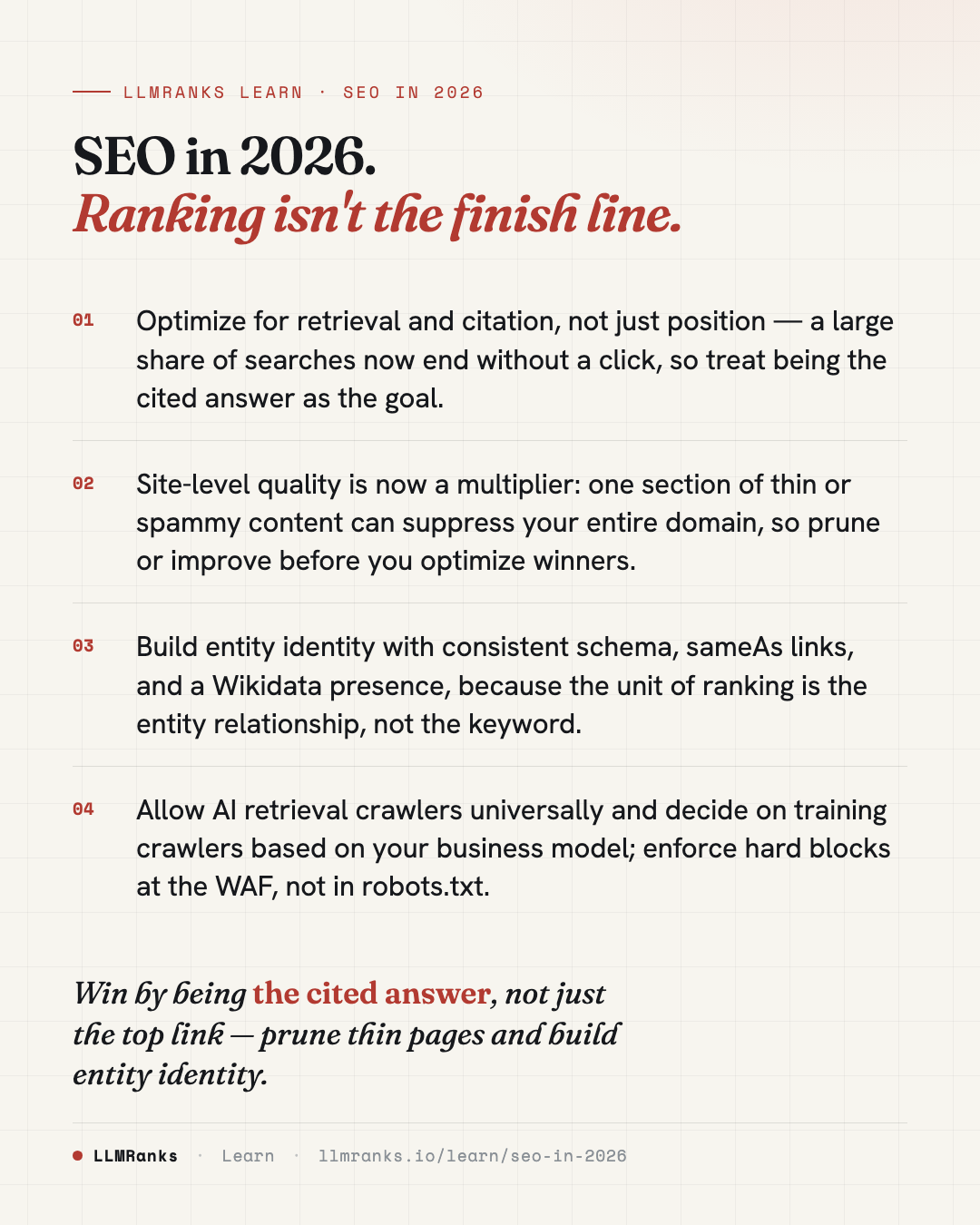
- Fix site-level quality first: prune, improve, or
noindexthin content before optimizing your winners. - Build entity identity —
Organization/Person@idgraph,sameAslinks, a Wikidata entry, and a clean brand SERP. - Apply an information-gain filter to every indexed page: it must add something the corpus lacks.
- Write answer-first, extractable HTML with dense, self-contained passages, real tables and lists, and TL;DR blocks.
- Add experience and authorship signals: named credentialed authors, original media, and first-person testing evidence.
- Map content to intent and cover the sub-query decomposition tree, not just head terms.
- Generate brand demand through off-page work, and track branded search volume and share of model voice.
- Allow retrieval crawlers universally, decide training crawlers by business model, and enforce hard blocks at the WAF.
- Measure zero-click value — citations, brand lift, branded search, and direct traffic — not just last-click organic.
- Drop the dead weight listed above and verify fast-moving specifics against official documentation.
save this card
 Download card
1080×1350 · post it anywhere