Nofollow, Sponsored & UGC Links
Nofollow and dofollow describe how a link passes ranking signals. A dofollow link (the default, with no special attribute) passes authority to its…
4 min read · updated 2026-08-05
Nofollow and dofollow describe how a link passes ranking signals. A dofollow link (the default, with no special attribute) passes authority to its destination; a nofollow link (rel="nofollow") tells search engines not to pass that signal. The important thing to understand is that adding nofollow doesn't redistribute equity elsewhere — the value simply evaporates. For internal links in 2026, you almost never want nofollow.
What the link attributes mean
There are four states a link can be in, controlled by the rel attribute. Each sends a different signal to search engines.
| Attribute | Markup | Use it for |
|---|---|---|
| dofollow | none (default) | Normal links you want to pass authority — the vast majority of internal links |
| nofollow | rel="nofollow" | Links you explicitly don't want to vouch for |
| sponsored | rel="sponsored" | Paid placements and advertising |
| ugc | rel="ugc" | Links inside user-generated content |
You can combine attributes when you need stricter control. For example, rel="ugc nofollow" is a reasonable choice for a comment section that attracts spam.
When to use nofollow on internal links
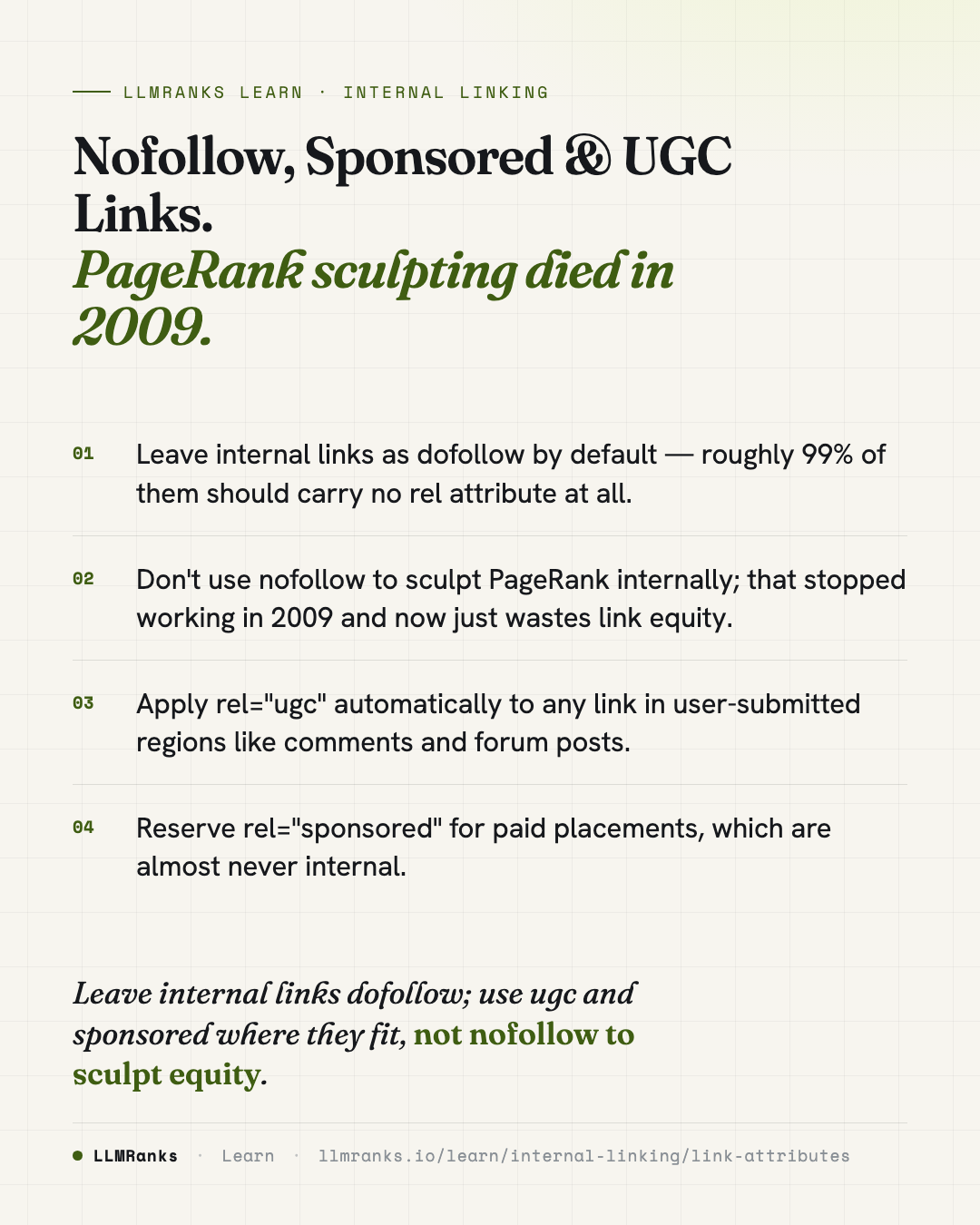
The short answer: almost never in 2026. The idea that you could add nofollow to "low-priority" internal links and funnel more equity to your important pages — PageRank sculpting — stopped working in 2009. Adding nofollow doesn't redistribute that equity to other links; it just makes it disappear.
There are a handful of internal cases where nofollow is acceptable:
- Login and logout links
- Account-specific URLs
- Internal search result pages
- Faceted navigation combinations you don't want crawled
Even in these cases, nofollow is usually the wrong tool. If your real goal is to control crawling or indexing, use a robots.txt disallow, a noindex directive, or a canonical tag. Those tools do the job nofollow was never designed for. For a deeper look at how authority moves through your site, see Link Equity & PageRank Flow.
Sponsored and UGC attributes
Sponsored. Use rel="sponsored" only for paid placements. On internal links this is almost never appropriate — the exception is publishers running internal advertorials, where a paid internal placement genuinely exists.
UGC. Use rel="ugc" for user-generated content such as comments and forum posts. The practical rule is to apply it automatically to any anchor in a user-submitted region of your site. Left unattributed, links dropped by spammers in your comment section leak equity straight to them. Where a comment area is a persistent spam magnet, combine attributes with rel="ugc nofollow" for tighter control.
Common mistakes to avoid
These are the errors that show up most often when reviewing how a site handles link attributes.
- Sitewide nofollow on all "low-priority" internal links. This dilutes equity that would otherwise have flowed through your site. It doesn't concentrate value anywhere — it destroys it.
- Nofollow on pagination. This breaks the crawl path to deep content that lives beyond page one. Use proper
<a href>links and let the search engine handle pagination. Therel="next"andrel="prev"markup was deprecated in 2019, but keeping it doesn't hurt anything. - Forgetting
rel="ugc"on comment sections. Without it, you leak equity to spam. rel="external"on internal links. This usually comes from a misconfigured CMS plugin and confuses crawlers about which pages belong to your site.- Mixing nofollow and dofollow to the same URL from different pages. This sends an inconsistent signal about whether you actually vouch for that destination.
- Nofollow on canonical equivalents. Applying nofollow to alternate versions of a page, such as
?utm=tracking URLs, is the wrong fix — use a canonical tag to point them at the real URL instead. target="_blank"withoutrel="noopener". This is a security issue rather than an SEO one, but it's worth flagging and fixing when you find it.
How this fits your internal linking
Link attributes are one lever inside a larger system. Most of the day-to-day work of moving authority around your site comes from how you structure and connect pages, not from rel attributes. Because dofollow is the default and should stay that way for internal links, the practical takeaway is mostly about restraint: don't reach for nofollow when a crawl or index directive is the right tool.
If you want to see how internal links shape crawl paths and authority, start with Internal Linking and Site Architecture for SEO. For choices about the visible link text that accompanies these attributes, see Anchor Text Strategy.
What to do
- Audit your internal links and confirm the default state — no
relattribute — on the roughly 99% that should be dofollow. - Remove any sitewide or "low-priority" nofollow rules on internal links; they destroy equity rather than redirecting it.
- Check pagination links and strip nofollow so crawlers can reach deep content.
- Apply
rel="ugc"automatically across all user-submitted regions, addingnofollowwhere spam is heavy. - Reserve
rel="sponsored"for genuine paid placements only. - Replace nofollow used for crawl or index control with
robots.txtdisallow,noindex, or canonical tags as appropriate. - Hunt down
rel="external"on internal links from CMS plugins, and fixtarget="_blank"links that are missingrel="noopener".
save this card
 Download card
1080×1350 · post it anywhere
put it to work
See how ChatGPT, Gemini and Google AI actually talk about your brand.