Site Architecture for SEO
Site architecture is how your pages are organized and linked so that both search engines and users can find, understand, and prioritize your content. In…
5 min read · updated 2026-08-03
Site architecture is how your pages are organized and linked so that both search engines and users can find, understand, and prioritize your content. In 2026 the goal has shifted: semantic clustering — grouping related pages around a clear topic — now matters more than a rigid URL hierarchy, because AI search tools increasingly crawl and cite content. That said, Google's classic link-equity flow still rewards intentional structure, so the best approach balances both.
The three core patterns
There are three architectures worth knowing. Each concentrates authority and organizes crawling differently, and each suits a different kind of site.
Hub-and-spoke (pillar + cluster) uses a central pillar page that links out to 8–30 cluster pages. Each cluster page links back to the pillar and laterally to a handful of siblings. This is the dominant pattern for AEO and GEO in 2026 because AI systems can ingest a single canonical entity definition — the pillar — and use the spokes for supporting sub-claims. See Topic Clusters & Pillar Pages for how to build these out.
Silo (strict hierarchical) organizes content into URL-based directories (/category/subcategory/page/) with firm boundaries and minimal cross-silo linking. It still earns its place on certain sites.
Flat architecture keeps everything within about two clicks of the root. It's simple and fast to crawl, but it spreads authority thin.
How hub-and-spoke works
The hub-and-spoke model is built around depth discipline and clear roles for each page type:
- Pillar page: 3,000–8,000 words, broad topic coverage, links out to all spokes.
- Spoke pages: 1,200–2,500 words, each targeting a narrow query intent. Spokes link back to the pillar using partial-match anchor text and link laterally to 3–7 sibling pages.
- Crawl depth: pillar to spoke is at most 1 click; pillar to a sibling-of-a-spoke is at most 2 clicks.
This keeps the topic tightly connected while giving every sub-topic its own dedicated, rankable page. The lateral sibling links matter — they help both crawlers and readers move across related intents without returning to the pillar each time. For guidance on anchor choices, see Anchor Text Strategy, and for how much linking is healthy, How Many Internal Links Per Page.
When a silo still makes sense
Strict silos concentrate topical authority within a directory, which remains useful for specific cases:
- E-commerce taxonomies where category-level equity must concentrate.
- Multi-vertical sites where search engines need strong topical separation — for example,
/legal/versus/medical/. - Sites with expertise, experience, authority and trust concerns that benefit from clear topic isolation. See Content Strategy & E-E-A-T.
One piece of older advice is now wrong: "never link across silos." In 2026, semantic bridges between related topics are rewarded, so cross-silo linking is fine when it's contextually justified. The one caveat is to keep those bridges inside body content — don't wire them into sitewide navigation.
When flat architecture fits
Flat structures work best for smaller or freshness-driven sites:
- Sites under roughly 500 URLs.
- News and publisher sites, where freshness matters more than hierarchy.
- SaaS documentation, where users often land deep via search.
The drawback is that authority dilutes evenly across the site, so there's no concentrated equity pushed toward your commercial pages. Flat is not recommended above about 1,000 URLs. If you use it, lean on sidebar navigation to keep everything shallow.
Choosing the right pattern
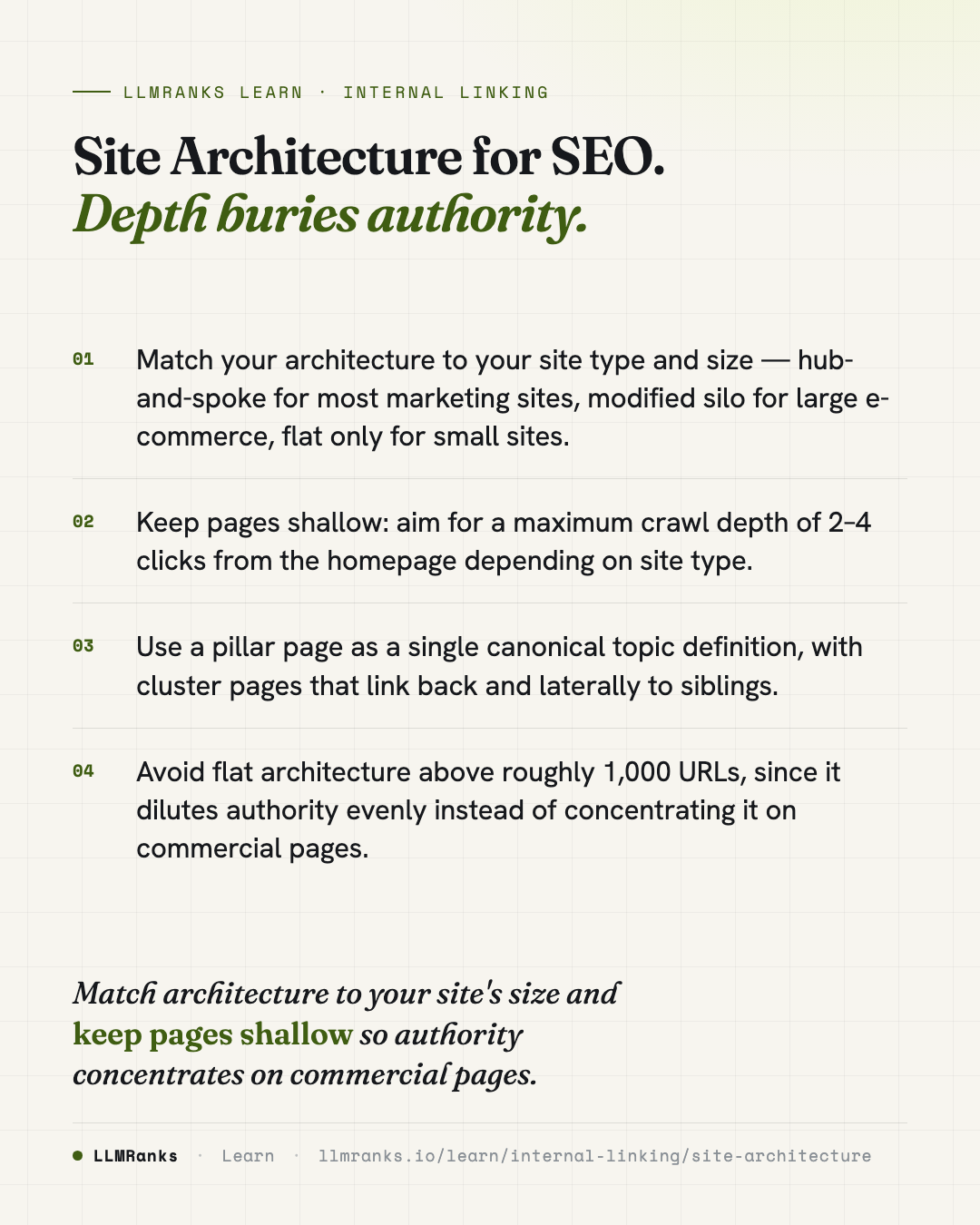
Match the architecture to your site type and expected size. The table below summarizes sensible defaults and how shallow you should keep your pages.
| Site type | Architecture | Max crawl depth |
|---|---|---|
| SaaS marketing site (50–500 URLs) | Hub-and-spoke | 3 |
| E-commerce (10k+ SKUs) | Modified silo + faceted hub pages | 4 |
| Publisher/blog | Hub-and-spoke + tag hubs | 3 |
| Documentation | Flat with sidebar nav | 2 |
| Enterprise multi-product | Silo per product, hub-and-spoke within | 4 |
Notice that the largest and most complex sites don't pick one pattern — enterprise multi-product sites, for instance, run a silo per product with hub-and-spoke inside each silo. Blending is normal; the point is that every section has a clear structural intent.
How architecture connects to the rest of your SEO
Architecture is the skeleton that other work hangs on. The way pages link determines how authority moves through your site — see Link Equity & PageRank Flow and the broader Internal Linking guide. Poor structure tends to create Orphan Pages that never get discovered, or Keyword & Link Cannibalization when multiple pages compete for the same intent.
Breadcrumbs reinforce hierarchy for both users and crawlers, and clean structure supports Technical SEO fundamentals. Because AI search tools now crawl and cite content, a clear pillar-and-cluster structure also helps your AEO & GEO visibility — a single canonical pillar gives these systems one entity definition to anchor to.
What to do
- Count your URLs and identify your site type, then pick a default pattern from the matrix above.
- If you're under ~500 URLs, consider flat; above ~1,000 URLs, move to hub-and-spoke or a modified silo.
- For each core topic, designate one pillar page (3,000–8,000 words) that links out to every related cluster page.
- Make each spoke 1,200–2,500 words, link it back to the pillar with partial-match anchor text, and link it laterally to 3–7 siblings.
- Enforce depth limits: keep pillar-to-spoke at 1 click and pillar-to-sibling at 2 clicks, and cap overall crawl depth at 3–4 per the matrix.
- Add cross-topic links only where they're contextually justified, and keep them out of sitewide navigation.
- Audit for orphan pages and cannibalization, and add breadcrumbs to reinforce your hierarchy.
save this card
 Download card
1080×1350 · post it anywhere
put it to work
See how ChatGPT, Gemini and Google AI actually talk about your brand.