Link Equity & PageRank Flow
Link equity is the ranking value that passes from one page to another through links. Internally, it still follows the same PageRank math from 2006: a page's…
5 min read · updated 2026-08-04
Link equity is the ranking value that passes from one page to another through links. Internally, it still follows the same PageRank math from 2006: a page's score equals a damping factor (0.85) multiplied by the sum of each incoming link's source score divided by that source's outbound link count, plus a teleport probability. In practical terms, the pages you link to most — and from your strongest pages — accumulate the most value. Managing that flow deliberately is one of the highest-leverage things you can do for internal linking.
How link equity flows
PageRank treats your site as a graph. Each page holds a score, and it passes that score along its outbound links. The receiving page's value depends on both how much its sources have and how many other links those sources spread their value across.
The core formula is unchanged: a page's PageRank equals the damping factor (0.85) times the sum of each incoming source's PageRank divided by that source's outbound link count, plus a teleport probability. The practical takeaway is simple — equity is finite and divided. A page that links to 200 destinations passes far less to each one than a page linking to 60.
Not all links pass the same value
Google's Reasonable Surfer model appears to still be active. Under it, links are weighted by how likely a user is to click them, factoring in position, anchor relevance, font size, and surrounding text. A contextual link in the second paragraph of your content can transfer meaningfully more equity than a footer link pointing to the same URL — an estimated 3–5x more, based on patent language and observed behavior rather than official confirmation.
This means placement matters as much as the link's existence. Burying an important link in a footer or sidebar is weaker than embedding it in relevant body text where a reader would plausibly click.
First-link priority and anchor attribution
The original "first link counts" rule is largely dead at the equity level — a page can now pass value through multiple links. But it still applies to anchor text attribution in many cases. If you link to /pricing twice on a page using two different anchors, Google may only credit the first anchor. Plan your primary anchor deliberately; see Anchor Text Strategy for how to choose it.
JavaScript-rendered links
JavaScript-rendered links do get crawled, but with a delay. For critical equity paths — like your homepage to your money pages — use server-rendered <a href> markup. Don't rely on onclick handlers, button-based navigation, or client-side routers that lack an <a> fallback. Making these paths crawlable directly is a Technical SEO fundamental.
Diagnosing your equity distribution
To understand where your value concentrates, model your internal link graph and look at a few specific patterns.
| Diagnostic | What it means | Why it matters |
|---|---|---|
| Internal PageRank per URL | Each page's score from the internal graph | Baseline for every other check |
| Equity per outbound link | Source score ÷ its outbound link count | Sitewide nav links count here |
| Equity gap | Money pages ranking below median internal PR | Commercial pages should sit in the top 20% |
| Equity sinks | High incoming value, few useful outbound links | Sitewide-linked privacy policies are classic offenders |
| Equity leaks | External dofollow links draining authority | Calculate the drain ratio from high-value pages |
The most common problem is an equity gap: your commercial and conversion pages should rank in the top 20% of internal PageRank, but they often sit below the median because they're linked less than blog posts or informational content. Flag any money page below the median and route more internal links to it.
Equity sinks are pages that receive a lot of value — usually because they're linked from every page in your navigation — but pass little onward. A privacy policy linked sitewide is the textbook example: it hoards equity it doesn't need. See Nofollow, Sponsored & UGC Links for how attributes affect what passes through such pages.
Equity leaks are external dofollow links from your high-value pages that drain authority off-site. That's not automatically bad — outbound links can serve users and signal relevance — but it's worth measuring the drain ratio so you know what's leaving.
Tactics to redirect equity
Once you know where value concentrates and where it's missing, a few moves make the biggest difference.
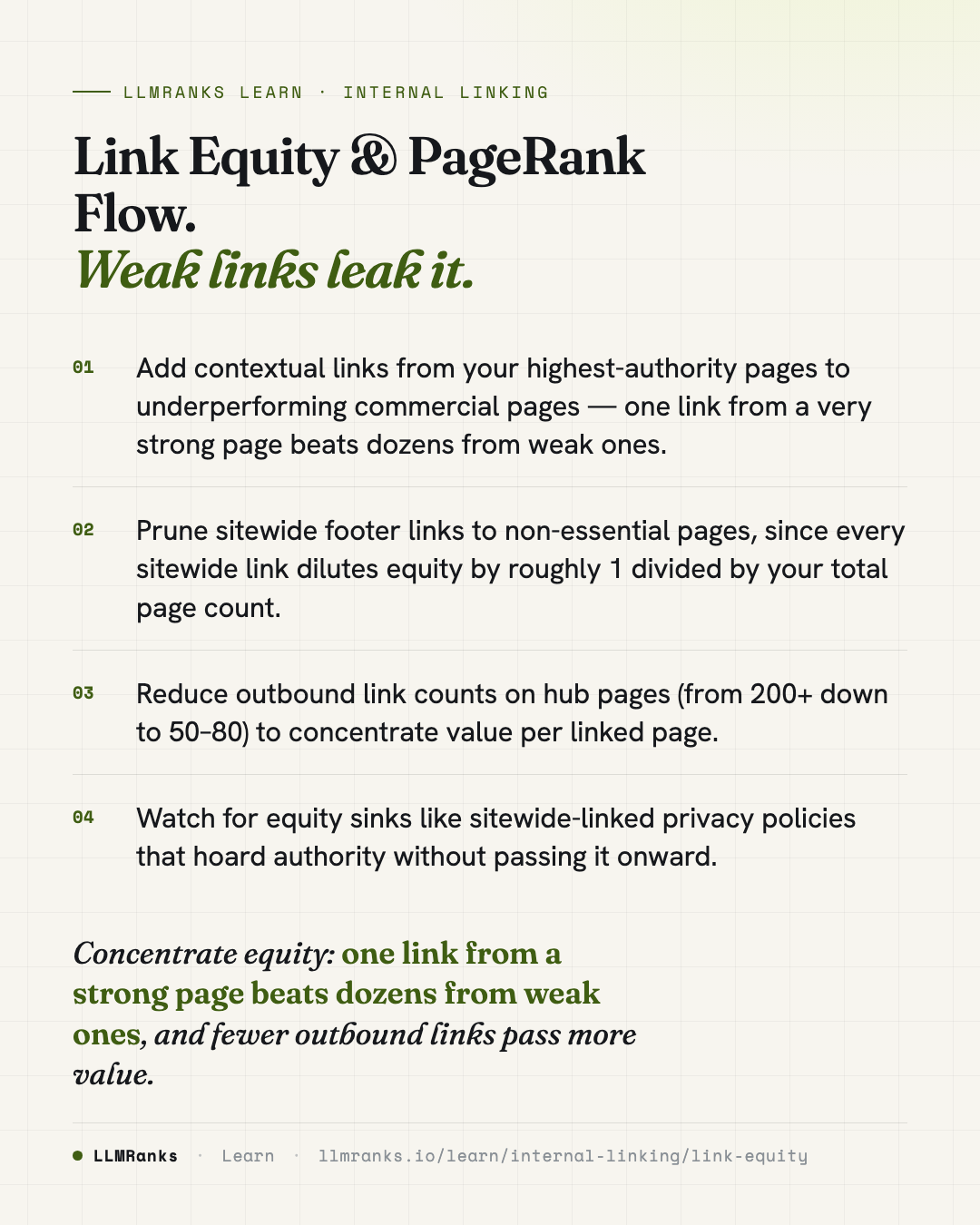
- Link from your strongest pages to your weakest important ones. Your highest internal-PR pages are usually the homepage, a top blog post, or a top-of-funnel pillar. Add contextual links from these to commercial pages that are underperforming. One link from a very high-authority page outweighs 50 from low-authority pages.
- Prune sitewide footer links to non-essential pages. Every sitewide link to something like
/aboutdilutes your other links by roughly 1 divided by your total page count. Remove the ones that don't need sitewide presence. - Reduce outbound link count on hub pages. A hub linking to 200+ destinations spreads its value thin. Trimming that to 50–80 concentrates equity per linked page. This ties directly into how you structure Topic Clusters & Pillar Pages and how many links you place per page — see How Many Internal Links Per Page.
These decisions also intersect with your overall Site Architecture for SEO. Shallow, well-connected structures distribute value more predictably than deep or fragmented ones, and pages left off the graph entirely — Orphan Pages — receive almost nothing.
What to do
- Model your internal link graph and calculate each URL's internal PageRank so you know where value actually concentrates.
- Identify your money pages and check whether they rank in the top 20% of internal PageRank; flag any that fall below the median.
- Add contextual body-text links from your highest-authority pages to those underperforming commercial pages, choosing the primary anchor deliberately.
- Audit sitewide footer and navigation links, and remove links to non-essential pages that dilute the rest.
- Trim bloated hub pages from 200+ outbound links down to 50–80 to concentrate value per destination.
- Find equity sinks — pages that receive value but pass little onward — and decide whether to reduce their inbound links or add useful outbound ones.
- Convert critical navigation paths to server-rendered anchor tags so equity flows without relying on JavaScript.
save this card
 Download card
1080×1350 · post it anywhere
put it to work
See how ChatGPT, Gemini and Google AI actually talk about your brand.