Anchor Text Strategy
Anchor text is the visible, clickable words in a link, and it tells both readers and search systems what the destination page is about. For internal links…
5 min read · updated 2026-08-04
Anchor text is the visible, clickable wording in a link. Google's published guidance is straightforward: make it descriptive, reasonably concise, and relevant to both the page containing the link and the page it opens. Write for the reader and the sentence first; there is no Google-published anchor-text ratio to satisfy.
There is no universal anchor-text ratio
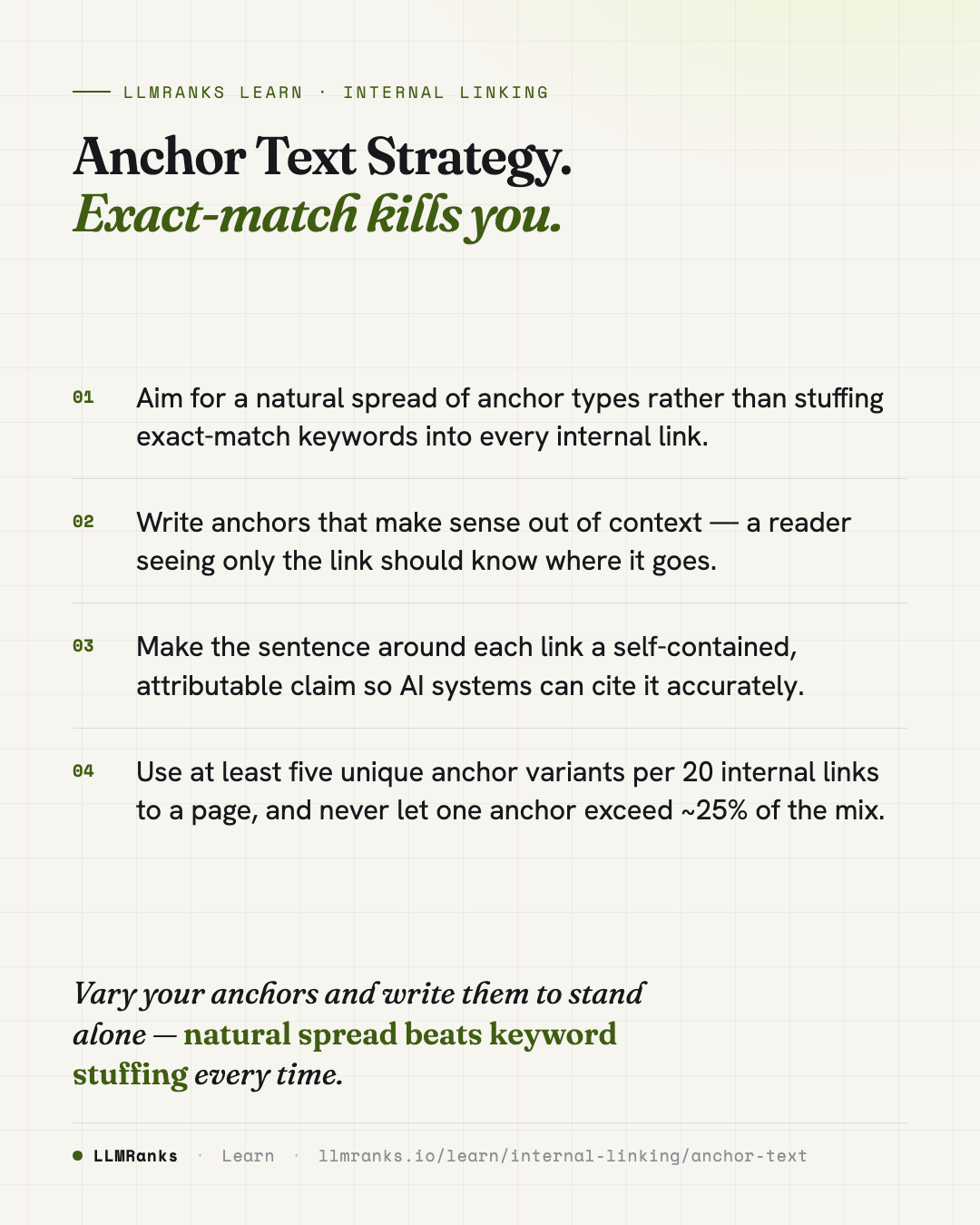
Google's link best practices do not prescribe exact-match, partial-match, branded, generic, or long-tail percentages for internal links. Ratios such as "5–10% exact match," "five variants per 20 links," or "no anchor above 25%" are not published thresholds and should not drive automated recommendations.
Different anchor styles can all be useful when they fit the page. Use the table as an editorial vocabulary, not a distribution target.
| Anchor style | Example | Review question |
|---|---|---|
| Direct topic name | "internal linking strategy" | Is this the clearest natural label here? |
| Descriptive phrase | "find orphan pages in your crawl" | Does it set an accurate expectation? |
| Branded phrase | "Acme's linking framework" | Is the brand relevant to the reader's choice? |
| Generic action | "learn more" | Would a more descriptive label reduce ambiguity? |
| URL | "example.com/guide" | Is showing the URL useful in this context? |
Sitewide templates may naturally repeat anchors such as product or category names. Editorial body links may vary because they sit in different sentences. Neither pattern needs an arbitrary diversity score. Review repetition when it makes links vague, misleading, or obviously forced—not merely because a percentage was crossed.
For the broader mechanics of how these links pass authority around your site, see Link Equity & PageRank Flow and the wider guide to Internal Linking.
Writing anchors for human readers
Anchors do two jobs at once: they help people decide whether to click, and they set expectations for what's on the other side. A few rules keep them effective.
- Set an accurate expectation. A reader should have a reasonable idea of what the destination contains before clicking.
- Be reasonably concise. Use as many words as clarity requires, without linking an unnecessarily long sentence or paragraph.
- Fit the sentence. A verb-led phrase may work for an action, while a noun phrase may be clearer for a concept or category.
- Don't echo the anchor in the surrounding sentence. Repeating the same phrase right next to the link wastes reader attention.
- Avoid "click here" and "read more" except in clearly UX-driven contexts like cards or call-to-action buttons.
These habits pair naturally with the rest of your On-Page SEO work, since the sentence around a link is part of the page's readable content.
Use the surrounding text as context
Google explicitly advises paying attention to the words before and after a link because they provide context. That is also a sound editorial practice for any system or reader trying to understand why two pages are related. It is not evidence for a special anchor formula for AI citations.
- Explain the relationship. Weak: "We discuss it here." Strong: "Use the orphan-page audit to find sitemap URLs with no crawlable inbound links."
- Place the link near the concept it expands. Do not make the reader hunt through a paragraph to learn what "this method" means.
- Keep claims accurate. The anchor and its sentence should not promise data, scope, or instructions the destination does not provide.
- Avoid link chains. Several adjacent links make it harder to tell which words describe which destination.
This approach connects directly to how AI Search Engines parse and reuse your content, and to the broader shift covered in AEO & GEO.
Scoring contextual relevance
You can judge whether a link is genuinely relevant rather than just present. A useful review looks at several signals:
- Anchor-to-destination similarity — does the anchor semantically match the page it points to?
- Anchor-to-paragraph similarity — does the anchor fit the paragraph it sits in?
- Heading overlap — does the anchor share meaningful terms with the destination's main heading?
- Entity match in the surrounding sentence — do the named entities in the sentence line up with those on the destination page?
Links that score low on these checks are candidates for a rewrite. Weak or mismatched anchors are a common reason otherwise well-linked pages fail to rank for the terms you intended.
Review repetition without quotas
Group inbound internal links by canonical destination and inspect their anchors in context. This can reveal:
- vague templated labels that do not describe the destination;
- different destinations using the same anchor for conflicting intents;
- keyword phrases forced into unrelated sentences; and
- stale anchors that no longer match a renamed or consolidated destination.
The percentage of repeated anchors can help sort a review queue, but it is not a pass/fail rule. A repeated product name in navigation may be correct; five different vague variants may all be poor. Judge clarity, relevance, and destination consistency. This also helps diagnose Keyword & Link Cannibalization, where similar pages compete for the same intent.
What to do
- Resolve internal links to their canonical destinations and group anchors by destination.
- Rewrite vague, misleading, or keyword-stuffed anchors so they describe the target naturally in the sentence.
- Check the surrounding words and add enough context to explain why the link is useful.
- Flag repeated anchors for editorial review only when the repetition suggests a template problem, ambiguity, or conflicting destinations.
- Re-check links after titles, headings, URLs, or page intent change so anchors do not become stale.
For the wider picture of how anchors fit into site structure and authority, start from LLMRanks Learn.
save this card
 Download card
1080×1350 · post it anywhere
put it to work
See how ChatGPT, Gemini and Google AI actually talk about your brand.