JSON-LD vs Microdata vs RDFa
Use JSON-LD. Across search engines and AI systems, it is the most reliably parsed structured data format, and it's the format Google explicitly recommends.…
4 min read · updated 2026-08-01
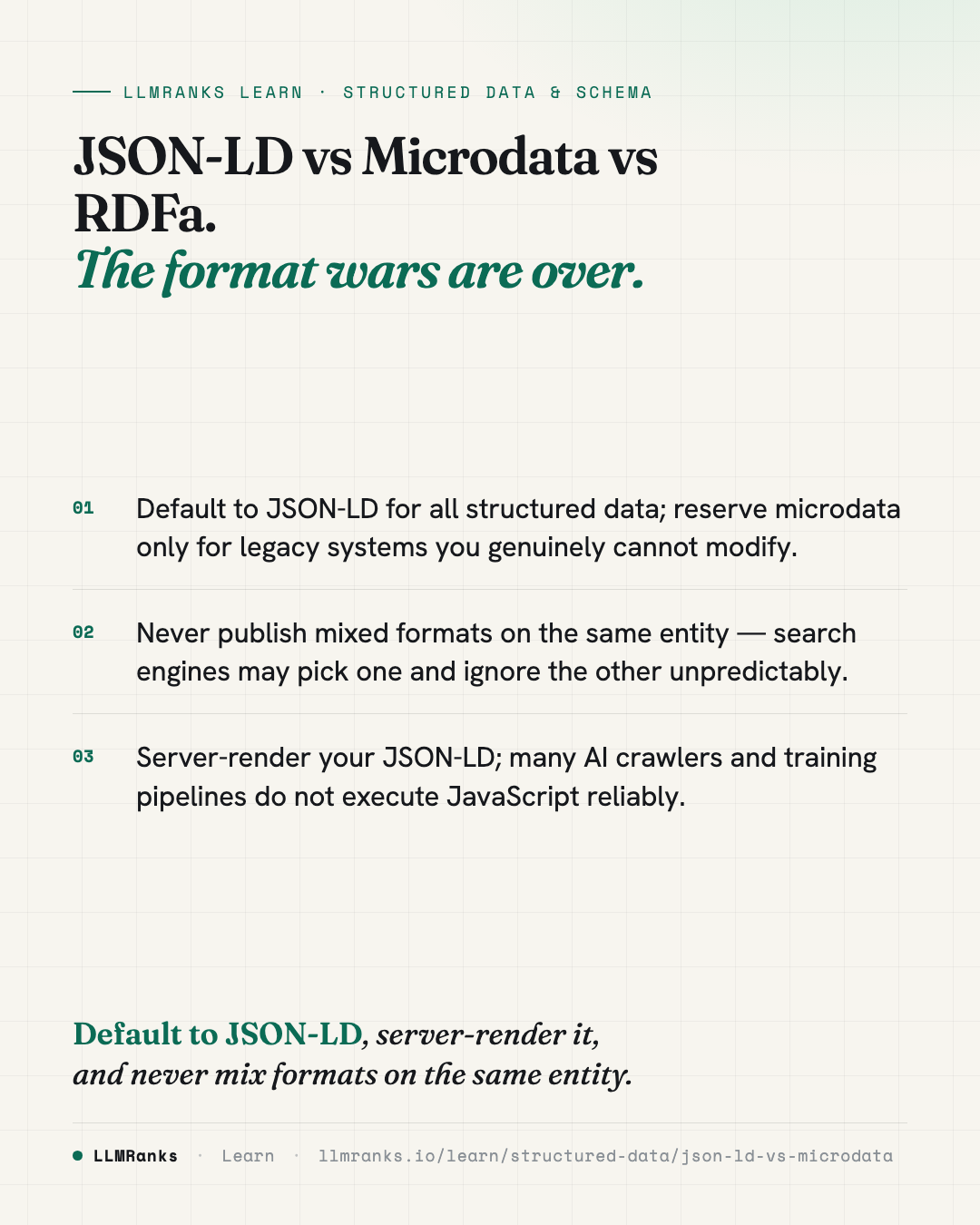
Use JSON-LD. Across search engines and AI systems, it is the most reliably parsed structured data format, and it's the format Google explicitly recommends. Microdata and RDFa still work in specific legacy situations, but for any site you can control today, JSON-LD is the default and the other two are migration targets — not choices worth debating.
Why JSON-LD wins
The choice was already settled by 2020, and three factors keep it that way.
AI ingestion preference. Large language model crawler stacks — including those behind GPT-5, Claude, Gemini, and Perplexity — parse JSON-LD blocks with near-100% extraction fidelity. Microdata embedded in DOM nodes gets parsed inconsistently, because crawlers frequently strip presentational HTML before semantic extraction. Published observations from Schema App, Merkle, and Botify consistently show JSON-LD entities being cited three to five times more often in AI Overviews and Perplexity answers than equivalent microdata.
Decoupling from rendering. JSON-LD lives inside a <script type="application/ld+json"> block in the <head> or at the end of the <body>. Because it isn't tangled into your visible markup, it survives DOM mutations, framework hydration mismatches, and AMP-equivalent transformations.
Google's explicit preference. Google Search Central documentation has recommended JSON-LD as the "preferred" format since 2017, and as of 2024 deprecated several microdata-only paths.
When microdata or RDFa still apply
There are narrow cases where you'll encounter the older formats, but they are exceptions rather than options.
| Format | Practical use in 2026 |
|---|---|
| JSON-LD | The default for everything you can control. |
| Microdata | Acceptable only for legacy CMSes you cannot modify — some Magento 1 installs, old WooCommerce themes. |
| RDFa | Near-zero practical use outside academic and government publishing. |
If an audit surfaces microdata or RDFa, flag it for migration to JSON-LD. The one thing to avoid at all costs: do not output mixed formats on the same entity. When you do, Google will pick one and ignore the other in ways you can't predict.
What schema actually does — and doesn't do
Be precise about what structured data buys you. Schema is a parsing and eligibility asset, not an AI-citation lever for Google.
Google's own AI documentation states that no special structured data is required for AI Overviews or AI Mode — in their words, "there's no special schema.org markup you need to add." Eligibility comes down to being indexed and snippet-eligible.
So where does schema earn its keep? Three places:
- Rich-result eligibility — qualifying your pages for enhanced search appearances.
- Entity disambiguation — using
@idandsameAsto make clear exactly which entity you're describing. - Clean machine-readable metadata — giving parsers unambiguous structure to work with.
Audit your schema and fix it, but never present FAQPage or HowTo markup as the mechanism that earns AI citations. If you want to understand where citations actually come from, see Rich Results vs LLM Citations.
JSON-LD placement rules
Where you inject JSON-LD affects both parsing reliability and page performance.
- Inject in
<head>for above-the-fold critical entities like Organization, WebSite, and BreadcrumbList. - Inject just before
</body>for large entities — a Product with 50+ offers, or an ItemList with 200+ items — to avoid blocking parse. - Use one
<script>block per entity as the cleanest approach. A single@grapharray is also acceptable and reduces payload; reach for@graphwhen entities reference each other via@id. - Never inject via client-side JavaScript only. Googlebot renders JS, but Perplexity, Common Crawl, and most LLM training pipelines do not execute it reliably. Server-render, or use ISR/SSG.
That last point is the one most likely to quietly break your visibility. If your structured data only exists after client-side hydration, a large share of AI crawlers will simply never see it.
How this fits your wider setup
Format choice is one piece of a healthy structured data practice. Getting the format right doesn't help if you're marking up the wrong things — start with Schema Types That Matter to decide what to describe, then confirm your implementation with Schema Validation Tools. For the broader context on how markup supports answer engines, see AEO Markup Patterns and the overview at Structured Data & Schema.
Because JSON-LD reliability depends on server-side rendering, this topic also overlaps with your Technical SEO foundation — rendering strategy is what determines whether crawlers see your markup at all.
What to do
- Standardize on JSON-LD for every entity on any site you control.
- Audit for existing microdata or RDFa, and flag it for migration to JSON-LD.
- Remove any mixed-format markup so a single format describes each entity.
- Place critical entities (Organization, WebSite, BreadcrumbList) in
<head>, and move large entities before</body>. - Consolidate cross-referencing entities into a single
@grapharray with@idlinks where it reduces payload. - Confirm your JSON-LD is server-rendered (or via ISR/SSG), not injected only after client-side JavaScript runs.
- Frame schema internally as an eligibility and disambiguation asset — not as a direct cause of AI citations.
save this card
 Download card
1080×1350 · post it anywhere
put it to work
See how ChatGPT, Gemini and Google AI actually talk about your brand.