Rich Results vs LLM Citations
Schema markup does not appear to cause AI engines to cite you. Controlled tests show no direct citation lift from JSON-LD, microdata, or RDFa in Google AI…
5 min read · updated 2026-08-02
Schema markup does not appear to cause AI engines to cite you. Controlled tests show no direct citation lift from JSON-LD, microdata, or RDFa in Google AI Overviews, AI Mode, or ChatGPT — engines extract your visible HTML and treat any schema they encounter as plain text. Where structured data helps citation is indirect: it can disambiguate your entities and feed the knowledge graphs that ground some AI answers. If you want to be cited, fix your visible content first and treat schema as supporting cast.
The honest position on schema and AI citations
The core question — does schema help AI citations — has a nuanced answer. Controlled studies, including a difference-in-differences analysis and multi-engine retrieval tests, show no causal citation lift from JSON-LD, microdata, or RDFa across Google AI Overviews, AI Mode, or ChatGPT. These engines extract the visible HTML on your page. When they encounter schema, they generally treat it as plain text, not as a special ranking or citation signal.
There is one controlled exception worth naming honestly: a LocalBusiness study showing a ChatGPT-specific local-visibility lift. That result was small, limited to a single vertical, and directional rather than definitive. Treat it as a hint, not a mandate.
So schema is not a citation lever you can pull. But it is not useless either — its value is indirect, and understanding that distinction keeps you from wasting effort.
Where schema does help — indirectly
Structured data earns its place in two indirect ways.
Entity disambiguation. Linking your entities with sameAs, @id, and Wikidata references helps knowledge graphs understand who and what your page is about. The Knowledge Graph and Bing Entity API both feed grounding for engines like Gemini and Copilot. Cleaning up entity linkage on your Organization and Person markup is an eligibility and grounding aid — it makes you easier to identify and connect, not automatically easier to cite.
Clean metadata when parsed. When an engine happens to parse your schema, well-formed markup gives it clean, structured facts. That is a supporting benefit, not a ranking mechanism.
Both of these are grounding aids, not ranking levers. Learn more about how to structure them well in Structured Data & Schema and Schema Types That Matter.
What actually drives citations
The real citation drivers are visible-text fundamentals. If you want AI engines to quote your page, focus here:
- Front-loaded, answer-shaped sentences. Put the direct answer near the top, phrased as a complete statement.
- Semantic HTML. Give engines clean structure to parse.
- Question-to-answer proximity. Keep the answer close to the question it resolves.
- Retrievable chunking. Structure content so passages can be extracted independently.
- Authoritative link context, both inbound and outbound.
Schema is the supporting cast here, not the lead. Work on your visible content through On-Page SEO, Content Strategy & E-E-A-T, and the citation-focused patterns in AEO & GEO.
Rich results are a separate game
Google rich results and LLM citations are two different outcomes with two different mechanisms. Rich results are SERP enhancements — stars, carousels, badges — that can improve click-through. They are driven by valid schema for specific supported types. LLM citations are driven by extractable visible content. Do not conflate the two, and do not promise rich-result gains from types Google has retired.
Still-active rich results worth implementing
These types still render and can earn SERP gains:
| Type | Status |
|---|---|
| Product / Merchant listings | Strong |
| Recipe (carousels intact) | Strong |
| Review / AggregateRating stars* | Strong |
| BreadcrumbList | Active |
| Event | Active |
| JobPosting (Google Jobs) | Active, strict |
| VideoObject (incl. key moments) | Active |
| SoftwareApplication | Active |
| Course (course list) | Active |
| Article / NewsArticle (Top Stories, host carousels) | Active |
| ImageObject (licensable badge) | Active |
| Organization (Knowledge Panel, logo, merchant info) | Active indirectly |
\*Stars apply within Product, Recipe, SoftwareApplication, and Course.
Dead or near-dead rich results
Do not promise SERP gains from these:
- FAQPage — dead, removed in 2026.
- HowTo — dead, removed in 2024.
- Sitelinks Search Box — rarely renders.
The FAQ and HowTo schema is harmless to leave in place, but it will not earn you rich results anymore, so it is not worth spending cycles on. See AEO Markup Patterns for how to structure Q&A content in visible HTML instead.
How to prioritize your fixes
When you are deciding where to spend effort, rank visible-content fixes first and schema fixes second. This priority order reflects what actually moves citations versus what only helps SERP presentation or grounding.
| Priority | Fix category | Why |
|---|---|---|
| P0 | Server-rendered, front-loaded visible answer text | The actual citation and extraction driver |
| P0 | Markup-vs-visible-text fact mismatches | Penalty risk and trust erosion |
| P1 | sameAs / Wikidata entity linkage on Org/Person | Grounding aid for Gemini and Copilot |
| P1 | Active rich-result schema (Product, Recipe, Event, Job, Video, Course) | Direct SERP CTR gains |
| P2 | @id graph integrity, about / mentions | Entity-graph hygiene |
| P3 | Dead-result schema (FAQ, HowTo) | Harmless; don't spend cycles |
The two P0 items deserve emphasis. First, server-rendered, front-loaded answer text is the driver of extraction and citation. Second, any mismatch between what your markup claims and what your visible page says is a trust risk — keep them consistent. For choosing a syntax and validating your output, see JSON-LD vs Microdata vs RDFa and Schema Validation Tools.
What to do
- Audit your key pages for a front-loaded, answer-shaped sentence near the top that directly answers the query — this is your highest-leverage citation fix.
- Confirm your answer content is server-rendered as visible HTML, not injected only after load.
- Check for any mismatch between your schema claims and your visible text, and fix mismatches immediately.
- Add
sameAs,@id, and Wikidata linkage to your Organization and Person entities to aid grounding. - Implement active rich-result schema (Product, Recipe, Event, JobPosting, VideoObject, Course) where it fits your content, for SERP click-through gains.
- Validate all markup and keep entity-graph hygiene clean with correct
@id,about, andmentions. - Leave existing FAQ and HowTo schema in place if present, but stop investing effort in it — those rich results are gone.
save this card
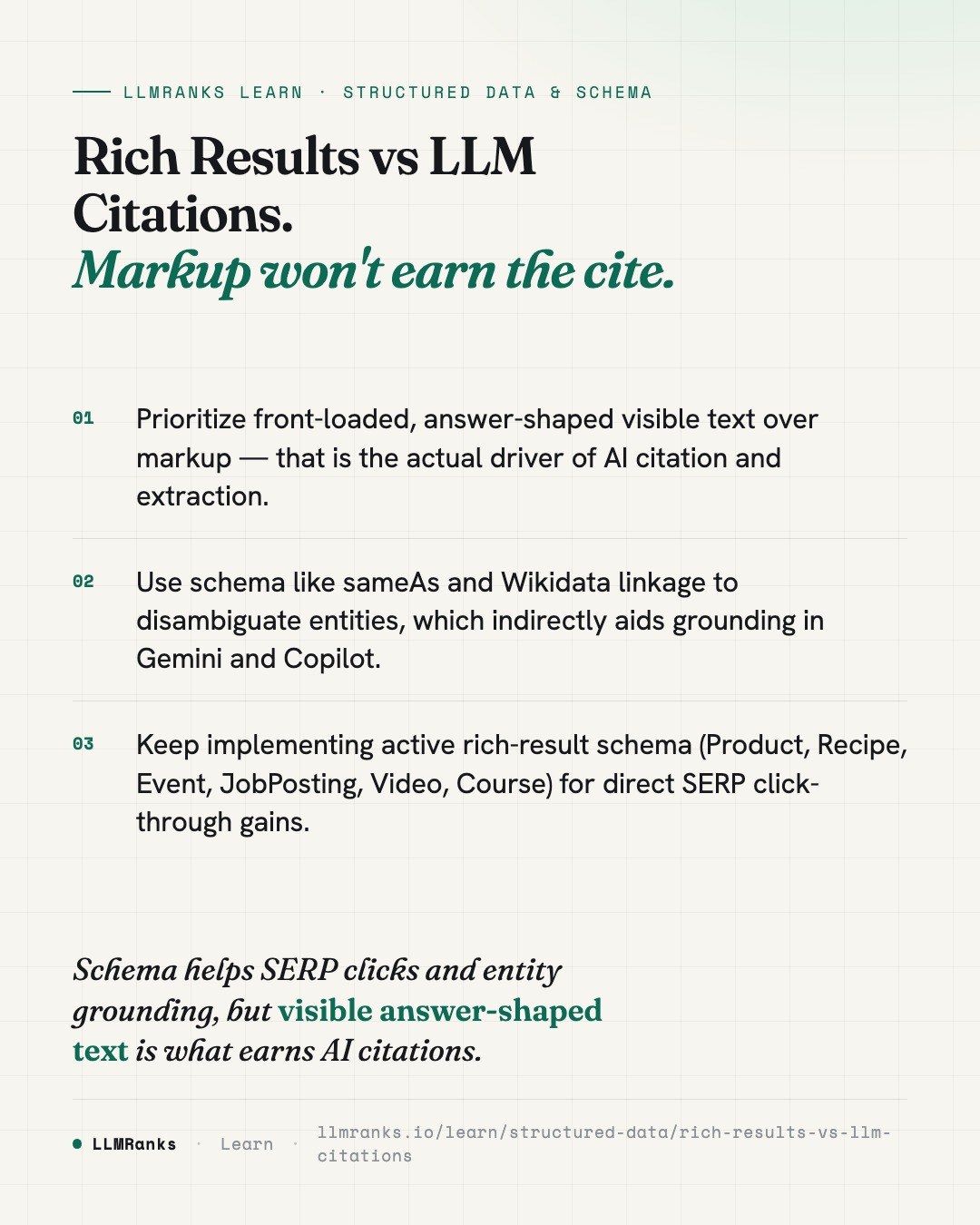 Download card
1080×1350 · post it anywhere
put it to work
See how ChatGPT, Gemini and Google AI actually talk about your brand.