Schema Types That Matter
Schema markup is structured data you add to a page so machines can read its meaning explicitly. The types that matter fall into two groups: those that still…
7 min read · updated 2026-08-01
Schema markup is structured data you add to a page so machines can read its meaning explicitly. The types that matter fall into two groups: those that still earn Google rich results in 2026 (Product, Recipe, Event, JobPosting, BreadcrumbList, VideoObject, Course, SoftwareApplication) and those whose main value is now entity clarity for AI and knowledge graphs (Organization, Person, WebSite, WebPage). A few once-popular types — FAQPage and HowTo — no longer produce any Google rich result, and controlled 2026 evidence indicates schema is not a reliable AI-citation lever on its own.
How to think about schema types in 2026
There are three jobs schema does: earn rich results in Google, wire up your entity graph, and (in theory) help AI systems understand your content. The evidence for each job differs, so pick types with the job in mind.
Rich results are shrinking. FAQPage rich results were restricted to authoritative government and health sites in August 2023, then removed entirely for all sites as of May 7, 2026. HowTo rich results were pared back through late 2023 and quietly removed in early 2024. Recipe, on the other hand, remains one of the last strongholds of robust Google rich results, with carousels, galleries, and recipe-specific AI Overview blocks still rendering.
On the AI side, keep the framing honest. A 2026 difference-in-differences study of 1,885 pages that added JSON-LD versus roughly 4,000 matched controls found no citation lift on Google AI Overviews, AI Mode, or ChatGPT. The often-quoted "AI-cited pages are ~3x more likely to have schema" correlation is confounded — schema-heavy sites tend to be better maintained and better linked. Multi-engine retrieval testing shows AI systems extract visible HTML text and treat any schema they encounter as plain text. The one controlled exception is narrow: a June 2026 LocalBusiness study (29 US green-industry domains, 5-week window) found no Google or Bing rank impact but a ChatGPT visibility gain on one of two tracked queries — directional, not definitive.
For deeper context, see Structured Data & Schema and Rich Results vs LLM Citations.
Entity types: Organization, Person, WebSite, WebPage
These types rarely produce a flashy rich result, but they build the graph that both Google's knowledge systems and LLMs traverse.
Organization establishes your publishing entity. Required fields are @type, name, and url; for entity clarity add logo (as an ImageObject with explicit dimensions — Google needs at least 112×112 px), description, foundingDate, founder, address, contactPoint, and a clean sameAs array. For AI disambiguation, order sameAs by weight: Wikipedia first, then Wikidata Q-ID, Crunchbase, LinkedIn, GitHub (for tech), then other social profiles. No Wikipedia page? A Wikidata entry is free and improves citation odds. Always use the most specific subtype — Corporation, LocalBusiness, NewsMediaOrganization — and never publish conflicting Organization entities with different @ids.
Person marks up authors and experts, feeding both E-E-A-T and AI author recognition. Define each author once with a stable @id, include sameAs (LinkedIn, ORCID, Google Scholar), a focused knowsAbout (3–7 domains, not 50), and worksFor linked to your Organization. Then reference that @id from every article. An author left as a plain string is technically valid but loses most of the E-E-A-T signal; authors with no external verification get treated as low-trust.
WebSite goes once on the homepage. Its SearchAction once drove the Sitelinks Search Box, but that result is now rarely displayed — keep the entity anyway for publisher linkage and @id anchoring. WebPage is often the connective tissue of an @graph: it links to WebSite via isPartOf and receives an Article's mainEntityOfPage. Use its about field for the 1–2 primary entities (ideally linked to Wikidata) and mentions for secondary ones — but don't stuff about with your keyword list.
Commerce and content types
| Type | Still earns Google rich result (2026)? | Key required fields |
|---|---|---|
| Product | Yes (Merchant / Shopping) | name, image, offers (price, priceCurrency, availability URI) |
| Recipe | Yes (carousel, gallery) | name, image, recipeIngredient, recipeInstructions |
| Event | Yes | name, startDate (with timezone), location |
| JobPosting | Yes (Google Jobs) | title, description, datePosted, hiringOrganization, jobLocation |
| Article | Yes | headline (≤110 chars), image, datePublished, author |
| FAQPage / HowTo | No | (markup valid but no rich result) |
Product demands care with data types: price must be a bare number ("29.99"), not "$29.99", with a separate priceCurrency, and availability must be a full URI like https://schema.org/InStock. One of gtin/mpn is now functionally required for Merchant, and missing priceValidUntil on dated offers triggers a warning as of late 2024. Add hasMerchantReturnPolicy and shippingDetails or you lose free-listing eligibility. Use ProductGroup with a hasVariant array for variants rather than cramming them into one Product.
Article / NewsArticle / BlogPosting — pick one, don't stack subtypes. Provide three image ratios (1×1, 4×3, 16×9, min 1200px) for Top Stories, keep headline under 110 characters, and sanity-check that dateModified isn't earlier than datePublished. Including articleBody measurably increases LLM citation rates per 2026 evidence, but for pages over 5,000 words omit it and rely on rendered HTML. speakable is underused and useful for voice answers.
Recipe should always use a HowToStep array for recipeInstructions, never a single string blob, and include calories for the nutrition enhancement. Event needs a timezone offset on startDate and accurate eventStatus; hybrid events include both a Place and a VirtualLocation. JobPosting is strict — Google index-suppresses policy violators. Always include validThrough, structure baseSalary rather than burying it in text, and remove filled jobs at the URL level (a 404/410), not just by stripping schema.
Review and AggregateRating drive star snippets, but Google's self-serving reviews policy means you cannot rate your own Organization or LocalBusiness on your own domain. Reviews of a Product you sell, a Recipe, a Book, or a SoftwareApplication are still allowed. Don't inflate counts beyond visible reviews — that risks a manual penalty.
SoftwareApplication and Course both carry strong AEO value for "best X tool" and "learn X" queries. Software requires offers plus either aggregateRating or review; use WebApplication for browser SaaS. Course requires name, description, and a provider with sameAs, plus hasCourseInstance for the richer carousel. In both cases keep featureList/teaches aligned with the visible on-page copy, since engines extract the visible text.
The deprecated pair: FAQPage and HowTo
Both types are harmless to keep and use valid syntax, but neither earns a Google rich result in 2026, and controlled evidence shows no AI-citation lift from the markup itself. What earns citations is the visible content — front-loaded, answer-shaped Q&A and clean numbered steps that retrievers can chunk and quote.
Practical rules:
- Only mark up FAQs that reflect genuine question intent; blanket Q&A formatting measures slightly negative for AI absorption.
- Never put FAQ schema on Q&A that isn't visible on the page — that's a manual penalty trigger — and don't repeat one FAQ block sitewide.
- Emit HowTo as clean numbered on-page steps; treat the markup as optional metadata, not an extraction lever. Use
Recipe, not HowTo, for cooking.
See AEO Markup Patterns and AEO & GEO for how to shape citable content.
Supporting types
BreadcrumbList is still fully active in 2026 and a strong CTR signal. Keep position 1-indexed and sequential, match the schema path to the visible on-page breadcrumb, and render the breadcrumb in the DOM so crawlers and LLMs get hierarchy context. VideoObject drives video results and key-moment chapters; provide at least one of contentUrl/embedUrl, format duration as ISO 8601 (PT8M30S), and — critically — render transcripts as visible text, since a transcript living only in the transcript field is largely invisible to retrieval. ImageObject powers the licensable-image badge, which needs both license and acquireLicensePage; also reference it as Organization.logo so you can specify dimensions.
What to do
- Add or audit Organization schema on your homepage, About, and Contact pages, using the most specific subtype and a weight-ordered
sameAsarray (Wikipedia or Wikidata first). - Define each author as a reusable Person entity with a stable
@id, externalsameAs, and a focusedknowsAbout, then reference it from every article. - For commerce and content, deploy the type that still earns rich results (Product, Recipe, Event, JobPosting, Article) and fill every Google-required field, checking data types like bare-number
priceand URIavailability. - Keep FAQ and step content visible on the page; treat FAQPage and HowTo markup as optional and never present it as the mechanism behind rich results or AI citations.
- Wire your
@graphwith WebSite and WebPage entities usingisPartOf,mainEntityOfPage,about, andmentionsfor entity clarity. - Confirm structured data matches visible text — reviews, features, salaries, transcripts — and run everything through Schema Validation Tools.
- Remove stale entities (expired events, filled jobs) at the URL level, not just by deleting schema.
For format-level decisions, see JSON-LD vs Microdata vs RDFa.
save this card
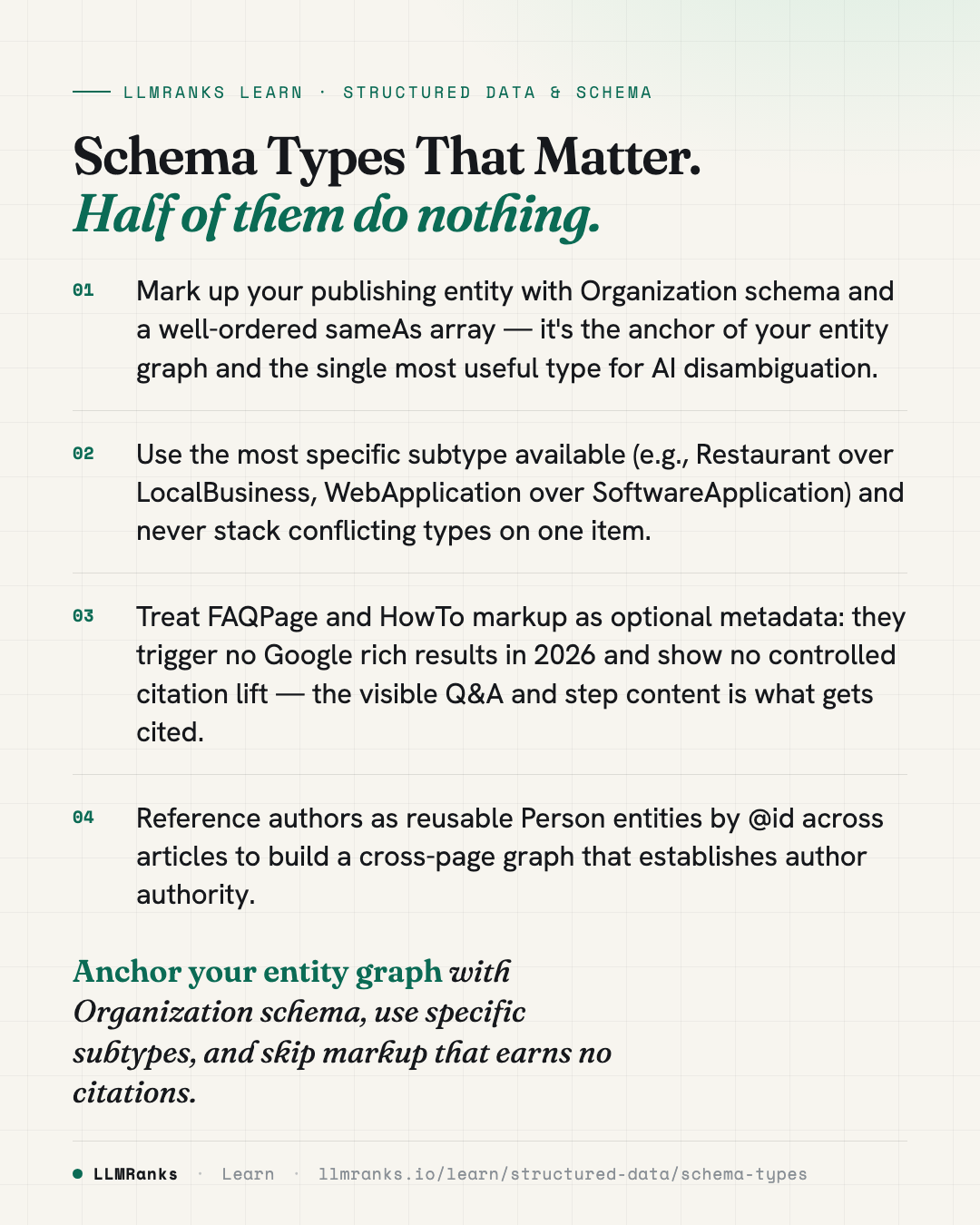 Download card
1080×1350 · post it anywhere
put it to work
See how ChatGPT, Gemini and Google AI actually talk about your brand.