Content Length for AI Search
Content length for AI search is not about hitting a word count — it's about how many self-contained, citable passages your page contains. AI answer engines…
5 min read · updated 2026-07-15
Content length for AI search is not about hitting a word count — it's about how many self-contained, citable passages your page contains. AI answer engines retrieve and cite individual chunks of content, not whole pages, so a well-structured page with several focused sections gives you far more chances to be quoted than one long, undifferentiated essay. Match your total length to the query type, then engineer each section to stand on its own.
Why word count is the wrong target
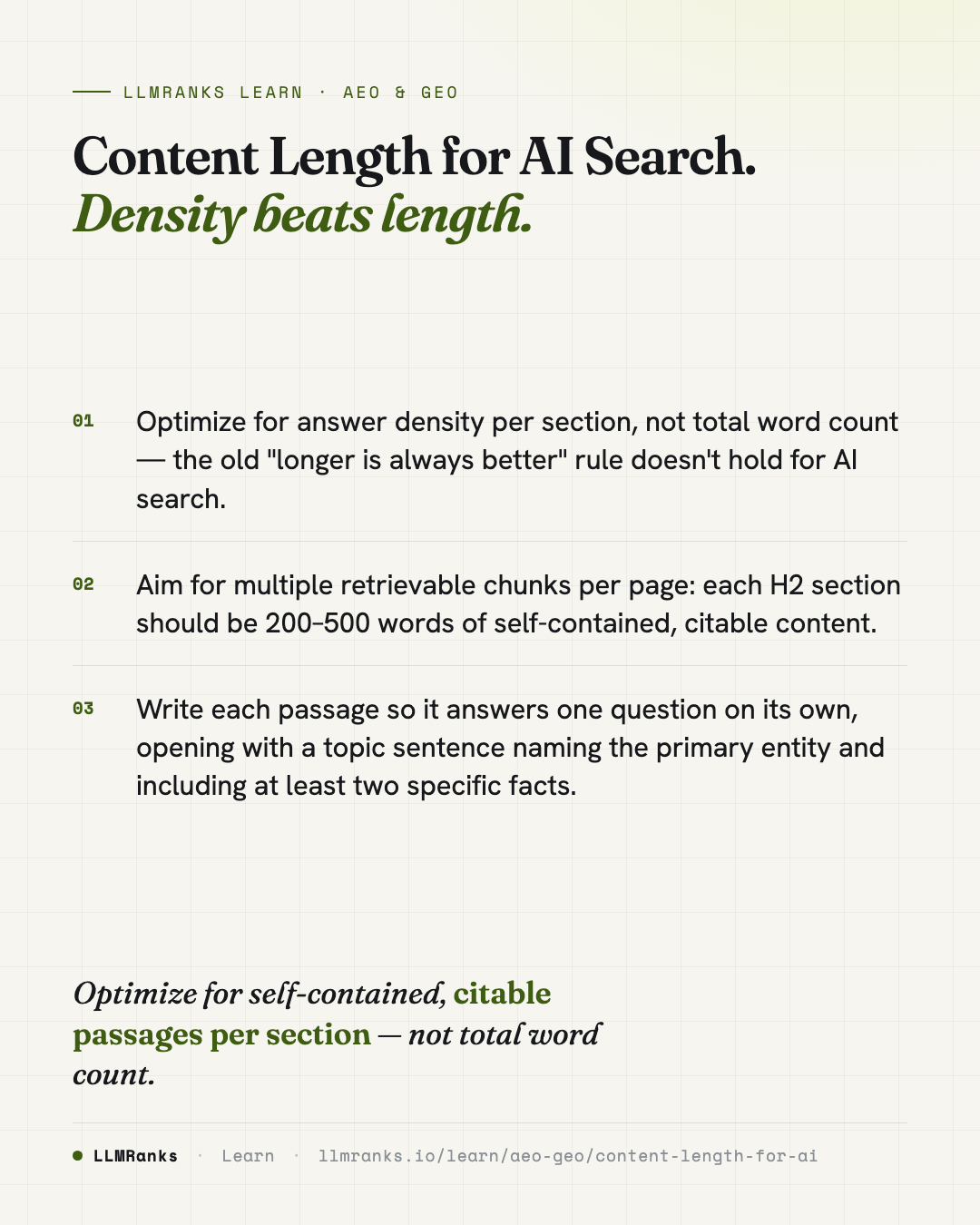
The heuristic that longer content ranks better — popular from roughly 2018 to 2022 — no longer applies to answer engine optimization. What matters now is answer density within each chunk of your page, not the size of the page overall.
AI answer engines pull passages, not whole documents. A 4,000-word page built as ten well-structured sections gives you ten chances to be cited. The same 4,000 words written as a single flowing essay gives you one. The real metric to track is retrievable chunks per page. For more on how engines select passages, see How LLMs Choose Citations.
Length sweet spots by content type
Total length still matters — but only as a consequence of covering a query type properly. These ranges reflect observed citation patterns, not hard rules. Use them as starting points, then let the structure of the topic decide the final length.
| Content type | Optimal length | Why |
|---|---|---|
| Definitional / "what is" queries | 600–1,200 words | Single-chunk retrieval; longer dilutes |
| Comparison ("X vs Y") | 1,500–2,500 words | Needs a table plus per-attribute sections |
| How-to / tutorial | 1,200–2,000 words | Stepwise blocks retrieved individually |
| Pillar / topical authority | 3,000–5,000 words | Multiple H2s mean multiple retrievable chunks |
| Listicle ("best N tools") | 2,000–3,500 words | Each list item is a retrievable unit |
| Original research / benchmark | 2,500–4,500 words | Methodology, data, and analysis sections |
The pattern across all of these: length rises when the topic naturally contains more distinct, separately citable units. A definition dilutes when padded past what the answer needs. A comparison or listicle grows because each attribute or item is its own retrievable piece.
Chunk engineering
Treat each H2 section as a unit that could be lifted out of your page and still make sense on its own. Aim for roughly 200–500 words per section, bounded by clear headings. That self-containment is the single property that most affects whether a passage gets retrieved and absorbed.
A passage that performs well tends to:
- Start with a topic sentence containing the primary entity.
- Contain at least two specific facts — numbers, dates, or names.
- End without a dangling reference that only makes sense in the previous paragraph.
- Sit inside clear H2/H3 boundaries, since retrievers use heading structure as chunk delimiters.
- Answer one sub-query on its own.
For deeper guidance on writing passages that get pulled into answers, see What Makes Content Citable and Getting Quoted Verbatim.
Don't chunk just for the parser
There's an important caveat here. Google has pushed back on the idea that chunking is a technical requirement, stating that there's no requirement to break your content into tiny pieces for AI to understand it, and that its systems can handle the nuance of multiple topics on a page.
So the reason to structure content into chunks is retrieval quality — giving each idea a clean, citable home — not because a parser forces you to. Write for readers and for clear retrieval, not to satisfy an imagined technical constraint.
Be equally skeptical of specific word-count bounds. Figures circulating online that claim an "optimal" chunk size of 150–300 words have not held up to verification. There is no validated word-count boundary for a chunk. Use the 200–500 word range above as a practical guideline, but let the content — a complete, self-contained answer to one question — set the actual length.
How this connects to the rest of your strategy
Content length is one lever among several. Structuring your page into clean, retrievable sections works alongside the formats engines tend to favor and the entities they recognize. See Content Patterns LLMs Favor and Entities & the Knowledge Graph for the surrounding pieces.
Because different engines cite differently, the same well-chunked page may perform unevenly across them. Citation Behavior by Engine covers those differences. And if you're mapping how this fits into a broader plan, start from AEO & GEO.
What to do
- Pick the query type your page targets and use the table above to set an initial length target.
- Break the page into H2 sections, each answering one distinct sub-question in 200–500 words.
- Open every section with a topic sentence that names the primary entity of that section.
- Put at least two concrete facts — numbers, dates, or names — inside each section.
- Check that each section reads coherently on its own, with no references that depend on the paragraph before it.
- Confirm your heading structure is clean, since retrievers use H2/H3 boundaries to split content into chunks.
- Count your retrievable chunks, not just your words — more well-formed sections mean more chances to be cited.
- Ignore rigid word-count "rules"; let a complete, self-contained answer decide how long each passage should be.
save this card
 Download card
1080×1350 · post it anywhere
put it to work
See how ChatGPT, Gemini and Google AI actually talk about your brand.