AI Content Disclosure Norms
AI content disclosure means telling readers when content was created or assisted by AI. As of 2026, there is no Google requirement to disclose AI use and no…
4 min read · updated 2026-07-23
AI content disclosure means telling readers when content was created or assisted by AI. As of 2026, there is no Google requirement to disclose AI use and no ranking penalty for undisclosed AI on its own — Google penalizes low-quality, mass-produced content, not the tool used to make it. Disclosure matters most as a trust signal and, in some regions, as a compliance obligation.
What Google actually requires
Google's position is straightforward: AI-assisted content is fine when it demonstrates experience, expertise, authoritativeness, and trust, and adds unique value. AI-generated spam produced at scale is what gets penalized.
There is no Google requirement to disclose AI use, and no ranking penalty for undisclosed AI as such. The penalties attach to low quality — thin, derivative, mass-produced pages — not to the fact that a model was involved. In other words, disclosure is not what saves or sinks a page; quality is.
If you want to go deeper on how quality signals shape rankings, see Content Strategy & E-E-A-T.
Disclosure as a trust signal
Even though disclosure isn't required, it's becoming a positive E-E-A-T pattern — especially for YMYL content where readers and search engines want assurance a human stands behind the claims.
The emerging pattern is to disclose both the AI assistance and the human review, naming a credentialed reviewer. For example:
"Written with AI assistance, reviewed and fact-checked by [Dr. Name, credentials]."
This framing does two things at once: it's honest about how the content was made, and it surfaces the human expertise and accountability that YMYL topics demand. The value isn't in the confession of AI use — it's in the named, credentialed review it's attached to.
Provenance standards: where things stand
Provenance is the machine-readable record of where a piece of content came from. The picture differs sharply between media types.
| Content type | Standard | Maturity |
|---|---|---|
| Images / video | C2PA / Content Credentials | Rising adoption — Adobe, Google, and OpenAI image outputs embed C2PA |
| Text | No equivalent standard | Immature; nothing reliably consumed by engines yet |
For images and video, C2PA (Content Credentials) adoption is growing, with several major image outputs embedding it. For text, there is no equivalent standard that engines reliably read today. Treat text provenance as an immature area — worth watching, not worth building your strategy on.
Schema and the aiGenerated question
There's been experimentation with declaring content origin through structured data, but there is no widely-honored aiGenerated schema property. Nothing in this space is reliably consumed by engines yet.
Don't build on it. If you're investing in markup that earns real weight today, focus on the established patterns covered in Structured Data & Schema rather than speculative origin declarations.
Regulatory: the EU AI Act
Beyond search, disclosure can be a legal obligation. The EU AI Act includes transparency obligations under Article 50 that require disclosure of AI-generated content in certain contexts, phasing in through 2025–2026.
Exact enforcement timing is uncertain and should be verified against current official guidance — this is a fast-moving area. The practical takeaway: if your business or your clients serve the EU, surface AI transparency as a compliance flag and confirm your obligations directly, rather than assuming search rules and legal rules are the same thing. They aren't.
Spotting quality risk
Because the real risk is quality, not disclosure, it's worth knowing the "AI tells" that correlate with quality penalties. These patterns tend to match what Google treats as scaled content abuse:
- Generic, filler introductions
- Listicle-of-obvious-points structure
- No original data or images
- No first-person experience
- No external citations
None of these individually proves a page is bad, but together they signal a page that adds little. The decisive factor is information gain — a real concept referenced in Google patents. The question is whether your page adds information not already present in the existing corpus. Low information gain reads as AI-spam risk regardless of whether you disclose AI use or not.
For YMYL content specifically, the safeguard is the same regardless of how the content was produced: require a named human expert reviewer, their credentials, and a review date.
What to do
- Stop treating AI disclosure as a ranking lever — Google penalizes low quality, not undisclosed AI.
- For YMYL content (health, finance, legal), require a named, credentialed human reviewer plus a review date on every page.
- When you disclose AI assistance, attach it to the human review — name the reviewer and their credentials, not just the tool.
- Audit your content for "AI tells": generic intros, obvious-points listicles, missing original data, no first-person experience, no external citations.
- Test each page for information gain — if it adds nothing beyond what's already indexed, rework it before publishing.
- Use C2PA / Content Credentials for images and video where your workflow supports it, but don't expect a reliable text equivalent yet.
- Skip any
aiGeneratedschema property for now; it isn't widely honored. - If you serve EU clients, flag EU AI Act transparency obligations as a compliance item and verify current enforcement timing directly.
save this card
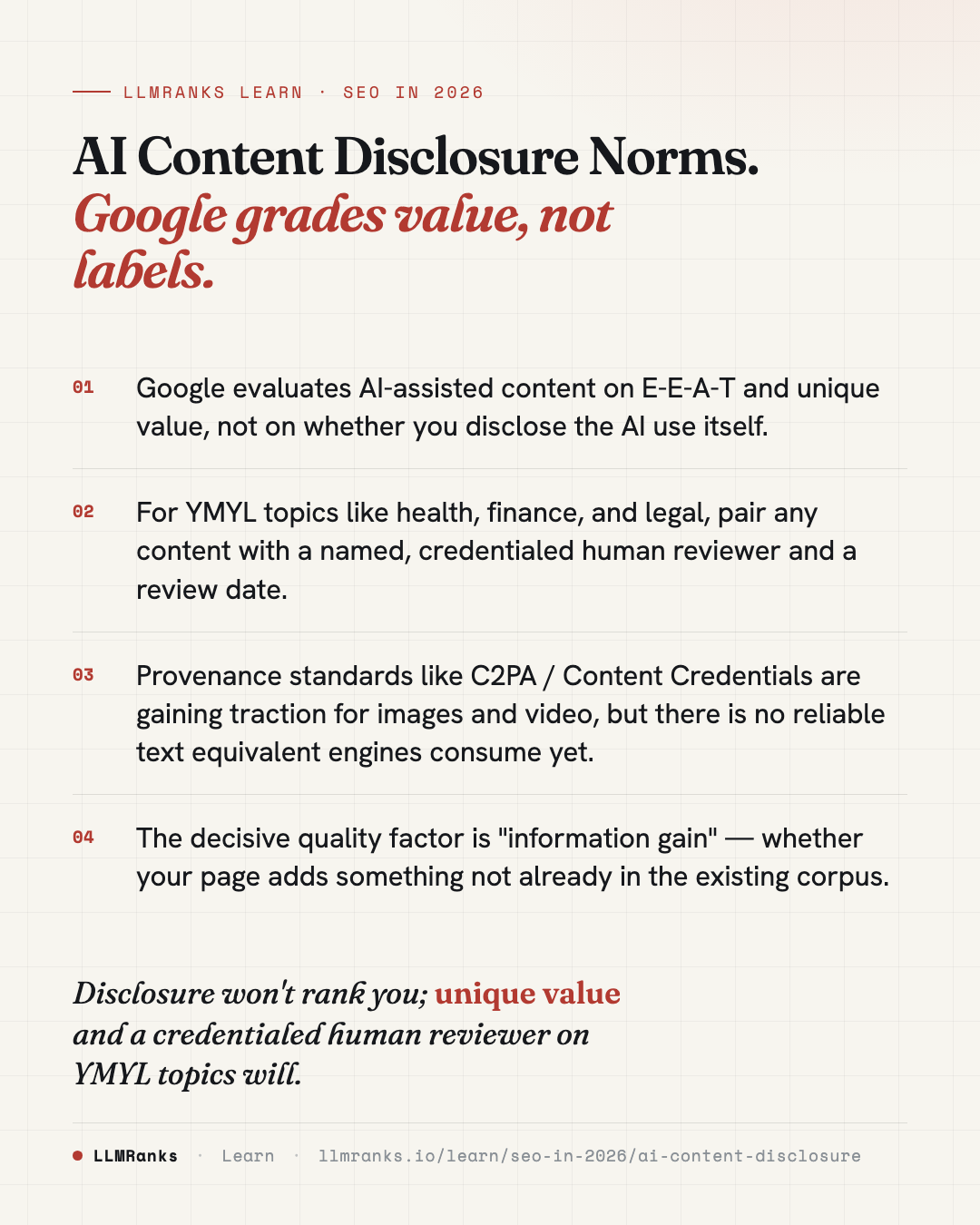 Download card
1080×1350 · post it anywhere
put it to work
See how ChatGPT, Gemini and Google AI actually talk about your brand.