Google Updates 2024–2025
Google's ranking has shifted decisively toward site-level quality between 2024 and late 2025. The March 2024 core update folded the Helpful Content System…
6 min read · updated 2026-07-20
Google's ranking has shifted decisively toward site-level quality between 2024 and late 2025. The March 2024 core update folded the Helpful Content System into the core algorithm, so "helpfulness" is now a continuous, site-wide signal rather than a separate classifier. Alongside stricter spam enforcement and the rollout of AI Overviews and AI Mode, the practical lesson is consistent: one weak section can now drag down an entire domain, and citation slots inside AI answers have become the positions worth chasing.
The core update timeline
The 2024–2025 sequence of core updates tells one story: site-level quality signals came to dominate page-level signals.
| Update | Focus |
|---|---|
| March 2024 Core | Folded the Helpful Content System into core ranking; "helpfulness" became continuous and site-wide |
| August 2024 Core | Refined site-level quality; targeted "site reputation abuse" (parasite SEO) |
| November 2024 Core | Smaller update, focused on recovery paths for sites hit by the HCU integration |
| March 2025 Core | Reportedly introduced author/entity-level reputation that propagates across domains |
| June 2025 + October 2025 Core | Continued the same trend line toward site-level quality |
A note on provenance: the March 2025 "contributor quality" weighting comes from leaked communications with uncertain provenance, so treat it as a plausible direction rather than confirmed fact. Details on the June and October 2025 updates are also less certain. The reliable takeaway is directional — quality is increasingly judged at the site and entity level rather than page by page.
What actually changed with Helpful Content
The 2023 framing of the Helpful Content System was "people-first content" delivered by a discrete classifier. After March 2024, that model no longer describes how it works.
- HCU is now a site-wide multiplier baked into the core system. There is no separate switch to flip; helpfulness signals are continuous.
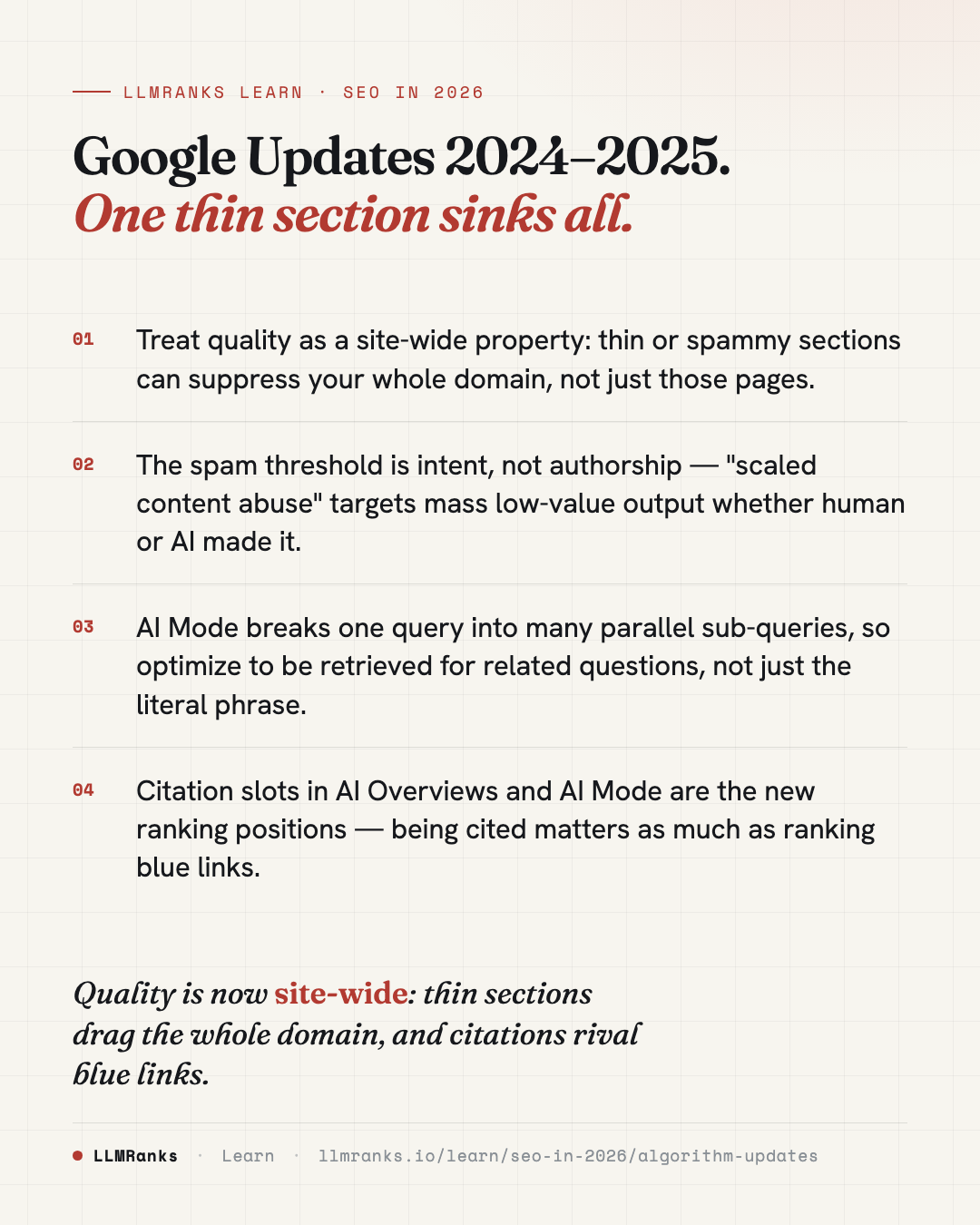
- Because the effect is site-wide, one section of thin or AI-spam content can suppress your entire domain — not just the offending pages.
- The "hidden gem" boost introduced in late 2023 persists. Small forums, niche blogs, and communities with genuine expertise can rank disproportionately well.
This is why consolidating or removing weak content matters more than it used to. If you're auditing your library, focus on Content Strategy & E-E-A-T and prune or rebuild pages that add no unique value.
The UGC surge and rebalance
Traffic to Reddit, Quora, and Stack Exchange exploded across 2024–2025, driven both by content deals and by an algorithmic preference for authentic user-generated content. That surge cooled somewhat in 2025 as Google rebalanced following complaints about Reddit spam. The underlying signal — genuine, experience-backed discussion ranks well — remains, but its intensity has moderated.
The spam updates and the AI question
The March 2024 spam update explicitly killed three patterns:
- Scaled content abuse — mass content generation regardless of whether a human or AI produced it. The test is intent, not authorship.
- Site reputation abuse — third-party or "parasite" content published on high-authority domains (coupon sections on major news sites were named examples).
- Expired domain abuse — buying aged domains to exploit their residual authority.
The wording shift matters. Google stopped saying "AI content is fine if it's helpful" and started saying "scaled content abuse." The threshold is not AI versus human — it's whether the content provides unique value at scale.
If your strategy involves publishing at volume, this reframing should shape your approach to Programmatic SEO in 2026. Volume itself isn't penalized; volume without unique value is. See also Dead SEO Tactics in 2026 for patterns that no longer work.
From SGE to AI Mode
Google's search experience evolved through three stages:
- SGE — an experimental phase in 2023–2024.
- AI Overviews — general rollout in May 2024.
- AI Mode — a dedicated tab, and the default for many query classes, in 2025.
The mechanical change under AI Mode is the biggest shift for practitioners.
Fan-out query architecture
AI Mode uses a fan-out architecture: your single query is expanded into multiple sub-queries that run in parallel, with results synthesized by Gemini. Google doesn't publish how many sub-queries it generates; one external estimate put the average around 10.7 for Gemini 3 (Seer, November 2025).
The practical consequence: you're now optimizing to be retrieved for any of the sub-queries, not just the user's literal phrase. That rewards content that covers a topic's related questions and adjacent facets, and it raises the value of clear entity signals. Work on Entity-Based SEO and AEO & GEO to improve your odds of being pulled into a synthesis.
Citation slots are the new positions
Citation patterns differ by surface:
| Surface | Typical citations |
|---|---|
| AI Overviews | ~4–8 sources |
| AI Mode | 10–20+ sources |
Citation slots are effectively the new ranking positions. AI Mode's wider citation count means more opportunities to appear, but it also means you're competing to be one useful source among many sub-queries. For more on how these surfaces choose and display sources, see AI Search Engines and The Zero-Click, Agent Future.
What this means for your site
The through-line across every 2024–2025 change is the same: quality is judged at the site and entity level, value must be unique rather than merely present, and visibility increasingly means being cited inside an AI answer rather than ranked as a blue link. A few thin pages, one parasite-style content section, or a volume play without unique value can now cost you site-wide.
What to do
- Audit for site-wide drag. Identify thin, duplicative, or AI-spam sections and prune or rebuild them, since one weak area can suppress the whole domain.
- Test content against the "unique value" bar. Ask whether each page provides something not already available at scale — that's the real spam threshold, not who or what wrote it.
- Remove parasite and expired-domain plays. Stop hosting low-value third-party content on authoritative sections and abandon aged-domain schemes flagged as abuse.
- Strengthen entity and author signals. Build consistent, verifiable expertise so reputation can work in your favor across pages; see Content Strategy & E-E-A-T.
- Cover the fan-out. Expand topic pages to answer the related sub-questions a fan-out query would generate, not just the head phrase.
- Optimize for citation. Structure content so it's easy to extract and cite in AI Overviews and AI Mode, and track which surfaces cite you.
- Watch the trend, not just the dates. Treat uncertain update details as directional signals, and keep aligning toward site-level quality as covered across LLMRanks Learn.
save this card
 Download card
1080×1350 · post it anywhere
put it to work
See how ChatGPT, Gemini and Google AI actually talk about your brand.