robots.txt for AI Bots
Blocking every AI crawler in your robots.txt is no longer the safe default for most commercial sites. The key distinction is between training crawlers and…
5 min read · updated 2026-07-21
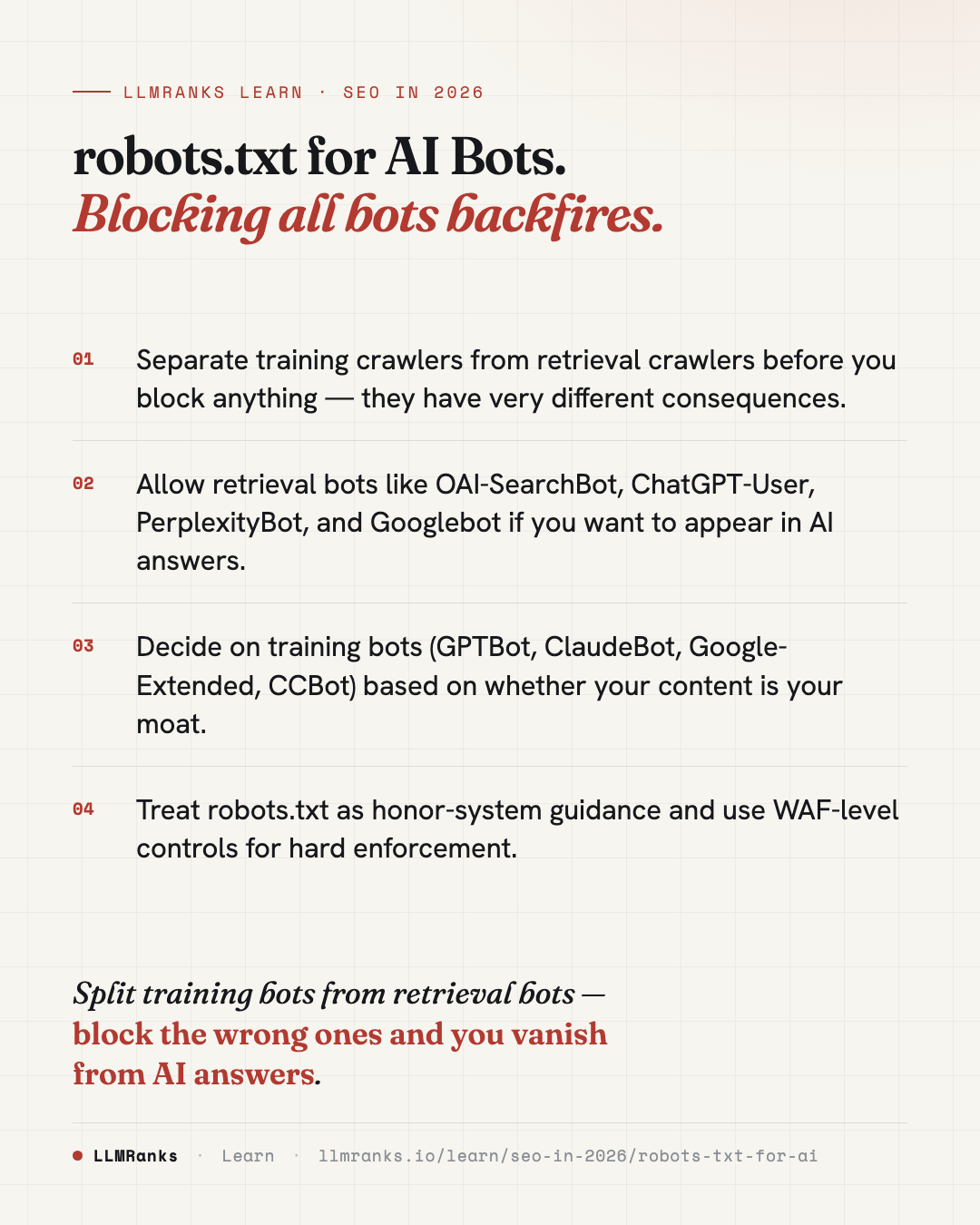
Blocking every AI crawler in your robots.txt is no longer the safe default for most commercial sites. The key distinction is between training crawlers and retrieval crawlers: blocking retrieval bots removes your site from AI answers and citations, while blocking training bots only affects whether your content feeds future models. Allow retrieval bots almost universally, and decide on training bots based on your business model.
Why "block all AI" backfired
The 2024 instinct to block every AI bot to protect content has reversed for most commercial sites. That advice was overcautious, and it cost sites measurable AI-Mode and ChatGPT visibility through 2025.
The reason is simple: blocking a training crawler is not the same as blocking a retrieval crawler. Training crawlers gather data that may feed future model versions. Retrieval crawlers fetch your pages live so an AI system can cite them in an answer right now. Block the retrieval crawlers and you disappear from AI citations — a direct hit to visibility.
The lawsuits-versus-licensing landscape has also stabilized since then. That means you can afford to block specifically rather than broadly, keeping the crawlers that drive distribution while restricting only the ones that conflict with your model.
Crawler reads
- HTML markup
- Plain text
- Outbound links
Agent drives
- Clicks & navigates
- Fills out forms
- Compares & checks policies
The current AI bot taxonomy
Most major AI bots respect robots.txt. The table below summarizes the operators, purposes, and a 2026 recommendation for each. Note that some naming has shifted over time — verify current user-agent strings before you commit rules.
| Bot UA | Operator | Purpose | 2026 recommendation |
|---|---|---|---|
Googlebot | Classic search index (also feeds AI Overviews) | Allow always | |
Google-Extended | Gemini training + grounding | Allow (blocking removes you from Gemini grounding) | |
GPTBot | OpenAI | ChatGPT training | Allow for training inclusion; blocking is fine |
OAI-SearchBot | OpenAI | ChatGPT Search live retrieval | Allow always |
ChatGPT-User | OpenAI | User-initiated fetches in ChatGPT | Allow always |
ClaudeBot | Anthropic | Training | Allow or block per training preference |
Claude-SearchBot / Claude-Web | Anthropic | Live retrieval for Claude | Allow always (verify current UA) |
anthropic-ai | Anthropic | Older, deprecated UA | Disallowing is harmless |
PerplexityBot | Perplexity | Indexing for Perplexity answers | Allow |
Perplexity-User | Perplexity | User-initiated | Allow |
Bytespider | ByteDance/TikTok | Training (Doubao etc.) | Block unless you want CN AI exposure |
Amazonbot | Amazon | Alexa + training | Allow |
Applebot | Apple | Siri + Apple Intelligence + training | Allow |
Applebot-Extended | Apple | Training opt-out control | Allow for AI exposure |
Meta-ExternalAgent | Meta | Llama training + Meta AI | Per preference |
cohere-ai / cohere-training-data-crawler | Cohere | Training | Per preference |
Diffbot | Diffbot | Knowledge graph | Allow (entity graph signal) |
CCBot | Common Crawl | Foundation training data | Allow (feeds most LLM pretraining via CC) |
DuckAssistBot | DuckDuckGo | DDG AI features | Allow |
MistralAI-User | Mistral | Le Chat retrieval | Allow |
A couple of caveats worth remembering. PerplexityBot mostly respects robots.txt but was caught spoofing in 2024, and Perplexity-User behavior has been inconsistent. Bytespider has historically respected robots.txt poorly.
Decide by business model
The core rule is to allow retrieval bots and decide on training bots based on your business model. Here is how that plays out across common site types.
- Publisher, news, or paywalled content: Block training (
GPTBot,ClaudeBot,Google-Extended,CCBot,Bytespider,Meta-ExternalAgent) and allow retrieval (OAI-SearchBot,ChatGPT-User,PerplexityBot,Googlebot). Negotiate licensing deals directly — the NYT/OpenAI, Reddit/Google, and FT/Anthropic arrangements are template examples. - SaaS, B2B, and docs sites: Allow nearly everything. You want to be the canonical answer when developers ask Claude or ChatGPT how to do something with your product, and training inclusion becomes future free distribution.
- E-commerce: Allow retrieval, which is essential for product discovery in agents. Training is lower-stakes because your inventory changes faster than training cycles anyway.
- Affiliate or content sites: Mixed. Allow retrieval, but block training if your moat is the writing itself.
If you run a documentation-heavy or product-led site, being cited well ties directly into AEO & GEO and the shift toward The Zero-Click, Agent Future.
A sample SaaS robots.txt
For a SaaS site that wants maximum AI exposure, a workable pattern looks like this. Notice that retrieval bots are named explicitly, because some bots only crawl when directly addressed.
User-agent: *
Allow: /

# Block low-value training crawlers
User-agent: Bytespider
Disallow: /

# Explicit allows for retrieval (some bots only crawl if explicitly named)
User-agent: OAI-SearchBot
Allow: /

User-agent: ChatGPT-User
Allow: /

User-agent: PerplexityBot
Allow: /

User-agent: Google-Extended
Allow: /

Sitemap: https://example.com/sitemap.xml
This is a starting point, not a universal answer — adjust the training-bot rules to match whichever business model above fits your site.
Enforcement is a separate problem
robots.txt is honor-system guidance. Compliant bots read it and behave, but it does not physically stop anything. If you need a hard block — for example, on a training crawler that ignores robots.txt or spoofs its user-agent — you enforce at the WAF level.
Cloudflare's AI Audit and bot-blocking features (launched in 2024) and similar WAF-level controls are how you actually prevent access. Use robots.txt to state your preference to well-behaved bots, and use those controls when you need enforcement that does not depend on cooperation.
For broader context on how crawling and indexing fit together, see Technical SEO. If you are also weighing whether a separate AI-guidance file helps, read llms.txt: The Reality Check.
What to do
- Classify each AI bot as training or retrieval before writing any rules, using the taxonomy above.
- Allow retrieval bots —
OAI-SearchBot,ChatGPT-User,PerplexityBot,Googlebot, and the current Claude retrieval UA — so you stay eligible for AI citations. - Match your training-bot rules to your business model: allow broadly for SaaS/B2B and e-commerce; block training for publishers and moat-driven content sites.
- Name retrieval bots explicitly in robots.txt, since some crawl only when directly addressed.
- Block
Bytespiderand other poorly-behaved crawlers unless you specifically want that exposure. - Verify current user-agent strings before deploying, because naming shifts over time (especially for Anthropic's bots).
- Add WAF-level controls for any bot you need to hard-block, since robots.txt alone cannot enforce.
- Revisit publisher-style blocks against licensing options, using existing deal templates as a reference point.
save this card
 Download card
1080×1350 · post it anywhere
put it to work
See how ChatGPT, Gemini and Google AI actually talk about your brand.