Entities & the Knowledge Graph
Entity SEO is the practice of making search engines and AI models recognize your brand as a distinct, well-understood entity — not just a string of text.…
5 min read · updated 2026-07-16
Entity SEO is the practice of making search engines and AI models recognize your brand as a distinct, well-understood entity — not just a string of text. The strongest lever is how often and how consistently your brand is mentioned across the web, because in 2026 unlinked brand mentions appear to outweigh backlinks for AI visibility. A 75,000-brand study found web mentions correlated with AI Overview brand visibility at a Spearman coefficient of 0.664 — the strongest of 11 factors tested and roughly three times the correlation of backlink count (0.218). Building entity strength means getting into knowledge graphs, structured databases, and authoritative co-citations so models can place you confidently in your category.
Why entities matter more than links now
Classical SEO taught you to chase backlinks. Entity SEO shifts the emphasis toward being mentioned — often without a link at all. Models learn who you are from how frequently your name appears near your category, your competitors, and the problems you solve.
This is the biggest divergence from classical SEO. Even a nofollow mention in the press, a podcast show note, or a Reddit thread can contribute to how an AI model understands your brand. The signal is presence and consistency, not link equity. For a fuller comparison of where these disciplines overlap and split, see SEO vs AEO: Where They Align and Where They Diverge.
How entity strength is built
Entity recognition is cumulative. No single mention makes you an entity; a pattern of consistent references does. These are the sources that build that pattern, roughly in order of leverage:
- Wikipedia / Wikidata entry — the single highest-leverage signal. If your company or product has a Wikipedia entry, it sits in the parametric memory of every major LLM. Without one, you're effectively invisible to non-retrieval queries.
- Co-occurrence with category terms — when your brand appears repeatedly near terms like "vector database," "RAG," or "embedding store" across thousands of pages, models learn your category position.
- Structured citations on authoritative sites — G2, Capterra, TrustRadius, Gartner Peer Insights, Crunchbase, GitHub (for developer tools), and Product Hunt are heavily crawled and high-signal.
- Founder and employee profiles — LinkedIn and personal sites help models disambiguate entities through people-to-company links.
- Press coverage with consistent naming — outlets like TechCrunch, The Verge, Wired, and industry trades count even when the mention is nofollow.
- Podcast appearances with show notes — a surprisingly high signal, because show notes are crawled and place the founder name, company name, and topic in close proximity.
Consistency of naming matters across all of these. If your brand appears under several variations, you dilute the signal.
The knowledge graph pipeline
Google's Knowledge Graph feeds Gemini and AI Overviews directly, so getting into the graph has downstream effects on AI visibility. Entities enter the graph through three main routes, each with a different trade-off between speed and authority:
| Route | Speed | Authority |
|---|---|---|
| Wikipedia → Wikidata → Knowledge Graph | Slowest | Highest |
Schema.org Organization + sameAs triangulation | Fast | Medium |
| Repeated co-citation across high-authority domains | Slowest | Unblockable signal |
OpenAI and Anthropic don't publish how they store entities, but their behavior suggests similar pipelines, weighted toward Wikipedia and Common Crawl frequency. Treat this as an informed inference rather than confirmed fact — the exact weighting is not disclosed.
The practical implication: pursue the fast route (schema) immediately, and work the slow-but-durable routes (Wikipedia, co-citation) in parallel. To get the schema side right, see Structured Data & Schema.
Auditing your entity signals
Before you build, measure where you stand. Work through these checks:
- Wikidata: Does your brand have a Q-number? Search at
https://www.wikidata.org/wiki/Special:Search. - Wikipedia: Is there an article? If not, is the brand notable enough to qualify — meaning at least three independent secondary sources?
- sameAs schema: Is
sameAspresent, linking to Wikipedia, Wikidata, Crunchbase, LinkedIn, X, and GitHub? - Organization schema: Does the homepage carry
Organizationschema withfounder,foundingDate,numberOfEmployees, andaddress? - Review volume: How many G2 or Capterra reviews do you have? At least 30 supports category visibility; at least 100 supports citation in "best of" AI answers.
- Reddit: How many mentions in your target subreddits over the last 12 months? Count with
site:reddit.com "brand name". - YouTube: Are there videos mentioning your brand, especially review and comparison videos?
These checks translate directly into a to-do list. A missing Q-number, absent sameAs block, or thin review profile each represents a specific gap you can close.
How this connects to citations
Being a recognized entity is a prerequisite for being cited. When a model already understands who you are and what category you belong to, it can reach for your brand confidently in an answer. When it doesn't, retrieval has to do all the work — and you're competing against brands that live in parametric memory.
Entity strength and content quality reinforce each other. Strong entity signals get you considered; citable content gets you quoted. For the content side, see What Makes Content Citable and How LLMs Choose Citations. For the broader answer-engine context, start with AEO & GEO.
Off-page mentions and reviews also feed traditional authority signals, so this work rarely goes to waste — see Off-Page Authority.
What to do
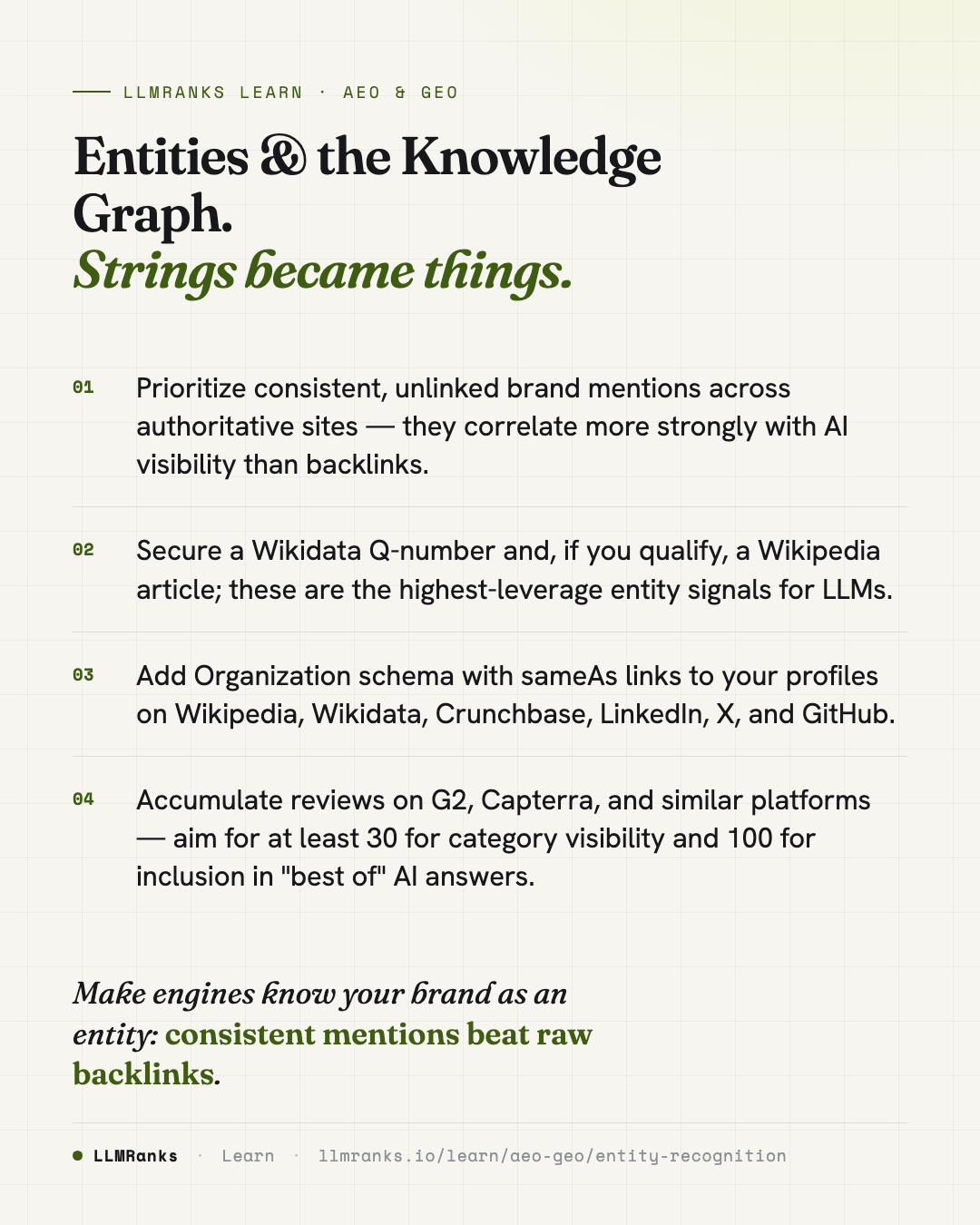
- Search Wikidata for your brand's Q-number. If none exists, create a Wikidata item with your verified profiles.
- Assess Wikipedia notability. If you have at least three independent secondary sources, pursue an article; if not, focus on earning that coverage first.
- Add
Organizationschema to your homepage withfounder,foundingDate,numberOfEmployees, andaddress. - Add a
sameAsarray linking to your Wikipedia, Wikidata, Crunchbase, LinkedIn, X, and GitHub profiles. - Build review volume on G2 and Capterra toward 30 for category visibility and 100 for "best of" inclusion; add TrustRadius, Gartner Peer Insights, Crunchbase, and Product Hunt where relevant.
- Standardize your brand name everywhere so mentions consolidate rather than split.
- Pursue press coverage and podcast appearances that name your brand alongside your category terms — the show notes and articles are crawled even when links are nofollow.
- Monitor Reddit and YouTube mentions with
site:reddit.com "brand name"and periodic searches, and seed genuine discussion in your target communities.
save this card
 Download card
1080×1350 · post it anywhere
put it to work
See how ChatGPT, Gemini and Google AI actually talk about your brand.