The Sources That Fuel LLMs
Large language models like ChatGPT draw on a handful of high-trust public sources far more than the open web at large: Wikipedia, Reddit, YouTube…
5 min read · updated 2026-07-16
Large language models like ChatGPT draw on a handful of high-trust public sources far more than the open web at large: Wikipedia, Reddit, YouTube transcripts, review aggregators like G2 and Capterra, and — for developer tools — GitHub. Some of these feed the model during training; others get pulled in at answer time through retrieval. Which sources matter for you depends on your category and which engine you're targeting, because citation behavior varies significantly between ChatGPT, Gemini, and others.
Wikipedia: trained on and heavily cited
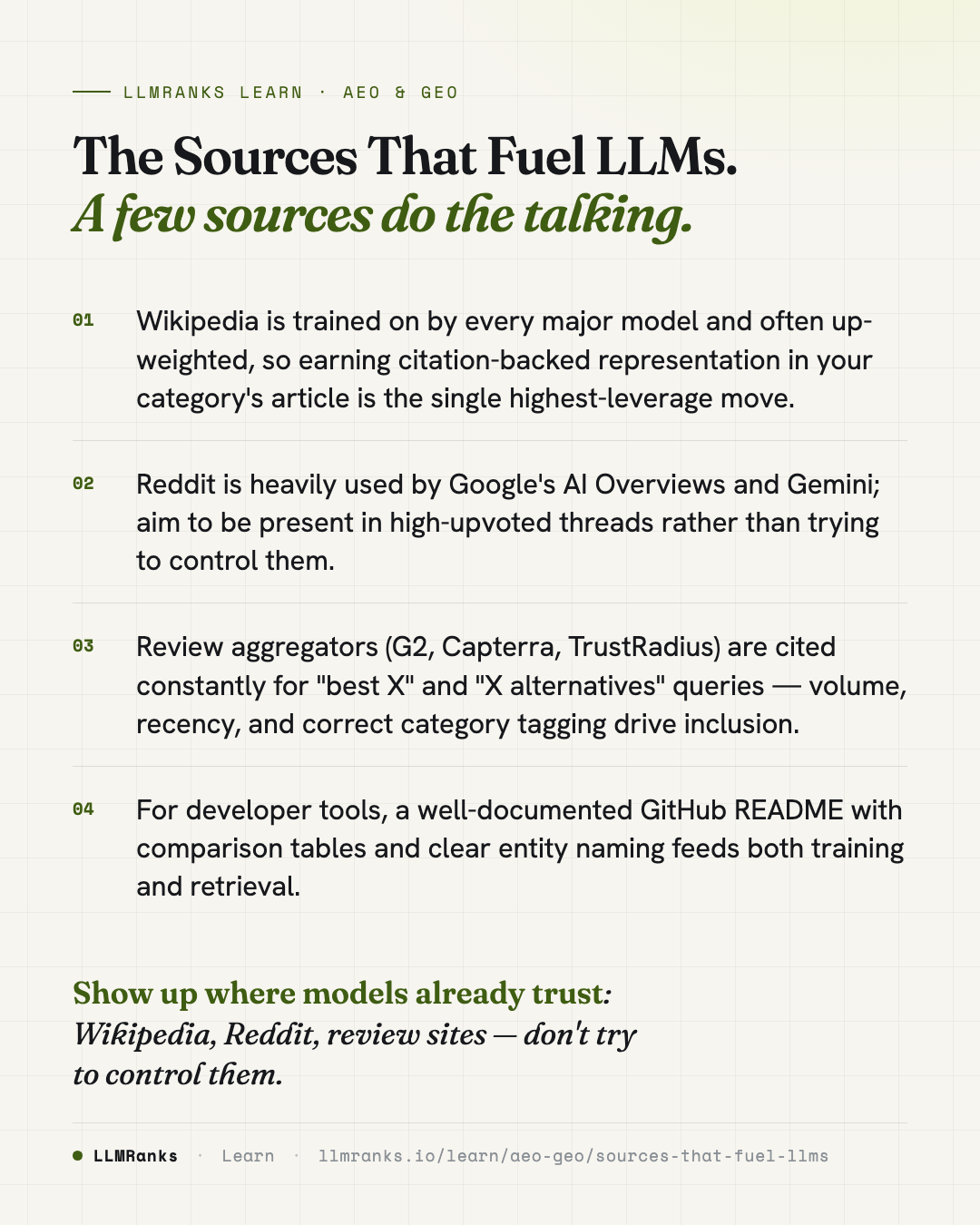
Every major LLM trains on Wikipedia, and many training mixes sample it at 2–5× its raw frequency. That up-weighting makes Wikipedia one of the most influential single sources a model sees, and it is cited at extremely high rates for definitional and historical queries.
The practical opportunity is category-level. If your category lacks a Wikipedia article — think "headless CMS" or "vector database" — creating or improving that article earns persistent representation, provided it's built on proper citations rather than promotional language. Adding your product as a citation-backed example inside an existing article is the highest-ROI single edit available, but it only works if it survives editorial review, which means citing real secondary sources.
This is closely tied to how models understand entities and the knowledge graph: a clean, well-sourced Wikipedia entry helps the model recognize your product as a distinct thing worth naming.
Reddit: licensed, fast-indexed, thread-level
All major LLMs trained on Reddit through 2023. Post-2024 access is licensed (Google) or restricted; Anthropic and OpenAI both have arrangements, but the terms are opaque. In retrieval, Reddit shows up heavily in Google's AI Overviews and Gemini, and at medium rates in other engines.
The pattern that works is genuine participation in category subreddits: detailed, helpful answers to real questions that mention your product as one option among several, with honest tradeoffs. Because Reddit's ranking combines with Google's licensing, a well-upvoted comment thread — for example, "I've used PgBouncer, PgCat, and Supavisor in production, here's the breakdown" — can become a citation source quickly, since Google indexes Reddit fast under the licensing deal. Timelines vary.
A critical nuance: it's the thread, not your specific comment, that gets cited. The engine quotes "Reddit users report..." and synthesizes the top comments. So the goal is to be present in the highest-upvoted threads, not to control them.
Avoid the two moves that backfire:
- Brand-new accounts dropping links get filtered as spam and hurt you.
- Single-product evangelism gets downvoted, and downvoted content is never retrieved.
YouTube: transcripts are the payload
Text LLMs don't "understand" video — they read the transcript. Auto-generated captions are in training corpora, but they mangle technical terms ("PgBouncer" becomes "pg bouncer" or "PG bounce sir"), which destroys entity matching.
Retrieval varies sharply by engine. Gemini cites YouTube natively and at very high rates, thanks to direct index access, and AI Overviews embeds video. ChatGPT and Claude rarely cite YouTube directly. This is one of the clearest examples of why citation behavior by engine should shape where you invest.
For Gemini and AI Mode visibility:
- Write clean, keyword-rich, sentence-structured descriptions.
- Add chapter markers (
0:00 Intro,2:14 PgBouncer setup) — these become retrievable timestamps. - Upload an accurate transcript instead of relying on auto-captions.
Review aggregators: the commercial-query engine
G2, Capterra, and TrustRadius pages are heavily crawled, and their structured pros, cons, and ratings end up in training data. In retrieval, they're cited constantly for "best X" and "X alternatives" commercial queries across all engines. These sites rank extremely well and carry high re-ranker trust for product comparison intent.
The levers here are volume, recency, and placement:
| Lever | What to aim for |
|---|---|
| Review volume | ≥30 reviews for baseline visibility; ≥100 for "best of" inclusion |
| Recency | Engines weight 2025–2026 reviews over 2022 reviews; a steady drip beats a one-time burst |
| Category tagging | Correct G2 category placement — the category page is what gets retrieved for "best [category]" |
| Content of reviews | Encourage specific use cases and named competitors |
Reviews that name competitors and use cases matter most. A line like "We switched from Heroku Postgres to X because..." creates the co-occurrence that trains comparison answers. Separately, Capterra's "alternatives" pages are a direct citation source for "X alternatives" queries, so being listed as an alternative to a market leader is high-value.
GitHub: underrated for developer tools
For dev-tool brands, GitHub is an underrated source. README files, issues, and discussions sit in every code-trained model. A well-documented README with comparison tables, benchmarks, and clear entity naming feeds both training and retrieval, since GitHub ranks well and is crawled by all LLM bots.
Star count appears to be a weak ranking proxy that re-rankers use for "popular library" queries — treat it as a soft signal, not a target in itself.
How these sources fit together
No single source guarantees visibility. Each one plays a different role depending on query type and engine: Wikipedia for definitions, Reddit for lived-experience and comparison, YouTube for Gemini-heavy audiences, aggregators for commercial intent, and GitHub for developer categories.
Deciding where to invest comes down to matching your category and target engine to the sources those engines actually pull from. That decision connects directly to how LLMs choose citations and what makes content citable in the first place.
What to do
- Check whether your category has a Wikipedia article; if not, draft a well-sourced one, and look for existing articles where your product could be added as a citation-backed example.
- Identify the highest-upvoted subreddit threads in your category and contribute genuinely helpful, multi-option answers with honest tradeoffs — never with a new link-dropping account.
- For any video content, publish accurate uploaded transcripts, keyword-rich descriptions, and chapter markers to make timestamps retrievable.
- Build review volume on G2, Capterra, and TrustRadius toward 30+ (then 100+), keep a steady recency drip, confirm correct category tagging, and prompt reviewers to name competitors and use cases.
- If you sell a developer tool, upgrade your GitHub README with comparison tables, benchmarks, and consistent entity naming.
- Prioritize sources by the engines your audience uses, since citation behavior by engine determines which of these actually surface your brand.
save this card
 Download card
1080×1350 · post it anywhere
put it to work
See how ChatGPT, Gemini and Google AI actually talk about your brand.