How Claude Web Search Works
Claude's web search works by fetching pages live at query time rather than leaning on a deep proprietary index, so how fast and cleanly your server responds…
5 min read · updated 2026-07-18
Claude's web search works by fetching pages live at query time rather than leaning on a deep proprietary index, so how fast and cleanly your server responds directly affects whether you get cited. It became generally available in mid-2025 and strongly favors primary sources, long-form analysis, and documentation with clear authorship. To be citable in Claude, you need fast responses, clean semantic HTML, honest publication dates, and verifiable author credentials.
How Claude fetches and reads the web
Claude's search leans more heavily on live fetch at query time than a deep index — more so than ChatGPT. It uses ClaudeBot for indexed crawling and Claude-User / Claude-SearchBot for live fetches, with anthropic-ai published as a legacy training-data agent. Anthropic has been less public than some competitors about its exact crawler taxonomy, so verify current details against Anthropic's own robots documentation before making changes.
Because retrieval happens live, your infrastructure becomes a ranking factor:
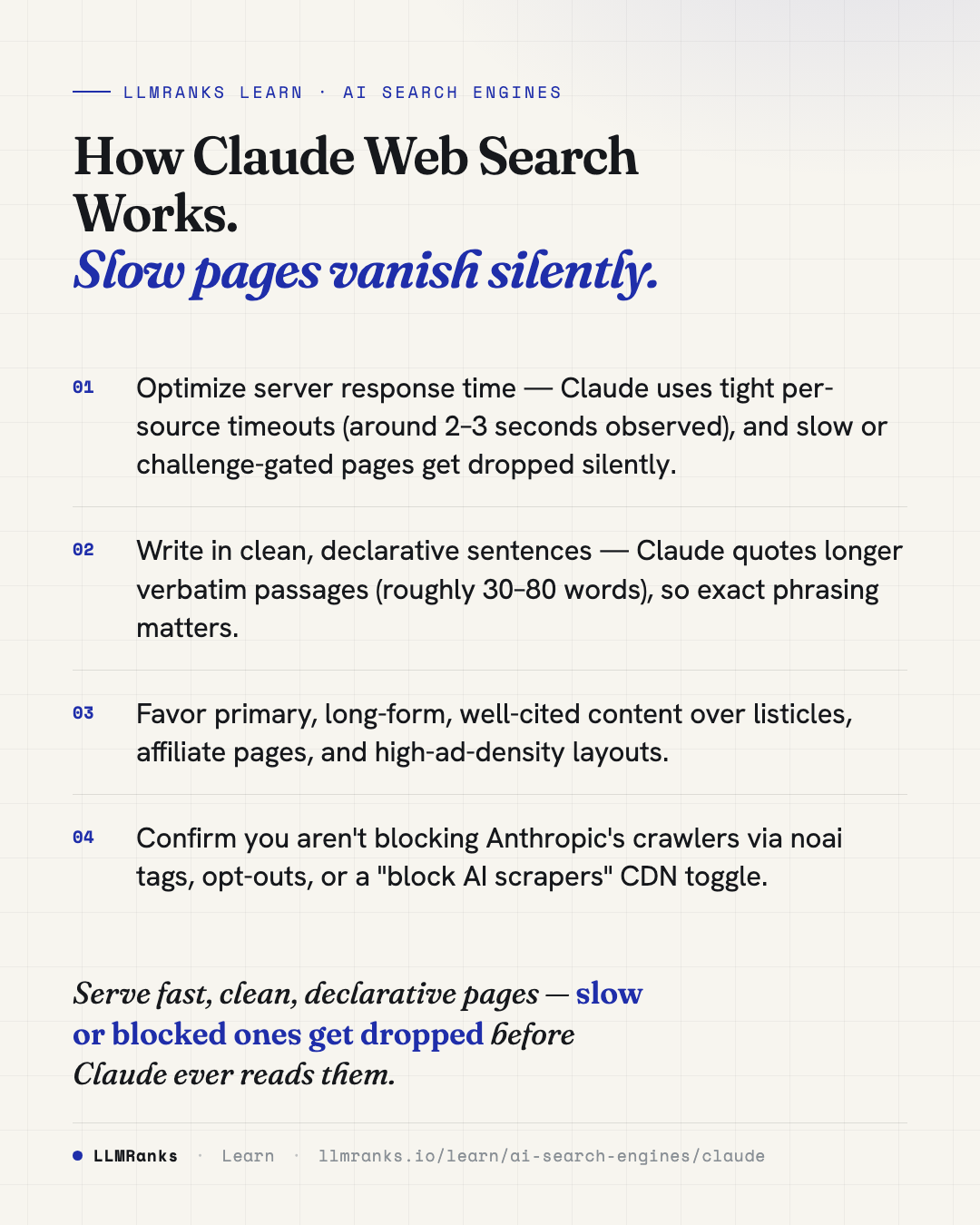
- Time to first byte matters. Claude appears to apply tight per-source timeouts (around 2–3 seconds observed). If your server is slow, your page may never enter the answer.
- Edge complexity hurts. Sites with heavy edge logic, geo-redirects, or bot challenges get dropped silently, with no error you'll notice.
- Caching helps. CDN caching with stale-while-revalidate behavior significantly improves your odds of being fetched in time.
If your pages depend on JavaScript to render primary content, that's a further risk. Claude's headless rendering is the weakest of the major players in 2026, so critical text should be present in the initial HTML. This overlaps heavily with general technical SEO and Core Web Vitals work.
What Claude prefers to cite
Claude's source selection shows the strongest bias of any major LLM toward authoritative origins. It skews toward:
- Primary sources over aggregators — academic papers, official documentation, and primary news reporting.
- Long-form analytical content, roughly 1,500–4,000 words, over short posts.
- Documentation sites such as developer docs, API references, and government publications.
- Established, trusted domains including Wikipedia, arXiv, PubMed, government sites, major news, and established trade publications.
Anthropic also appears to weight Organization schema with verified sameAs links more heavily than competitors do.
By contrast, Claude under-weights SEO-optimized listicles, affiliate-heavy commercial content, and pages with high ad density. Per leaks from late 2025, Anthropic reportedly applies explicit penalties tied to ad-to-content ratio. This makes Claude a strong argument for the kind of substance-first approach covered in Content Strategy & E-E-A-T.
Signals that get you cited — and ignored
The table below summarizes what helps and what hurts.
| Helps citation | Hurts or blocks citation |
|---|---|
Clean HTML with semantic tags (<article>, <section>, <figure>, <cite>) | Pages requiring JS for primary content |
ScholarlyArticle, TechArticle, APIReference, Dataset schemas | Generated or spun content flagged by a low-perplexity classifier |
Author credentials via Person schema linking to verifiable profiles | Anything blocked by noai, noimageai, or Anthropic-specific opt-outs |
| Content that itself cites sources (a meta-authority signal) | Sites with a CDN "block AI scrapers and crawlers" toggle that now blocks ClaudeBot |
Verified Organization schema with sameAs | Sources on fact-check debunk lists (e.g., Snopes, PolitiFact) |
Claude appears to favor sources that cite other sources — treating citation as a meta-authority signal. Its Constitutional AI filters now reject sources flagged for misinformation patterns, so being on a fact-check blacklist measurably reduces your citation probability.
Your schema and markup choices here connect directly to broader Structured Data & Schema practice.
Freshness and dates
Claude handles freshness conservatively and will explicitly cite publication dates inline — for example, "according to a March 2026 article from...". If datePublished and dateModified are missing or contradictory, Claude often refuses to cite the page or hedges the reference with a note that it "may be outdated."
Two practical rules follow:
- Always include both
datePublishedanddateModifiedin your JSON-LD. - Only update
dateModifiedon substantive content changes. Claude appears to detect and discount sites that bump dates without changing content, comparing indexed snapshots for similarity.
How Claude renders citations
Claude renders citations as numbered footnotes with full URLs visible, plus a separate "Sources" panel. It tends to quote longer verbatim passages — often 30–80 words — attributed to a source, rather than paraphrasing and citing the way some other engines do.
The implication is direct: well-written declarative sentences get pulled in whole. Structure your key claims as clean, self-contained statements that read well out of context. This is the same discipline that helps across AEO & GEO and other AI search engines.
Platform-specific tactics
A few conventions are worth adopting specifically because Claude parses them well:
- Add Highwire-style
<meta name="citation_*">tags, the academic publishers' convention — Claude reads these. - Maintain a public bio page for each author with
PersonJSON-LD, and link it from every article that author writes. - Publish an
/llms.txtfile (the proposed 2024 standard, increasingly respected). Among major LLMs, Claude respects it most consistently.
How this changed from 2024 to 2026
In 2024, Claude had no native web search and relied on context the user provided directly. By 2026, it performs full retrieval, multi-hop reasoning over fetched sources, and parallel fetching of 8–15 sources per complex query. Constitutional AI filters now actively reject sources flagged for misinformation. The shift means visibility in Claude is now an ongoing, technical concern rather than something you can ignore — see Cross-Engine AI Visibility for how it fits alongside other engines.
What to do
- Measure and cut your TTFB. Aim to respond well inside Claude's ~2–3 second fetch window, and add CDN caching with stale-while-revalidate.
- Remove silent blockers. Check for geo-redirects, bot challenges, and CDN "block AI scrapers" toggles that stop
ClaudeBot; verify your rules against Anthropic's robots documentation. - Serve primary content in HTML. Don't require JavaScript to render the text you want cited.
- Add honest date markup. Include both
datePublishedanddateModified, and update the modified date only on real changes. - Mark up authors and organizations. Use
Personschema with links to verifiable profiles, plusOrganizationschema with verifiedsameAs. - Choose article schema by content type. Apply
ScholarlyArticle,TechArticle,APIReference, orDatasetwhere they fit, and add Highwirecitation_*meta tags. - Write citable sentences. Draft key claims as clean, declarative statements Claude can quote verbatim.
- Prioritize primary, long-form, well-sourced content. Cite your own sources, and reduce ad density and affiliate padding.
- Publish an
/llms.txtfile and keep it current.
save this card
 Download card
1080×1350 · post it anywhere
put it to work
See how ChatGPT, Gemini and Google AI actually talk about your brand.