How Perplexity Ranks Sources
Perplexity works as a search engine with a language model layered on top, not a language model with search added later. It retrieves from multiple sources,…
5 min read · updated 2026-07-18
Perplexity works as a search engine with a language model layered on top, not a language model with search added later. It retrieves from multiple sources, re-ranks them with its own models, synthesizes an answer, and injects citations at the sentence level. The defining trait is forced source diversity: it pulls from a spread of domains rather than leaning on one publication, which rewards being the single best source on a specific topic.
How Perplexity retrieves and answers
Perplexity's flow moves through four stages. A query triggers multi-source retrieval across its own index, Bing, a Google fallback, and specialized indices. Results are re-ranked with proprietary models, then synthesized by an LLM answer layer. Finally, citations are injected at the sentence level so claims map to specific sources.
Two crawlers matter here. PerplexityBot is the indexing crawler that builds the index over time. Perplexity-User handles on-demand fetches when a live query needs fresh content. There was significant controversy in 2024 over Perplexity ignoring robots.txt for live fetches, involving Forbes, NYT, and Wired. By 2026 the access rules have been formalized, and both agents need to be allowed for full visibility:
User-agent: PerplexityBot
Allow: /

User-agent: Perplexity-User
Allow: /
Perplexity has been the most aggressive of its peers about respecting noai directives since the 2024 lawsuits. If you're comparing crawler behavior across platforms, see How ChatGPT Search Works and How Claude Web Search Works.
Why source diversity changes your strategy
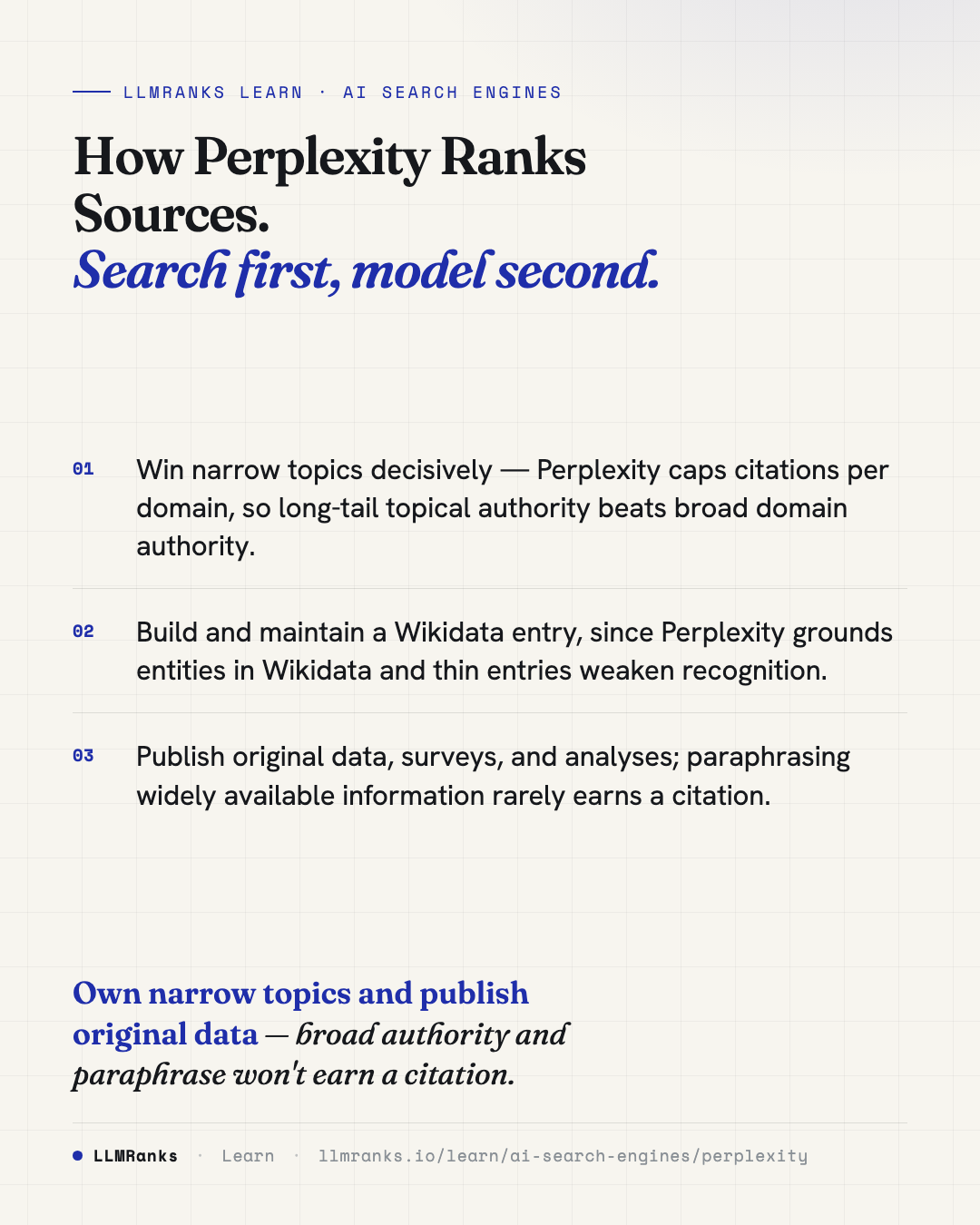
Perplexity's defining behavior is forced source diversity. Where another assistant might cite three sources from the same trade publication, Perplexity actively spreads citations — typically 5–10 sources per answer with strict per-domain caps, usually one and occasionally two.
That has direct consequences for how you rank:
- Being the single best source on a niche topic gets you cited reliably.
- Being one of many similar sources means you rotate in and out of citations.
- Long-tail topical authority is rewarded more than overall domain authority.
The practical takeaway: pick topics you can own outright rather than adding another near-duplicate voice to a crowded query. This is where Content Strategy & E-E-A-T and Off-Page Authority support each other.
Focus modes route to different indices
Perplexity's Focus modes send queries to different source pools, and each one rewards different preparation.
| Focus | Source pool | Optimization |
|---|---|---|
| Web | General + Bing | Standard SEO + schema |
| Academic | Semantic Scholar, arXiv, PubMed | DOI, ORCID, ScholarlyArticle |
| Social | Reddit, X (limited), YouTube | Native presence required |
| Math | Wolfram + computational | N/A for content sites |
| Video | YouTube transcripts | VideoObject schema, transcripts |
| Finance | SEC, financial data providers | Structured financial data |
If you target academic queries, getting indexed in Semantic Scholar matters more than your own site's SEO. If you target Reddit-heavy queries — product comparisons or "best X for Y" — brand presence in relevant subreddits is non-negotiable. For structured markup that supports these modes, see Structured Data & Schema.
Freshness versus evergreen authority
Perplexity's freshness is the strongest of the major platforms for news and trending queries. It runs continuous re-crawls of news sources and uses query-time fetches aggressively. For breaking topics, content published less than 60 minutes ago can appear in citations.
For evergreen content the balance shifts. Index lookup dominates, the freshness premium drops off, and old authoritative content — Wikipedia, classic explainers — gets cited heavily. Match your publishing cadence to the type of query you want to win: fast for trending, durable and authoritative for evergreen.
What gets cited and what gets ignored
Perplexity favors a recognizable set of source types:
- Definitive primary sources: official announcements and original research.
- Reddit discussion threads, which appear heavily in product and recommendation queries.
- YouTube videos with transcripts and
VideoObjectschema. - News with strong
NewsArticleschema, andReportageNewsArticlewhere applicable. - Wikipedia and Wikidata, which Perplexity uses for entity grounding.
It tends to skip:
- Duplicative content — if 50 sites say the same thing, it picks the most authoritative and the rest never appear.
- Pages without clear topical focus, because the relevance threshold is high.
- Content gated by paywalls without metadata exposure.
- Slow-loading pages (over 2s TTFB) in live-fetch contexts, which is where Core Web Vitals work pays off.
Platform-specific tactics
A few moves are specific to how Perplexity assembles answers:
- Build a Wikidata entry for your organization or brand. Perplexity grounds entities in Wikidata, so a missing or thin entry means weaker entity recognition.
- Establish Reddit presence. Answer questions in your domain on Reddit with linked source content; those comments can cite back into Perplexity answers.
- Be the original. Original data, surveys, benchmarks, and analyses get cited because they're the only source — paraphrasing widespread information gets you nowhere.
- Use comparison tables. Perplexity's interface surfaces tables prominently and pulls them into structured answers.
- Expose API references for developer audiences. Developer queries route heavily to API references, so publishing OpenAPI specs helps.
What changed from 2024 to 2026
In 2024, Perplexity was mostly Bing-backed and drew growing controversy over scraping. By 2026 it runs a substantial proprietary index and has formalized publisher partnerships, including revenue-share arrangements with major publishers. Comet browser integration brings agentic retrieval into the mix — for how that broader shift plays out, see The Agentic Web.
The Pages feature also changes the citation game. User-published Pages often outrank original sources because of Perplexity-internal weighting, so creating high-quality Pages on your topics is a way to use that behavior deliberately.
What to do
- Allow both
PerplexityBotandPerplexity-Userin yourrobots.txt, and confirm you aren't blocking either. - Create or strengthen a Wikidata entry for your brand or organization to improve entity grounding.
- Choose narrow topics you can own outright rather than duplicating crowded queries, given the per-domain citation cap.
- Publish original data, surveys, benchmarks, or analyses that no other source can provide.
- Identify which Focus mode fits your queries and prepare accordingly — Semantic Scholar indexing for academic, subreddit presence for social,
VideoObjectschema and transcripts for video. - Add comparison tables to pages where users weigh options, since Perplexity surfaces them directly.
- Keep live-fetch pages fast (TTFB under 2s) and expose metadata so paywalled or slow content isn't skipped.
- Consider publishing high-quality Pages on your core topics, and coordinate your approach across platforms using Cross-Engine AI Visibility.
save this card
 Download card
1080×1350 · post it anywhere
put it to work
See how ChatGPT, Gemini and Google AI actually talk about your brand.