Content Freshness
Content freshness in SEO is query-dependent: some queries reward recently updated pages (the "Query Deserves Freshness" idea), while others are stable and…
5 min read · updated 2026-07-30
Content freshness in SEO is query-dependent: some queries reward recently updated pages (the "Query Deserves Freshness" idea), while others are stable and rarely need updating. Match your refresh cadence to what the content actually is — news needs hours, glossary definitions can go years. Update pages in place with genuine changes rather than gaming the dateModified timestamp, because systems detect and discount fake freshness.
Freshness is query-dependent
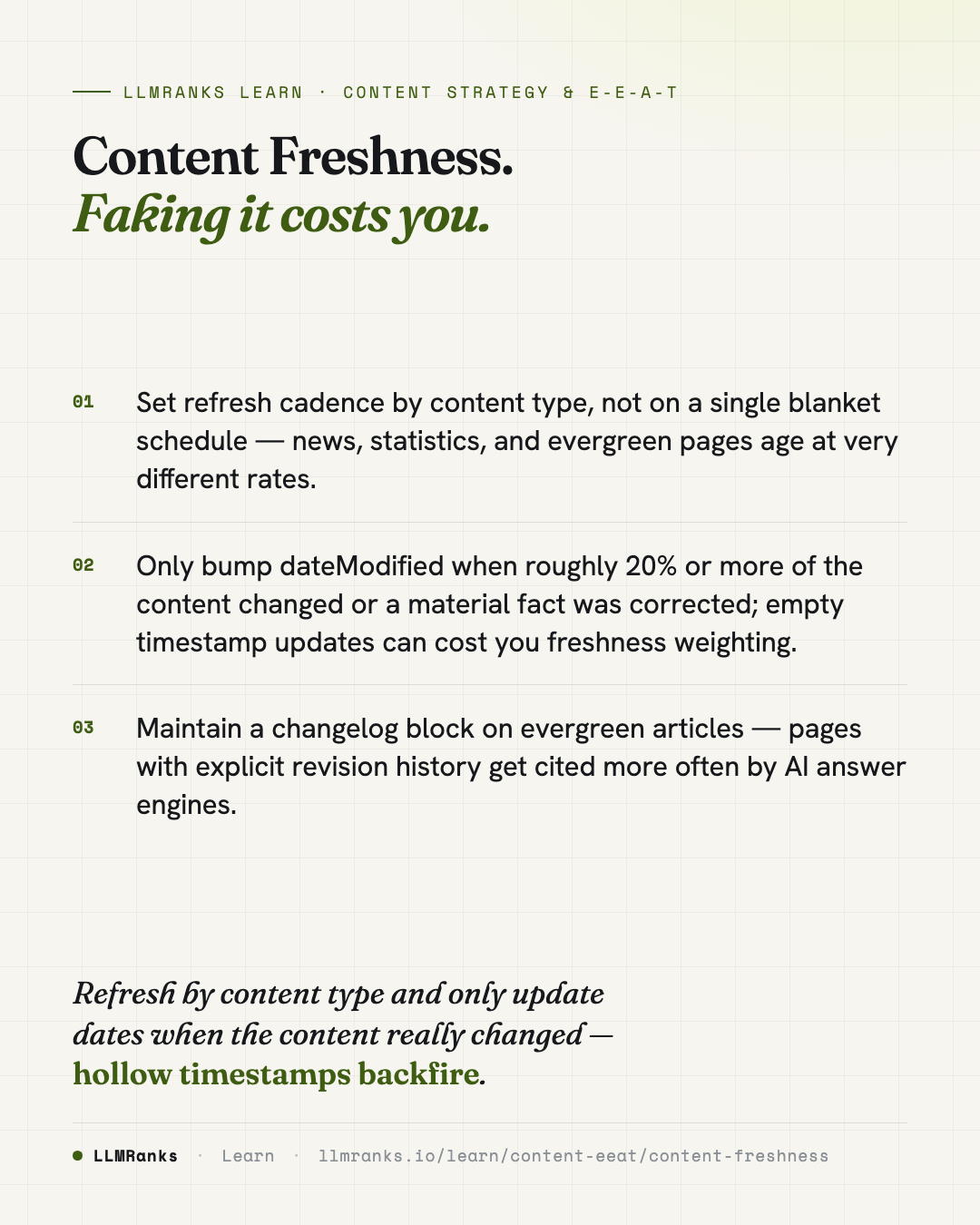
Not all content needs the same refresh rhythm. The "Query Deserves Freshness" principle means some searches favor recently updated results — breaking events, current statistics, changing prices — while others are satisfied by stable reference material. Before you set a schedule, decide which kind of page you're maintaining.
The practical takeaway: don't refresh everything monthly, and don't leave everything to rot for years. Assign each page a cadence and a trigger, then update when the trigger fires.
Refresh cadence by content type
Use this table as a starting map. The trigger column matters as much as the cadence — an event, a data release, or a tool changelog is often the real signal that a page needs work.
| Content type | Refresh cadence | Trigger |
|---|---|---|
| News / current events | Hours–days | Event-driven |
| Statistics / "X stats for [year]" | Quarterly minimum, monthly ideal | New data release |
| Software tutorials | Per major version release | Tool changelog |
| Pricing / product comparisons | Monthly | Vendor changes |
| Algorithm/policy explainers (SEO, tax, law) | Per official update | Source changelog |
| How-to evergreen | 6–12 months | SERP composition shift |
| Definitional / glossary | 12–24 months | Term evolution |
| Historical / reference | 24–36 months | Scholarly correction |
Notice that most of these triggers are external: a new version ships, a vendor changes pricing, an official policy updates. Watching those sources is more reliable than watching the calendar.
The dateModified trap
This is where most teams cheat and get caught. Touching dateModified weekly with no substantive changes is "fake freshness," and search systems detect it — sites that do this lose freshness weighting rather than gain it.
Rules that keep you honest:
- Only update
dateModifiedwhen ≥20% of the content actually changed, or when you've corrected a material fact. - Include both
datePublishedanddateModifiedin yourArticleschema, using ISO 8601 with a timezone offset — for example,"datePublished": "2024-03-12T09:00:00-05:00". - Surface both dates visibly to readers, and note what changed: "Published March 12, 2024 · Last updated March 4, 2026 (added Section 4 on Core Web Vitals INP threshold change)." Both people and AI answer engines want to see what was updated, not just that something was.
- Don't refresh by republishing under a new URL unless the content is fundamentally different. Update in place so you preserve the URL's accumulated equity.
For more on how these date fields are marked up, see Structured Data & Schema.
Changelogs as an AEO signal
Maintaining a changelog block at the bottom of an evergreen article does two jobs. It gives readers a transparent history of edits, and it acts as a strong signal for answer engines: content with explicit revision history gets cited more often.
Treat the changelog as part of the page, not an afterthought. Each entry should say what changed and when, which reinforces both the visible last-updated note and the machine-readable dateModified. This is a low-effort habit that pays off for AEO & GEO visibility.
Freshness signals beyond dateModified
A timestamp alone is weak. Real freshness shows up across several signals that are harder to fake because they reflect actual work on the page:
- New citations to recent primary sources — ideally published in the last six months.
- Updated screenshots, which change the underlying image hashes.
- New comments or engagement on the page.
- Updated
lastmodin your sitemap.xml, which must match the page'sdateModified— mismatches undercut the signal. - Internal links from new content pointing back to the older page.
That last point connects freshness to your wider site structure: as you publish new material, link it back to the evergreen pages it supports. See Internal Linking for how to build those connections deliberately.
How freshness fits with quality
Freshness is not a substitute for quality or depth — it's one factor among many. A page still needs to genuinely help the reader and demonstrate expertise. When you refresh, look for the chance to deepen the content, not just re-date it. That means checking it against your broader approach to Content Strategy & E-E-A-T and, where relevant, Topical Authority.
Updating in place with substantive changes is the version of freshness that survives scrutiny. Bolting a new date onto a stale page is the version that gets discounted.
What to do
- Classify every important page by content type and assign it a cadence and an external trigger from the table above.
- Set up trigger monitoring for your highest-value pages — track the tool changelogs, vendor pricing, official policy updates, or data releases that should prompt an edit.
- Add both
datePublishedanddateModifiedto yourArticleschema in ISO 8601 with a timezone offset, and make surelastmodin your sitemap matchesdateModified. - Show both dates on the page with a short note on what changed in the latest update.
- Only bump
dateModifiedwhen at least 20% of the content changed or you corrected a material fact — never on empty edits. - Add a changelog block to your evergreen articles and keep it current with each revision.
- Refresh in place: update the existing URL, add recent citations, replace outdated screenshots, and point new internal links back to the page rather than spinning up a new URL.
save this card
 Download card
1080×1350 · post it anywhere
put it to work
See how ChatGPT, Gemini and Google AI actually talk about your brand.