E-E-A-T in Practice
E-E-A-T stands for Experience, Expertise, Authoritativeness, and Trustworthiness. It's not a ranking factor in the algorithmic sense — it's the framework…
5 min read · updated 2026-07-28
E-E-A-T stands for Experience, Expertise, Authoritativeness, and Trustworthiness. It's not a ranking factor in the algorithmic sense — it's the framework Google's quality raters use to calibrate its systems, and since 2024 it also loosely describes how AI systems filter for authoritative sources when grounding answers. The practical takeaway is that you demonstrate each quality with concrete, verifiable evidence rather than asserting it. Trust is the leg everything else depends on.
Experience: show first-hand engagement
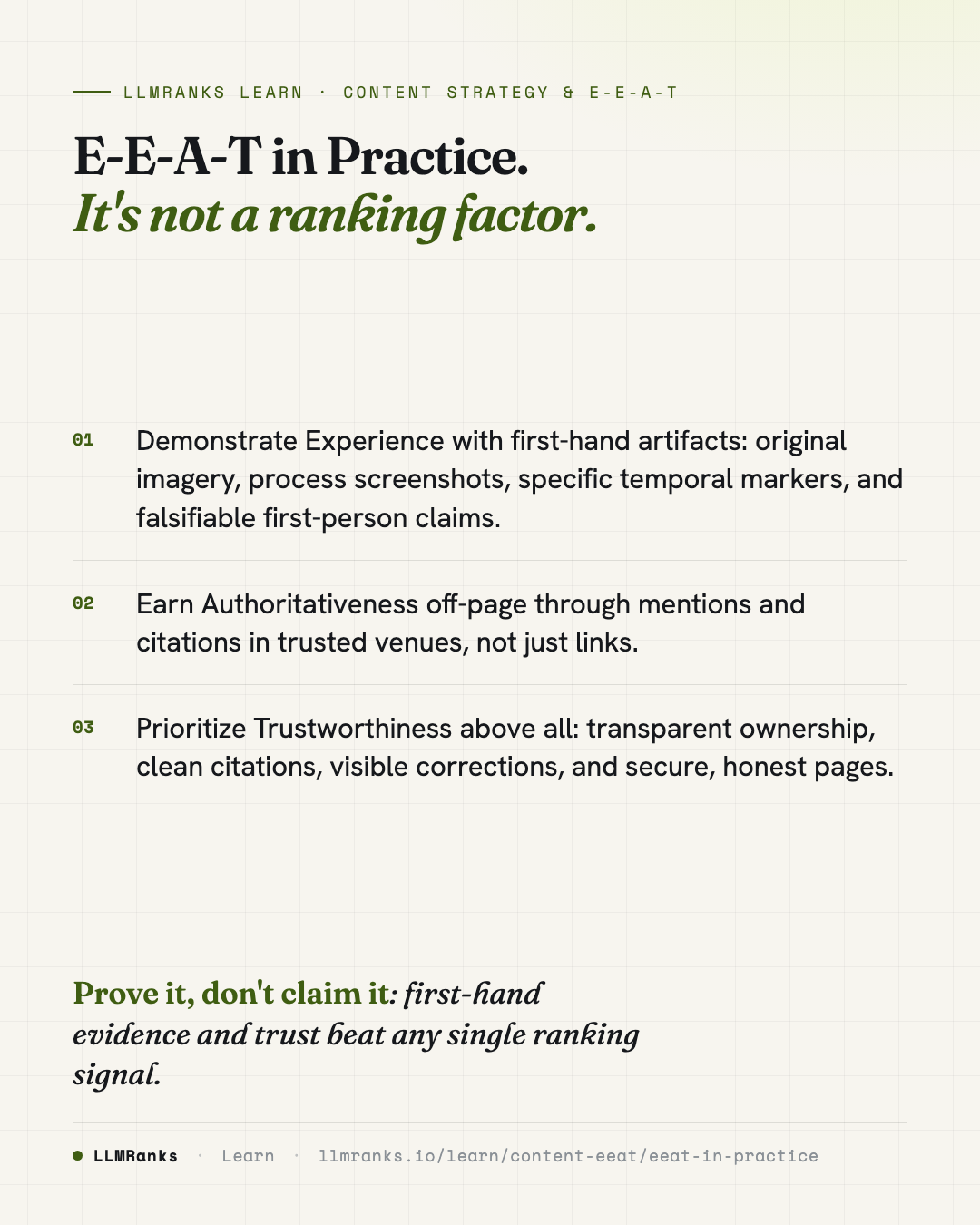
Experience is the "second E," added in December 2022. It asks whether the content reflects first-hand, verifiable engagement with the subject — and you demonstrate it by leaving evidence.
- Original imagery: use photos your author actually took, not stock. Where privacy allows, preserve EXIF data such as
DateTimeOriginal,GPSLatitude, andMake/Model, since Google's image understanding reads these fields. - Process artifacts: screenshots with your real interface or account visible, terminal output with real timestamps, receipts, dashboards, and before/after data from your own runs.
- Temporal markers in prose: "I ran this benchmark on an M3 Max on Nov 14, 2025" beats "I tested this." Specific temporal anchors are treated as a higher-veracity signal during retrieval scoring.
- First-person voice with falsifiable claims: for example, "We migrated 47 sites off Next.js 13 to 14; 31 saw LCP regress by 80–200ms on mobile." Specific and falsifiable reads as genuinely experiential.
- Embedded video showing the process: even a 30-second clip helps. A YouTube embed tied to the same author entity strengthens the experience signal across properties.
For more on how first-hand signals attach to a person, see Author Bylines & Signals.
Expertise: demonstrate subject-matter command
Expertise is about demonstrable command of the subject. Assert less; show more.
- Author bio with verifiable credentials: link to sources others can check — a university page, a conference talk, GitHub, ORCID, or LinkedIn — and reflect them with
sameAsin your schema. - Correct in-domain terminology at the right density: this isn't jargon-stuffing but precise vocabulary. Medical content should use ICD-10 codes; legal content should cite statutes by jurisdiction; engineering content should reference RFCs or specs by number.
- Anticipate expert objections: for example, "You might object that this conflates X with Y — here's why that distinction doesn't apply when…"
- Show your work: include methodology sections, sample sizes, error bars, and limitations. Content with explicit methodology is heavily favored when AI systems answer "how" and "why" queries.
Depth of this kind is closely related to Topical Authority and to writing that earns its length — see Content Depth vs Word Count.
Authoritativeness: how others perceive you
Authoritativeness is about whether others treat you as the go-to source. It is largely earned off-page.
- Unlinked brand mentions in authoritative venues: among practitioners these are arguably now weighted higher than links by both Google and AI grounding systems. Note the framing, though — this is practitioner consensus, and Google has not publicly confirmed that it weights mentions this way.
- Citations in Wikipedia, government sites, and .edu domains: these feed Google's Knowledge Graph and flow into public training corpora.
- A Wikidata entity (Q-number) for both the author and the brand, with
sameAscross-references. - Co-citation patterns: when your brand appears alongside established authorities in the same paragraphs, that proximity carries an authoritativeness signal into AI retrieval.
Because most of this happens beyond your own pages, treat it as part of your Off-Page Authority work.
Trustworthiness: the center of the diamond
Trustworthiness is the most critical leg. Google has emphasized since 2022 that trust is the prerequisite — the other three qualities matter little without it.
- Accurate, transparent ownership: use real
Organizationschema, a registered business address, a working contact, and traceable WHOIS. Avoid privacy-protected WHOIS for YMYL topics. - Citation hygiene: link out to primary sources rather than aggregators. Use
rel="nofollow"only when warranted — over-nofollowing legitimate citations damages trust. - Correction policies and visible edit history: a short note such as "Updated Mar 4, 2026: corrected the LCP threshold" signals editorial integrity.
- Secure, honest pages: HTTPS with valid certs, no mixed content, no deceptive interstitials, and transparent affiliate disclosure above the fold.
- Claim and counter-claim balance: for contested topics, present opposing positions with citations.
Structured ownership and author markup connect directly to Structured Data & Schema.
How the four qualities fit together
Think of the four legs as one system rather than a checklist you tick once. Experience and Expertise are mostly demonstrated on the page through what you show and how you show it. Authoritativeness is earned elsewhere, in how other trusted sources reference you. Trustworthiness sits at the center — it's the prerequisite that makes the other three count.
| Quality | Where it lives | How you demonstrate it |
|---|---|---|
| Experience | On-page | Original imagery, process artifacts, temporal markers, first-person claims |
| Expertise | On-page | Verifiable credentials, precise terminology, visible methodology |
| Authoritativeness | Off-page | Mentions and citations in trusted venues, entity references, co-citation |
| Trustworthiness | On-page + entity | Transparent ownership, citation hygiene, corrections, secure pages |
This framework also underpins broader content work — see Content Strategy & E-E-A-T and the Helpful Content System.
What to do
- Replace stock imagery with original photos, preserving EXIF fields where privacy allows.
- Add process artifacts — screenshots, timestamped output, before/after data — to show first-hand work.
- Anchor claims in specific dates, tools, and numbers so they are falsifiable and experiential.
- Build author bios with credentials linked to verifiable sources and mirrored in
sameAsschema. - Include explicit methodology, sample sizes, and limitations in research-style content.
- Pursue mentions and citations in authoritative venues, and establish Wikidata entities for author and brand.
- Lock down trust basics: transparent ownership, HTTPS with valid certs, honest disclosures, clean outbound citations, and a visible correction history.
save this card
 Download card
1080×1350 · post it anywhere
put it to work
See how ChatGPT, Gemini and Google AI actually talk about your brand.