Helpful Content System
Google folded the standalone Helpful Content System into its core ranking system with the March 2024 core update. There is no separate "helpful content"…
5 min read · updated 2026-07-28
Google folded the standalone Helpful Content System into its core ranking system with the March 2024 core update. There is no separate "helpful content" signal anymore — the people-first principles are now baked into how core ranking works. If you're following advice that still treats the Helpful Content Update (HCU) as a discrete, standalone classifier, that advice is out of date.
What "helpful content" means now
The most important thing to understand is structural: the Helpful Content System no longer exists as a standalone piece. In the March 2024 core update, Google integrated it into the core ranking system. There is no separate HCU signal to satisfy — the "people-first" idea is now woven through core ranking itself.
Practically, this changes how you should think about recovery and diagnosis. You can't chase a single classifier or wait for a discrete "helpful content refresh" to lift a penalty. People-first quality is continuous and systemic. The rest of this guide breaks down what that looks like in operational terms.
Satisfy intent at the top of the page
Answer the query in the first 100 words. The pattern of a long introduction before you get to the answer is finished — and it's actively working against you.
Two mechanisms punish the slow lead-in:
- User behavior signals. When readers don't find the answer quickly, dwell-time and pogosticking patterns tell Google the page didn't satisfy the query.
- AI Overviews. If your answer is buried, AI Overviews can skip you entirely, so you lose visibility even when your content is otherwise strong.
Lead with the answer, then expand. This front-loading is one of the highest-leverage changes you can make and it aligns with how AEO & GEO surfaces work.
Add information gain
Your page has to add something the current top results don't already say. Google's information-gain patent (US20220245190) is operative, which means novelty is a live ranking consideration, not a nice-to-have.
The working test is a delta analysis against the current search results for your target query: compare what's already ranking and confirm your page contributes materially new claims, data, or perspective. A useful threshold to aim for is roughly 30% novel content — new claims, original data, or a distinct point of view that isn't already covered.
This is a different discipline from simply writing more. Length alone doesn't create information gain; see Content Depth vs Word Count for why depth and volume aren't the same thing. Original data and a genuine perspective are what move the needle — related work lives in Originality & Duplicate Content.
One page, one purpose
Keep each URL focused on a single query cluster. Pages that try to serve five or more unrelated intents underperform compared to splitting the topics into separate pages and connecting them.
The split-and-link approach does two things at once: each resulting page can fully satisfy one intent, and the internal connections help both users and crawlers understand how the pieces relate. If you're structuring a cluster this way, Internal Linking covers how to wire the pages together, and Topical Authority explains why focused coverage compounds.
Make each page earn its place
For every URL, ask a blunt question: what would be lost if this page returned a 404? If the honest answer is "nothing unique," the page is a candidate for retirement or consolidation.
This "demonstrable need to exist" test is a fast way to find dead weight. Thin, redundant, or purely derivative pages don't just fail to rank — in aggregate they can drag on how your whole site is assessed. Consolidating weak pages into stronger, more complete ones is often better than leaving them live.
Avoid scaled content abuse
The March 2024 spam policy update explicitly targets "scaled content" — and it does so regardless of how the content was produced, whether by AI or by humans. The method isn't the issue; the pattern is.
The pattern Google is looking for:
| Signal | What it looks like |
|---|---|
| Volume | Many pages published |
| Information gain | Low value added per page |
| Structure | Templated, near-identical layouts |
The exact threshold is fuzzy, so there's no precise page count that flips a switch. But if your site produces lots of templated pages that each add little, you're in the risk zone. This applies to AI-assisted workflows too — for how Google treats machine-written material, see AI-Generated Content & Google. The broader quality framing sits under Content Strategy & E-E-A-T.
What to do
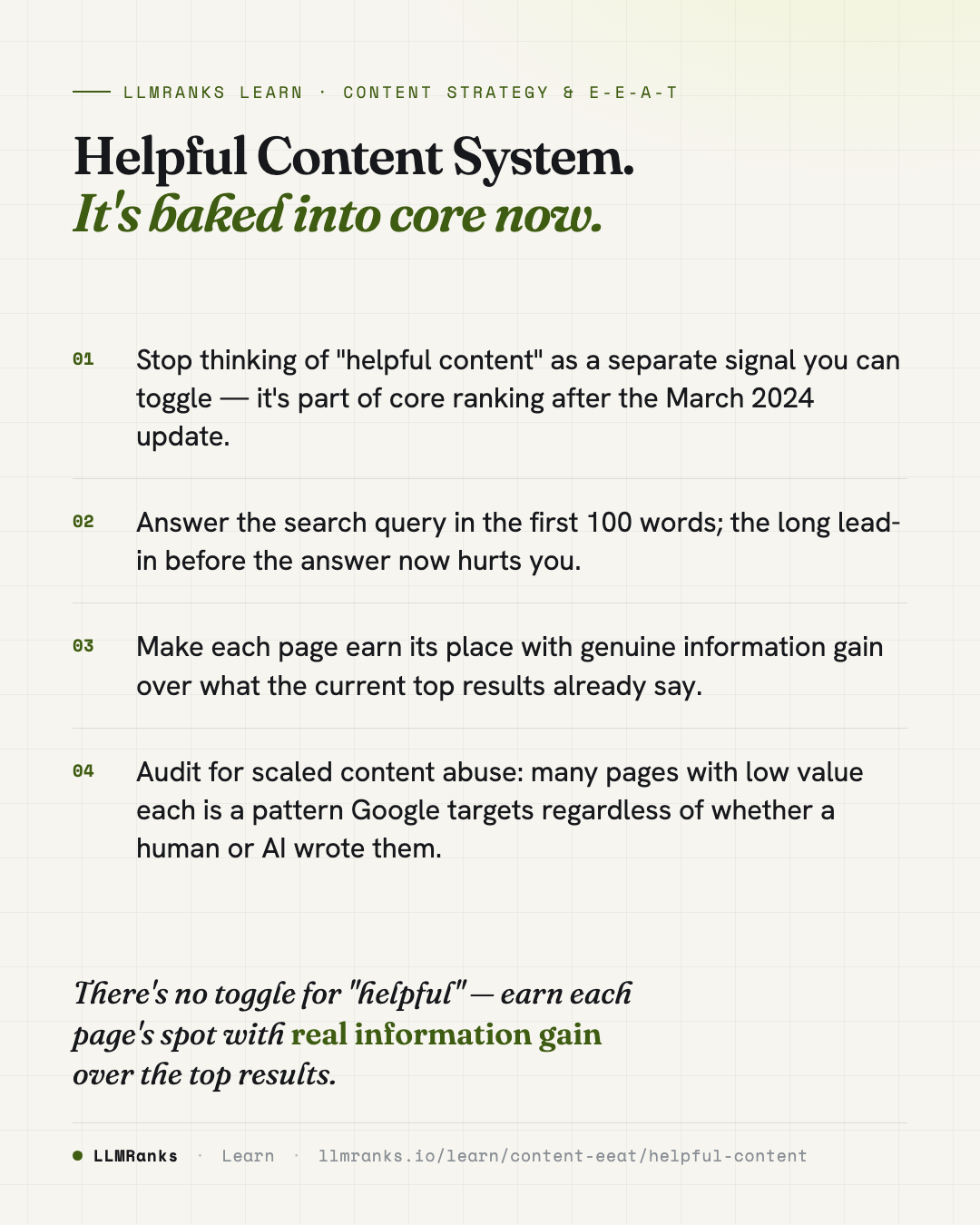
- Reframe your mental model. Stop treating "helpful content" as a separate signal or waiting for a standalone refresh. Since March 2024 it's part of core ranking, so quality work is continuous.
- Front-load your answers. Rewrite pages so the target query is answered within the first 100 words, then expand with detail below.
- Run a delta analysis. For each target query, compare your page against the current top results and confirm it adds materially new claims, data, or perspective — aim for roughly 30% novel content.
- Enforce one purpose per URL. Identify pages targeting multiple unrelated intents and split them into focused pages connected by internal links.
- Apply the 404 test. For every page, ask what would be lost if it disappeared. Retire or consolidate anything that adds nothing unique.
- Audit for scaled-content patterns. Look for clusters of templated, low-information-gain pages — regardless of whether AI or humans made them — and fix the volume-over-value problem at the root.
save this card
 Download card
1080×1350 · post it anywhere
put it to work
See how ChatGPT, Gemini and Google AI actually talk about your brand.