Topical Authority
Topical authority is best understood as how completely your site covers a defined topic, measured by entity coverage rather than raw page count. In…
5 min read · updated 2026-07-29
Topical authority is best understood as how completely your site covers a defined topic, measured by entity coverage rather than raw page count. In practice, that means mapping a topic as a set of related entities and building interconnected pages that cover most of that set. A focused site that covers a topic thoroughly outperforms one that scatters thin content across many partially-covered subjects.
What topical authority actually measures
Topical authority in 2026 is measured by how completely you cover a defined topic graph — the set of entities associated with your subject — not by how many pages you publish. Volume alone does not build authority. A site that covers roughly 30% of a topic will underperform a focused niche site that covers the same topic thoroughly.
This reframes content strategy around coverage completeness. Instead of asking "how many articles should I write," ask "which entities within this topic am I missing." The goal is a body of content that answers the full range of questions and sub-intents a searcher (or an AI system) associates with your topic.
Define the topic as an entity set
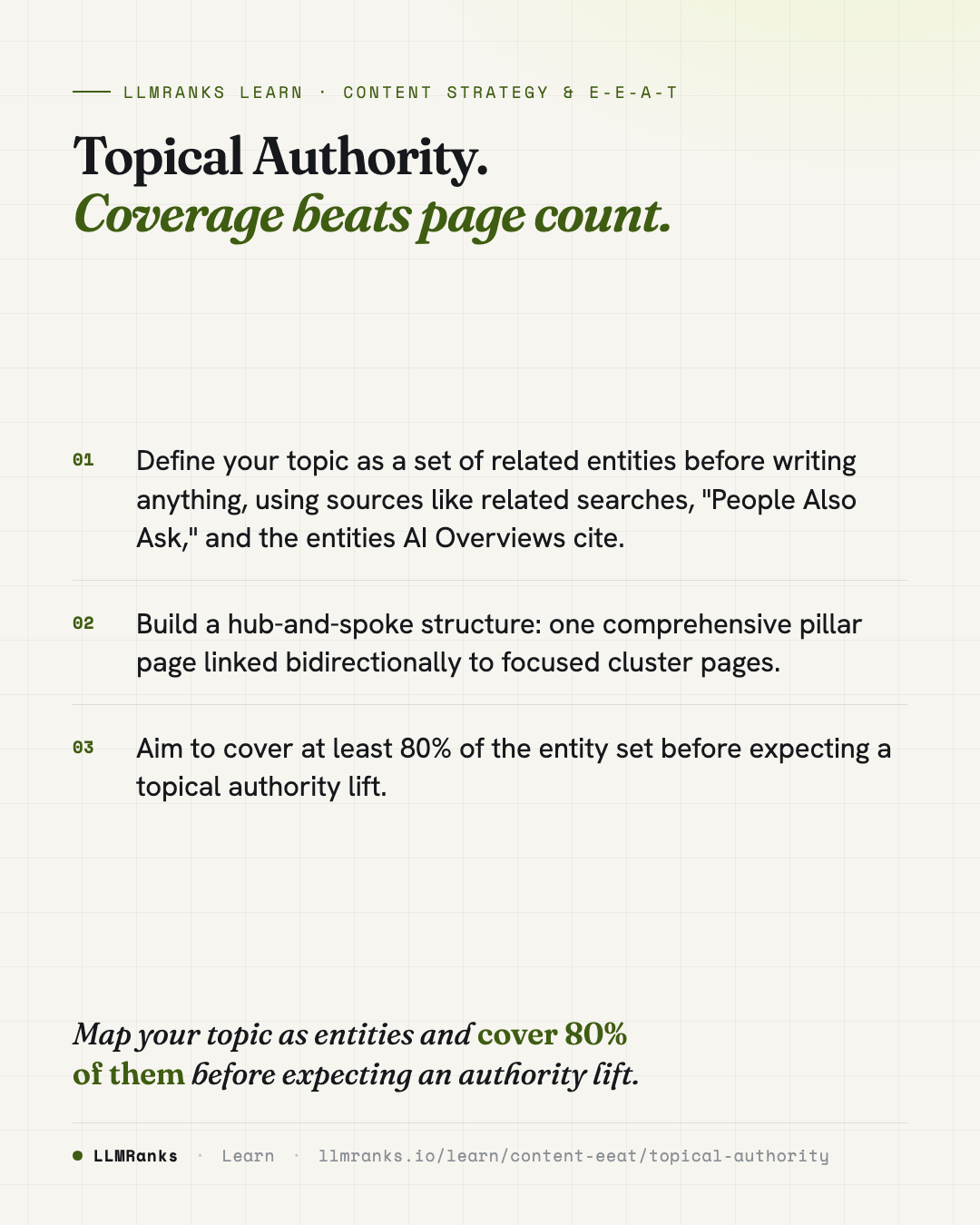
Before building pages, treat your seed term as an entity and identify the entities connected to it. You can pull these from several sources:
- Related searches around your seed term.
- "People Also Ask" questions.
- The entities that AI Overviews cite for that query cluster.
Collecting entities from these sources gives you a concrete map of what "complete coverage" looks like for your topic. This entity set becomes the checklist you build against, and the thing you measure coverage against later.
For more on how coverage and quality intersect, see Content Strategy & E-E-A-T and Content Depth vs Word Count.
Architect a hub-and-spoke structure
Once you have your entity set, map it to a hub-and-spoke model. This has two page types working together.
| Page type | Role | Target | Length |
|---|---|---|---|
| Pillar page | Comprehensive overview | The head term | 3,000–6,000 words |
| Cluster page | One sub-entity or long-tail intent | A specific sub-topic | 800–2,500 words |
The pillar page gives a broad, thorough overview of the whole topic. Each cluster page goes deep on a single sub-entity or long-tail intent. Together they cover the entity set from both the top-down and the detailed angles.
The structure only works when the pages are connected properly. Link the pillar to every spoke. Link each spoke back to the pillar, and also to two to four sibling spokes, using descriptive anchor text. This bidirectional linking is what ties the cluster together into something a search engine can read as a coherent topic. For a deeper treatment of link structure, see Internal Linking.
Hit your coverage threshold
Coverage is the lever that determines whether you see a topical authority lift. Aim for at least 80% coverage of your entity set before expecting that lift to appear.
This is why sparse coverage fails. Covering only around 30% of a topic underperforms a focused niche site that covers its narrower topic more completely. If you can't realistically cover 80% of a broad topic, it's often better to define a narrower topic you can cover thoroughly. Depth of coverage beats breadth of ambition.
Practically, this means finishing a cluster before starting the next one. A half-built cluster spread across three topics will underperform one fully-built cluster.
Distribute internal anchor text deliberately
How you word your internal links matters as much as where they point. Aim for a deliberate distribution across your cluster's internal links:
- ~40% exact-match or partial-match anchors for cluster pages.
- ~30% topical anchors referencing a related entity.
- ~20% branded anchors.
- ~10% generic anchors.
Avoid over-optimizing. When more than 60% of your internal anchors are exact-match, you risk devaluation rather than a boost. The mix above keeps the linking natural while still signaling relevance. This same principle carries over into Off-Page Authority, where anchor patterns also matter.
Validate that clusters are distinct
A common failure is publishing multiple cluster pages that are really about the same thing. When two pages overlap too heavily, they compete with each other — cannibalization — and neither ranks as well as a single consolidated page would.
Check that each cluster page is semantically distinct from the others. If two cluster URLs are extremely similar in meaning, they are cannibalizing and should be consolidated into one stronger page. As a rough guide from embedding-based comparison: pages that are highly similar are candidates for consolidation, and the more nearly identical two pages are, the clearer the case for merging them.
Treat consolidation as a routine part of maintaining a cluster, not a one-time cleanup. As you add pages, new overlaps appear, and pruning them keeps the cluster sharp. For related guidance, see Originality & Duplicate Content.
How this fits with AI search
The entities that AI Overviews cite for a query cluster are one of the sources you use to define your topic in the first place. That makes topical authority directly relevant to visibility in AI-driven search, not just traditional rankings. Complete, well-structured coverage gives these systems more of your topic to draw from. For more on optimizing for these surfaces, see AEO & GEO and AI Search Engines.
What to do
- Pick a seed term and pull its associated entities from related searches, "People Also Ask," and the entities AI Overviews cite for that query cluster.
- Assemble those entities into a coverage checklist that defines "complete" for your topic.
- Build a pillar page (3,000–6,000 words) targeting the head term as a comprehensive overview.
- Build cluster pages (800–2,500 words), each targeting a single sub-entity or long-tail intent.
- Link the pillar to every spoke, and each spoke back to the pillar plus two to four sibling spokes, using descriptive anchor text.
- Keep internal anchor text at roughly 40% exact/partial-match, 30% topical, 20% branded, 10% generic — and stay under 60% exact-match to avoid devaluation.
- Aim to cover at least 80% of your entity set before expecting a topical authority lift; if you can't, narrow the topic.
- Regularly check cluster pages for semantic overlap and consolidate any that are effectively duplicates.
save this card
 Download card
1080×1350 · post it anywhere
put it to work
See how ChatGPT, Gemini and Google AI actually talk about your brand.