Keyword & Link Cannibalization
Keyword cannibalization happens when several pages on your site target the same query, and none of them rank as well as a single focused page would. It…
6 min read · updated 2026-08-06
Keyword cannibalization happens when several pages on your site target the same query, and none of them rank as well as a single focused page would. It comes in two forms: pages competing for the same keyword, and internal links whose anchor text points at multiple URLs for the same intent, splitting search engines' understanding of which page should win. The fix is to decide, page by page, whether to consolidate the competitors into one stronger page or to differentiate them by intent and anchors.
The two kinds of cannibalization
There are two distinct problems hiding under the same word.
Keyword cannibalization is when multiple pages target the same query and none of them ranks well. Instead of one strong page, you get two mediocre ones competing against each other.
Internal link cannibalization is when anchor text from your internal links points to multiple URLs for the same intent. That splits a search engine's understanding of which page is the right answer, so authority and relevance get divided instead of concentrated.
The two often travel together. Overlapping pages tend to attract overlapping anchors, which reinforces the confusion. Understanding Anchor Text Strategy and Link Equity & PageRank Flow helps you see why splitting signals across near-duplicate targets weakens both.
How to detect it
Don't diagnose cannibalization from a hunch. Look for concrete signals across your rankings, content, and internal links.
- Two URLs both ranking in positions 5–15 for the same query, oscillating between each other over time.
- Two URLs receiving internal links with overlapping exact-match anchors — roughly more than 40% anchor token overlap.
- Two URLs with H1 and title similarity that's very high (cosine similarity above about 0.85).
- Search Console showing the "best page for query" flipping from one URL to another across weeks.
Any one of these is worth investigating. Two or more pointing at the same pair of URLs is a strong case that they're competing.
| Signal | What it looks like | What it suggests |
|---|---|---|
| Rank oscillation | Two URLs trading spots in positions 5–15 | Search engine can't decide which page wins |
| Anchor overlap | >40% shared anchor tokens across two URLs | Internal links are splitting intent |
| Title/H1 similarity | Cosine similarity >0.85 | Near-duplicate targeting |
| Best-page flip | GSC winner changes week to week | Unstable relevance signal |
Decide: consolidate or split
Once you've confirmed two pages are competing, ask one question: do they serve the same intent?
- Same intent, similar content → consolidate. Merge the content and 301 the weaker page into the stronger one.
- Overlapping keywords but genuinely different intent → differentiate. Sharpen each page's focus and fix the anchors.
- Different intent, accidentally cannibalizing → fix the anchors and add disambiguating context so each page reads as its own answer.
The middle and last cases are about clarity, not merging. If the pages should exist separately, the problem is usually that your internal links and on-page signals don't make the distinction obvious. That's an On-Page SEO and internal-linking fix, not a redirect.
When to consolidate
Consolidate when the two pages are really one page split in two:
- Both URLs target the same primary intent.
- The combined content would still feel cohesive — under about 6,000 words.
- One URL has a dominant backlink profile, giving you a clear winner to merge into.
- The SERP for the query shows only one type of result.
When to split
Keep them separate — and reinforce the separation — when the demand and intent are genuinely distinct:
- Each sub-topic has its own search demand (roughly 500+ monthly searches).
- A combined page would exceed about 6,000 words and hurt the reading experience.
- The SERP shows distinct intents, such as commercial versus informational.
- The sub-topics have different conversion goals.
If you split, treat the two pages as parts of a deliberate structure rather than accidents. Framing them within Topic Clusters & Pillar Pages gives each a clear role and reduces the odds they drift back into competing.
Consolidation execution
When consolidation is the right call, work in order so you don't lose content or signals along the way.
- Identify the canonical winner. Pick the URL with the most backlinks, the best rankings, and the best user experience. That page absorbs the other.
- Merge the unique content. Move anything valuable from the losing page into the winner so nothing worth ranking disappears.
- 301 redirect the loser to the winner. This passes the losing page's equity and points visitors to the right place.
- Update all internal links in the source. Don't rely on the redirect alone — change the actual links so they point directly to the winner. Leaving old links to bounce through a redirect keeps the signal muddy.
- Update anchor text to match the new combined intent. The merged page now covers more ground, so the anchors pointing at it should reflect that.
- Resubmit your XML sitemap and request indexing. Help search engines re-crawl the change quickly instead of waiting for them to find it.
Step 4 is the one people skip. A 301 tells search engines where a page moved, but stale internal links still describe the old split. Cleaning them up is part of keeping your Internal Linking coherent and is closely tied to how Link Equity & PageRank Flow reaches the pages you actually want to rank.
Fixing without merging
If the pages should stay separate, your job is to make their difference unmistakable to both readers and search engines.
- Rewrite titles and H1s so their similarity drops well below the near-duplicate range.
- Reassign anchor text so each intent has its own consistent, distinct anchors instead of shared exact-match phrases.
- Add disambiguating context to each page — a sentence or section that makes clear which question it answers and which it doesn't.
- Audit which page each internal link should point to based on the linking page's context, and correct mismatches.
Done well, this removes the overlap that caused the ranking to oscillate while preserving two pages that each capture their own demand. It's the same discipline that keeps a well-planned Site Architecture for SEO from collapsing into internal competition.
What to do
- Pull the queries where two of your URLs both sit in positions 5–15 and oscillate; those are your candidates.
- For each pair, check title/H1 similarity and internal anchor overlap to confirm they're actually competing.
- Ask whether the two pages serve the same intent by comparing them against the SERP for the query.
- If intent and content match, choose the canonical winner (most backlinks, best rankings, best UX) and consolidate: merge unique content, 301 the loser, update internal links in the source, refresh anchors, and request indexing.
- If intent differs, differentiate instead: rewrite titles and H1s, split the shared anchors, and add disambiguating context so each page owns its query.
- Re-check the same signals a few weeks later to confirm the ranking has stabilized on one URL.
save this card
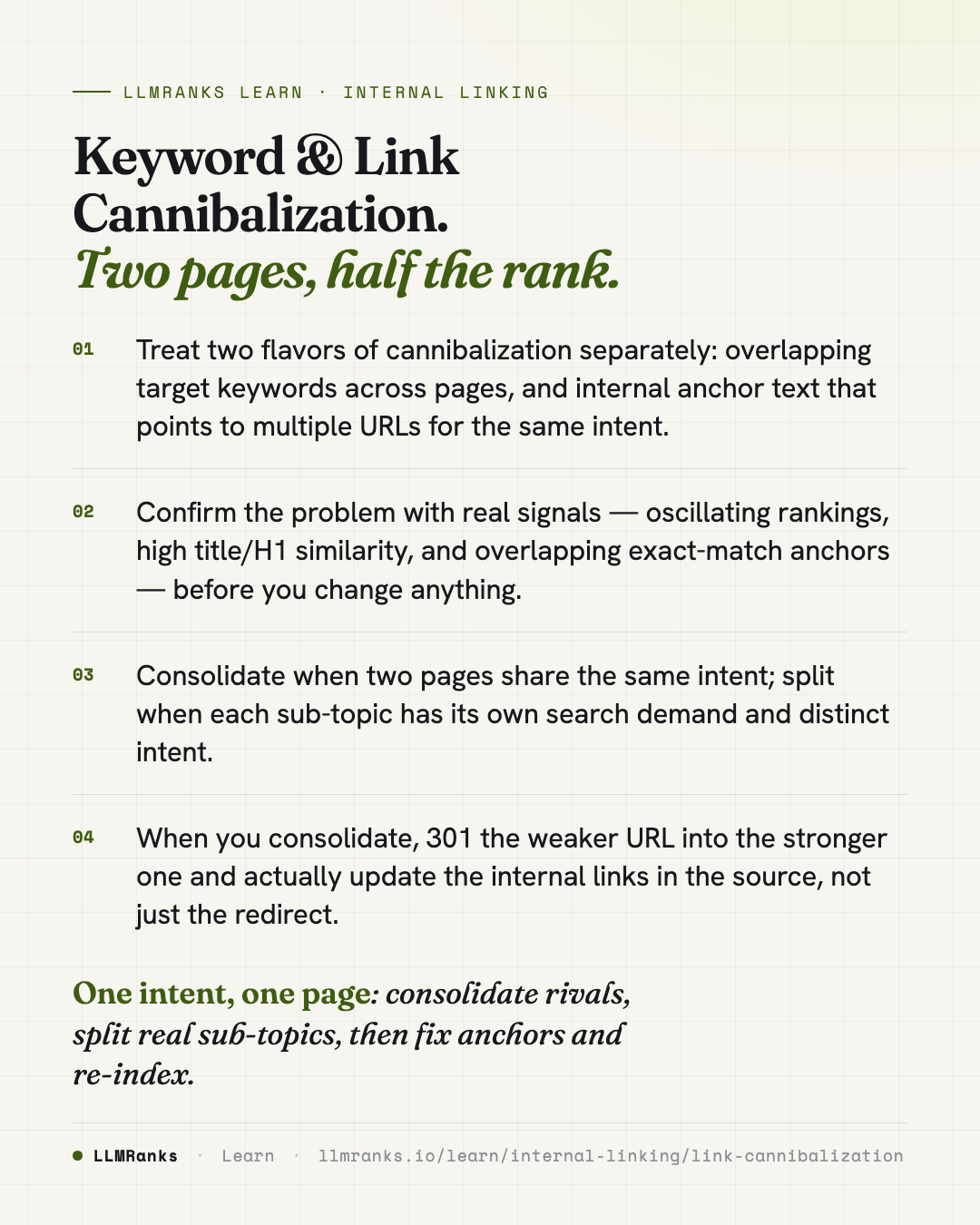 Download card
1080×1350 · post it anywhere
put it to work
See how ChatGPT, Gemini and Google AI actually talk about your brand.