Topic Clusters & Pillar Pages
Topic clusters organize your content into a pillar page covering a head term plus a set of spoke pages that each target a distinct long-tail sub-intent, all…
6 min read · updated 2026-08-07
Topic clusters organize your content into a pillar page covering a head term plus a set of spoke pages that each target a distinct long-tail sub-intent, all interlinked so search engines and LLMs can see that you cover a subject comprehensively. In 2026, this pillar-cluster model is the default unit of topical authority and the primary structure large language models use to assess how completely you cover an entity. A complete cluster signals thorough coverage; an incomplete one leaves visible gaps that competitors fill.
Why the pillar-cluster model matters now
A complete cluster tells both Google and LLMs that you cover an entity comprehensively. Rather than treating pages as isolated documents, search systems now read the relationships between them — which topics you address, how they connect, and where your coverage stops. A well-formed cluster makes that coverage legible.
This makes the pillar-cluster structure the practical foundation of topical authority. It also ties directly into your site architecture: clusters are how you turn a pile of pages into a navigable, crawlable subject map.
Anatomy of a complete cluster
A complete cluster has three parts:
- One pillar page targeting the head term and broad intent. It links to every spoke and contains a table-of-contents-style section that links out to spokes with descriptive anchors.
- 8–30 spoke pages, each targeting a distinct long-tail sub-intent. Each spoke links up to the pillar (using a partial or branded anchor) and laterally to 3–7 sibling spokes.
- Internal link reciprocity: pillar and spoke link bidirectionally. Spoke-to-spoke linking is selective — connect siblings only where they are genuinely related.
The pillar is usually the highest internal-PageRank page in the cluster because it receives a link from every spoke. To stop the pillar from hoarding equity, make sure spokes link laterally to each other so equity recirculates rather than dead-ending at the pillar. See Link Equity & PageRank Flow for how that distribution works.
How to build the pillar page
The pillar carries the head term and the broad intent behind it. Construction rules:
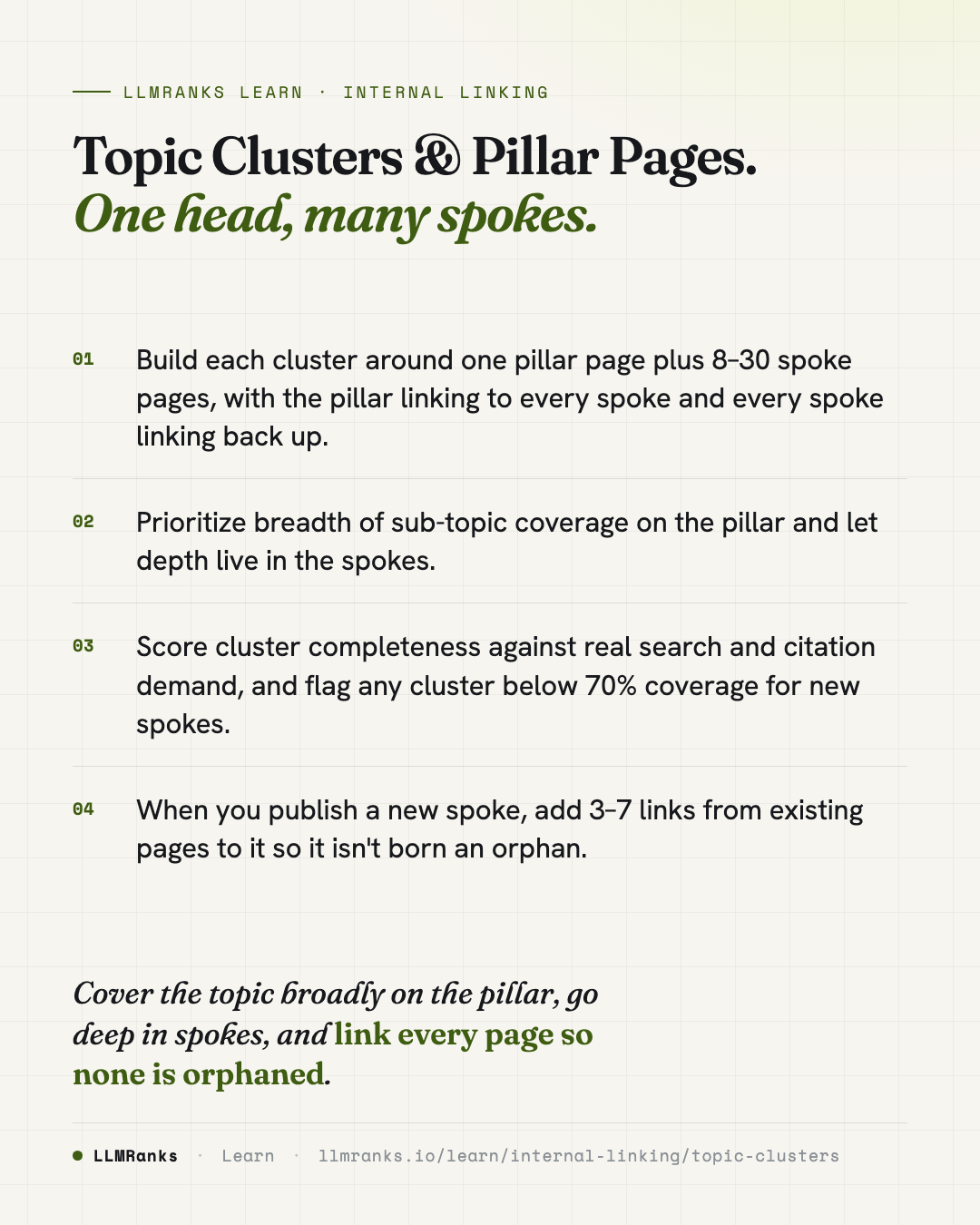
- Length is typically 3,000–8,000 words, but prioritize breadth of sub-topic coverage over depth — depth belongs in the spokes.
- Each major H2 maps to one spoke topic, with a 100–250 word summary plus a contextual link to the full spoke.
- The pillar should rank for the head term itself. If a spoke outranks the pillar for that head term, you have intra-cluster cannibalization — consolidate the pages or re-differentiate them. See Keyword & Link Cannibalization for how to resolve this.
- Place a visible, linked cluster index — not just a footer list — so both users and crawlers can see the full spoke set.
Use descriptive anchor text for those spoke links rather than generic labels.
Scoring cluster completeness
You don't have to guess whether a cluster is finished. Score it against real demand:
- Pull the SERP, the People-Also-Ask questions, and the follow-up questions LLMs generate for the pillar's head term.
- Extract the sub-topic space — the entities, questions, and modifiers that define the topic.
- Map your existing spokes to those sub-topics.
- Identify gaps: sub-topics with search or citation demand but no spoke covering them.
- Score coverage as
covered sub-topics / total demand-weighted sub-topics.
Treat any cluster below 70% coverage as incomplete, and address the specific missing sub-topics with new spokes targeting real queries. This keeps your cluster expansion driven by demand rather than by whatever is easiest to write.
Cross-linking within and between clusters
Internal links are what make a cluster function. A few specific practices:
- Link forward and backward in user journeys. Top-of-funnel informational pages should link down to mid- and bottom-funnel commercial pages; commercial pages should link back up to supporting educational content to reinforce experience and expertise.
- Use one contextual link per logical claim, placed at the moment of relevance — not batched at the end of the page.
- Make lateral sibling links reciprocal only when the relevance is genuinely bidirectional. Don't force A to link to B if B has no natural reason to reference A.
- Limit cross-cluster links to genuine semantic bridges. A spoke in an internal-linking cluster can link to a spoke in a PageRank cluster when it's topically justified — but don't cross-link clusters wholesale.
The broader mechanics are covered in Internal Linking and the question of how many internal links per page is a related tuning problem.
Keeping clusters reachable
Even a well-built cluster fails if equity can't reach it.
- Avoid isolated islands. A subgraph where five pages link densely to each other but receive no links from the rest of the site is an island — equity can't flow to it from the homepage. Find these by checking reachability from the site root.
- Keep money pages within 3 clicks of the homepage. Calculate the shortest path and flag any commercial page more than 3 clicks deep.
- Refresh links when you publish. When a new spoke goes live, add links to it from 3–7 existing pages so it isn't born an orphan, and decide which existing pages the new spoke should link to.
Related-content blocks that actually help
Algorithmically generated "related posts" widgets are partially discounted by Google because they're templated and easy to pattern-detect. They still earn their place for crawl discovery of fresh and deep content, for user dwell time and pages-per-session, and for reducing orphan pages at scale. To keep them useful rather than templated:
- Generate related links by content similarity, not tag or category match alone. Tag-based widgets surface weakly relevant content; ranking by actual content similarity produces stronger matches.
- Cap at 3–6 related links. More dilutes equity and signals a template.
- Vary the anchor text — pull the destination's H1 or a descriptive variant rather than an identical "Related: [title]" format on every card.
- Mix editorial and algorithmic links. Pages that also carry at least two hand-placed contextual body links to the same destinations get stronger equity transfer, because a body link carries weight a widget link doesn't.
- Exclude already-linked pages from the related block to avoid duplicate-anchor and first-link waste.
- Server-render related blocks. Lazy-loaded, JS-injected related sections below the fold may not be crawled reliably, and most AI search crawlers won't see them on first fetch.
When you weight what a related-content system surfaces, content similarity should dominate, with shared entities, cluster or pillar membership, recency for publishers, and the conversion value of the destination as secondary factors. The conversion-value factor lets you nudge clicks and equity toward money pages without making the widget irrelevant.
What to do
- Pick a head term and draft the pillar page as a broad map, with one H2 per intended spoke.
- List the 8–30 sub-intents the topic demands, and create or plan a spoke for each.
- Wire up reciprocity: pillar links to every spoke, every spoke links back up, and siblings link laterally only where genuinely related.
- Score the cluster against SERP, People-Also-Ask, and LLM follow-up demand; if coverage is below 70%, build the specific missing spokes.
- Check reachability — no islands, money pages within 3 clicks of the homepage.
- Add related-content blocks that rank by content similarity, cap at 3–6 links, vary anchors, and render server-side.
- Every time you publish a new spoke, add 3–7 inbound links from existing pages and set its outbound links so it launches fully connected.
save this card
 Download card
1080×1350 · post it anywhere
put it to work
See how ChatGPT, Gemini and Google AI actually talk about your brand.