How Many Internal Links Per Page
Google publishes no ideal internal-link count. Evaluate links by crawlability, usefulness, canonical destination, and site-relative graph needs.
5 min read · updated 2026-08-05
Internal linking has no universal "correct" number. Google's published guidance says there is no magical ideal link count. Add links when they help readers navigate or understand related material, and make sure every important page has at least one crawlable link from another page Google can find.
How many internal links a page should have
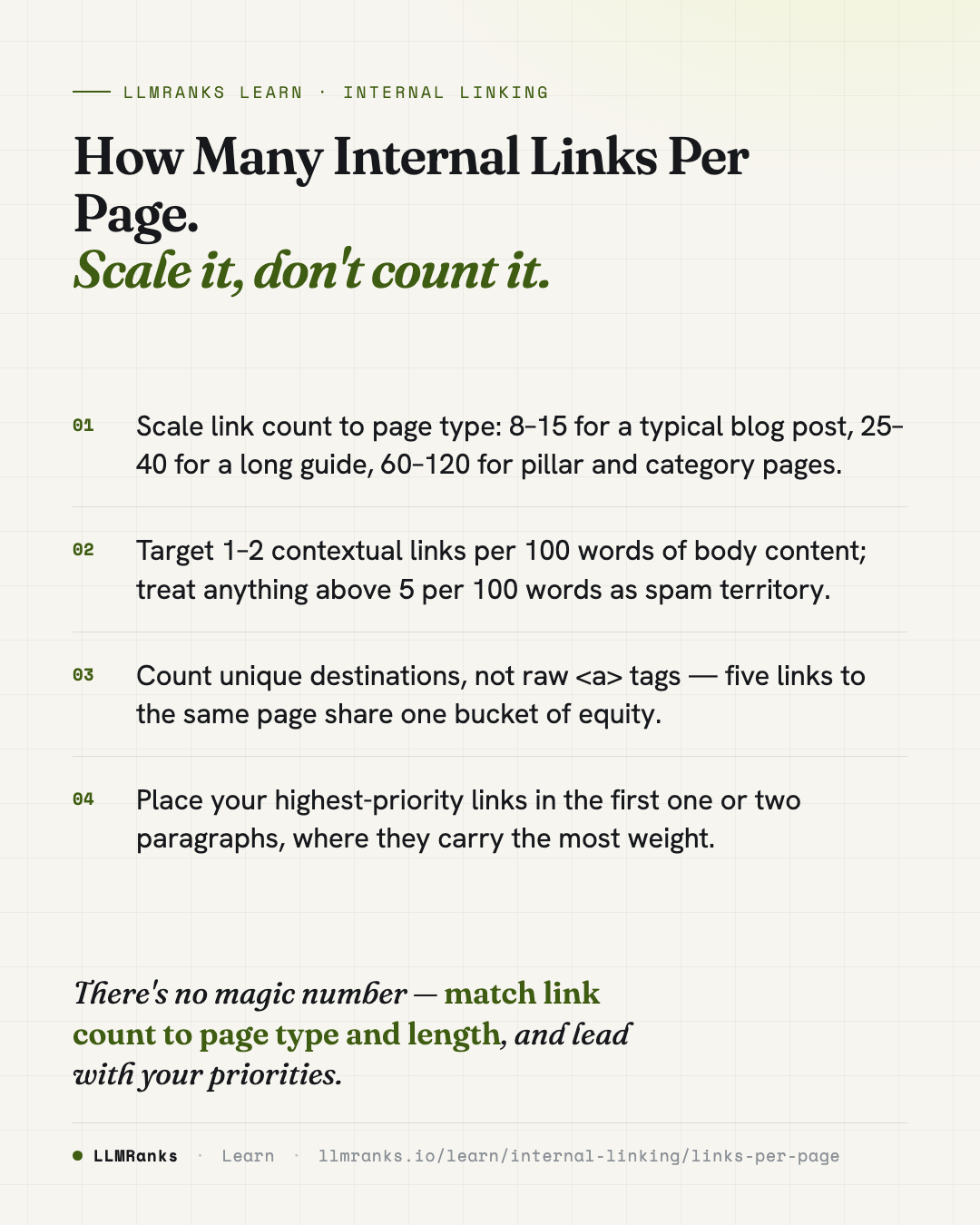
Google's link best practices explicitly say there is no ideal number of links a page should contain. Google advises linking to other sites or internal pages when it makes sense in context. That rules out a universal ceiling such as 150–200 destinations and a universal density such as one or two links per 100 words.
Different templates legitimately produce different counts. A category page may need many product links; a short policy page may need only its navigation; a long guide may link to several supporting resources. Review the purpose of the template and the usefulness of each link instead of trying to hit a quota.
| Page type | Expected role of links | Useful review question |
|---|---|---|
| Homepage or primary navigation | Expose major user paths and important sections | Can users and crawlers reach the site's core areas? |
| Hub or category | Enumerate useful children and related groups | Are important child pages reachable without a search box? |
| Article or guide | Cite and explain genuinely related material | Does each editorial link help at the point where it appears? |
| Product or service | Support comparison, evidence, and next steps | Do links clarify the decision rather than distract from it? |
| Utility or legal page | Provide necessary navigation and references | Are extra links present only because of a sitewide template? |
Count links as diagnostics, not ranking thresholds
Record both total links and unique canonical destinations. The first exposes repeated widgets and boilerplate; the second shows how broadly the page connects to the site. Google does not document a rule that repeated links to one destination "count once" for PageRank, so do not present that as established behavior.
Remember that sitewide navigation counts on every page. A 30-item mega-menu means every page already carries 30 baseline outbound internal links before you add a single word of content. Factor that in when you assess whether a page is over-linked.
Segment links by template region—navigation, breadcrumb, body, related-content block, footer, and user-generated content—so the recommendation explains where an anomaly comes from. There is no Google-published requirement that contextual links make up 30–60% or any other fixed share. See Internal Linking for how these links fit into the wider graph.
Use density as a site-relative signal
Links per 100 words can still be a useful comparison metric when pages share a template and purpose. It can reveal a broken component, an auto-linker that fires on nearly every keyword, or a page with no editorial connections. It cannot establish that a page is optimal or spammy by itself.
Use density this way:
- compare the page with pages of the same type on the same site;
- inspect outliers rather than failing them automatically;
- separate editorial links from navigation and generated widgets; and
- verify that every proposed change improves a real user or crawl path.
Where you place links matters as much as how many
Placement changes how users encounter a link and what context surrounds it. Google's guidance supports writing links in context and spacing them so readers can distinguish them. Google has not published multipliers for body, navigation, sidebar, breadcrumb, or footer links, so automated recommendations should not claim that one placement passes a fixed multiple of another.
| Placement | Primary role | Review question |
|---|---|---|
| Body copy | Explain a relevant relationship at the point of need | Does the anchor and sentence accurately describe the destination? |
| Header or navigation | Expose stable, high-value user paths | Does this item deserve sitewide visibility? |
| Breadcrumb | Show hierarchy and provide an upward path | Does it match the site's real structure? |
| Related-content block | Offer useful next reading | Are results relevant and non-duplicative? |
| Footer | Provide persistent utility, legal, and secondary navigation | Is each sitewide link useful on every template? |
| Image | Make the image a meaningful navigation control | Does its alt text describe the destination? |
Tactical implications
- Make every important page discoverable. Google's requirement is at least one crawlable link from another findable page; choose additional sources based on relevance and navigation needs.
- Use canonical destinations. Update links that point through redirects, parameters, or duplicate URL variants.
- Keep navigation intentional. A large menu may be appropriate, but generated combinations and faceted paths can create accidental crawl expansion.
- Place editorial links where they help. Do not force priority links into an opening paragraph when they are irrelevant there.
- Treat widgets as part of the graph. Evaluate their relevance, duplication, and rendered markup rather than assuming Google applies a fixed discount.
See Breadcrumbs for hierarchy, Anchor Text Strategy for wording, and Nofollow, Sponsored & UGC Links for link attributes.
What to do
- Classify each page and template region so article links are not compared blindly with category or navigation links.
- Resolve every destination to its canonical URL and identify redirects, duplicate variants, and non-crawlable markup.
- Compare counts within the site to find outliers in total links, unique destinations, density, and generated paths.
- Inspect each outlier and explain the concrete navigation, relevance, or crawl problem before recommending a change.
- Confirm every important page has a crawlable inbound link from another page Google can discover.
- Add in-text links only where the source passage and destination are genuinely related, using descriptive anchor text.
save this card
 Download card
1080×1350 · post it anywhere
put it to work
See how ChatGPT, Gemini and Google AI actually talk about your brand.