Meta Descriptions
Meta descriptions are the short summary text that can appear under your page's title in search results. In 2026 their role has narrowed: Google rewrites…
5 min read · updated 2026-08-11
Meta descriptions are the short summary text that can appear under your page's title in search results. In 2026 their role has narrowed: Google rewrites them for the majority of informational queries, but they still influence click-through on branded and navigational searches, act as a social-sharing fallback, and may feed the snippet-selection signal pool for AI answers. Write them where they earn their place, and stop writing them where they don't.
How long a meta description should be
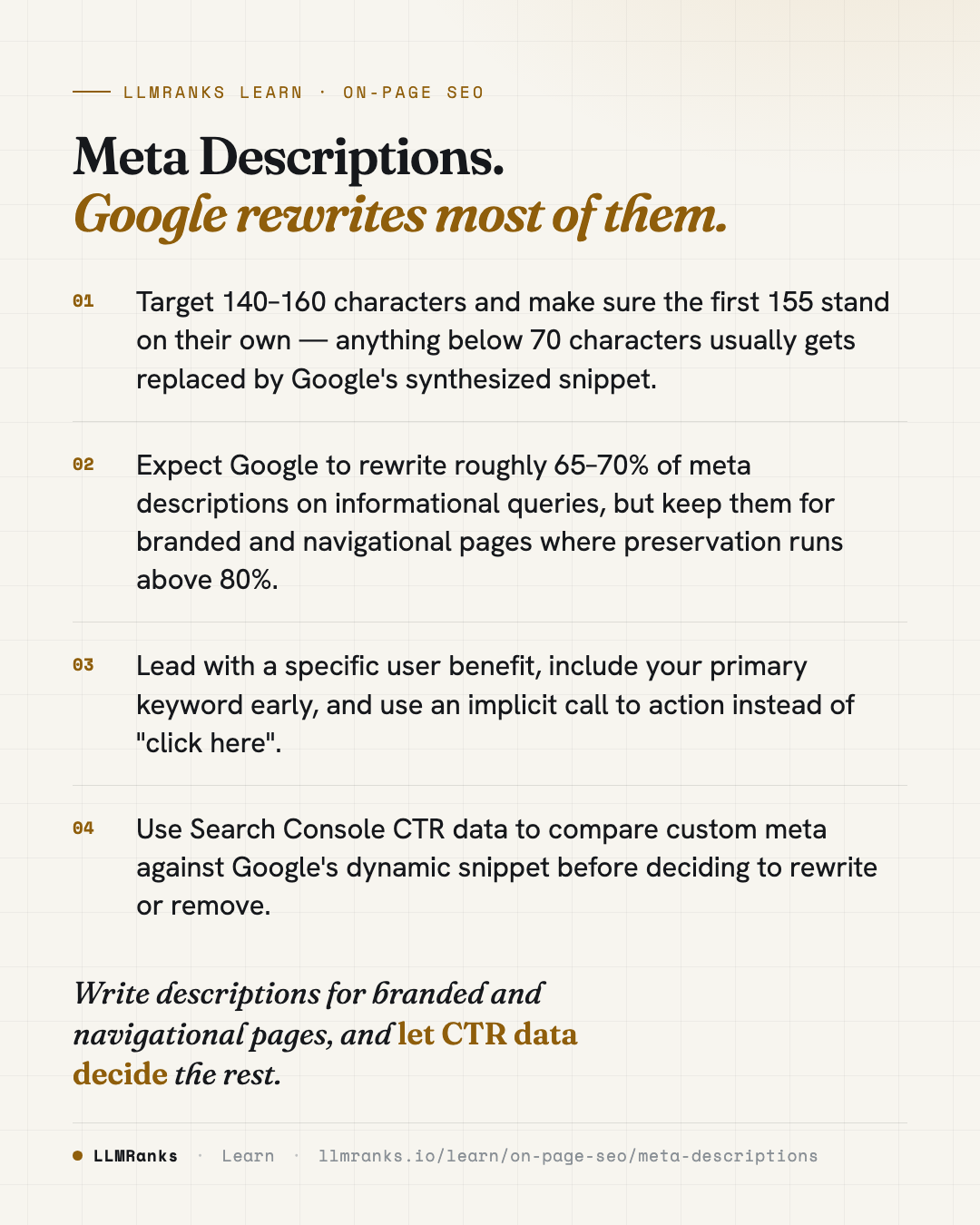
Aim for 140–160 characters, which is roughly 920px on desktop and 680px on mobile. Google sometimes displays 200+ characters on long-form informational results, but planning for that extra space is wasted effort — treat the first 155 characters as the part that has to stand alone.
There's a floor, too. The minimum useful length is about 70 characters. Below that, Google synthesizes a snippet from your page content roughly 85% of the time anyway, so a very short description rarely survives to the results page.
What meta descriptions actually do now
The function of meta descriptions has shifted. Google rewrites them 65–70% of the time for informational queries, up from around 63% in 2024. Despite that, they still matter in specific situations:
- Branded and navigational queries. Preservation rate is around 80% or higher, so your written copy is much more likely to be shown as-is.
- Click-through. When your meta is preserved, the CTR difference between a great description and a mediocre one is roughly 15–25%.
- Social sharing fallback. The meta description is used when an
og:descriptionis missing. - AI answer citations. Google's AI Overview and ChatGPT search appear to draw on meta descriptions as part of their snippet-selection signals. The exact weighting is uncertain — this is an observed correlation, not a confirmed ranking factor.
The takeaway: don't treat the meta description as a guaranteed billboard. Treat it as one input among many, and prioritize the page types where it's most likely to be shown.
Copy patterns that earn clicks
When your description does get displayed, the wording drives clicks. A few reliable patterns:
- Lead with the user benefit, not the feature. "Cut report time by 70%" beats "Automated reporting platform".
- Include your primary keyword plus one secondary keyword. Google bolds terms that match the query, which draws the eye.
- Write in active voice, present tense.
- Use an implicit call to action. "See pricing for teams of 5–500." works better than "Click here to learn more."
- Be specific. Numbers, time periods, and named features outperform vague summaries.
These patterns pair with a strong title tag — the two work together in the result and should feel consistent. For the broader picture of on-page elements, see On-Page SEO.
Pages that should not have a meta description
Not every page benefits from a hand-written description. Leave the field empty when Google's extraction beats yours:
- Long-tail informational pages where Google's dynamic snippet outperforms your written copy. Confirm this by comparing CTR in Search Console.
- Programmatic SEO pages where templated descriptions create thin or duplicate signals. Omitting them and letting Google extract from the page is usually the better call.
Advice that still holds from 2024: don't write a meta description just to fill the field. An empty field that Google fills intelligently often beats a weak, generic one.
How to audit your meta descriptions
Work through your pages looking for these issues:
| Issue | How to spot it |
|---|---|
| Missing | No meta description present on the page |
| Over length | Longer than 160 characters |
| Under length | Shorter than 70 characters |
| Duplicate | The same description across two or more canonical URLs |
| Keyword absent | Target keyword doesn't appear |
| Templated / thin | Follows a low-variation pattern like "Buy {product} at {brand}" |
| Ignored by Google | Search Console shows the displayed snippet differs from your meta in more than 70% of impressions over 30 days |
| Missing CTA pattern | No verb in the first 60 characters |
| Sentiment mismatch | A product or commercial page reads neutral or informational, or vice versa |
Duplicate descriptions are the most common quick win. If two canonical URLs share the same meta, at least one needs rewriting — this often surfaces alongside broader content structure problems on templated sections of a site.
Testing and iterating
For pages that get real traffic, you can measure rather than guess:
- Compare against the dynamic snippet. If Search Console shows Google ignoring your meta in more than 70% of impressions over 30 days, that's a signal to rewrite or remove it.
- A/B test high-traffic pages. Rotate two variants and measure the CTR difference in Search Console. You need roughly 2,000 impressions per variant before the result is meaningful.
- Match sentiment to intent. A commercial page should read commercial; an informational page should read informational. A mismatch undercuts the click.
When you write a replacement, anchor it to the page itself: use the H1, the opening content, and the target keyword. Keep it under about 158 characters, put the keyword in the first 100 characters, and end with a benefit clause.
What to do
- Audit for the basics first. Flag pages that are missing a description, over 160 characters, under 70 characters, or sharing duplicate copy across canonical URLs.
- Prioritize branded and navigational pages. These have the highest preservation rate, so hand-written copy pays off most here.
- Rewrite weak descriptions using the CTR patterns. Lead with the benefit, include the primary keyword early, use active voice, and close with an implicit call to action.
- Check Search Console for ignored metas. Where Google replaces your description more than 70% of the time over 30 days, rewrite it or remove it.
- Strip or omit templated descriptions on programmatic pages. Let Google extract rather than serve thin, duplicate copy.
- A/B test your highest-traffic pages. Rotate two variants and wait for roughly 2,000 impressions each before deciding a winner.
- Keep sentiment aligned with intent. Make commercial pages read commercial and informational pages read informational.
save this card
 Download card
1080×1350 · post it anywhere
put it to work
See how ChatGPT, Gemini and Google AI actually talk about your brand.