Content Structure for SEO & AI
Content structure is how you arrange text on a page — paragraph length, sentence rhythm, bullets, tables, and answer placement — so both readers and AI…
5 min read · updated 2026-08-13
Content structure is how you arrange text on a page — paragraph length, sentence rhythm, bullets, tables, and answer placement — so both readers and AI systems can parse it. The highest-leverage move is answer-first writing: put a direct, self-contained answer in the first 40–60 words after your H1, since that span is most often lifted into AI Overviews and featured snippets. Beyond that, favor scannable formatting, varied sentences, and complete topic coverage over raw word count.
Paragraph length and readability
Aim for 2–4 sentences and roughly 40–80 words per paragraph. Single-sentence paragraphs are fine and effective for emphasis. The goal is to keep each block digestible on the narrowest screen your readers use.
Mobile is where structure breaks down. A five-line desktop paragraph can run 10+ lines on a phone, so optimize for the narrowest viewport. Treat any paragraph over 100 words as a warning and anything over 150 words as a "wall of text" — these tank scroll depth and dwell time.
Readability matters too. Target a Flesch Reading Ease of 60–70 for general audiences, or 50–60 for technical and B2B content. An average sentence length of 14–20 words usually lands you in that band.
Sentence variance
Vary your sentence length on purpose. Mix short sentences (5–8 words) with medium ones (15–20) and the occasional long sentence (25–35). Monotone length — every sentence sitting at 15–20 words — reads robotic.
There's a 2026 wrinkle here worth stating carefully. Uniform sentence structure tends to correlate with low-quality, scaled content, and machine-written text often shows this pattern. But Google has not confirmed any AI-detection ranking signal — so don't claim one. Treat low sentence variance as an advisory style flag, not a proven penalty.
Watch for other machine-writing tells while you're at it: low burstiness, repetitive transitions, and overuse of connectors like "Moreover" and "Furthermore." None of these is a confirmed signal on its own, but together they read as thin.
Bullets and lists
Bullets are for parallel, scannable items — features, steps, criteria. They get extracted into AI Overviews and featured snippets at high rates, which makes them a genuine visibility asset when used well.
Follow a few rules to keep them working:
- Keep list items parallel in structure — all starting with a verb, or all noun phrases. This helps both readability and snippet extraction.
- Aim for 3–8 items per list. Lists of 15 or more should become tables or be split into subsections.
- Don't over-bullet. A page that's 80% bullets has no narrative connective tissue and reads as thin or scraped.
As an editorial target, keep prose dominant over list content — roughly 70/30. That's a style guideline, not a measured ranking threshold, but it keeps your pages from collapsing into fragments.
Tables for comparisons
Tables are one of the highest-leverage formats for AI search in 2026. Use them for comparisons, specs, pricing, and data — they're extracted directly into SERP features and AI Overviews.
Build them properly:
| Practice | Why it matters |
|---|---|
Use semantic <table>, <thead>, <th scope="col"> | Extraction relies on real table semantics, not styled <div> grids |
| Keep tables to ≤5 columns | Wide tables get truncated or ignored, especially on mobile |
| Add a caption or preceding sentence | Naming the comparison helps associate the table with the query |
Avoid pseudo-tables — CSS-grid divs styled to look like tables. They render fine to a human eye but carry none of the structure that extraction depends on. If you're comparing plans, say so in the sentence before the table ("The table below compares pricing across the three plans").
Depth and structure for AI answers
Lead with the answer. For question-targeting pages, put the direct answer in the first 40–60 words after the H1 — this is the span most often lifted into AI Overviews and featured snippets. The inverted-pyramid approach front-loads the payoff instead of burying it.
The canonical format is a definition block: a question-form H2 followed immediately by a 40–55 word direct-answer paragraph. That's the shape AI citations and featured snippets favor, so build it deliberately on any page targeting a question. See Heading Hierarchy for how those H2s should nest.
Semantic completeness beats word count. The old "long content ranks better" heuristic is dead. What matters is covering the topic's full entity set — the concepts your top-ranking competitors cover — rather than padding to a target length. A 900-word page that covers all the relevant entities beats a 3,000-word page that pads. When you find entity gaps, fill them with genuine new sections, not filler. For more on topical coverage and trust signals, see Content Strategy & E-E-A-T, and for how this fits AI answer engines, AEO & GEO.
Common structure problems to catch
When you audit a page, look for these recurring issues:
- Wall of text: any paragraph over 150 words with no break.
- Long paragraph: any paragraph over 100 words (treat as a warning).
- Sentence monotony: very low variation in sentence length.
- Readability mismatch: Flesch Ease outside the target band for your vertical.
- Over-bulleting: list content exceeding half the body.
- Non-parallel bullets: mixed grammatical structure inside one list.
- Pseudo-tables: visually tabular div grids without real table semantics.
- Wide tables: more than five columns.
- No answer-first: a question-targeting page with no direct answer in the first 60 words.
- Missing definition block: a question-form H2 not followed by a 40–55 word answer.
- Entity gaps: missing concepts present on top-ranking competitor pages.
What to do
- Rewrite the opening of every question-targeting page so a self-contained answer appears in the first 40–60 words.
- Add a 40–55 word definition paragraph under each question-form H2.
- Split any paragraph over 100 words, and break up walls of text over 150 words at natural sentence boundaries near the 80-word mark.
- Convert any pseudo-table div grids into semantic
<table>markup withscopeattributes on headers, and cap tables at five columns. - Make every list parallel in structure, hold lists to 3–8 items, and rebalance any bullet-heavy section back toward prose.
- Read your draft aloud to check sentence variance, and prune repetitive transitions.
- Compare your entity coverage against top-ranking pages and add genuine sections to close the gaps — reviewing any new factual claims for accuracy before publishing.
For related fundamentals, start with On-Page SEO and browse the full LLMRanks Learn library.
save this card
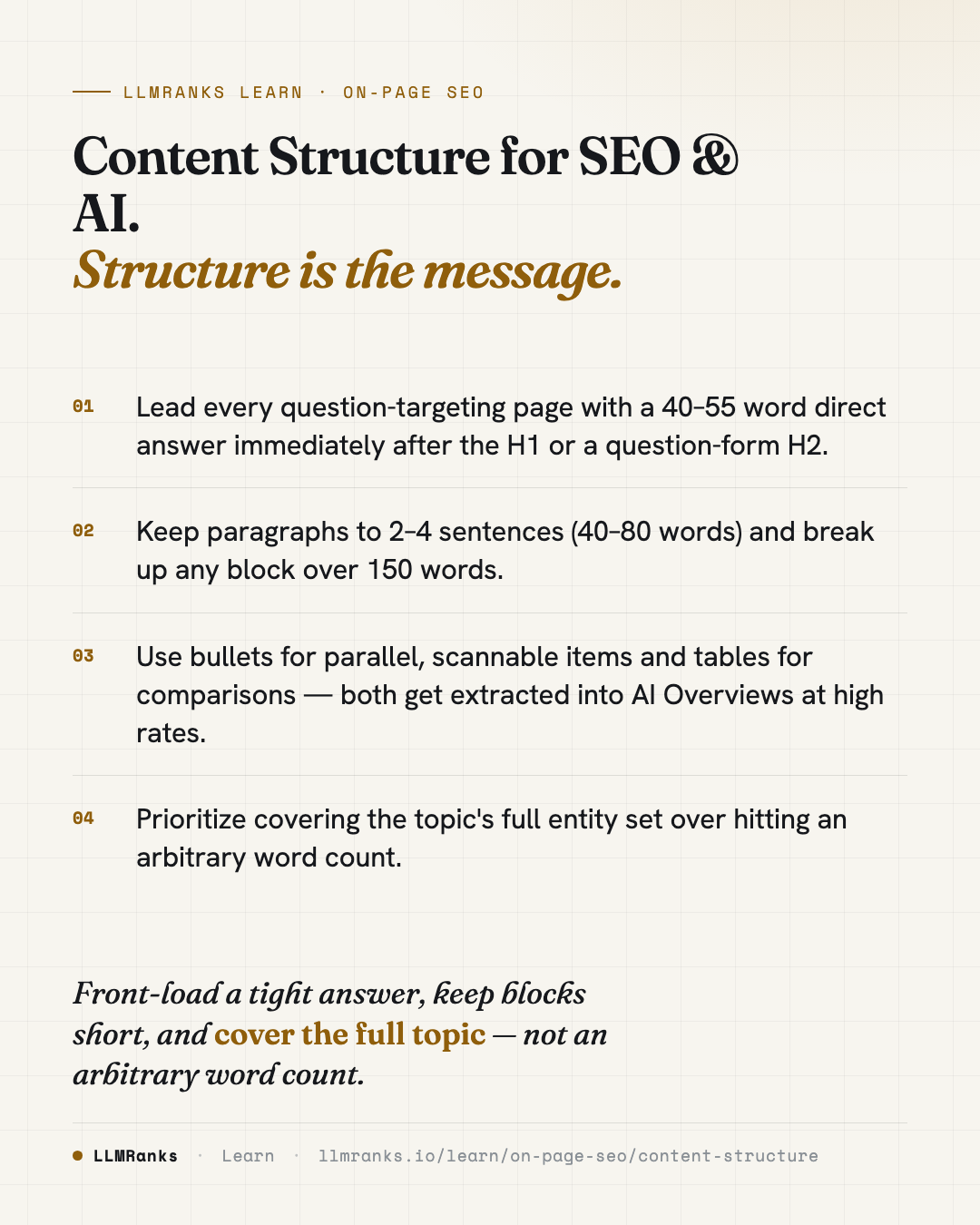 Download card
1080×1350 · post it anywhere
put it to work
See how ChatGPT, Gemini and Google AI actually talk about your brand.