Title Tags
Title tags remain one of the highest-leverage on-page signals you control. They tell search engines what a page is about and shape whether a searcher…
6 min read · updated 2026-08-11
Title tags remain one of the highest-leverage on-page signals you control. They tell search engines what a page is about and shape whether a searcher clicks. In 2026 the fundamentals still hold — put your primary keyword near the front, keep the title within a display budget, and make every title unique — but the details have shifted from character-counting toward pixel-aware, CTR-driven optimization.
Length and display mechanics
Search engines truncate titles by pixel width, not character count. Google cuts off at roughly 580px on desktop and about 920px on mobile — mobile is actually wider in pixel terms after the 2024 SERP redesign. Character count is a lossy proxy because a "W" eats about three times the pixels of an "i".
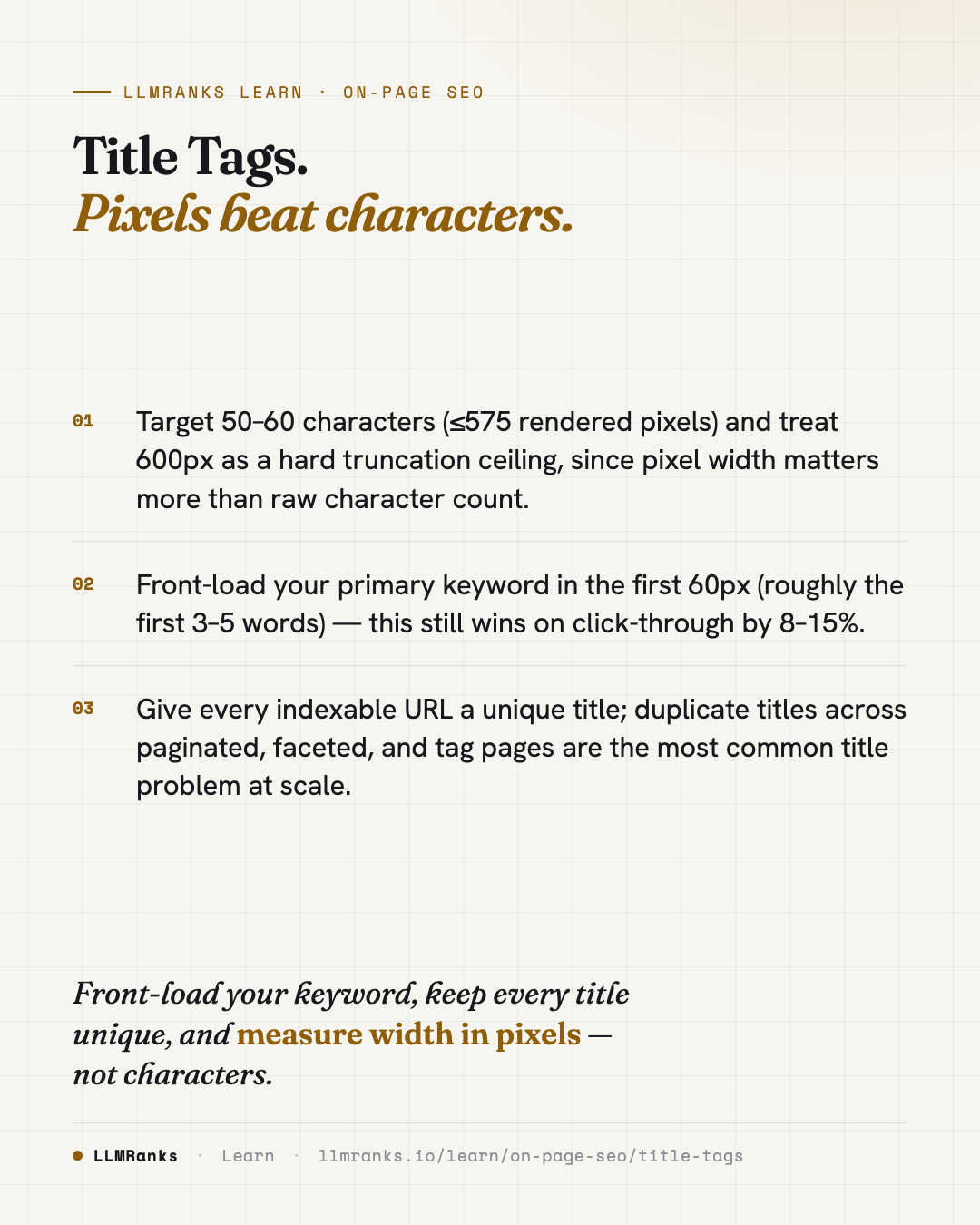
A safe practical target is 50–60 characters or ≤575 rendered pixels, with a hard ceiling at 600px, above which truncation risk climbs past 90%. Don't go under 30 characters either — a very short title leaves SERP real estate unused and signals thin metadata.
You may have heard the 2024-era claim that "Google rewrites 60%+ of titles, so length doesn't matter." That advice is now wrong. Google's title rewriting rate stabilized around 40–45% in 2025, and well-constructed titles that stay under the pixel budget get preserved at roughly 80%+. Rewrites are also more conservative now, so a good title is more likely to survive intact.
Keyword placement
Put your primary keyword in the first 60px — roughly the first 3–5 words. Eye-tracking and click-through data still show that front-loading beats mid-title placement by 8–15% CTR.
Use one primary keyword plus at most one secondary modifier. Stuffing three or more keywords can trip on-page over-optimization classifiers folded into Google's helpful content system. Also avoid repeating the same term: a title like "Best Running Shoes — Running Shoes for Men" should be rewritten.
For more on how titles fit alongside your other page elements, see On-Page SEO and Heading Hierarchy.
Brand position
Put your brand at the end, separated by an em dash (—) or a pipe (|). The em dash is now preferred — Google's title rewriter respected it more often than the pipe in SERPs observed through 2025.
There are exceptions. For navigational (brand-dominant) queries, or for brands with under 40% awareness in their category, lead with the brand instead. You can gauge this by comparing branded-search volume against category search volume.
Your homepage deserves special treatment. Use a pattern like Brand: Primary Value Prop kept under about 55 characters. Don't waste the homepage title on something like "Home | Brand".
Click-through optimization
Some modifiers still reliably move click-through in 2026. Use them deliberately rather than piling them all in.
| Modifier | Effect | Notes |
|---|---|---|
Year token (2026) | +12–18% CTR for evergreen informational | Auto-decays; needs an annual refresh |
Numerals (7 Ways, 12 Tools) | +8–10% for listicles | Works best on list content |
Brackets/parens ([Updated], (Free Tool)) | +5–8% | Losing potency as they get overused |
Specificity (Under $50, In 10 Minutes) | +6–10% | Durable over time |
Things to avoid: ALL CAPS words (often rewritten by Google), emoji (rendered only about 30% of the time, inconsistently), and clickbait phrases like "You Won't Believe," which now correlate negatively with helpful content scores.
If a page is tagged as evergreen and updated recently, keep its year token current — a stale year works against you. Your Content Strategy & E-E-A-T approach should build in a refresh cadence for these.
Uniqueness
Every indexable URL needs its own title. Duplicate titles are the single biggest source of title issues at scale, and they usually come from paginated archives, faceted navigation, and tag pages that reuse one template.
For pagination, differentiate the pages explicitly. Use a pattern like Title — Page 2 of 7 | Brand rather than repeating Title | Brand across every page in the series. Strong Internal Linking and clean Technical SEO practices help keep these templated sections under control.
Common title problems to catch
When you audit titles across a site, these are the recurring issues worth checking for:
- Over-length: rendered width over 600px or more than 65 characters.
- Under-length: fewer than 30 characters.
- Missing primary keyword: your target keyword doesn't appear in the title.
- Keyword not front-loaded: the primary keyword starts after roughly the first 30 characters.
- Brand misplacement: the brand appears in the first 30 characters on a non-navigational page.
- Duplicate titles: an exact match across two or more canonical URLs.
- Near-duplicate titles: templated pages that differ by only a handful of characters.
- Rewritten by Google: the displayed title in search differs from your
<title>element, visible in Search Console query data. - Stop-word stuffed: more than 40% of the title is stop words.
- Stale year: an evergreen, recently updated page with no current year token.
How risky is each fix
Not all title changes carry the same risk, so match your appetite to the page's value.
- Low-risk changes you can apply broadly: appending a missing brand, replacing a pipe with an em dash, correcting capitalization to title case, and trimming to the pixel budget by removing trailing modifiers.
- Changes worth reviewing before shipping: full rewrites, keyword swaps, and adding CTR modifiers. Draft these with the page's H1, first 200 words, and target keyword in mind, then validate with real click-through data where you can.
- Changes to avoid on high performers: don't touch titles on pages already ranking positions 1–3 for high-value queries. The downside risk dominates any potential upside — treat those as recommendations only, not automatic edits.
Titles work alongside your Meta Descriptions to shape the snippet a searcher sees, so tune them together.
What to do
- Measure each title's rendered pixel width, not just its character count, and keep it under ~575px (hard ceiling 600px).
- Move your primary keyword into the first 3–5 words, using one primary plus at most one secondary modifier.
- Place your brand at the end with an em dash, unless the query is navigational or your brand awareness is low.
- Rewrite the homepage title to lead with your value proposition instead of "Home | Brand".
- Add one durable CTR modifier where it fits — specificity or a numeral — and refresh any year tokens on evergreen pages.
- Audit for duplicate and near-duplicate titles across paginated, faceted, and tag pages, and differentiate them.
- Compare your
<title>against the title Google displays in Search Console, and revise titles that are being rewritten. - Hold off on editing titles for pages ranking in positions 1–3 for valuable queries; log those as recommendations and test cautiously.
For the bigger picture on how titles fit into search visibility, start with LLMRanks Learn.
save this card
 Download card
1080×1350 · post it anywhere
put it to work
See how ChatGPT, Gemini and Google AI actually talk about your brand.