The Zero-Click, Agent Future
Most searches now end without a click. AI Overviews, featured snippets, and knowledge panels answer the query directly on the results page, and estimates…
5 min read · updated 2026-07-24
Most searches now end without a click. AI Overviews, featured snippets, and knowledge panels answer the query directly on the results page, and estimates from Similarweb and SparkToro trended past 60% of Google searches ending without a click across 2024–2025 — far higher for informational queries. That doesn't mean visibility is worthless: it means your goal shifts from earning the click to being the cited answer, because citation builds brand impressions and the entity associations that win the queries people still click on.
Zero-click is the default now
The combination of AI Overviews, featured snippets, and knowledge panels means a large share of searches resolve on the results page itself. Estimates trended past 60% of Google searches ending without a click during 2024–2025, and for informational queries the figure runs considerably higher.
This changes what "winning" means. When there's no click, the value comes from two places:
- Brand impression. Being named as the source plants a brand memory that can drive later branded search.
- Entity association. Being the cited source builds the associations that help you win the queries people still do click on.
So the strategy is to optimize for being the answer, not only for the outbound click. For more on how answer engines surface and cite sources, see AEO & GEO.
Measuring what zero-click actually delivers
If you measure only last-click organic sessions, zero-click visibility looks like a loss. It isn't — but attributing its value is genuinely hard.
Your analytics need to account for brand lift that never shows up as a direct organic session. There's no clean way to attribute this, so the practical approach is to watch proxies:
- Branded search volume — is more of your audience searching for you by name over time?
- Direct-traffic trending — are people arriving without a referring query?
Treat these as directional signals, not precise measurement. The goal is to see whether zero-click exposure is compounding into recognition.
Conversational search
Search is increasingly a conversation, not a single query. In AI Mode and tools like ChatGPT, users refine across multiple turns within one session, asking follow-ups as they narrow down. Your content gets pulled across the whole conversation arc rather than matched to one entry query.
Two implications follow:
- Optimize for topical completeness. If your coverage of a subject is thin, you'll surface for the entry question but drop out as the conversation deepens. Broad, connected coverage keeps you retrievable across turns. Strong internal linking and a coherent content strategy support this.
- Comparative and decision content wins conversations. Follow-ups are usually shaped like "but what about X" or "which is better for Y." Content that directly answers comparisons and decisions is what the conversation keeps pulling from.
Agent-driven search: the 2026 frontier
Autonomous agents — Operator-class tools, Mariner descendants, shopping agents — are starting to perform tasks directly: booking, buying, comparing, filling out forms. Adoption is still early, so treat this as an emerging shift rather than a dominant channel. But the direction is clear enough that preparing now is reasonable.
The discipline forming around this is agent-readiness: making your site something an agent can parse and act on reliably.
Crawler reads
- HTML markup
- Plain text
- Outbound links
Agent drives
- Clicks & navigates
- Fills out forms
- Compares & checks policies
What agent-readiness looks like
- Clean, semantic, deterministic HTML. Real buttons and links with stable selectors, ARIA labels, and predictable forms so an agent can act without guessing.
- Structured product and availability feeds so agents can transact accurately rather than scraping prices and stock from rendered pages.
- Stable URLs and predictable architecture. Agents break on JavaScript-only navigation and obfuscated DOMs, so consistency matters more than cleverness.
Much of this overlaps with existing Technical SEO and Structured Data & Schema work — the same clarity that helps crawlers helps agents.
Agent-facing endpoints: watch, don't build
There's growing interest in machine-readable action descriptions — endpoints that describe what an agent can do on your site. The standards here are immature and there's no dominant spec yet. Watch this space rather than committing engineering effort to any one approach. For related context on emerging conventions, see The Agentic Web and llms.txt: The Reality Check.
The bot-blocking anti-pattern
A common mistake is aggressive bot-blocking that also blocks legitimate, user-initiated agents. Fetchers like ChatGPT-User, Perplexity-User, and Operator-class agents act on behalf of real people who chose to use them — blocking them can mean blocking paying customers.
The fix is to distinguish two categories in your WAF and access rules:
| Category | Example | How to treat it |
|---|---|---|
| Training crawlers | Bots collecting content for model training | Block or allow per your policy |
| User-action fetchers | ChatGPT-User, Perplexity-User, Operator-class | Allow — these represent real users acting |
For guidance on separating these in practice, see robots.txt for AI Bots.
What to do
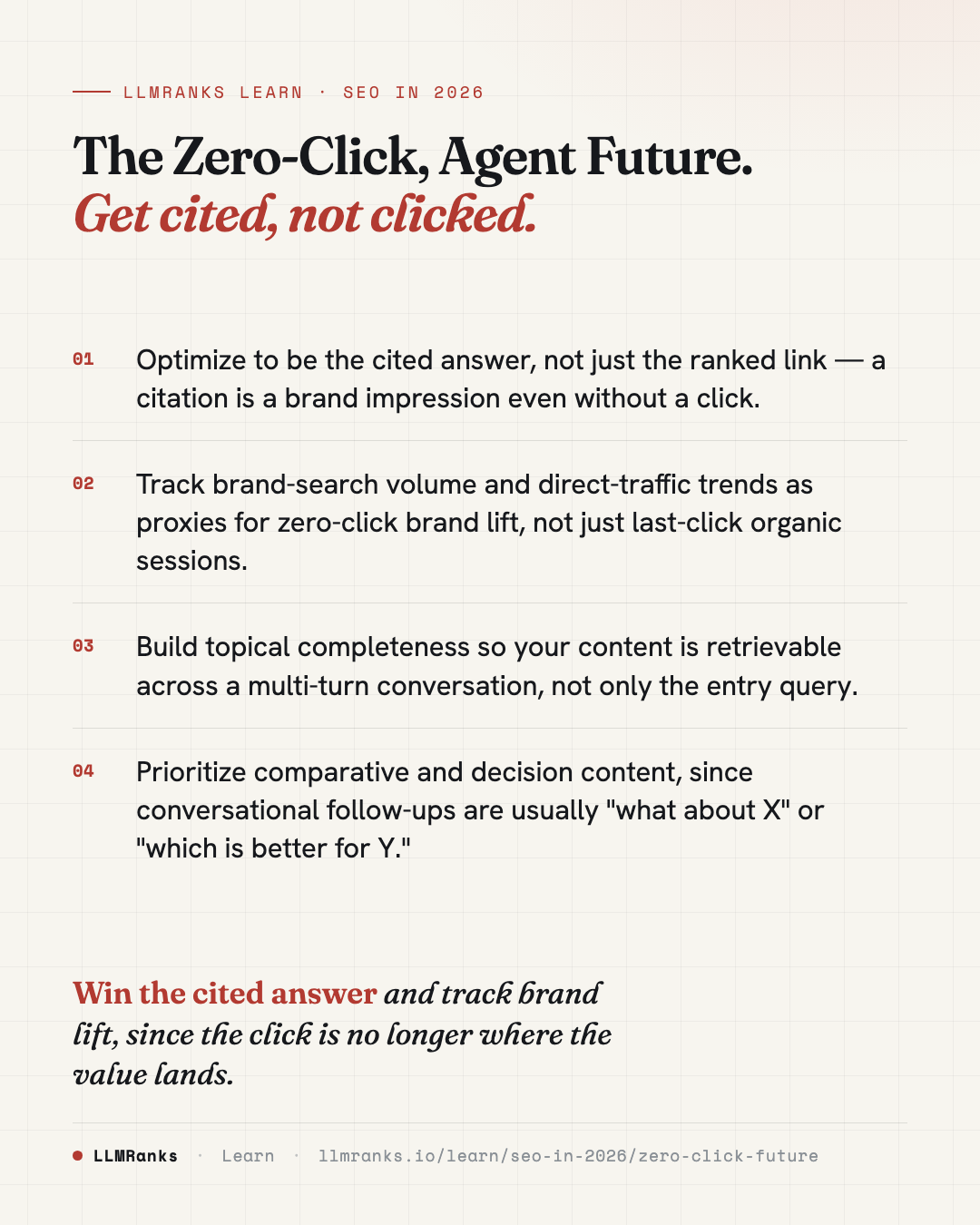
- Reframe your goal for informational queries around being the cited answer, not just earning the click.
- Set up proxy measurement for zero-click value: trend your branded search volume and direct traffic over time.
- Build topical completeness on your priority subjects so you stay retrievable across multi-turn conversations.
- Prioritize comparative and decision-focused content to win conversational follow-ups.
- Audit your HTML for semantic, deterministic markup — real links and buttons, stable selectors, ARIA labels, predictable forms.
- Publish structured product and availability feeds so agents can transact accurately.
- Keep URLs stable and avoid JavaScript-only navigation that breaks agent parsing.
- Review your WAF and bot rules to separate training crawlers from user-action fetchers, and allow the fetchers that represent real customers.
- Monitor emerging agent-endpoint standards, but don't build production dependencies on any single immature spec yet.
save this card
 Download card
1080×1350 · post it anywhere
put it to work
See how ChatGPT, Gemini and Google AI actually talk about your brand.