Dead SEO Tactics in 2026
Outdated SEO tactics fall into two groups: things that have been dead for over a decade but still get recommended, and practices that Google actively…
5 min read · updated 2026-07-22
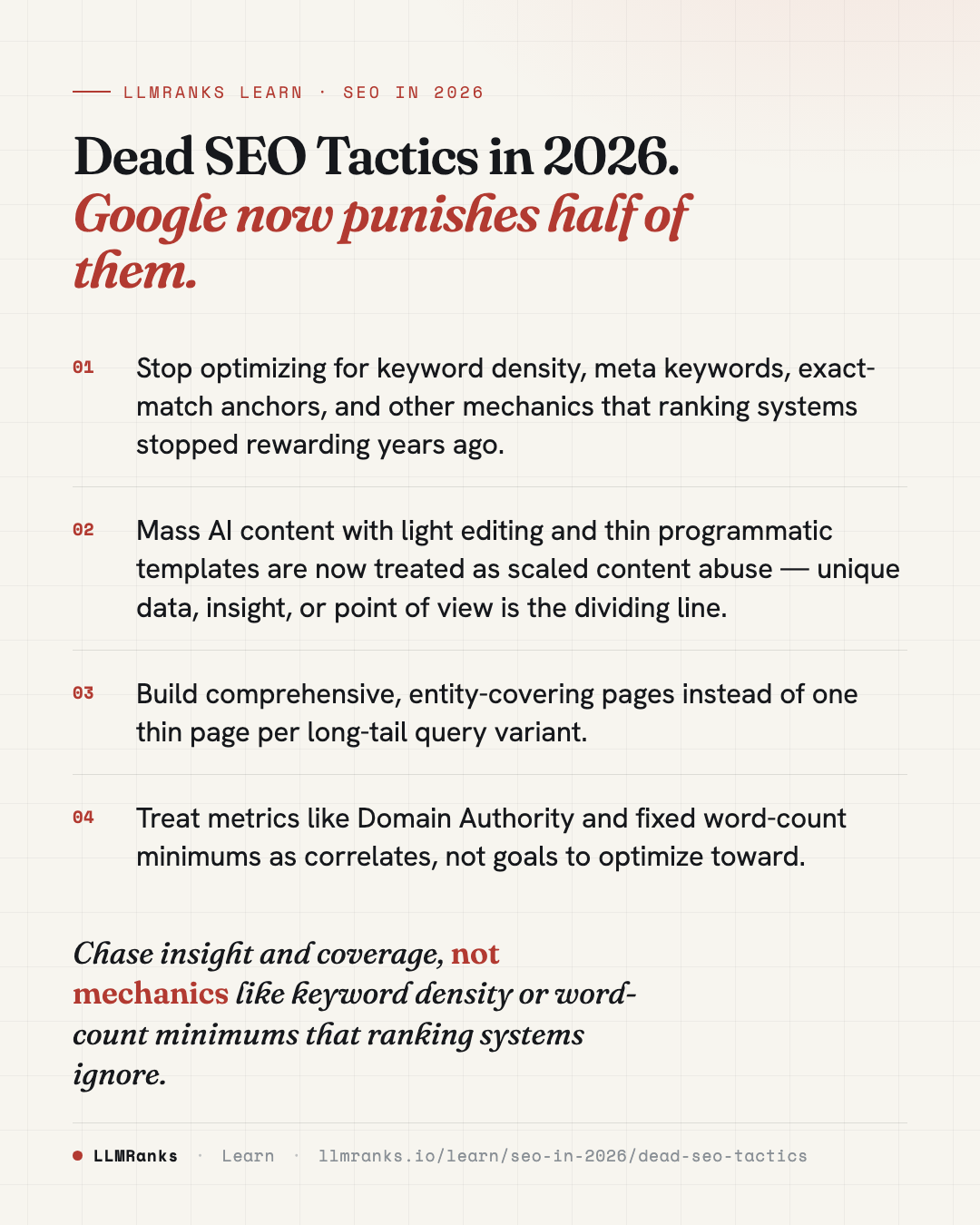
Outdated SEO tactics fall into two groups: things that have been dead for over a decade but still get recommended, and practices that Google actively deprecated or penalized between 2024 and 2026. The common thread is that ranking now runs on entity relevance, passage-level meaning, and genuine information density — not keyword mechanics, markup tricks, or volume plays. If a tactic is designed to game a signal rather than serve a reader, assume it no longer works.
Tactics that have been dead for over a decade
Some advice survives in recycled guides long after it stopped mattering. These are safe to ignore entirely.
<meta name="keywords">has been irrelevant for Google since roughly 2009. Any tool that flags it as a positive signal is broken.- Keyword density (the old 2–3% rule) died around 2013 with Hummingbird. Ranking now uses passage embeddings and entity relevance, so counting keyword occurrences accomplishes nothing.
- Article spinning and synonym swapping are trivially detected by embedding similarity, and have been since 2020.
- The "exactly one H1 per page" rule is an accessibility consideration under the HTML5 outline algorithm, not a ranking factor. Multiple H1s don't hurt your rankings.
For the underlying shift toward meaning-based ranking, see Entity-Based SEO and On-Page SEO.
Link tactics that backfire
Manipulative link building is not just ineffective — some of it is actively risky.
- Exact-match anchor-text optimization trips spam filters. Since Penguin 4.0 became real-time, over-optimized anchor profiles get filtered. A healthy profile looks natural, roughly:
| Anchor type | Healthy share |
|---|---|
| Branded + URL | ~50–65% |
| Partial-match | ~20–30% |
| Exact-match | ≤5–8% |
| Generic ("click here") | ~5–10% |
- PBNs and bulk link buying are detected, devalued, and occasionally penalized.
- Guest posting at scale on irrelevant sites has been deprecated for years. People still do it; it still doesn't work.
For what actually builds authority, see Off-Page Authority.
Newly dead: the 2024–2026 deprecations
This is where most sites get caught, because these tactics worked recently.
AI content with light review
Mass AI-generated content with only light human editing was hit by the March 2024 spam update and its integration with the Helpful Content system. The "use AI but edit it" advice, absent unique data, insight, or a genuine point of view, is a losing strategy. Sites like HouseFresh and Retro Dodo, along with many affiliate sites, rebuilt around expert review in response. If you use AI in your workflow, understand the AI Content Disclosure Norms and lead with something a model couldn't generate on its own — see Content Strategy & E-E-A-T.
Thin programmatic templates
Programmatic SEO built on [city] × [service] permutations with no unique data per page is now treated as scaled content abuse and penalized. Programmatic SEO with genuinely unique data per permutation — the Zillow, G2, and Tripadvisor pattern — still works. The distinction is whether each page carries information that exists nowhere else. See Programmatic SEO in 2026.
One page per long-tail keyword
Targeting individual long-tail queries with separate pages lost to topic clusters. Build comprehensive pages that cover an entity thoroughly rather than fragmenting intent across near-duplicate query variants. Internal Linking ties those clusters together.
Schema that no longer earns visibility
Structured data still has legitimate uses, but two popular types stopped delivering the results people expect.
- FAQ schema lost its rich results for most sites in August 2023, and Google ended FAQ rich results entirely for all sites on May 7, 2026. It is also not an AI-citation lever: a 2026 controlled study found no citation lift, and retrieval testing shows engines read visible HTML rather than the JSON-LD. Keep visible Q&A where the question intent is genuine; stop selling the markup as a ranking or citation tactic.
- HowTo schema visibility was deprecated in search results in September 2023. AI engines quote your visible numbered steps; the markup itself is optional metadata.
The takeaway: visible content is what gets read and quoted. Use Structured Data & Schema for the cases where it still helps, not as a substitute for on-page substance.
Signals and metrics people still chase
A few habits persist because they feel measurable, even though they don't drive results.
rel="author"authorship — the old Google+ approach — is a ghost. Authorship is now signaled by linking author entities viasameAsto Wikipedia, Wikidata, LinkedIn, or ORCID, plusPersonschema withknowsAbout.- AMP is dead. Google removed the AMP requirement for Top Stories in mid-2021. If you still maintain AMP, stop.
- Domain Authority chasing is cargo-culting. DA is a Moz metric, not a Google metric. It correlates loosely with ranking ability, but optimizing for it directly optimizes for the wrong thing.
- "Write 1,500–2,000 words minimum" treats a correlate as a cause. Length correlates with ranking; it doesn't create it. AI engines especially prefer dense, citable, factual chunks — many AI Overview citations come from pages under 500 words with high information density.
For how these engines actually retrieve and cite content, see AI Search Engines and AEO & GEO.
Why these tactics died
The pattern behind every entry above is the same. Ranking and AI citation now reward meaning, entities, and unique information — not keyword mechanics, markup signaling, or volume. Tactics built to manipulate a specific signal (density, anchors, schema types, word count) fail because the systems no longer read that signal the way they once did.
For the broader context of these changes, see Google Updates 2024–2025 and SEO in 2026.
What to do
- Audit your content for AI-generated pages with no unique data or point of view, and rebuild them around genuine insight or expert review.
- Check any programmatic pages: keep only permutations that carry unique data, and cut thin
[city] × [service]templates. - Stop treating FAQ and HowTo schema as visibility levers; keep the visible Q&A and numbered steps that engines actually quote.
- Review your anchor-text profile against natural ratios and stop pursuing exact-match anchors, PBNs, and irrelevant guest posts.
- Replace
rel="author"remnants withPersonschema andsameAslinks to authoritative author entities. - Consolidate one-page-per-keyword content into comprehensive, entity-covering pages linked as clusters.
- Drop Domain Authority and fixed word-count minimums as KPIs; measure information density and real ranking or citation outcomes instead.
- Remove AMP and delete any lingering
<meta name="keywords">tags and keyword-density tuning from your workflow.
save this card
 Download card
1080×1350 · post it anywhere
put it to work
See how ChatGPT, Gemini and Google AI actually talk about your brand.