Author Bylines & Signals
Author signals tell search engines and AI systems who stands behind your content and whether they have the expertise to write it. At minimum this means a…
5 min read · updated 2026-07-31
Author signals tell search engines and AI systems who stands behind your content and whether they have the expertise to write it. At minimum this means a visible byline linked to a real bio page, a bio block with verifiable credentials, and Person schema that ties every article back to a consistent author entity. For YMYL topics, add a distinct reviewer attribution. Done well, this strengthens your trust signals; done carelessly — or faked — it becomes a liability.
Visible author elements
Author signals start with what readers can see on the page. Every non-trivial article should carry these elements:
- Byline at the top: "By [Name], [Role]", linked to the author's bio page.
- Bio block at the bottom: 80–200 words covering credentials, links to other publications, social profiles, and contact details.
- Reviewer block for YMYL: something like "Medically reviewed by Dr. X, MD, on [date]."
- Contributor list where multiple people worked on the piece.
These visible elements do double duty: they help readers judge who is speaking, and they give machines structured text to extract. They also reinforce the broader E-E-A-T picture your site is trying to establish.
Author bio page requirements
Each author needs a dedicated page at a stable URL — for example, /authors/firstname-lastname/. That page is the canonical home for the author's identity, and it should include:
- Full name and a real photo (keep the EXIF data intact).
- Credentials, each with verifiable links.
- Areas of expertise, mapped to entities where possible.
- A publication list linking to their articles on your site and externally.
- Contact and social details.
sameAslinks to profiles that prove the person exists: LinkedIn, X/Twitter, GitHub, Google Scholar, ORCID, a university page, Wikipedia, Wikidata.
The point of the sameAs links is corroboration. An author who can be traced to real, external profiles is far more credible than a name that appears only on your own domain. This connects directly to your off-page authority footprint.
Author schema
Author markup ties the visible byline to a machine-readable Person entity and integrates it with the Article schema. A typical structure looks like this:
{
  "@context": "https://schema.org",
  "@type": "Article",
  "headline": "...",
  "datePublished": "2024-03-12T09:00:00-05:00",
  "dateModified": "2026-03-04T14:30:00-05:00",
  "author": {
    "@type": "Person",
    "name": "Jane Doe",
    "url": "https://example.com/authors/jane-doe/",
    "image": "https://example.com/img/jane-doe.jpg",
    "jobTitle": "Senior Performance Engineer",
    "worksFor": { "@type": "Organization", "name": "Example Inc", "@id": "https://example.com/#org" },
    "knowsAbout": ["Core Web Vitals", "INP optimization", "React rendering"],
    "alumniOf": { "@type": "CollegeOrUniversity", "name": "MIT" },
    "sameAs": [
      "https://www.linkedin.com/in/janedoe",
      "https://github.com/janedoe",
      "https://orcid.org/0000-0002-1825-0097",
      "https://www.wikidata.org/wiki/Q12345678"
    ]
  },
  "reviewedBy": {
    "@type": "Person",
    "name": "Dr. Alan Smith, MD",
    "url": "https://example.com/authors/alan-smith/"
  }
}
A few things make this markup work rather than just exist. For the full schema picture, see Structured Data & Schema.
Keep the entity consistent
Use a stable @id — for example, the author URL with a #person fragment — so the Person entity is reconciled across every article they write. Inconsistent or missing @id fragments fragment the author's entity graph, which means search engines may treat the same person as several different, weaker entities.
Map knowsAbout to real entities
Where possible, knowsAbout should point to real schema.org or Wikidata entities rather than free text. Use the entity form, like {"@type":"Thing","@id":"https://www.wikidata.org/wiki/Q..."}, so the expertise claim resolves to something concrete instead of an ambiguous string.
Separate reviewedBy from author
For YMYL content, keep reviewedBy distinct from author. Google has published reviewer-markup guidance for medical content. Extending reviewer attribution to other YMYL verticals such as finance and legal is a reasonable best practice, but it is not confirmed — treat it as sensible rather than official.
Don't fabricate authors
Fake personas do more harm than having no byline at all. AI-generated headshots are detectable — they tend to show StyleGAN artifacts, fail reverse-image searches, and leave no off-site footprint. That combination constitutes a trust violation.
The pattern to watch for is a listed author whose photo returns zero reverse-image matches and whose sameAs links do not resolve to any real profile. That is a high-risk sign of a fabricated author. If you cannot stand behind an author as a real, verifiable person, don't invent one.
How AI systems use author signals
AI grounding and retrieval systems increasingly extract author entities and appear to weight retrieval by author authority when the entity resolves to a known expert — for instance, a Google Scholar profile with citations, or a verified domain expert. Recognized author entities plausibly increase the likelihood of being cited.
Treat this as directional, not settled. It is consistent with the general E-E-A-T direction, but no vendor documentation or controlled study confirms that author authority is used as a retrieval weight. Build for it because it aligns with credibility signals you'd want anyway — not because it's a proven ranking lever. If AI visibility is a priority, connect this work to your broader AEO & GEO strategy.
What to do
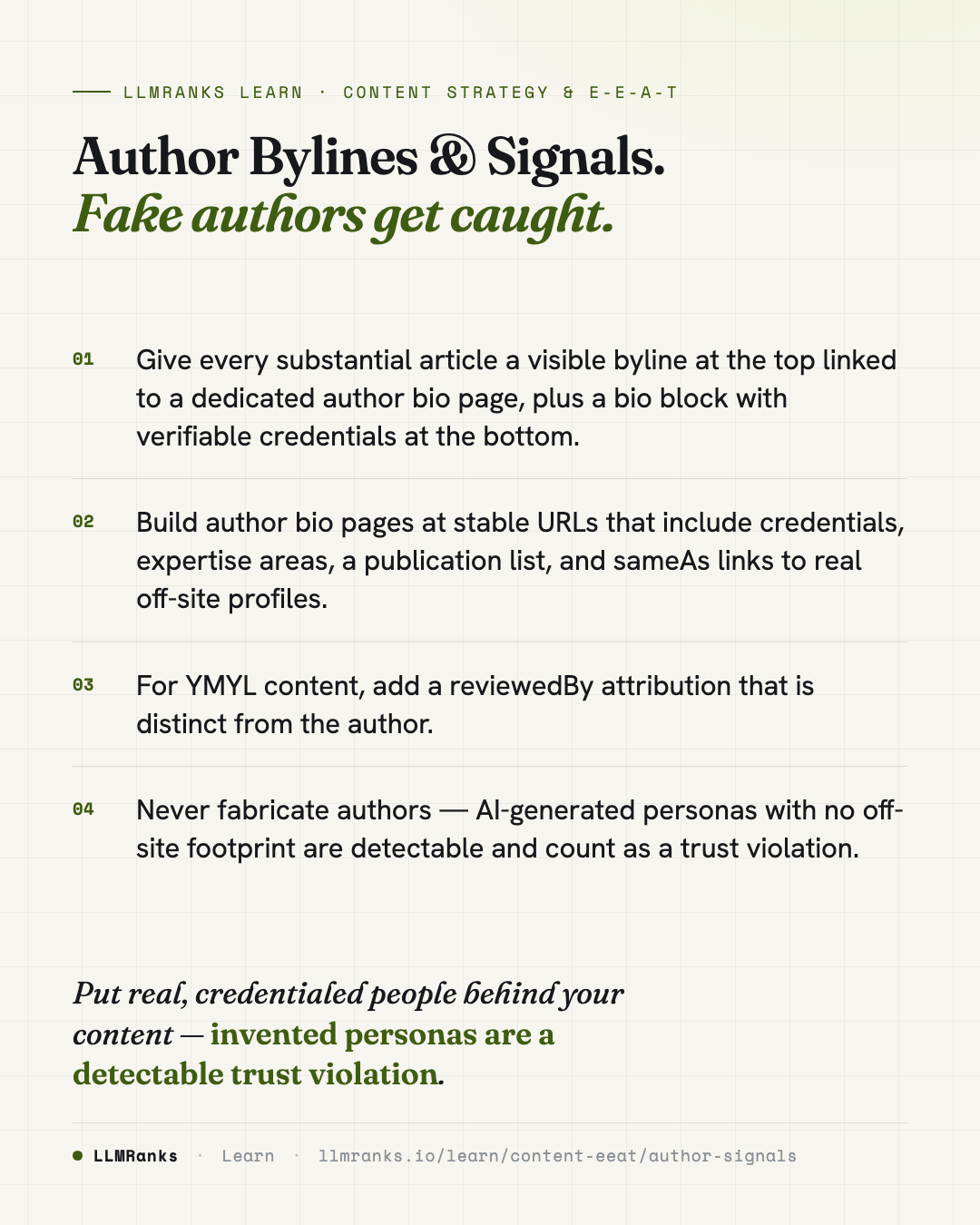
- Add a visible byline to every substantial article, linked to the author's bio page, with a role or title.
- Publish a bio block of 80–200 words at the end of each article covering credentials, other publications, social, and contact.
- Build a dedicated author bio page at a stable URL with a real photo (EXIF intact), verifiable credentials, expertise areas, a publication list, and
sameAslinks. - Add
Personschema to yourArticlemarkup, using a stable@idfragment so the author reconciles into one entity across all pages. - Map
knowsAboutto real schema.org or Wikidata entities instead of free text wherever you can. - For YMYL topics, add a distinct
reviewedByattribution — including a review date on the page for medical content. - Audit for fabricated authors: flag any byline whose photo returns no reverse-image matches and whose
sameAslinks don't resolve to real profiles.
save this card
 Download card
1080×1350 · post it anywhere
put it to work
See how ChatGPT, Gemini and Google AI actually talk about your brand.