Content Depth vs Word Count
Word count doesn't cause rankings — depth does. A blog post should be exactly as long as it needs to be to fully answer the query, which means a fact-dense…
5 min read · updated 2026-07-29
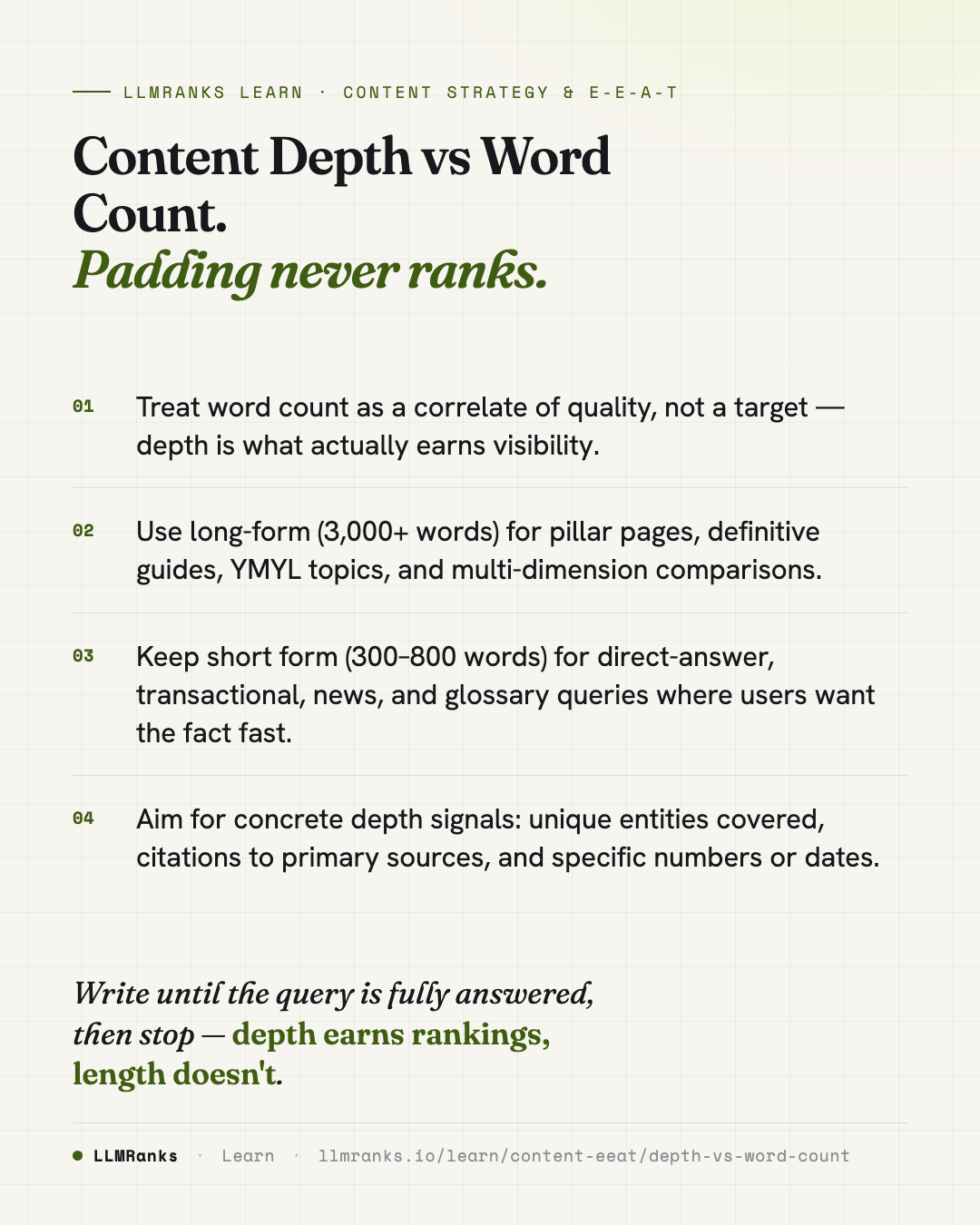
Word count doesn't cause rankings — depth does. A blog post should be exactly as long as it needs to be to fully answer the query, which means a fact-dense direct answer might run 300–800 words while a definitive pillar guide justifiably runs 3,000+. Stop targeting a word count and start counting claims, citations, and unique entities instead.
Why word count is the wrong target
Longer content tends to rank, but length isn't the reason. Comprehensive pages often rank because they cover a topic thoroughly — the extra words are a symptom of that coverage, not the cause of the ranking. When you write to hit a word count, you pad. Padding buries the answer and hurts you, especially in AI search where long preambles get skipped.
The better frame is fitness for the query. Match the length to what the searcher actually needs, then make every sentence carry a claim, a fact, or a step. For more on how substance and expertise drive rankings, see Content Strategy & E-E-A-T and the Helpful Content System.
When long-form wins
Some queries genuinely reward comprehensive coverage. Go long when the user expects everything on the topic in one place, or when leaving out context would break trust.
- Pillar and hub pages targeting competitive head terms.
- Definitive guides where the user signals they want full coverage — queries like "complete guide to" or "everything about."
- YMYL topics (your money or your life), where omitting context is itself a trust failure.
- Comparison content that spans multiple dimensions.
- Technical deep-dives that require background, theory, and application together.
These pages also give you room to build topical authority by covering an entire subject cluster in depth.
When short wins
Just as often, brevity is the right call. Short, fact-dense pages win when the user wants an answer or an action, not a read.
- Direct-answer queries ("what is X," "how tall is Y"). AI Overviews pull from concise, fact-dense answers, and long preambles get skipped.
- Transactional queries where the user wants to act, not read.
- News and updates with a finite amount of information.
- Definitional pages in glossaries.
- FAQ entries, where roughly 50–150 words per question is optimal for answer-engine citation.
If AI-driven answers are a priority, the length discipline here connects directly to AEO & GEO and how AI search engines select what to quote.
Depth metrics that actually matter
Instead of counting words, count the things that signal real coverage. These targets scale with page type — a pillar page carries more of each than a supporting spoke page.
| Metric | Target | Why it matters |
|---|---|---|
| Unique entities mentioned | 25+ for a pillar, 8+ for a spoke | Signals entity coverage of the topic |
| Citations to primary sources | About 1 per 300 words | Builds trust and grounds answer-engine responses |
| Specific numbers or dates | About 1 per 200 words | Raises fact density |
| Original assets (chart, table, image) | 3 or more per pillar | Differentiates your page from thin competitors |
| Subheading depth | H2/H3 covering the real questions asked about the term | Helps capture SERP features |
Citations to primary sources do double duty: they support your claims for readers and give answer engines something concrete to ground on. Original assets — a chart, a comparison table, an image you made — separate your page from pages that only restate what everyone else says. See Originality & Duplicate Content for why that differentiation matters.
Fact density beats padding
Fact density is the through-line across every page type. Whether you're writing 400 words or 4,000, the ratio of concrete information to filler is what determines whether the page is useful. A specific number or date every couple hundred words, and a primary-source citation every few hundred, keeps the page grounded and hard to dismiss as thin.
This is also what serves AI search well. Concise, fact-dense answers are the ones that get quoted; vague, padded ones get passed over. So the discipline that helps a short FAQ entry — say the answer directly, back it with a fact — is the same discipline that keeps a long guide from turning into filler.
Structure for the questions people ask
Length should follow structure, not the other way around. Map out the real questions searchers have about your term, then give each a heading. On a short page that might be one clear answer; on a pillar it's a full H2/H3 outline covering every angle. When your subheadings match the questions people actually ask, you're positioned to capture SERP features that surface those answers directly. Supporting practices like On-Page SEO and Internal Linking help those sections get found and connected.
What to do
- Identify the query type first — direct-answer, transactional, comparison, definitive guide — and let that set your rough length band, not an arbitrary target.
- Outline your headings around the actual questions people ask about the term before you write a word.
- Write to answer, not to fill. If a sentence carries no claim, fact, or step, cut it.
- Hit the depth targets for your page type: unique entities, primary-source citations, and specific numbers or dates.
- Add at least three original assets — a chart, table, or image — to any pillar page to differentiate it.
- Keep FAQ answers tight (roughly 50–150 words each) and put the direct answer up front so answer engines can quote it.
- Audit finished pages by counting claims, citations, and entities — not words.
save this card
 Download card
1080×1350 · post it anywhere
put it to work
See how ChatGPT, Gemini and Google AI actually talk about your brand.