Programmatic SEO in 2026
Programmatic SEO still works in 2026 — but only when every generated page carries genuinely unique, useful data that a searcher can't easily find elsewhere.…
5 min read · updated 2026-07-23
Programmatic SEO still works in 2026 — but only when every generated page carries genuinely unique, useful data that a searcher can't easily find elsewhere. Google now explicitly treats thin templated pages with interchangeable variables and no unique value as "scaled content abuse," while data-rich programmatic sites continue to thrive. The dividing line is information gain per page, not page count.
The line Google now enforces
There are two clearly different kinds of programmatic SEO, and they get treated very differently.
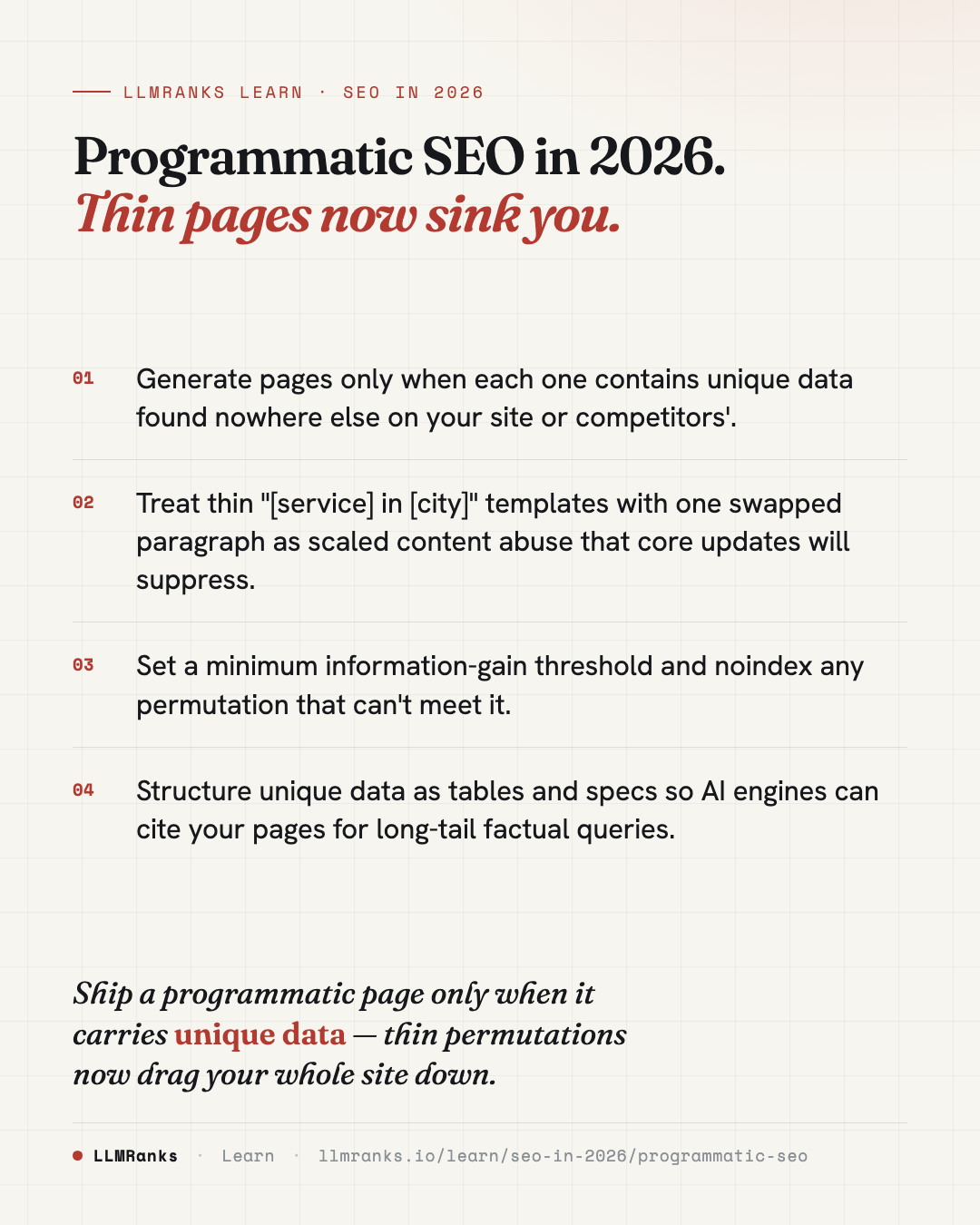
The banned version is thin templated pages built from interchangeable variables with no unique value — the classic "[service] in [city]" pattern multiplied across 5,000 pages, each with a single paragraph swapped in. Google explicitly labels this as scaled content abuse.
The version that keeps working puts genuinely unique, useful data on every page. Sites like Zillow (per-property data), G2 (per-product reviews), Tripadvisor (per-location reviews), PriceRunner (live prices), and Wise (live FX rates) all run at massive scale because each page answers a search with data the user can't easily get anywhere else.
The scale isn't the problem. The absence of unique value per page is the problem. If you can defend the data on each page, volume works in your favor. If you can't, volume works against you.
Will your pSEO survive a core update?
Run every template through this test before you commit to generating and indexing pages. If a page type fails on more than one question, it's a liability.
| Test | Question to ask | Fail signal |
|---|---|---|
| Unique data | Does this page contain data or content found on no other page — mine or a competitor's? | The page is prose padding around a swapped variable |
| Standalone value | Would a user be satisfied landing here directly from search? | The page only makes sense as one of thousands |
| Indexation discipline | Are low-value permutations noindex'd rather than flooding the index? | Millions of thin URLs are indexable |
| Crawl budget sanity | Is this page worth Googlebot's crawl? | Crawlers burn budget on near-empty permutations |
The indexation point is worth dwelling on. Index bloat from millions of thin pages now actively suppresses site-level authority — so unindexed junk isn't neutral, it drags down the pages you care about. And AI crawlers are even more budget-constrained than Googlebot, so wasted crawl has a compounding cost across both traditional and AI search.
Build the system around information gain
The core discipline is to decide what deserves to exist before you generate anything.
- Set a minimum information-gain threshold. Before a page is generated or indexed, confirm it can be populated with enough unique data to clear the bar. If a permutation can't,
noindexit — or don't generate it at all. - Render unique data dynamically; don't pad with prose. Templated prose padding is detectable by both Google and AI engines. The page should lead with the data that makes it worth visiting, not with boilerplate wrapped around a variable.
- Monitor page quality per template. Track engagement signals like dwell time and pogo-sticking at the template level, not just the page level. When a template shows patterns of bad clicks — people landing and immediately bouncing back to search — prune it.
Treating quality as a per-template metric is what makes programmatic SEO manageable at scale. One weak template can spawn thousands of weak pages, so the leverage is in killing the template, not fixing pages one at a time.
The AI search opportunity
Programmatic pages with structured, genuinely unique data — tables, specs, live figures — get cited in AI Mode for long-tail factual queries. This is a real 2026 opportunity, but the qualifier matters: it only holds when the data is genuinely unique.
The mechanism is straightforward. When an AI engine assembles an answer to a specific factual question, it pulls from sources that hold the specific data point. If your page is the canonical place that fact lives in a machine-readable form, you become a citation candidate. Prose padding gives an AI engine nothing to extract; a clean table of specs or prices gives it exactly what it needs.
This reinforces the same discipline that protects you from core updates. Unique data structured for extraction is what earns both traditional rankings and AI citations. There's no separate playbook — the data-first approach serves both. To go deeper on how AI engines choose and cite sources, see AEO & GEO and AI Search Engines.
How the fundamentals still apply
Programmatic SEO doesn't exempt you from the basics — it just applies them at scale.
- Structured data makes your unique tables and specs legible to both search engines and AI systems. Mark it up properly; see Structured Data & Schema.
- Internal linking determines whether your generated pages get discovered and whether crawl budget flows to the pages worth crawling. See Internal Linking.
- Technical SEO governs crawl budget and indexation — the two constraints that make or break a large template. See Technical SEO.
- Thin, templated, low-value pages sit squarely in the category of Dead SEO Tactics in 2026, so if that describes your current build, treat it as a rebuild rather than a tweak.
What to do
- Inventory your templates. List every page type your system generates and how many URLs each produces.
- Run the survival test on each template. Score every one against unique data, standalone value, indexation discipline, and crawl budget. Flag any that fail.
- Define a minimum information-gain threshold. Decide the specific unique data a page must contain before it's allowed to be generated or indexed.
noindexor stop generating permutations that can't clear the bar. Remove thin pages from the index to lift the authority of the pages you keep.- Replace prose padding with structured unique data. Lead each page with the tables, specs, or live figures that make it worth visiting.
- Set up per-template engagement monitoring. Watch dwell and pogo-sticking by template, and prune templates showing bad-click patterns.
- Structure your unique data for AI extraction. Use clean tables and specs so your long-tail factual pages become citation candidates in AI search.
save this card
 Download card
1080×1350 · post it anywhere
put it to work
See how ChatGPT, Gemini and Google AI actually talk about your brand.