Agentic-Readiness Myths
Agentic SEO is about whether an AI agent can actually operate your website during a live browser session — click, fill, navigate, and complete a task — not…
4 min read · updated 2026-08-19
Agentic SEO is about whether an AI agent can actually operate your website during a live browser session — click, fill, navigate, and complete a task — not whether a search engine can read it. That distinction trips up a lot of teams, because most "agentic-readiness" advice recycles tactics from adjacent problems. Adding a protocol server, publishing a content index, or shipping more schema does not make your pages operable by an agent. Below are the most common myths and what they actually address.
Myth: "Build an MCP server" or "add an llms.txt"
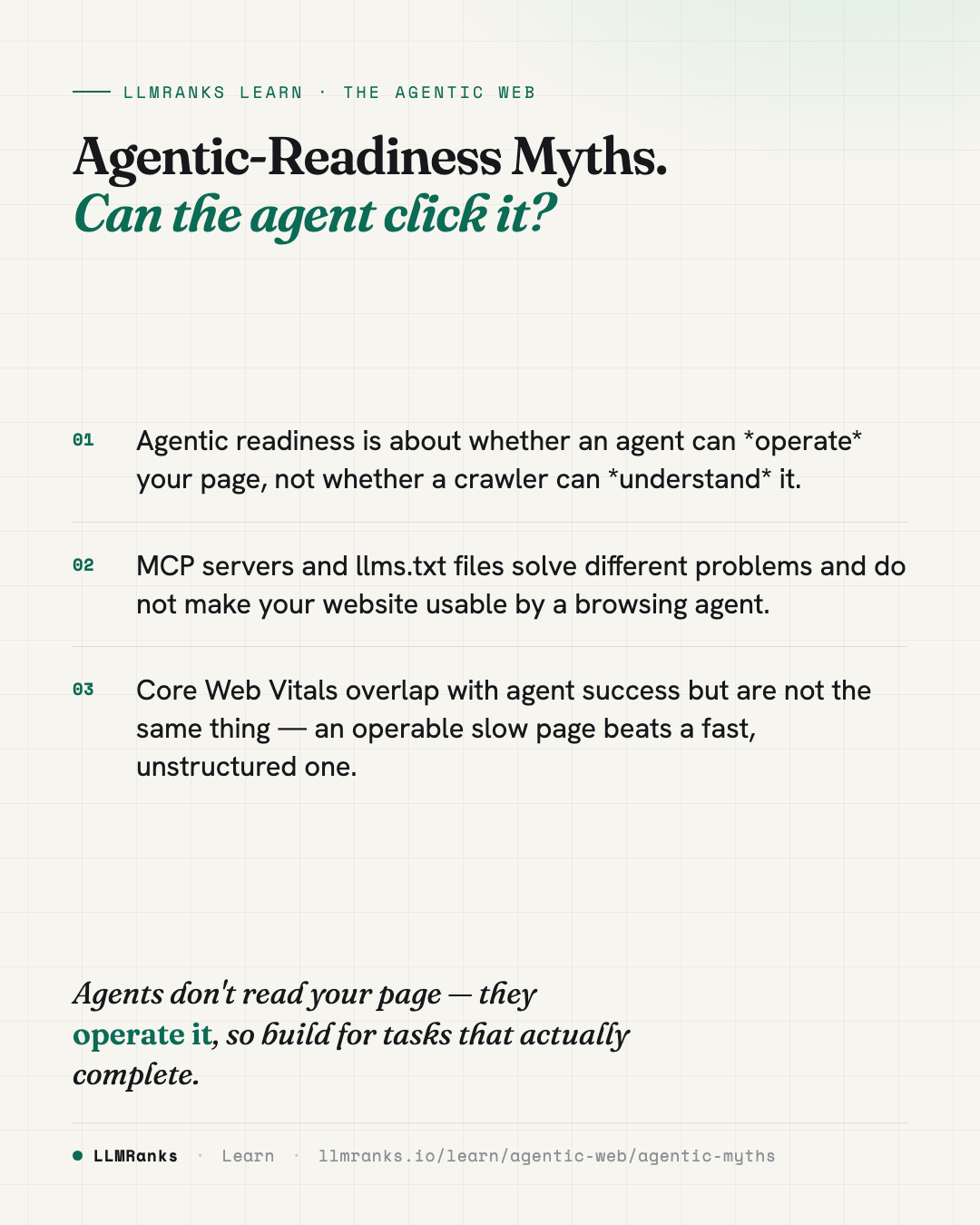
Neither of these is what agentic experiences require. They solve real but different problems.
MCP is a protocol for tools an agent can call directly. It is useful when a SaaS product wants to expose a structured integration an agent can invoke. That is not the same question as "can an agent use my website as it currently exists in a browser."
An llms.txt file is a curated content index. It helps summarize or point to your content, but it does not change whether an agent can navigate and complete tasks on your live pages.
If your goal is a website an agent can operate, both of these sit to the side of the actual problem. They may be worth doing for other reasons, but they are not a substitute for making your pages functional. For what genuinely matters here, see Agent-Readiness and How AI Agents See Your Site.
Myth: "Just add structured data"
Schema helps crawlers and AI engines understand your content. It is genuinely useful for meaning extraction, and it belongs in your broader program — see Structured Data & Schema.
But agents primarily care whether they can operate the page, not extract its meaning. Knowing what a button represents in the abstract is not the same as being able to find, identify, and click it during a session. Schema is helpful, but it is not the main lever for agentic readiness.
Treat structured data as one input among many. It supports the engines that read your site, and it can clarify content, but it will not rescue a page an agent cannot actually use.
Myth: "Improve Core Web Vitals and you're done"
Core Web Vitals and agentic readiness overlap, but they are not the same thing.
A fast Largest Contentful Paint and a stable layout do help agents. Speed and stability reduce friction for anything interacting with the page, and they are worth pursuing — see Core Web Vitals.
The catch is the direction of the trade-off:
| Situation | Agent outcome |
|---|---|
| Slow page that is operable | Agents are generally fine — they can still complete the task |
Fast page that is a <div> soup | Agents struggle — there is nothing structured to operate |
The lesson is that performance is not a proxy for operability. Optimizing your metrics without fixing structure can leave you with a page that scores well and still fails an agent.
Myth: "Optimize for AI Mode citations"
AI Mode citations and agentic experiences are different surfaces, and they are addressed differently.
AI Mode is retrieval-augmented generation over search results — it reads and cites content. Agentic experiences are browser sessions where an agent takes actions on your site. Both matter, but the work is not interchangeable.
If you want to be cited in AI answers, that is the domain of AEO & GEO and AI Search Engines. If you want an agent to complete a task on your site, that is agentic readiness. Optimizing for one does not automatically win you the other.
Crawler reads
- HTML markup
- Plain text
- Outbound links
Agent drives
- Clicks & navigates
- Fills out forms
- Compares & checks policies
Why the confusion persists
Each myth borrows a tactic that is legitimately valuable somewhere else and misapplies it here. Protocol servers and content indexes come from the integration and content-summary world. Schema and Core Web Vitals come from crawler and page-experience work. AI Mode optimization comes from the citation surface.
All of them touch AI in some way, so they get folded under "agentic" as a catch-all. But the defining question for agentic readiness is narrow and concrete: can an agent use your website as-is to complete a task? When you keep that question in front of you, it becomes easier to see which of these efforts is on-target and which is adjacent.
For the wider context of how these surfaces relate, see The Agentic Web, and to understand failure modes specifically, see What Breaks AI Agents.
What to do
- Anchor every decision to one question: can an agent operate this page as it currently exists?
- Do not treat an MCP server or an llms.txt file as agentic readiness — use them for tool integration and content indexing if you need those, but not as a substitute for operability.
- Keep structured data in your program for meaning extraction, but do not expect it to make a page operable on its own.
- Pursue Core Web Vitals for the friction they remove, while remembering that a fast, unstructured page can still fail an agent.
- Handle AI Mode citations and agentic browser sessions as separate workstreams, since they live on different surfaces.
- Prioritize fixing page structure and operability first, then layer the adjacent tactics where they genuinely help.
save this card
 Download card
1080×1350 · post it anywhere
put it to work
See how ChatGPT, Gemini and Google AI actually talk about your brand.