Originality & Duplicate Content
Duplicate content in SEO refers to substantial blocks of text that appear either in multiple places on your own site or across other domains. Search engines…
5 min read · updated 2026-07-30
Duplicate content in SEO refers to substantial blocks of text that appear either in multiple places on your own site or across other domains. Search engines don't penalize most duplication outright, but they do choose one version to index and rank — and if that choice goes against you, your original work can lose visibility to copies. Managing duplication is about controlling which URL gets credit through canonical signals, indexing directives, and genuinely original content.
Internal duplication
Internal duplication happens when your own site serves the same or near-identical content under multiple URLs. The main tool for resolving it is the canonical tag: place one on every URL, self-referencing where the page should be the indexed version.
A few common sources need specific handling:
- Pagination. The
rel="next/prev"markup is deprecated for indexing — Google removed support in 2019 — so don't rely on it. Where feasible, canonicalize paginated series to a view-all page. Otherwise, use self-canonical paginated pages with unique titles so each page in the sequence is distinct. - Faceted navigation. Facets multiply URLs fast. Apply
noindexto non-canonical facets, or block them via robots.txt to protect crawl budget on large sites. - Boilerplate ratio. Navigation, footers, and sidebars repeat across every page. Keep that boilerplate below about 30% of a page's rendered DOM text. Pages where boilerplate dominates tend to get treated as thin.
Getting these signals right is part of broader Technical SEO hygiene, and how you connect pages through Internal Linking reinforces which URL you want treated as canonical.
External duplication
External duplication is when your content appears on domains you don't control. Here you have less direct control, so the goal is to make sure your version is the one search engines credit.
Syndication
If you syndicate content to partners, require them to add a canonical link back to your original URL, or to apply <meta name="robots" content="noindex"> on their copy. Many syndication partners refuse these terms — accept syndication only when the canonical-back is in place.
Scraped content
Scrapers copy content without permission. Monitor for it with duplicate-detection services, and file DMCA takedowns where a copy is doing real damage. Google generally identifies the original source using first-seen timing and authority signals — but it doesn't do this perfectly, so scraping can still cost you visibility.
Press releases
PR distribution duplicates the same text across hundreds of domains at once. To keep your own domain from being outranked by wire copies, publish a unique version on your site first, with material additions that the distributed version doesn't contain.
The stronger your site's Off-Page Authority, the more likely search engines are to treat your URL as the original when copies exist elsewhere.
Measuring originality before you publish
Avoiding duplication isn't only about markup — it's about producing content that isn't a near-copy of what already ranks. Run new content through a few checks before publishing:
| Check | What it measures | Target |
|---|---|---|
| Embedding similarity | How close your content sits to the top-ranking results | Cosine below 0.88 vs. the top 10 |
| N-gram overlap | Repeated phrasing shared with a single source | 5-gram overlap below 15% with any one source |
| Claim novelty | Claims not already present in the current results | At least 5 novel claims per pillar page |
These thresholds give you a concrete bar to clear. Similarity and phrasing checks catch content that's technically rewritten but adds nothing new. Claim novelty is the most demanding: it forces each pillar page to contribute points that don't already appear across the top of the results.
This is where originality connects to real editorial value. Adding novel, defensible claims is closer to Content Depth vs Word Count than to length for its own sake, and it supports the experience and expertise signals covered in E-E-A-T in Practice. Original content that clears these bars is also what the Helpful Content System is designed to reward.
Why originality matters for AI search
Duplication risk isn't limited to traditional search. When answer engines and AI Search Engines pull from the web, near-duplicate pages compete to be the single cited source. Content that only restates what everyone else has published gives an engine no reason to choose your version — the novel claims that clear your originality checks are what make a page worth citing.
Building a body of distinct, original work across a topic also strengthens Topical Authority, which compounds the benefit: the more genuinely original coverage you own, the more likely you are to be the source that both search engines and answer engines credit.
What to do
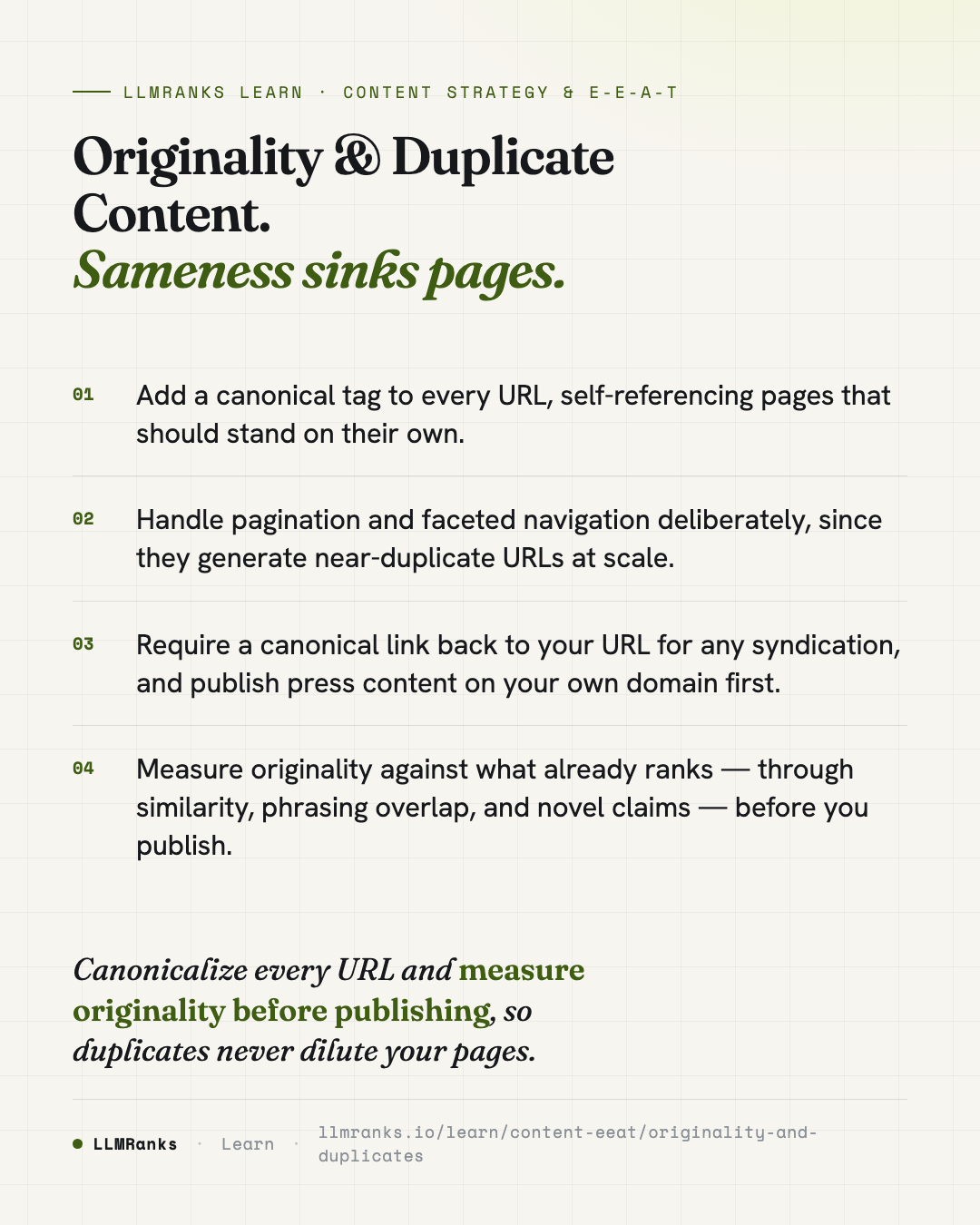
- Add a canonical tag to every URL, self-referencing pages that should be indexed on their own.
- Resolve pagination with a canonical to a view-all page, or use self-canonical paginated pages with unique titles.
- Handle faceted navigation by applying
noindexto non-canonical facets or blocking them in robots.txt on large sites. - Audit your templates so boilerplate stays under roughly 30% of rendered page text.
- For any syndication, require a canonical link back to your URL or a
noindexon the partner's copy — and walk away if they refuse. - Monitor for scraped copies and file DMCA takedowns where a copy is causing real harm.
- Publish a unique, materially expanded version of press content on your own domain before it goes out on the wire.
- Before publishing new content, check embedding similarity, 5-gram overlap, and claim novelty against what already ranks — and revise anything that fails to clear the bar.
save this card
 Download card
1080×1350 · post it anywhere
put it to work
See how ChatGPT, Gemini and Google AI actually talk about your brand.