AI-Generated Content & Google
Google does not penalize content simply because AI helped create it. The policy that matters is "scaled content abuse," updated in March 2024, which targets…
5 min read · updated 2026-07-31
Google does not penalize content simply because AI helped create it. The policy that matters is "scaled content abuse," updated in March 2024, which targets content produced primarily to manipulate rankings — no matter how it was made. AI used as a drafting, research, or editing aid, backed by real human expertise and original contribution, is permitted and can perform well. Publishing pure AI output at scale with no human review, original data, or demonstrated expertise is what carries real risk.
What Google's policy actually says
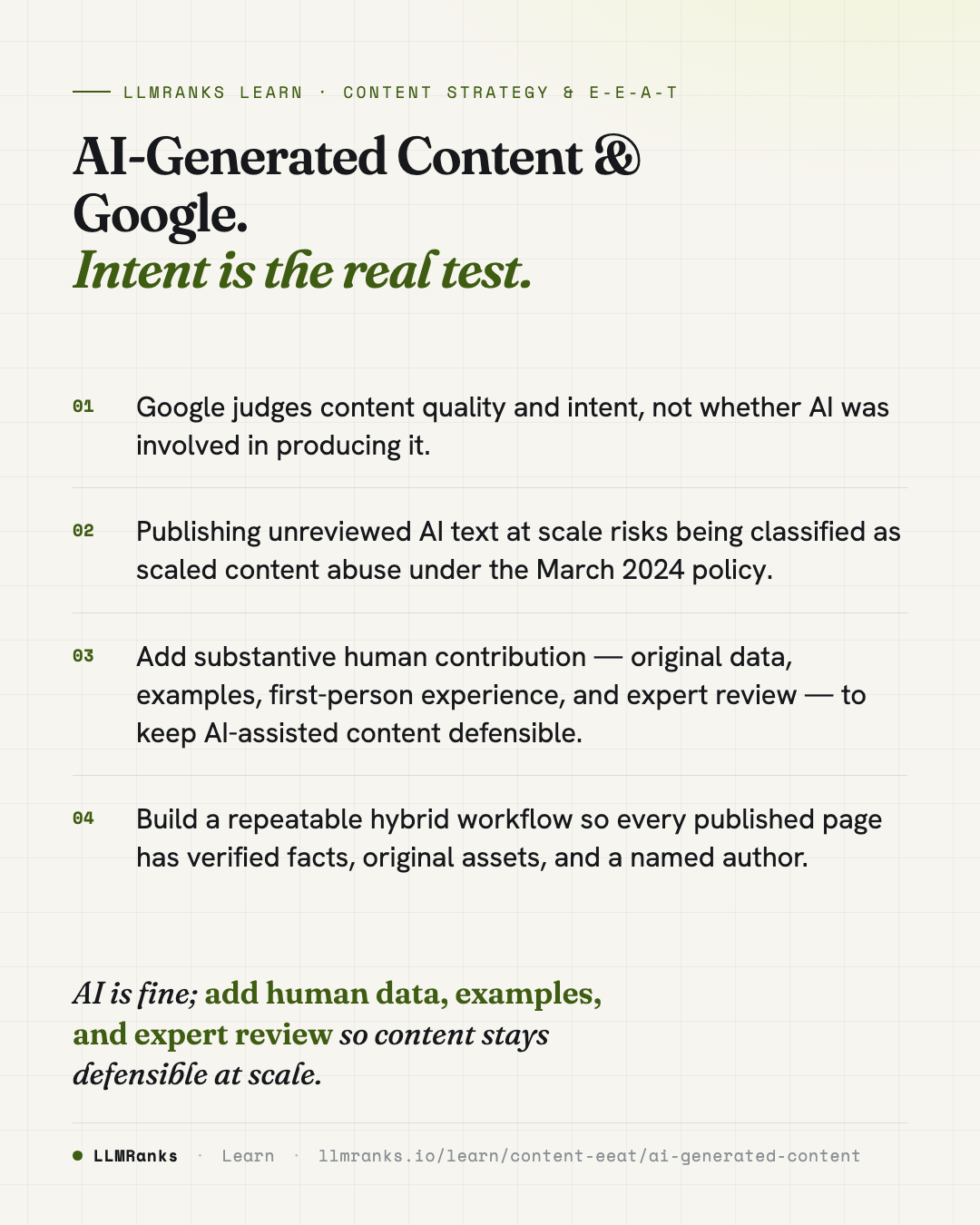
Google has restated its position repeatedly through 2024 and 2025: AI-generated content is not inherently against its guidelines. Content created primarily to manipulate search rankings — regardless of how it's produced — is the problem. The relevant policy is scaled content abuse, updated in March 2024.
In practice, this splits into two clear cases:
- High risk: Pure AI generation at scale, published with no human review, no original data, and no demonstrated expertise. This is the profile Google targets as scaled content abuse.
- Permitted and effective: AI used as a drafting, research, or editing tool, with substantive human contribution — expertise, original data, and editorial judgment.
The dividing line is intent and contribution, not the tool. If your process removes the human expertise and originality, you drift toward the risky side regardless of how polished the output reads. Grounding your work in real E-E-A-T signals is how you stay on the safe side, and the Helpful Content System reflects the same underlying priorities.
The transparency question
As of late 2025, Google does not require AI disclosure — but treat this as a moving target that could change. Several forces are pushing toward disclosure even where Google doesn't mandate it:
- Regulation: The EU AI Act, with phases effective in 2026, requires disclosure of AI-generated content in some contexts.
- LLM pipelines: Content with provenance metadata is increasingly favored in LLM training and citation. Adding a
<meta name="content-generation" content="human-authored">tag or schema-level provenance is becoming a soft trust signal. - User trust: Surveys show 60–70% of users want disclosure, and on tested sites disclosure correlated with engagement.
None of these alone forces your hand today, but together they point toward disclosure being a defensible default rather than a risk. If you're formalizing provenance, coordinate it with your Structured Data & Schema setup.
A defensible hybrid workflow
The most reliable way to use AI without tripping the scaled-content line is a structured workflow where humans own the parts that demonstrate expertise and originality. AI handles volume and speed; humans handle judgment, verification, and lived experience.
Here's a defensible workflow to adapt:
- Research (AI-assisted): Use an LLM to gather sources, summarize, and identify gaps — then verify every cited fact yourself.
- Outline (human): Build it from entity coverage analysis, SERP analysis, and a deliberate original-angle decision.
- Draft (AI + human): Let AI draft sections, then have a subject-matter expert rewrite the analysis, examples, and any first-person or experience-based passages.
- Original asset injection (human): Add original data, screenshots, charts, and quotes from interviews.
- Fact-check pass (human, or AI-assisted with human sign-off): Verify every number, name, and date against a primary source, and add citations.
- Editorial pass (human): Tighten voice consistency, claim hierarchy, and narrative flow.
- Schema + metadata: Apply
ArticleandPerson(author) markup plus citations. - Review board (human, for YMYL): Name a subject-matter expert reviewer with visible credentials.
The steps that most affect search trust are the human-owned ones: original assets, first-person experience, verified facts, and a credible author. See E-E-A-T in Practice and Author Bylines & Signals for how to make those signals visible.
What separates safe content from risky content
The workflow above matters because the difference between defensible and abusive content shows up in observable signals. When reviewing AI-assisted content, watch for these risk indicators:
| Risk signal | What it looks like | Fix |
|---|---|---|
| Pure-LLM output patterns | Uniform, generic phrasing typical of unedited model text | Substantive human rewriting and editing |
| No original assets | No proprietary data, screenshots, charts, or quotes | Inject original assets in every piece |
| No first-person experience | Nothing showing hands-on knowledge | Add SME-written experiential sections |
| Generic citations | Only Wikipedia or top-10 SERP results cited | Cite primary sources |
| Author with no footprint | Byline with no verifiable identity | Use real, credentialed authors |
| Suspicious publish velocity | Output volume inconsistent with team size | Publish at a sustainable, credible pace |
Note that detecting pure-LLM output through burstiness or perplexity patterns is a heuristic and imperfect — no single signal is conclusive. What holds up is the combination: original assets, genuine experience, primary-source citations, and a credible author working at a believable pace. These are the same qualities that build Topical Authority and support Originality & Duplicate Content health.
Why depth and originality outrank volume
The instinct to publish more, faster is exactly what the scaled-content-abuse policy targets. Volume without contribution is the failure mode. Content that adds original data, real experience, and verified analysis is what earns durable visibility — and that's a matter of substance, not length. Content Depth vs Word Count unpacks that distinction, and keeping material current through Content Freshness reinforces the same effort.
What to do
- Treat AI as an assistant, not an author — keep humans responsible for analysis, experience, and final judgment.
- Audit any AI-assisted content against the risk table above and fix every signal you can before publishing.
- Inject at least one original asset — data, screenshot, chart, or quote — into every page.
- Verify every fact, name, number, and date against a primary source and cite it.
- Publish under real, credentialed authors, and add a named expert reviewer for YMYL topics.
- Adopt provenance metadata now as a soft trust signal and to stay ahead of disclosure regulation like the EU AI Act.
- Match your publishing pace to a believable team size rather than chasing raw volume.
save this card
 Download card
1080×1350 · post it anywhere
put it to work
See how ChatGPT, Gemini and Google AI actually talk about your brand.